Starting a new project? Choose knitting needles that make it enjoyable. Interchangeable needles are key. They let you change tips and cables for any project, from sweaters to blankets, without buying many pairs.
Material is important. Metal needles are fast and smooth, while wood or bamboo are gentle on hands. Carbon fiber and plastic are good for specific yarns and knitting styles.
Looking to save money? Knit Picks has great beginner sets. For faster, better options, Addi and ChiaoGoo are top choices for durability and fine tips.
Interchangeable needles save space and money. They come with cables from 16″ to 60″ and tips from US 4 to US 17. Look for memory-free cables and a cable key for easy use.
Key Takeaways
- Interchangeable needles offer the most versatility for sweaters, shawls, and afghans.
- Match needle material—metal, wood, plastic, or carbon—to your tension and yarn type.
- Beginner knitting needles and budget sets from Knit Picks are great starting points.
- Top brands like Addi and ChiaoGoo excel in smooth joins and tiny gauge options.
- Choose memory‑free cables and a reliable cable key for secure, snag‑free knitting.
Why Choosing the Right Knitting Needles Matters When You Buy Knitting Needles
Choosing needles is more than just picking a pretty pair. The right needles affect how your fabric looks and fits. They also impact how your yarn behaves and whether your sweater will fit perfectly or not.
Small changes in needle size or shape can make a big difference. This is because they change how stitches are formed. So, it’s important to pick the right needles before you start knitting.
How needle choice affects gauge and finished size
The size of the needle determines the size of your stitches. If you use needles that are different from what the pattern suggests, your finished size will change. To avoid this, it’s a good idea to knit a swatch first.
Swatching helps you find the right needle size for your project. You can then adjust your needles as needed to get the correct gauge.
Interchangeable sets make it easier to switch between different needle sizes. This way, you can easily adjust your needles for different parts of your project, like sleeves or lace panels, without having to buy a lot of fixed needles.
Comfort, hand pain, and long knitting sessions
Your hands will tell you which needles feel best. Some knitters prefer smooth metal needles because they make stitches slide easily. Others like wood or bamboo needles for extra grip to prevent slipping.
When it comes to comfort during long knitting sessions, weight and temperature are important. Lighter materials like carbon fiber or bamboo can help reduce hand fatigue. Metal needles can be cold and heavy, so choose based on your comfort and how long you plan to knit.
Project type: sweaters, socks, shawls, hats, and accessories
The type of project you’re making will determine the best needles to use. For example, socks and small items like tubes are best made with tiny fixed circulars or double-pointed needles (DPNs), usually US 0–3.
For larger projects like sweaters and shawls, long cables and interchangeable needles are better. Short tips or 16″ circulars are great for sleeves and hats.
Always match your yarn, stitch pattern, and needles to get the right gauge. Use lifelines with interchangeable needles for lace and complex patterns. This way, you can adjust your gauge without losing your place.
Overview of Knitting Needle Styles: Straight, Circular, DPNs, and Interchangeables
Choosing the right needle style makes knitting easier. Each type is best for different shapes, yarns, and hand sizes. Learn when to use straight needles, double-pointed needles, or circular needles for a smooth project.
Straight needles are great for flat items like scarves and dishcloths. They have stoppers to keep stitches in place. They offer simple handling and clear edges. But, they can cause wrist strain on long projects, mainly with heavy or long needles.
Double-pointed needles are essential for small, tube-like projects. They’re perfect for socks, mittens, and narrow sleeves. They allow you to knit small circles without dealing with many pieces.
Circular needles are versatile for both in-the-round and flat knitting. Fixed circular needles are ideal for hats, cowls, and seamless sweaters. Short fixed circulars are great for very small circumferences when you need tiny sizes.
Magic Loop turns a long circular needle into a multi-tasker. It lets you knit small tubes and wide pieces with one tool. It reduces the need to switch between double-pointed needles.
Interchangeable needles are a modern knitter’s best friend. They let you swap tips and cables to create many circular needles. You can use short tips for sleeves and longer cables for shawls. Brands like ChiaoGoo, Addi, and Knit Picks offer smooth joins and flexible cables.
Choose based on your project and comfort. Use straight needles for flat pieces, double-pointed needles for small tubes, fixed circulars for common in-the-round work, and interchangeable needles for everything with one set.
Needle Materials Explained: Metal, Wood/Bamboo, Plastic, and Carbon Fiber
You’ve picked your pattern and yarn. Now, choose a needle material that fits your hands and project. Each material affects stitch speed, feel, and tension differently. Find the right match for your knitting style.
Metal needles move stitches quickly and smoothly. Brands like Addi and ChiaoGoo offer polished tips for fast lace and stockinette. They’re great for tight knitters and work well with sticky fibers.
Wood and bamboo needles offer a warmer, grippier feel. Knit Picks’ laminated birch has a smooth surface that slows stitches. This helps loose knitters control tension and is gentle on cold hands. But, very thin wood can snap under heavy force, so choose sturdier sizes for dense work.
Plastic needles are light and easy on sore hands. Some find them a bit grabby, which slows speed but reduces dropped stitches. They’re perfect for beginners, kids, or anyone who dislikes cold metal.
Carbon fiber needles are light yet rigid. They reduce wrist fatigue while staying straight and strong. They’re ideal for a light tool without losing the firm tip needed for precise stitch work. Specialty sets often pair carbon fiber shafts with metal tips for a hybrid feel.
Tip finishes and shapes are important across materials. Interchangeable tips come in slick nickel or laminated wood. A sharper taper suits lace, while a rounder tip helps purl-heavy textures. Smooth joins improve stitch transfer, so check the brand’s fit and feel before buying.
| Material | Best for | Feel | Drawbacks |
|---|---|---|---|
| Metal knitting needles | Tight knitters, fast stockinette, lace | Slick, cool to touch, durable | Can be noisy, cold for sensitive hands |
| bamboo needles | Loose knitters, warm feel, control | Grippy, warm, slightly softer | Can break in thin gauges, slower speed |
| plastic knitting needles | Beginners, lightweight projects, kids | Soft, cushioned, nonmetallic | Variable quality, may feel grabby |
| carbon fiber needles | Long sessions, reduced strain, hybrid projects | Light, strong, stable | Specialty cost, fewer tip options |
How to Match Needle Material to Your Knitting Style and Yarn
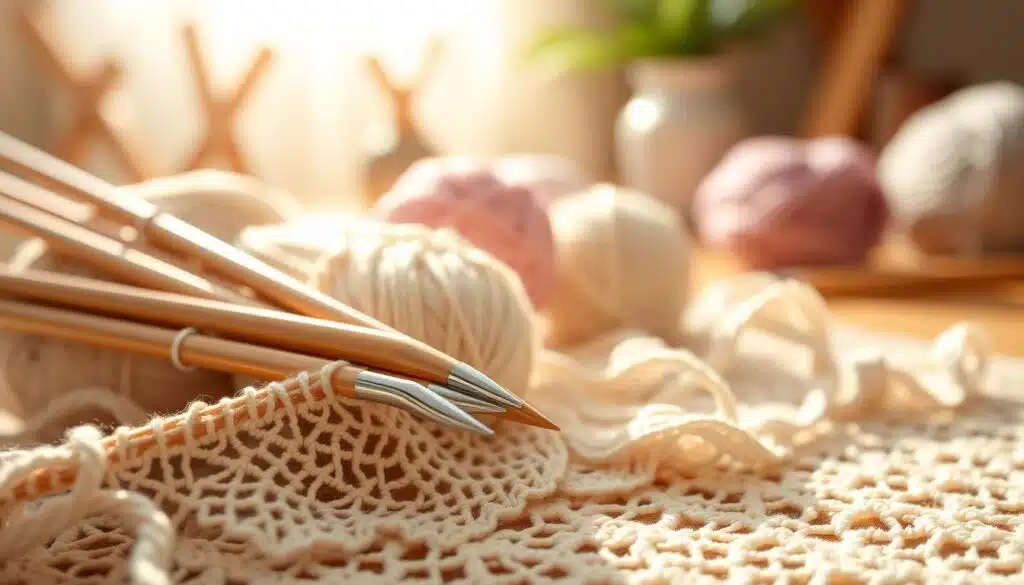
Finding the right needle is like finding a perfect match. Your hands, the yarn, and the project all have unique qualities. A simple test can show if metal, wood, or carbon fiber is right for you.
Tight vs. loose knitters: which surface helps you
If you pull stitches tight, metal needles can be a big help. Using a smaller gauge tip in your non-dominant hand helps manage stitches. This trick works well with tight knitter needle materials like aluminum or nickel-plated steel.
If you tend to lose stitches, wood or bamboo needles are better. They offer more grip, keeping your work in place and calming your hands during long sessions.
Fiber type matters: wool, cotton, linen, silk, and blends
Think about how the yarn feels. Wool and alpaca yarns grab well, so metal needles help them move smoothly. Cotton and linen yarns are slippery, so metal is often best. Silk yarns can be tricky. Metal needles help them flow smoothly, while bamboo offers more control.
Choosing the right needle for your yarn balances grip and glide. For mixed fibers, test a swatch. Changing needle materials can affect stitch appearance and knitting speed.
Project complexity: lace, cables, and textured stitches
For lace, you want needles that let stitches slide smoothly. Metal is great for lace and heavy cables because it’s fast and clean. Lace enthusiasts often prefer Addi or ChiaoGoo tips for speed and precision.
For textured projects like seed stitch or garter, bamboo or laminated birch needles are good. Carbon fiber is ideal for reducing hand strain while maintaining a sharp tip for complex stitches.
Try different needles and swatch each one. For a quick guide to top picks and where to buy, check best knitting needles 2025. Small tests will show the best match for your style and yarn.
Interchangeable Needles Deep Dive: Tips, Cables, and Best Uses
You want a single kit that meets your needs. Interchangeable needle tips let you change sizes from US 4 to 17. You can pair each tip with a cable that fits your project.
The cable lengths include the needle tips. So, a 100 cm cable is 100 cm tip-to-tip, whether you use 13 cm or 9 cm tips.
Mix-and-match tips and cable lengths for maximum flexibility
Choose a 32″–40″ cable for Magic Loop small circumference work. You won’t need extra tools. Short interchangeable needles and 16″ cables are great for socks and sleeves.
Memory-free cables and smooth joins: why they matter
Memory-free cables prevent the cord from curving back. This keeps your stitches flat and reduces snag points. A quality set avoids rough joins that catch yarn.
Cable key, end caps, and assembly steps for secure joins
Kits usually come with a cable key and end caps. Use the cable key to tighten joins after threading the tip onto the cable. End caps keep live stitches when you remove tips.
Short interchangeable options and when to own a short set
Short interchangeable needles are good for tiny tubes or avoiding long cords. A 16″ cable with short tips is like fixed short circulars. Try a Try-It set from Knit Picks before buying a full kit.
For more on systems and compatibility, read the Addi Click deep dive and a buying roundup. Addi Click explained and a practical guide can save you time.
Needle Sizes, Gauge, and Why You Need a Variety of Sizes
You want your projects to fit right and look great. To achieve this, understanding US needle sizes is key. A simple chart helps you pick the right needle for any yarn without confusion.
Understanding the numbering and the measure
US needle sizes range from 0 to 50. Patterns usually list sizes in both US numbers and millimeters. A conversion chart can help match sizes. Interchangeable tips, like sizes 4–17, can handle various yarns with one kit.
Why you benefit from a full range of sizes
Your knitting tension and yarn choice matter a lot. If you knit tightly, you might need larger needles. Having many sizes saves time and keeps your project moving.
How to swatch and adjust until the gauge fits
Swatching is your best defense against sizing issues. Knit a 6-inch square, wash and block it, then measure. If it’s too tight, go up a size. If too loose, go down.
Start with the pattern’s suggested size, then adjust until your swatch matches the gauge. Use the same yarn and needles as your project. Once you get the swatch right, you can switch to your preferred needles.
| Yarn Weight | Typical US needle sizes | Typical mm range |
|---|---|---|
| Lace | US 000–1 | 1.5–2.25 mm |
| Fingering | US 1–3 | 2.25–3.25 mm |
| Sport | US 3–5 | 3.25–3.75 mm |
| DK | US 5–7 | 3.75–4.5 mm |
| Worsted | US 7–9 | 4.5–5.5 mm |
| Aran | US 9–10 | 5.5–6.0 mm |
| Bulky | US 10–11 | 6.0–8.0 mm |
| Super Bulky | US 11–17 | 8.0–12.0 mm |
| Jumbo | US 17+ | 12.0 mm and above |
For a quick size guide, check out TD Knitter’s size guide or CrochetCraze for size comparisons.
Practical tips for smarter swatching
Use the same stitch pattern as your project. Measure after blocking, as patterns often specify. Try a Try-It set or a small pack to test sizes like US 6 and 7 before buying full sets.
Having the right sizes saves frustration and keeps your project flowing. Swatching is part of the project, not a chore. Let the needle size chart guide your choices.
Top Brands and Best Picks for Different Budgets and Needs
Choosing the right knitting kit makes your hobby easier. Look for smooth joins, reliable tips, and good cables. The market offers top brands and budget-friendly options, so you can find the perfect match for your projects.
Premium picks: Addi, ChiaoGoo—what they excel at
Addi needles are known for their speed and precision. Their nickel-plated Addi Turbos offer a smooth glide and sharp points. These are great for lace and cables.
ChiaoGoo needles are praised for their small fixed circulars and strong DPNs. They’re perfect for socks and small projects. Both brands offer high-end interchangeables with secure joins and reliable cables.
If you want a professional feel, choose Addi or ChiaoGoo. You’ll notice the difference right away.
Great value and beginner-friendly sets: Knit Picks Options
Knit Picks Options is a smart choice if you’re on a budget. Their interchangeable sets offer multiple tip sizes and common cable lengths at a lower price.
You can start with a Try-It subset or a full kit for around $60. These sets are versatile and easy to use, making them perfect for beginners.
Specialty tools: short tips, lace tips, and tiny fixed circulars for socks
Short interchangeable tips and 16″ cables are great for sleeves, hats, and narrow projects. Lace tips with sharp points are ideal for complex patterns. Tiny fixed circulars from ChiaoGoo or Addi are perfect for sock knitting.
When buying specialty pieces, check the join quality. Cheap cables and rough joins can slow you down and snag delicate yarns.
Where to buy: local yarn shops, brand sites, and reliable online retailers
You have many options when buying knitting needles. Visit local yarn shops to test the feel and balance. Brand sites from Addi, ChiaoGoo, and Knit Picks list full inventories and deals. Large online retailers and craft stores also carry many items, but compare prices and shipping.
For a detailed guide and product notes, check out this overview at best knitting needle brands and picks. It provides practical comparisons and buying tips to help you choose the right set.
| Brand | Strength | Good for |
|---|---|---|
| Addi | Fast nickel-plated tips, secure joins | Lace, cables, long sessions |
| ChiaoGoo | Small fixed circulars, durable cables | Socks, DPN work, travel knitting |
| Knit Picks Options | Budget-friendly interchangeables | Beginners, multi-project kits |
When shopping, balance price and quality. Spending more on a quality set can save time and frustration. Use these notes to find the best knitting needle brands and models for your style and projects.
Practical Buying Tips: What to Look For When You Go Shopping
Before buying knitting needles, feel them in your hands. They tell you more than any specs. Look at the balance, weight, and tip shape. Metal tips are cool, while wood or bamboo are warm.
Light materials like carbon fiber and bamboo are easier on your hands for long hours. Metal is better for small stitches and tight knitting.
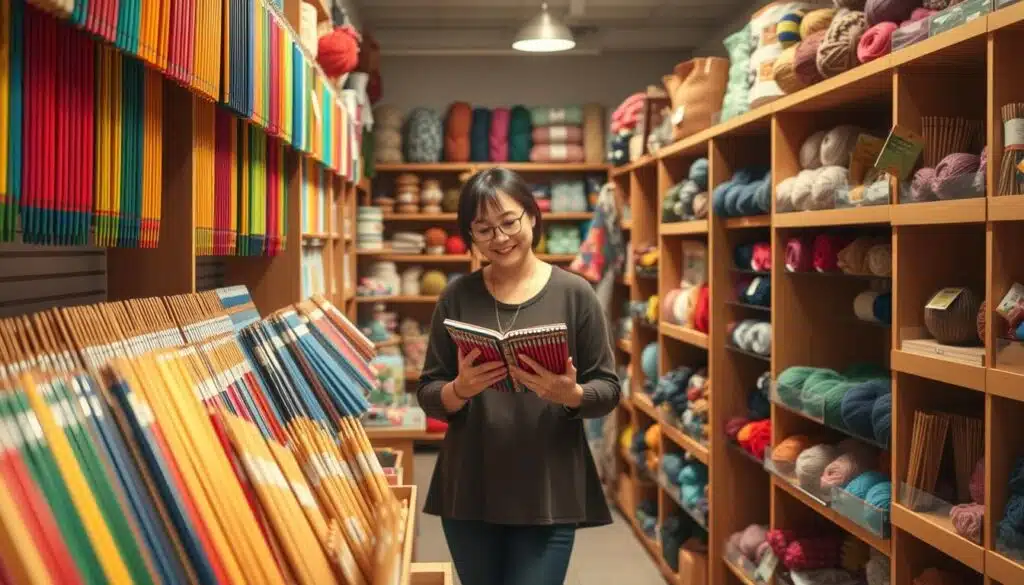
Check the needle joins closely. Good joins make stitches move smoothly from cable to tip. Bend the cable and try screwing tips on and off to test flexibility.
Look for memory-free cables and a reliable cable key to avoid snags. Use end caps to keep stitches safe when swapping tips.
Use a needle gauge to check tip sizes before buying. Make sure the join works well with your yarn. Bad joins or stiff cables might not show up until later.
Choose between try-it sets and full kits based on your needs. Try-it sets are good for trying out materials and systems without spending too much. Full kits from brands like Addi or ChiaoGoo are more expensive but last longer for frequent knitters.
Keep your needles organized to find sizes quickly. Store tips and cables by size and label cases. Use end caps and secure cases to prevent damage. Good care extends the life of your needles and keeps joins smooth.
For a quick feel of materials, check this comparison of wood vs metal needles at wood vs metal needles. It helps narrow your choices before buying a full set.
Clever Techniques and Tricks You’ll Use with New Needles
Want to get more from your new needles? A few clever tricks can change how you work on lace, socks, and big garments. These tips save time, reduce frustration, and make swatching a small win. Here are some practical tips to use right away.
Using a knitting lifeline is a simple lifesaver for lace and complex patterns. Thread a thin yarn or dental floss through the cable key hole. Tie it to the cable and let it drop through the next row as you knit. If you need to rip back, you return to a known point without losing your place.
Pairing a knitting lifeline with interchangeable sets adds flexibility. You can change tips or cable lengths mid-project without losing your place. This is great for shawls by Stephen West and complex patterns from Rowan.
Mixing needle tips improves stitch handling when working in the round. Use a smaller tip in your non-dominant hand and a standard tip in your dominant hand. Tight knitters find it easier to pick up and manage stitches, as your dominant hand controls stitch size.
This trick is useful for sock heels and seamless yoke increases. Brands like Addi and ChiaoGoo offer interchangeable tips that make swapping easy. You keep gauge stable while improving control and speed.
You can knit flat on circulars for large projects to reduce strain. Most stitches rest on the cable, so a bulky sweater or blanket sits in your lap. Your shoulders and wrists will thank you when you finish the next big cardigan.
Knitting flat on circulars also simplifies seaming and storing work. Use a 32″–40″ cable for body pieces. For a neater feel during sleeve caps or narrower panels, keep a 16″ short interchangeable cable.
The Magic Loop technique lets you create small tubes on one long circular needle. Divide stitches in half, fold the cable, pull slack, slide groups to the tips with tips parallel and pointing right, then work across the front stitches. Repeat to form socks, mittens, or sleeves without juggling DPNs.
Magic Loop technique pairs well with lifelines and mixing needle tips. Use a 32″–40″ cable for most small circumferences. Keep a short 16″ option if you prefer real short circulars. This minimizes the need for many DPNs or extra fixed circulars.
Conclusion
When you buy knitting needles, think like a toolbox builder. Start with a solid interchangeable set and a few fixed circulars in small sizes. Interchangeables with a wide range of tips (US 4–17) and cables (16″–60″) let you tackle many projects without buying many needles.
Choose materials that match your tension and yarn. Metal needles from Addi or ChiaoGoo are great for slick fibers. Wood or bamboo needles are better for tight knitters and cozy wools. Knit Picks offers affordable kits and Try-It options for learning Magic Loop and swatches.
Avoid cheap joins and stiff cables; quality saves time and frustration. Use lifelines, mix tips, and practice the Magic Loop to expand what one set can do. For a clear guide, see this resource: interchangeable knitting needles guide.
In short, invest smartly, learn a few techniques, and build a versatile collection. This way, your next project will go smoothly from start to finish. buy knitting needles conclusion, best knitting needle advice, knitting needles summary
FAQ
What needle types should you buy first?
Start with a versatile set. Get a 32″–40″ interchangeable circular kit and a couple of short 16″ cables or a short interchangeable set. This lets you knit flat pieces and use Magic Loop for sleeves, hats, and small circumferences.
Add a pair of fixed small circulars or tiny ChiaoGoo needles (US 0–3) if you plan to knit socks or very small gauges.
Why are interchangeable circular needles considered the modern knitter’s toolbox?
Interchangeables let you mix-and-match tips and cables to build almost any circular length from 16″ to 60″. Tips usually cover a wide size range, joins are smooth, and memory-free cables keep stitches flowing.
The cable key tightens joins and end caps secure live stitches when you detach tips, so one kit replaces dozens of fixed needles.
How does needle material affect your knitting?
Material changes speed, grip, and feel. Metal (stainless steel, nickel-plated brass like Addi Turbos) is slick and fast—great for tight knitters and lace. Wood or bamboo gives grip and warmth, helping loose knitters control stitches.
Plastic can be gentler on cold hands but may feel grabby. Carbon fiber is light and strong for reduced hand strain.
Which brands are worth buying?
For premium performance, choose Addi and ChiaoGoo. Addi Turbos are known for slick, durable finishes; ChiaoGoo excels at fixed small circulars and sock tools. Knit Picks Options offers excellent value with well-made interchangeables and accessible Try-It sets for beginners or budget shoppers.
How do you choose needle size to hit gauge?
Always swatch. Gauge is stitches and rows per 4″ square; your tension may differ from the pattern’s, so try the recommended size first, then go up or down to match gauge.
Measure after blocking if the pattern specifies blocked gauge. Having many sizes on hand—or an interchangeable set—prevents stopping mid-project to hunt for the right size.
What role do cable quality and joins play?
Smooth joins and memory-free, flexible cables prevent snagging and let stitches glide from tip to cable. Poor joins cause yarn to catch and disrupt stitch count. Use the included cable key to tighten joins and test cables before you commit to a set—quality matters more than price.
When should you use Magic Loop versus short circulars or DPNs?
Use Magic Loop on 32″–40″ cables to knit socks, mittens, and small tubes with one needle. Short 16″ cables or dedicated short interchangeables give a true short circular feel if you prefer that. DPNs are traditional for very small tubes and work well if you like juggling multiple needles.
Are metal needles better for lace and cables?
Yes. Slick metal tips speed up stitch transfers and reduce drag, which helps with lace, complex cabling, and fine-gauge work. Tight knitters benefit from metal because stitches glide easily and thin metal resists bending.
Are wood or bamboo needles good for beginners?
They can be. Wood and bamboo add grip, preventing stitches from slipping off, which is forgiving for loose knitters and new stitchers. Laminated birch (like Knit Picks) offers a pleasant feel and slightly faster performance than average wood needles.
What about carbon fiber needles—who should use them?
Choose carbon fiber if you need lightweight but rigid needles to reduce wrist and forearm strain. They combine strength with low weight, making them a smart option for knitters with hand pain who want stability.
How many needle sizes do you really need?
Ideally, you want a range that covers the yarns you use most. Interchangeable sets remove the need to own every individual circular. A practical start: sizes US 4–8 for worsted and DK, plus a couple of smaller sizes (US 0–3) for socks if you knit them. Expand based on projects and swatch results.
What are cable keys and end caps for?
The cable key tightens the threaded join between tip and cable so the connection won’t loosen while you knit. End caps screw onto the cable ends to secure live stitches when you remove tips or store an in-progress project. Both are essential for interchangeable systems to work reliably.
How do you assemble interchangeable needles correctly?
Thread the tip onto the cable and twist to engage the threads. Use the cable key in the base hole to snug the join—don’t over-tighten. Attach end caps to safely store or transport live stitches. Test the join by sliding a few stitches across to ensure the transition is smooth.
What tools help protect complex work like lace?
Lifelines are invaluable. Thread a thin strand of contrasting yarn or dental floss through a row and secure it; if you need to rip back, you can return to that row without guessing. Use lifelines with interchangeable sets and keep end caps nearby to secure live stitches when changing tips.
How does knitter tension affect material choice?
Tight knitters benefit from slick metal needles so stitches glide and reduce hand strain. Loose knitters usually prefer wood or bamboo to add grip and stop stitches from slipping. Also match material to yarn: slippery fibers like silk or rayon often work better on metal; wool and alpaca pair nicely with wood.
Are Try-It sets worth it?
Absolutely. Try-It sets from brands like Knit Picks let you test the interchangeable concept and a couple of popular sizes without a large investment. They help you decide if you like a brand’s tip shape and cable feel before buying a full kit.
Where should you buy quality needles?
Buy from local yarn shops, official brand sites (Addi, ChiaoGoo, Knit Picks), or reputable retailers like Amazon. Avoid cheap craft-store brands with stiff cables or poor joins—quality tools save time, frustration, and yarn.
How do you care for and organize needles?
Store tips and cables separately in labeled pouches or cases to avoid mixing sizes. Keep a needle gauge handy to verify sizes. Clean metal and carbon fiber with a soft cloth; wooden needles benefit from occasional polishing with a small amount of mineral oil if they dry out. Use end caps and cases to prevent loss and damage.
Do needle tips affect stitch size when knitting in the round?
The needle in your dominant hand mainly sets stitch size in the round. You can use a slightly smaller tip in your non-dominant hand to ease stitch handling for tight knitters without altering overall gauge. Always swatch to confirm.
What should you inspect before buying an interchangeable set?
Check that cables are memory-free and flexible, joins are smooth with no snag points, and tips have consistent sizing and taper. Test the cable key and end caps. Prefer established brands (Addi, ChiaoGoo, Knit Picks) that deliver reliable finishes and durable parts.