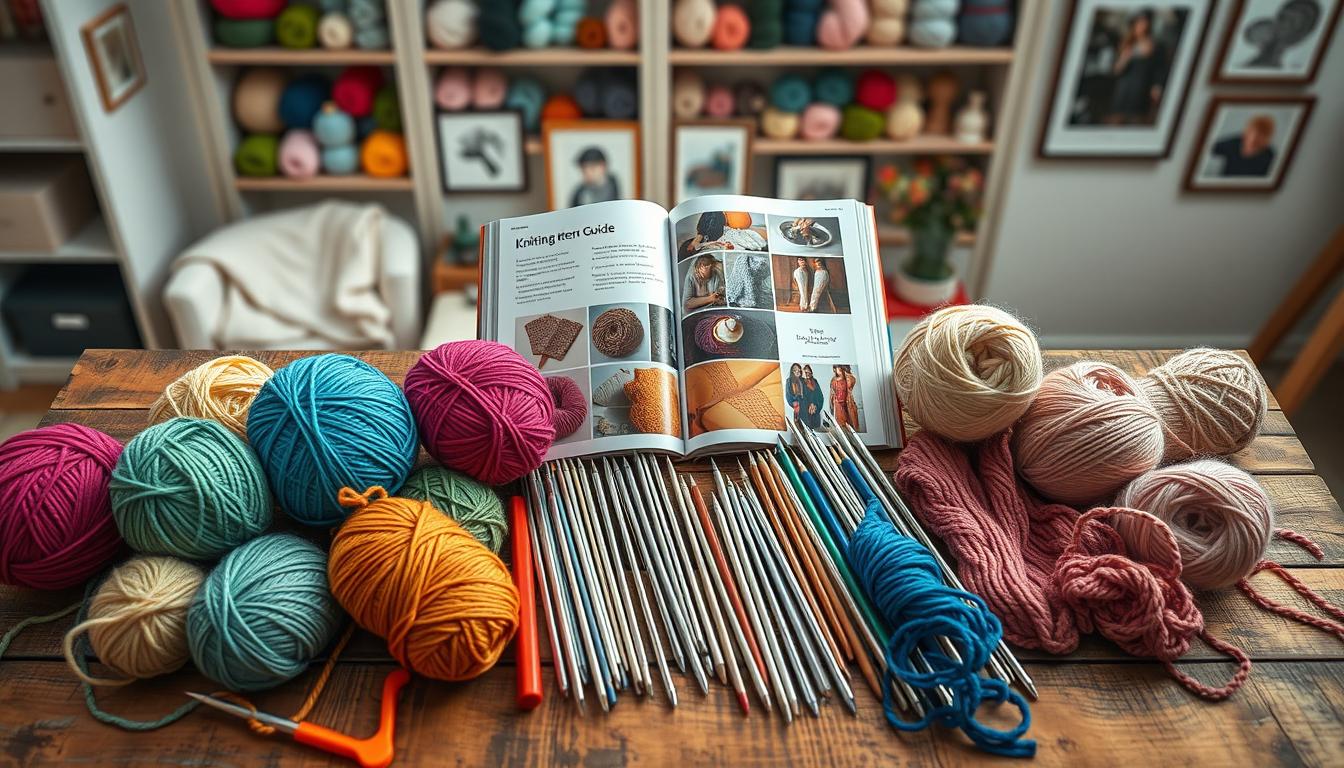
You’re about to create a knitting bag that makes your sweaters great. This guide will help you pick the right tools for your projects. It’s like a quick guide to help you shop and stitch with confidence.
Start with medium-weight yarn and straight needles, US 7 to US 9. Many prefer wood or bamboo needles because they grip well. As you get better, consider an interchangeable circular set. It saves space and money in the long run.
This guide also talks about the small tools that make a big difference. You’ll learn about sharp scissors, stitch markers, and more. It shows how to choose, organize, and care for your tools. For more ideas, check out tools knitters love.
Key Takeaways
- Start with worsted yarn and US 7–9 straight needles to learn comfortably.
- Choose wood or bamboo needles for better control and less slipping.
- An interchangeable circular set is a smart long-term buy for versatility.
- Pack essential knitting supplies: scissors, tape measure, markers, and a small blocking kit.
- Organize and store your knitting gear to extend tool life and save time.
Essential Knitting Needles: Types, Materials, and How to Choose
Choose needles that fit your first project and your comfort. There are many types of needles, from straight to short ones for small projects. Start with simple ones and see how they change your stitches.
Lykke Driftwood Interchangeable and ChiaoGoo 9” circulars are great for beginners. They are from trusted brands.
Needle types explained: straight, double-pointed, fixed circular, and interchangeable
Straight needles are easy to use for flat pieces like scarves. DPNs are best for small tubes, like socks and sleeves. Circular needles are great for bigger projects.
Interchangeable needles offer many options in one set. They save space and are easy to carry.
Material pros and cons: wood and bamboo for beginners, metal for speed and sock work, plastic and aluminum as budget options
Wood and bamboo needles feel warm and gentle. They are good for beginners because they help keep stitches in place.
Metal needles are fast and smooth. They are perfect for lace and small socks. Aluminum and plastic are cheaper but can be slippery.
Needle size guidance: picking the right US sizes for common projects and understanding how size affects gauge
Use a needle size guide to choose the right size. Start with US 7–9 for worsted yarn. Small changes in size can affect your gauge.
Always swatch before starting a project. For specific gauges, test with the needle that gets you closest.
Why an interchangeable needle set can save you money and space
An interchangeable set costs $50–$80 and replaces many fixed circulars. Look for smooth joins and flexible cables. Brands like Knit Picks and ChiaoGoo offer kits with extra parts.
Keep fixed circulars for special sizes and small projects. Wood DPNs, like those from Knit Picks, are great for sock knitters.
For a quick guide on needles, check this knitting needle guide.
Choosing the Right Yarn for Your Project
Picking yarn is a mix of instinct and math. You need yarn that looks good with your pattern and holds up well. Start by checking the pattern’s gauge and yardage to pick the right yarn.
Before you buy, use a yarn weight guide. Match the pattern’s weight category and check the yardage per skein. If the substitute’s yardage is about 20 yards off, your project will likely work. This rule saves time and hassle if your first choice is sold out.
Beginner-friendly picks
For beginners, choose a worsted-weight yarn. It shows stitch definition and moves at a good pace. Avoid chenille, eyelash, and mohair early on because these novelty fibers hide mistakes and slow learning.
Fiber choices and care
Consider wear and washing when choosing yarn. Merino is soft and stretchy. Superwash yarn is easy to machine wash without heavy felting, perfect for everyday clothes. Cotton is breathable for summer but lacks bounce. Acrylic is affordable and washable. Specialty fibers like silk or alpaca add luxury but can change gauge and feel.
Merino vs acrylic
When deciding between merino and acrylic, think about comfort and care. Merino is soft and warm. Acrylic is cheaper and easy to clean. For softness and machine washing, look for an Everyday Merino-style superwash worsted from a reputable mill.
Practical substitution tips
Swatch before committing. Gauge is more important than labels when two yarns have the same weight. Use the 20-yard rule for worsted swaps: if yardage matches within that range and your swatch hits gauge, proceed. Different fibers change drape and stitch definition, so expect small adjustments.
Color and finishing
Always check dye lots for large projects. Buy extra skeins from the same dye lot or alternate skeins as you knit to blend tiny shade differences. These dye lot tips keep shoulders and seams from looking patchy when you finish.
Final checklist
- Confirm pattern gauge and total yardage.
- Use a yarn weight guide to pick the right category.
- Apply the yarn substitution rule: swatch and compare yardage.
- Decide merino vs acrylic based on feel and care needs.
- Choose superwash yarn for easy-care projects.
- Follow dye lot tips to avoid color surprises.
Scissors, Cutting Tools, and Safe Options
Good cutting tools make knitting neater and safer. You need a sharp pair at home for clean ends. And a blunt pair for travel. Think about use, storage, and airline rules when choosing.
Sharp vs. safe: Fine embroidery scissors are great for weaving in and finishing. My top pick is the Star Dust Rainbow Embroidery Scissors. They are sharp and feel good in your hand. Keep them in a protective sheath for your work table.
For everyday use, carry blunt kiddie scissors. They are light, cheap, and safe. These blunt tools are also good for travel without worrying about blades.
Steeking needs: Steeking scissors cut through fabric without messing up stitches. Choose a sturdy pair and store them safely. If flying, leave steeking scissors in checked luggage; they might not be allowed in carry-ons.
Consider pendant-style yarn cutters and small snips for quick cuts. But check current rules. Some might get confiscated. Always check TSA guidance before flying.
Practical kit setup:
- At home: quality embroidery scissors locked in a sheath for finishing work.
- On the go: a pair of kid’s blunt-tip scissors labeled and stored in your notions pouch.
- Travel knitting tools: small, enclosed cutters and safety-first solutions that meet TSA rules.
Label or sheath sharp pieces to prevent accidents in project bags. When traveling, check your kit for TSA-friendly supplies. Leave sharp steeking scissors at home or in checked luggage.
Tape Measures, Rulers, and Gauge Tools
You want your garments to fit perfectly. Start with the right tools. Use a flexible tape for body curves and a firm ruler for stitch counts. A retractable tape measure fits in your bag and works for all measurements.
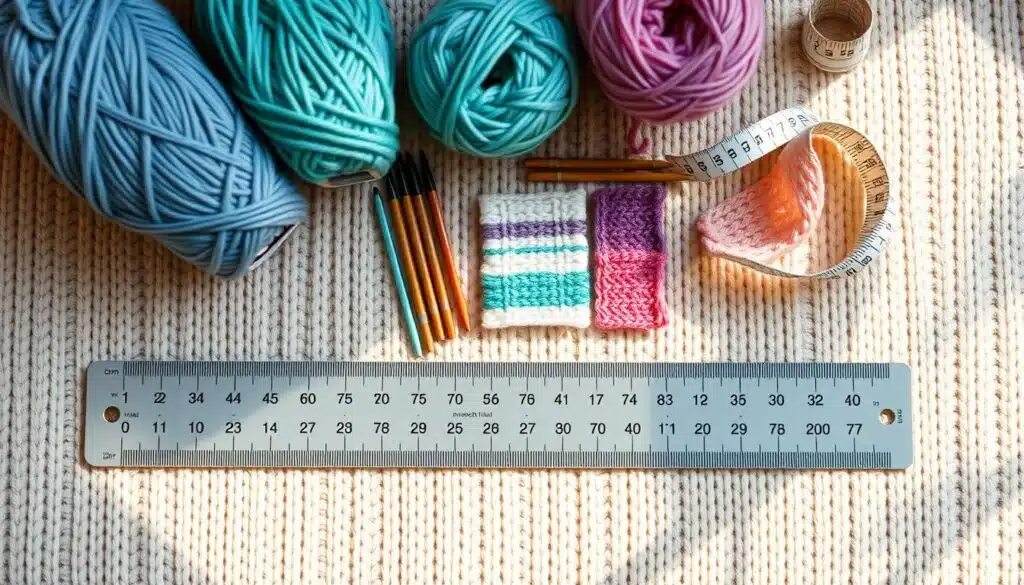
Flexible tape measures for body and project measurements
A soft tape follows body curves without pinching yarn. It’s great for full-body measurements and checking project length. For travel, a compact tape is best for quick checks between rows.
Gauge rulers and swatch measuring: 4-inch vs. 1-inch options and why measuring gauge matters
Measuring gauge is key to avoiding size issues. A 4-inch ruler gives a more accurate average. One-inch tools are good for socks but can show small counting errors. Ann Budd suggested using one-inch rulers, but experts recommend measuring over four inches for accuracy.
Keep a dedicated gauge ruler in your kit. Measure gauge across several swatch sections to spot tension changes. Use visual aids like markup or photos to confirm counts.
Using a smartphone and gauge ruler combo to accurately count stitches and rows
Use an EZ PZ Gauge Ruler with your phone for quick counting. Lay your swatch, set the ruler, snap a photo, then zoom in. Mark stitches on the image to avoid double-counting. This method is great for dense gauges and small needles.
Needle sizers from brands like ChiaoGoo and Knit Picks measure diameter and WPI. For extra help, check a troubleshooting guide like this resource for tips on common gauge issues.
- Always swatch in the yarn and needles you plan to use.
- Measure over 4 inches for reliable gauge.
- Use tape measure knitting for body fits and a rigid ruler or knitting gauge ruler for stitch counts.
- Phone plus EZ PZ Gauge Ruler speeds up counting and reduces eye strain.
Stitch Markers and Specialized Notions
Choosing the right markers makes knitting feel organized and calm. This guide helps pick the best stitch markers. It also shows how removable and clip-style markers work, and introduces budget-friendly jewelry markers.
Removable vs. clip-style markers
Removable markers slide onto needles or sit between stitches. They mark pattern repeats, stitch counts, or round starts. You can easily move them when changing needle sizes or rearranging stitches.
Clip-style markers latch onto stitches or rows. They’re great for securing live stitches, catching dropped stitches, or marking progress on long projects. Keep both types in your notions bag for flexibility and security.
Increase/decrease and side markers
Increase decrease markers help avoid mistakes. Place one at each increase point for neat shaping. Use contrasting markers for right/wrong side indicators to keep track of direction in patterns.
Color-code markers for faster lace repeats and cable setups. This small habit prevents errors and saves time when returning to a project.
Jewelry and snag-free alternatives
There are affordable, durable options if you don’t like specialty markers. Solid closed jump rings or circle connectors from jewelry suppliers make good markers. Sizes around 6mm fit sock needles and don’t snag yarn.
Store mixed markers in a small tin or clear pouch. This keeps removable, clip-style, increase decrease, and jewelry markers organized and ready for any project.
Needle Storage and Organization Solutions
Good needle storage saves time and protects your tools. Start by doing a quick count of your needles. You’ll need different homes for straight sets, circulars, and DPNs. A tidy system means less lost needles and fewer surprises, letting you focus on knitting.
Binder pocket systems for small sets
A binder with clear zipper pocket pages is perfect for small circulars and DPNs. Label each pocket by size and keep needles in their original packaging. This helps you fit more pairs in and makes them easy to find. You can find affordable pocket pages on Amazon or use a small three-ring binder for quick access. For a step-by-step guide, check out this binder pocket needle storage guide.
Needle rolls for straight needles
For long straights, a sturdy needle roll is essential. Look for one with a secure flap to keep needles in place. Canvas or leather rolls protect the points and keep sizes organized with labeled pockets. A good needle roll keeps your tools tidy and prevents bent tips when you carry them.
DPN holders and protective cases
DPN organization requires a small but effective solution. Use snap envelopes, elastic wraps with pockets, or padded sleeves to keep stitches in place. Carry a few DPN holders in each project bag to avoid accidental pokes.
Practical kit building
Combine different systems to fit your space. Use binder pocket needle storage for small items, a sturdy needle roll for straights, and dedicated DPN holders for socks. Store spare DPNs in your system; wooden DPNs can break, and extras save you from mid-project panic.
- Tip: Keep a labeled index card in each pocket or roll slot for quick size checks.
- Tip: Group by project type so your travel kit always has the right tools.
Row Counters, Chart Keepers, and Progress Tools
Stay in rhythm and avoid mistakes. Small tools can save you time and effort. Use clip-on row counters for easy tracking, then switch to sturdier tools for bigger projects.
Clip-on counters that streamline your flow
Clip-on row counters help you keep moving. Just slide the clip to mark each row. This way, you’ll knit faster and make fewer mistakes.
Clickers, mini Kacha Kacha, and locking features
Clicking row counters are great for quick checks. The mini Kacha Kacha fits well on needles and in bags. Choose ones with locks to avoid mistakes when you move your bag.
Keep a locked clicker as a backup. This way, you’ll never lose count.
Magnetic chart keepers and chart highlighter tape
A magnetic chart keeper makes complex charts easy to follow. Just slide the magnet to the current line. Use chart highlighter tape to mark rows on charts or patterns. It’s thin, lasts long, and fits chart columns well.
Want to count rows and track time on your phone? Try the row counter & counting app.
- Use clip-on row counter markers for steady, in-hand tracking.
- Carry a locked clicker, like the mini Kacha Kacha, as a secure backup.
- Invest in a magnetic chart keeper and chart highlighter tape for lace or colorwork.
These tools boost your confidence on tough patterns. They cut down on mistakes and make long projects easier. Your hands stay on the needles, and your mind stays on the pattern.
Blocking Tools and Finishing Supplies
You want your garments to look like they came from a high-end store, not a messy pile. Good finishing tools help you shape edges, set stitches, and neaten ends. This makes your work look professional. Start with the right surface and a plan for the type of fabric you’re using.
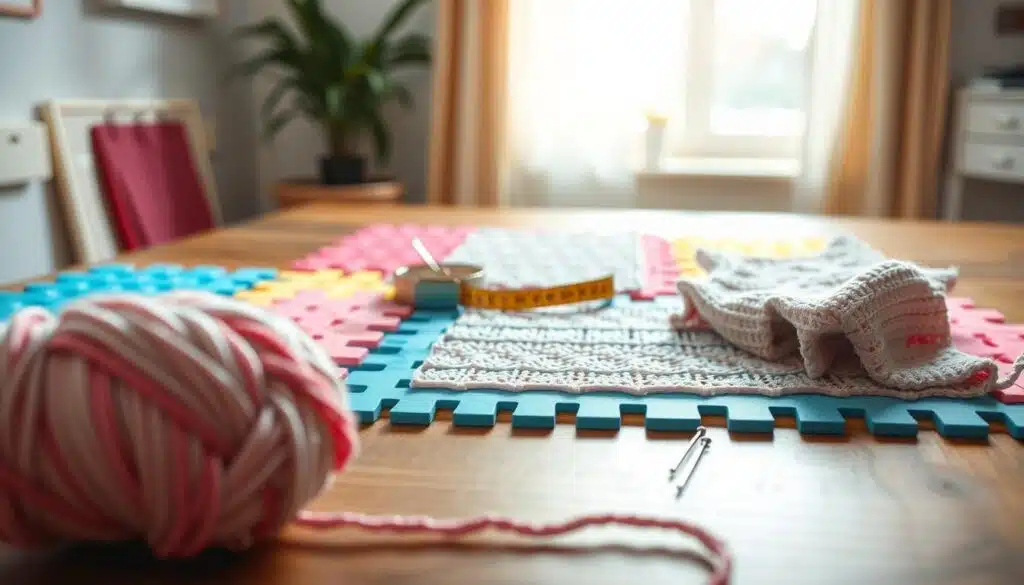
Blocking mats and pinning systems for professional finishes
Blocking mats provide a flat, breathable surface for even drying and straight hems. Choose a size that fits your usual projects. Brands like Knit Picks offer affordable interlocking foam mats.
Use a dedicated pinning system to avoid warping curves. Plastic mats with grid lines help you measure and line up edges without guessing.
Blocking wires, T-pins, and care for wet blocking vs steam blocking
Blocking wires help you stretch long edges smoothly. Slide the wire through stitch loops and pin the wire, not the yarn. Use rust-resistant T-pins for secure shaping.
Wet blocking vs steam blocking depends on the fiber. Wool does well with wet blocking and holds shape as it dries. Steam blocking is faster and better for delicate fibers if you avoid direct contact. Always check yarn care and test a swatch if unsure.
Small finishing tools: darning eggs/mushrooms for weaving and finishing touches
A small darning egg or mushroom gives a firm surface for closing gaps at heels, thumbs, and sewn seams. Use one when weaving in ends so tension stays even and the repair blends with the fabric. Etsy and Knit Picks sell user-friendly darning eggs in wood and plastic.
Avoid using lightbulbs as substitutes. They can break or make awkward curves that ruin your finish.
Practical tips: match your blocking mats to project size, pick rust-resistant T-pins, and use blocking wires for straight edges. For wool, favor wet blocking; for superwash or delicate blends, prefer gentle steaming and spot tests.
| Tool | Best Use | Tip |
|---|---|---|
| Blocking mats | Large items, even drying, measured shaping | Choose interlocking grid mats sized to your biggest project |
| Blocking wires | Smooth long edges, lace shawls, straight hems | Thread through stitches and pin the wire to avoid lace distortion |
| T-pins | Securing shapes to mats, holding wires | Buy rust-resistant pins and place them at an angle for grip |
| Wet blocking vs steam blocking | Permanent shaping vs quick shaping for delicate yarns | Wet block wool; steam with care for superwash and synthetics |
| Darning egg | Finishing heels, thumbs, and weaving ends | Use a smooth wooden egg for even tension and safer handling |
| Finishing tools kit | All-in-one set for blocking and final touches | Include small scissors, needles, a darning egg, wires, and T-pins |
Project Bags, Clear Vinyl Storage, and On-the-Go Kits
You want neat, portable knitting without digging through a pile of yarn. Pick a bag that fits your style and your projects. A cotton tote looks great at home and on the shelf. Clear vinyl knitting bags make it fast to see which project is in progress when you have several WIPs.
Choosing project bags: cotton vs. clear vinyl for visibility and protection
Cotton project bags feel warm and handmade. They protect fibers from sunlight and are pleasing to display at home. Clear vinyl knitting bags give instant visibility so you can grab the correct yarn and needles at a glance.
Use a cotton bag when you want softness and storage flair. Choose vinyl when you need quick identification or plan to travel with multiple projects. Both styles should have sturdy seams and a reliable zipper to avoid runaway skeins.
Notions pouches and small clear bags for organizing stitch markers, scissors, and needles
A compact notions pouch keeps small tools tidy. Look for one with zippered pockets and a liner that resists snagging. Small clear bags work well for tiny items like markers and tapestry needles because you can see contents instantly.
Avoid thin sandwich bags that tear or let needles poke through. Brands such as Knit Picks offer vinyl pouches built for craft use. If you want extras, store safety items like blunt-end needles separately to reduce tangles.
How to assemble an efficient travel knitting kit including TSA-friendly tools
Assemble a smart knitting travel kit so security checks move fast. Start with a main project bag and a small notions pouch. Add a compact tape measure, a dependable pair of needles or a small fixed circular, and a locking row counter.
For TSA-friendly knitting, swap out sharp steeking scissors for kid-safe scissors or snips that comply with rules. Keep pattern printouts, needles, and small projects inside a clear vinyl knitting bag for quick inspection.
Label kits by color or project to prevent mix-ups when you carry multiple WIPs. Pack one or two extra notions pouches for spares like stitch markers and yarn needles. If you want gift ideas for new stitchers, check a helpful shopping guide at gifts for new knitters.
| Kit Element | Why it matters | Travel tip |
|---|---|---|
| Project bag | Holds yarn and current pattern; sets the kit’s size | Choose cotton for style or clear vinyl for quick checks |
| Notions pouch | Keeps markers, needles, and scissors organized | Use clear pouches to spot missing tools quickly |
| Needle option | One reliable pair or a small fixed circular covers most tasks | Bring TSA-friendly options when flying |
| Extras | Tape measure, locking row counter, pattern notes | Pack extras in a small clear bag for security checks |
Keep your system simple. A single project bag with a well-stocked notions pouch forms the backbone of a practical knitting travel kit. That setup saves time, reduces frustration, and gets you knitting sooner wherever you go.
Specialty Tools to Level Up Your Knitting
Ready to upgrade your kit? A few specialty notions will change how you approach cables, tiny work, and yarn checks. These tools save time and keep your projects looking sharp.
Cable helpers and the DPN cable hack
Cable needles make crossing stitches neat, perfect for chunky sweaters. You can save cash by using a DPN cable hack. Spare wood double-pointed needles work great as temporary cable holders.
Wood DPNs grip yarn better than metal, so slips are less likely. Keep a few sizes on hand that match your small needles for smooth transfers.
Needle gauge and WPI tool combos
A good needle gauge does more than size your needles. Many multi-function gauges include a WPI tool window and ruler notches. They let you test both needle gauge and yarn wrap-per-inch before you cast on.
If you need exact sizing, buy a gauge from the same manufacturer as your needles. If personality matters, Etsy makes charming WPI tool designs that get the job done.
Small circular needles and magic loop tips
Small circular needles in sizes 0–3 are essential for socks, sleeves, and tiny knits. Brands like ChiaoGoo Red Lace and Knit Picks offer pointy tips, flexible cables, and smooth joins that speed knitting.
For magic loop, add a 24″ or 32″ cable. A 32″ or 40″ cable gives extra room for doll clothes and unusual dimensions. Metal small circular needles give you the pointiness and strength you need for tight stitches.
Keep a dedicated set of small circular needles for sock knitting and fine work. Pair them with your DPN cable hack and a reliable needle gauge or WPI tool to avoid surprises at the first bind-off.
| Tool | Primary Use | Why It Helps |
|---|---|---|
| cable needles | Crossing cable stitches | Provide steady hold; wood variants reduce slippage |
| DPN cable hack | Temporary cable holder using spare DPNs | Cost-saving, versatile, matches needle sizes easily |
| needle gauge | Measure needle diameter | Prevents size mismatches; some include ruler notches |
| WPI tool | Measure yarn wraps per inch | Helps match yarn to pattern and estimate yardage |
| small circular needles | Socks, sleeves, tiny garments | Offers pointy tips and flexible cables for magic loop |
| magic loop (with 32″ or 40″ cable) | Knitting small circumferences on one circular | Flexible for many project sizes; reduces need for many DPNs |
Want a single resource that covers these and more? Check this essential tools overview for compact buying tips and brand notes: essential knitting tools.
knitting tools guide
You want to build a starter kit without spending too much or taking up too much space. This guide helps you create a kit that grows with your skills. Start with a few project-specific needles, basic notions, and a reliable project bag to keep things organized.
How to build a starter kit using this knitting tools guide: budget picks and splurge-worthy investments
Begin with comfortable needles in US 7–9 and a skein of worsted yarn. Bamboo or wood is great for beginners. Add small scissors, a flexible tape measure, removable stitch markers, and a gauge ruler.
For budget-friendly options, choose aluminum or plastic needles. Knit Picks fixed circulars are cost-effective for circular work. If you’re willing to splurge, consider ChiaoGoo or Addi interchangeable sets and high-quality wooden DPNs for small projects.
Recommended brands and where to buy: LYS, Knit Picks, ChiaoGoo, Addi, and Etsy options
Visit a local yarn shop for advice and supplies that match your yarn. Knit Picks offers value and variety. ChiaoGoo and Addi are for those who want premium quality. Etsy has handmade DPN holders, project bags, and unique notions for a personal touch.
When shopping online, consider Knit Picks, Etsy, or major retailers. Remember the best brands when choosing needles and accessories to match your preference.
Maintenance and replacement tips: when to replace wooden DPNs, caring for cables and joins
Wooden DPNs lose pointiness over time. Replace them every couple of years or when tips blunt or split. Look for laminated birch needles for longer durability.
Cables need care. Store them coiled to avoid kinks and replace worn joins on interchangeable sets as soon as you notice wobble. Use a needle gripper to tighten threaded joins and keep scissors sharp with a protective cover.
Below is a compact checklist and brand comparison to help you choose between budget and splurge options while keeping needle maintenance in mind.
| Item | Budget Pick | Beginner Pick | Splurge Pick |
|---|---|---|---|
| Primary needles | Aluminum straight or plastic circulars | Bamboo wood needles US 7–9 | ChiaoGoo or Addi interchangeable set |
| Circulars | Knit Picks fixed circulars | Short fixed circular for magic loop | Premium interchangeable cables with smooth joins |
| DPNs | Basic metal DPNs | Quality wooden DPNs for control | Laminated birch DPNs for longevity |
| Notions | Kids scissors, basic stitch markers, tape measure | Sharp small scissors, removable markers, gauge ruler | Magnetic chart keeper, premium row counter, blocking kit |
| Storage & extras | Simple project bag from Etsy | Structured project bag and clear pouches | Custom leather roll, handmade DPN holder from Etsy |
| Where to buy | Online retailers and Knit Picks | Local yarn shop for LYS supplies | Manufacturer sites, specialty shops, ChiaoGoo/Addi dealers |
| Needle maintenance | Replace blunt tips; keep joins tight | Oil wooden needles sparingly, replace when worn | Buy replacement cables/joins; use needle gripper for upkeep |
Conclusion
This knitting tools guide conclusion wraps up the key tips for knitting with ease and joy. Begin with a basic kit: medium needles, worsted-weight yarn, sharp scissors, a tape measure, and stitch markers. Look for trusted brands like Knit Picks, Addi, ChiaoGoo. Also, visit your local yarn shop for special notions as you improve.
Your essential knitting tools summary is simple. Start with basics, then add more like an interchangeable needle set, blocking mats, and a magnetic chart keeper. An interchangeable set saves space and money. Also, take care of your tools, replacing wooden DPNs and worn cables when needed.
The main takeaway is to swatch often and avoid fuzzy yarns until you can see your stitches. Create a travel kit that fits your projects and style. Buy wisely, take care of your tools, and enjoy knitting with the right gear.
FAQ
What needle materials should I start with as a beginner?
Start with wood or bamboo needles. They’re comfy, flexible, and prevent stitches from slipping. A medium straight needle in the US 7–9 range works well with worsted weight yarn. This combo gives you good control and stitch definition.
When should I choose metal or plastic needles instead?
Use metal needles for small work like socks. They’re sharp and fast. Plastic and aluminum are cheaper but can slip. Choose metal for sharpness and speed, and wood/bamboo for grip.
Are interchangeable circular needle sets worth the splurge?
Yes, they’re a great investment. For about –, you get many sizes with replaceable tips. This saves space and money. Make sure the joins are smooth and the cables are flexible.
How do I match yarn to a pattern without a panic attack?
First, match the yarn weight and check the yardage. For worsted patterns, use yarn in the same weight and about 20 yards more than the pattern suggests. Always swatch and measure gauge over four inches. Prefer consistent dye lots for big projects.
What fiber should I choose for my first wearable project?
Merino or superwash merino is a great first choice. It’s soft, elastic, and forgiving. Cotton is good for summer clothes but has less stretch. Acrylic is affordable and washable. Avoid novelty yarns until you can read your stitches well.
How important is swatching and how do I measure gauge properly?
Swatching is key. Knit a swatch in the yarn and needles you plan to use. Measure over four inches for accuracy. Use a flexible ruler or a 4-inch swatch ruler. Consider taking a photo of your swatch with a ruler for zooming.
What scissors should I carry in my knitting bag?
Carry two pairs of scissors. A small, sharp embroidery or finishing scissor for home, and a blunt kid’s scissor for travel. Keep sharp tools in protective sheaths and follow TSA rules when flying.
Do I need special steeking scissors?
Yes, if you plan to steek. Use sharp steeking scissors with a cover and store them at home. Steeking scissors are made for cutting steeked fabric cleanly and safely.
What measuring tools should I pack for accurate garment fit?
Pack a flexible tape measure for body and project curves. Also, a 4-inch gauge ruler for swatches and a one-inch ruler for small work like socks. The EZ PZ gauge ruler and your phone can help count stitches and rows quickly.
Which stitch markers should I use and how many kinds do I need?
Carry both removable ring markers and clip-style markers. Removable markers are good for pattern repeats. Clip-style markers catch live stitches or mark a specific row. Include a few specialty markers and some cheap jewelry jump rings as alternatives.
How should I organize needles and small notions so nothing disappears into the yarn void?
Use a binder with clear zipper pocket pages for circulars and DPNs, labeled by size. A needle roll with a flap is best for straight needles. Keep DPN holders or snap envelopes to prevent stitches slipping off and protect points.
What row counters and chart tools are most useful?
Clip-on row counters and locking clicker counters are handy for counting without breaking rhythm. Magnetic chart keepers and highlighter tape make reading and marking colorwork or lace charts easier.
What blocking tools should I own for professional finishes?
Own a blocking mat set with rust-resistant T-pins, blocking wires for straight edges, and a selection of pin sizes for different fibers. Use wet blocking for wool and gentler steam blocking for delicate or superwash yarns. Darning eggs or mushrooms are useful for finishing socks and tubular areas.
How do I put together a travel-friendly knitting kit that won’t get yanked at security?
Pack a project bag with clear vinyl pouches for notions, a compact tape measure, locking row counter, blunt kid’s scissors (TSA-friendly), and one dependable needle option. Remove sharp tools like steeking scissors before flying.
Can spare DPNs double as cable needles?
Yes—wooden DPNs make excellent cable needles because they grip yarn well. Keep a spare set of DPNs in your kit for both socks and cable work.
Which small circulars should I own for socks and magic loop?
Keep fixed small circulars in metal for strength and sharp tips (useful in sizes US 0–3). Have at least one 24″ or 32″ cable for the magic loop method. ChiaoGoo Red Lace and Knit Picks small circulars are reliable choices.
How should I care for and when should I replace wooden needles and cables?
Replace wooden DPNs every couple of years or when tips blunt or break. Laminated birch lasts longer. Store cables coiled to avoid kinks, tighten interchangeable joins with a needle gripper, and replace worn cables or joins. Keep scissors sharp and tool covers on sharp items.
What’s in a good starter kit from budget to splurge?
Essentials include US 7–9 straight or circular needles, worsted yarn, small sharp and kid’s scissors, flexible tape measure, removable stitch markers, row counter, gauge ruler, and a project bag. Splurge add-ons are a high-quality interchangeable set (ChiaoGoo or Addi), blocking kit, laminated wooden DPNs, and a magnetic chart keeper.
Where should I buy tools and notions?
Buy locally at a LYS for hands-on advice and immediate support. Online, Knit Picks offers value, ChiaoGoo and Addi offer premium needles, and Etsy is great for handmade organizers. Amazon and specialty retailers also fill gaps when you can’t visit a shop.