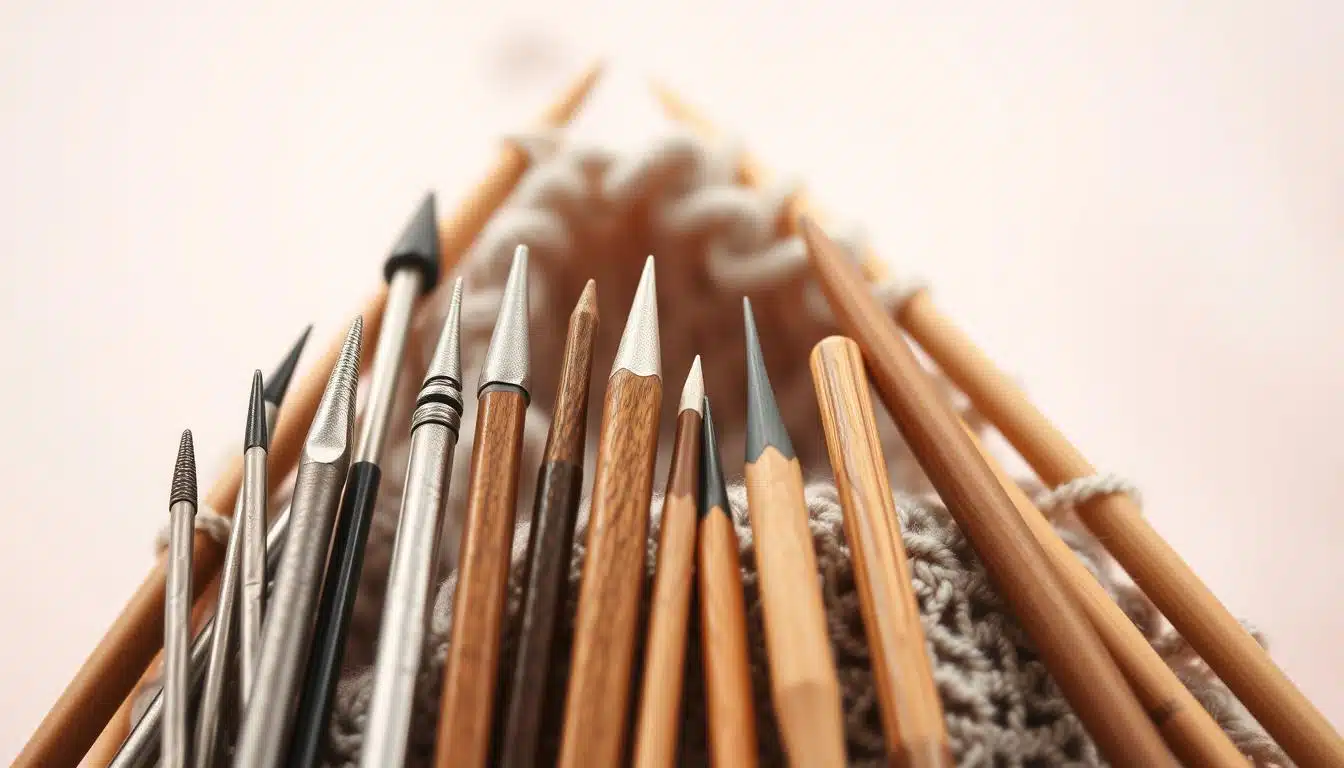
Welcome to Stitch Wiz, your ultimate guide for choosing knitting needles. We offer practical and witty advice for U.S. knitters. Whether you’re new to gauge, refining your tools, or looking for interchangeable sets from brands like Addi or ChiaoGoo, we’ve got you covered.
This guide will help you pick the best needles for any yarn and project. You’ll learn how to avoid wasted swatches and frogging. Plus, you’ll discover how to streamline your tools.
We’ll show you why needle choice affects fabric. You’ll also learn about materials and types and how they impact speed and grip. We’ll even tell you when a two-needle circular method can replace double-pointed needles for small circumferences.
Stitch Wiz covers sizing and conversions, including specialty tools like Tunisian hooks and interchangeable sets. We’ll guide you on choosing needles for specific projects like socks, cowls, and sweaters. You’ll also learn about swatching and gauge math to save time.
Modern pattern tools like PDF viewers, color palettes, and bead palettes also play a role in needle choices for finework and beading.
Read on to let Stitch Wiz help you pick the right needle. We’ll reduce guessing and make your knitting smoother from start to finish.
Key Takeaways
- Stitch Wiz is a practical knitting needle guide for beginners to advanced knitters.
- Choosing the right needle prevents frogging and saves swatching time.
- Materials and needle type affect stitch speed, grip, and finished fabric.
- Two-needle circular methods are a good alternative to double-pointed needles.
- Modern pattern tools influence needle choices for beading and finework.
- Focus on swatching and gauge math to hit fit and dimensions reliably.
Why needles matter: how needle choice changes your fabric
Needles are key for every stitch. The size of the needle affects the size of your stitches. This, in turn, changes how dense or loose your fabric will be.
A smaller needle means a tighter fabric. A bigger needle makes your fabric looser and airier. This difference is why needle size is so important for how your fabric looks and feels.
Think about it practically. If you use a different needle than your pattern suggests, your fabric will change. This can affect how well a sweater fits or how a hat sits on your head. The right needle size is key to avoiding a garment that doesn’t fit right.
How needle size affects gauge and finished dimensions
Stitch size is directly tied to the number of stitches per inch. Going down one needle size means more stitches and a smaller piece. Going up one size does the opposite. Even a small change can make a big difference in some projects.
Why millimeters aren’t a perfect shortcut for size changes
Comparing Size 7 (4.5 mm) to Size 8 (5.0 mm) might seem simple. But, the actual size difference in your finished project is not always as straightforward. Yarn type, stitch pattern, and your knitting tension all play a role.
Needle millimeter conversion is a useful guide, but it’s not always accurate. Ribbing and certain stitch patterns can make size changes more noticeable. Always swatch to get a better idea of how your project will turn out.
When switching sizes makes a small vs. big difference
Changing needle sizes can have a small or big impact, depending on the project. For example, going down two sizes can make a big difference in ribbing. This can change how tight or loose your fabric is.
When working with ribbing, you might need to go down two or three sizes to get the right fit. Some knitters adjust their stitch count by about 10% instead of changing needles. This can help achieve the desired tightness.
| Scenario | Typical Needle Change | Observed Effect |
|---|---|---|
| Loose scarf pattern | ±1 size | Small gauge impact, drape changes, fit not critical |
| Fitted sweater body | ±2–3 sizes | Large needle size change effect, alters measurements and pattern repeats |
| Ribbed cuff or collar | -2 to -3 sizes | Tighter fabric and recovery; may need stitch count adjustments ~10% |
| Lacy shawl with open pattern | +1 to +2 sizes | More open stitches, changed drape, pattern proportions shift |
Swatching is the best way to see how different needles will affect your project. It shows how your yarn, needles, and stitch pattern work together. Use needle millimeter conversion as a starting point, but always swatch to get accurate results.
Needle materials explained: metal, wood, plastic, and hybrid options
Choosing needle material lets you shape your project’s personality. The feel, speed, and sound of your needles change with each material. You can pick metal, wood, plastic, or hybrid needles to find the perfect fit.
How material affects stitch speed, grip, and noise
Metal needles, like stainless steel or nickel-plated brass, are smooth. They make stitches slide quickly, speeding up your work. You’ll hear a slight clack and feel a cool touch.
Wood needles, made from bamboo or hardwood, offer a firm grip. This grip helps with slippery yarns, reducing dropped stitches. Wood needles are warm to hold and quiet, perfect for late-night knitting.
Plastic needles are light and often quiet. Their smoothness varies by brand. Some glide like metal, while others hold stitches like wood. Hybrid needles combine tips and shafts for a balance of speed and control.
Choosing materials for slippery or textured yarns
For slippery yarns, wood needles are the best choice. Bamboo’s natural texture helps stabilize stitches, making cables and lace easier. This is great for textured patterns.
For wool blends that slide easily, metal needles are ideal. They help maintain even tension in detailed patterns. When working with beads, consider the type of needle based on your project’s needs.
Durability, warmth, and travel considerations
Stainless steel and nickel-plated needles are durable and travel-friendly. They resist dents and keep their points sharp. Plastic and bamboo needles are lighter, making them easier to carry.
Bamboo needles may wear over time. A little sanding or mineral oil can restore them. Avoid extreme temperature changes with wood needles to prevent warping. For travel, use secure joins or locked tips to prevent pieces from coming loose.
| Material | Feel | Best for | Care & durability |
|---|---|---|---|
| Stainless steel / nickel | Slick, cool, noisy | Finework, slippery yarns, heavy use | Very durable, resists dents, low maintenance |
| Hardwood / bamboo | Warm, grippy, quiet | Slippery fibers, textured stitches, evening knitting | Can dent or wear; occasional oiling or sanding helps |
| Plastic / acrylic | Lightweight, variable smoothness | Travel, beginners, lightweight projects | Inexpensive, may scratch or warp with heat |
| Hybrid needles | Balanced: tip from one material, shaft from another | Mixed yarns, knitters who want speed plus control | Depends on components; generally durable with care |
For a hands-on comparison, check out a needle guide. It reviews popular options like HiyaHiya stainless steel, Knitter’s Pride Dreamz, and Addi hybrids at how to choose circular and double-pointed. This guide helps you compare metal, wood, plastic, and hybrid needles for your next project.
Needle types decoded: straight, circular, and double-pointed needles
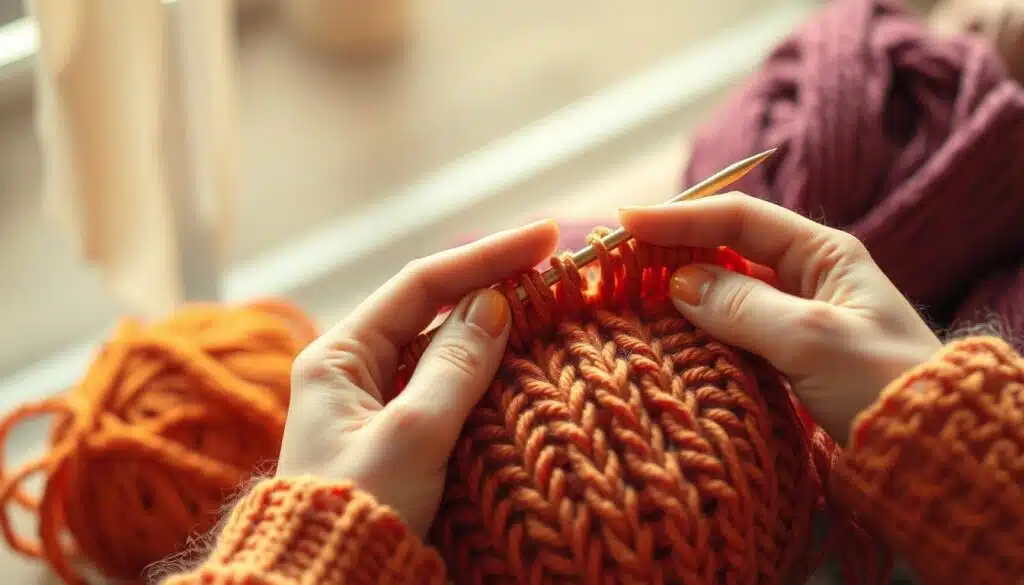
Choosing the right needle can make your project feel calm. Straight needles are great for flat items like scarves and sweater panels. They help you see your stitches clearly and are easy to block.
When straight needles are the best choice
Long, open pieces or lace charts need straight needles. They offer simple handling and a consistent fabric. Beginners find them helpful because they keep stitch count easy to see.
Circular needles: why two needles can replace many (and how you can knit in the round without DPN frustration)
Circular needles are versatile. They work well for flat knitting and seamless items like hats. They’re perfect for holding many stitches comfortably.
The two-needle circular method is a DPN alternative. It uses one circular for working and another for holding stitches. This method is great for knitting two socks at once, saving time and reducing tangles.
For a quick guide on needle types, check this needle explainer. It offers visual comparisons and practical tips.
Double-pointed needles: when to use them and how to simplify with circulars
DPNs are best for small circumferences like tiny sock toes and tight sleeves. Their short length makes stitches easy to manage.
If DPNs are frustrating, try small circulars or the two-needle circular method. Many knitters prefer interchangeable or fixed circulars for versatility. This choice makes your bag lighter and covers most projects.
When choosing between straight and circular needles, consider the project’s shape and your preference for stitch visibility. The right needle makes your kit lighter and smarter.
Essential knitting tools can fill gaps in your set and make switching between techniques easy.
Knitting needle guide
Learning needle sizes is like learning a new alphabet. Metric numbers show the shaft diameter in millimeters. US sizes have a numbering system that grew over time. This means two tools with the same number might not feel the same.
Start with metric when you can. A quick needle sizing conversion table is very helpful. For example, a 4.5 mm needle is US 7 and a 5.0 mm needle is US 8. This makes swapping needles easy, but remember, a 4.5/5.0 comparison doesn’t mean your sweater will be 90% of the size.
How to read the chart
- Match the millimeter number to the pattern first.
- Use US to mm conversion only when you lack metric-marked needles.
- If a pattern lists a range, start at the middle and swatch to refine your pick.
Choosing a needle size for your yarn and project
Look at the yarn band and pattern recommendations. Worsted weight often asks for US 7–9, which equals 4.5–5.5 mm. Pick within that range to match fabric drape. Your hands matter: knitters who favor tight tension may choose one size up.
When you must choose needle size, remember gauge beats labeling every time. A bulky hat and a fitted sweater want different hand and stitch definition. Use the recommended needle as your first test, then adjust based on your swatching guide results.
Practical swatching steps
- Cast on enough stitches to measure a 4 in / 10 cm square plus borders.
- Knit in the stitch pattern the project uses for several inches.
- Wash and block the swatch exactly as you will the finished item.
- Measure stitches per inch and rows per inch, then calculate cast-on counts and shaping adjustments.
Community advice is helpful for context. Many knitters report that changing a single needle size produces a small difference. You should swatch to confirm if you need to add roughly 10% more stitches or other adjustments. Swatching guide practices keep surprises out of your next project.
Use metric-first thinking, rely on US to mm conversion when needed, and let a solid swatching guide decide whether to choose needle size A or B for the yarn and silhouette you want.
Specialty needles and tools: cable, interchangeable, Tunisian, and more
When your project needs more than basic stitches, the right tools make a big difference. Small gadgets and special hooks help with cables, textures, and Tunisian panels. Choose tools that fit your yarn and storage needs.
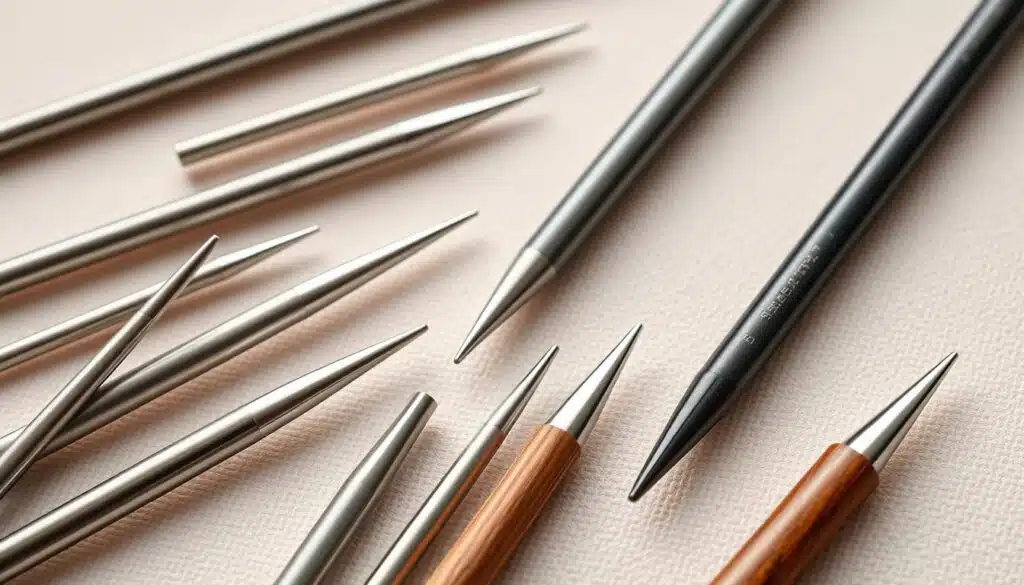
Interchangeable sets are great for knitters who work on many projects. They offer various tip sizes and cables for the perfect length. This reduces clutter and saves time searching for the right tool.
Tunisian crochet hooks offer a unique texture and rhythm. They sit between knitting and crochet, perfect for dense textures and colorwork. Hybrid tools combine crochet and knitting features, allowing for more design options.
Cable needles are essential for classic cable patterns. They come in metal or wood, ensuring crisp cable twists. Flexible and stitch holders are also useful for long cables and storing stitches.
Today’s pattern software includes tools for beading and color selection. These tools help you choose the right needles and tools for your project. Plan ahead to avoid gauge issues with specialty techniques.
Having a few key items like interchangeable sets, Tunisian hooks, and cable needles is essential. Choose brands like ChiaoGoo, Knit Picks, or Lantern Moon for quality and consistency.
How to choose needles for common projects: socks, cowls, sweaters, and beading
When picking needles, think about your project and how patient you are. For small projects like socks, you need needles that help manage tiny stitches. This makes your work easier.
For open designs like cowls, you can play with different textures and needle sizes. Sweaters need careful planning to fit right and look good. Beading projects require needles that can smoothly pass through beads without splitting the yarn.
Socks and small circumferences
Knitting socks means choosing between DPNs, magic loop, or two-circulars. DPNs are great for small rounds and keeping needles in hand. Magic loop uses one long cable, making it good for mid-calf and leg lengths.
Two-circulars are perfect for making two socks at once. This method is great for those who like symmetry and fewer finishing steps.
For stability in tiny ribbing, sharp metal tips are best. Bamboo or wooden needles offer a bit of grip to prevent slipping stitches. Choose needles that match your yarn and pattern, considering size and material.
Cowls and hats
Cowls are forgiving, allowing for a looser gauge. But, fitted cowls and hat brims need precise sizing. Following your instructor’s needle choice in class saves time and avoids mistakes.
Many knitters prefer circulars with short cables for hats. Smaller circulars work well for the crown. For loose textures, try larger needles. Test different sizes for brims and fitted parts to see how they work with your yarn.
Sweaters and garments
Choosing needles for sweaters starts with swatching. Gauge is key for fit, so measure carefully before casting on. Changing yarns might require adjusting needle size or cast-on counts.
Plan for body shaping and repeats in your sweater. Use interchangeable sets or various sizes to adjust as needed. Interchangeable sets save space and let you try different lengths for set-in sleeves or seamless yokes. For more on choosing circular needles, see this guide: how to choose circular knitting needles.
Needles for beading and finework
Beading requires fine, smooth needles that fit through small bead holes. Choose thin, straight tips with a consistent finish for easy bead movement. Use needles sized to your bead and yarn for best results.
Use pattern and color planning tools with bead palettes to place beads correctly. Match bead palettes with yarn palettes for designs. Small changes in needle tip shape affect bead placement, so test a swatch first.
- Quick tip: Metal needles speed up work on slippery yarns; wooden or bamboo needles offer grip for sticky or handspun yarns.
- Quick tip: Karbonz or hybrid tips offer a mix of speed and control for complex lace and beaded patterns.
- Quick tip: Interchangeable kits are worth it for projects like socks, cowls, sweaters, and fine beading.
Swatching, math, and troubleshooting gauge panic
Ever felt your sweater pattern go wrong with measurements? Start with a calm swatch and some math to avoid gauge disasters. Good swatch instructions show how yarn and needles work together.
Cast on enough stitches for at least 4 inches. Use the actual pattern stitch, like ribbing or stockinette, to match the finished sweater. Block the swatch like the garment to get accurate measurements. Measure the center to avoid edge issues.
How to create a useful swatch and measure stitches per inch
Choose a needle size for your project and add a few extra stitches. Knit the pattern sections that affect fabric density. After blocking, count stitches in the middle inch and multiply for stitches per 4 inches. If counts vary, try different needles until it matches the pattern.
Real-world examples: what happens when you drop a needle size
Dropping a needle size, like US 8 to US 7, usually changes dimensions by a few percent. But dropping two to three sizes can shrink dimensions sharply. Ribbing may need a bigger size change or a 10% stitch-count tweak for fit.
Adjusting stitch counts and rounds instead of changing needle size mid-project
If you hit gauge panic mid-project, don’t switch needles right away. Calculate the percent difference between your swatch and the pattern. Use that percent to adjust cast-on numbers or repeats. For stranded work, check pattern multiples before changing repeats. This way, you can adjust stitch count and rounds without changing needles.
| Issue | Quick test | Fix without changing needles | When to change needle size |
|---|---|---|---|
| Too loose by ~5% | Compare blocked swatch to pattern gauge | Reduce cast-on by 5% or trim repeats | Only if look/hand feels off |
| Too tight by ~10% | Measure stitches per inch across center | Increase rounds or add repeats matching multiple | If fabric is stiff or pattern detail lost |
| Ribbing too stretchy | Work rib sample and block | Adjust stitch count by pattern multiple (≈10%) | When elasticity ruins shaping |
| Stranded colorwork off | Test full motif on swatch | Change number of pattern repeats, keep multiples | If tension change distorts motif |
If you’re in a class or following a designer’s pattern, ask before ripping back. Use swatch math to decide whether to frog and restart or to tweak counts. This saves time and keeps your project on track for the right fit without last-minute changes.
Care, storage, and maintenance of your needle collection
Keep your needles ready for use with simple care. Wipe metal needles with a soft cloth after each use to remove oils and sweat. For wood and bamboo, apply a little mineral oil or beeswax to keep them smooth and prevent damage.
Cleaning and preserving different materials
For metal and plastic, clean with lukewarm water and mild soap, then dry right away to prevent rust or warping. Never soak wooden needles. For a deeper clean, dampen a cloth with soap, wipe gently, dry, and oil. Stay away from harsh chemicals and extreme heat to protect finishes.
Organizing sets, cables, and spare tips for fast project changes
Label your tips and cables in zip pouches or padded cases for quick access. Store spare end caps, tightening keys, and tips with your set to avoid delays. Use coil-friendly organizers or labeled boxes to keep materials separate and prevent scratches.
Travel tips: what to pack and how to avoid lost tips or tangled cables
When traveling, choose a strong case and secure tips with end caps. Coil cables flat and use small cable ties to prevent tangles. Carry a tiny needle gauge, stitch markers, and a small repair kit for quick fixes. Opt for lightweight tips and flexible cables for air travel to reduce bulk and lost items.
For a handy checklist and specific product suggestions on maintaining your needles and smart storage tips, see this care and maintenance guide. Follow these routines to extend your needles’ life, prevent damage, and keep them organized. This way, you can start knitting faster.
Conclusion
Your needle choice affects your fabric more than the yarn label does. Size, material, and type change how your stitches look, feel, and how fast you work. This guide’s main point is simple: take your time to swatch and choose wisely.
When you want softer stitches or warmer hands, try wood and metal needles. This guide from Crochet Craze shows you the difference wood vs metal needles.
Good habits lead to better projects. Use two-circular methods to avoid DPN trouble. Choose an interchangeable set for flexibility, and follow your teacher’s needle advice for class projects after swatching.
For detailed work, use beading and pattern tools to plan and count. These tips save you time and frustration later.
Start by swatching carefully, label sizes in millimeters, and keep a small toolkit. Include one metal, one wood, and one interchangeable set. Keep your tools in good shape for many seasons. Now, pick a pair, make a swatch, and let Stitch Wiz help you improve your gauge. Choose your tools with care and enjoy the results.
FAQ
What makes Stitch Wiz the go-to resource for choosing knitting needles?
Stitch Wiz offers a clear guide to picking the right needles. You’ll learn about the impact of needles on fabric, how materials and types affect speed and grip, and more. It covers sizing, conversions, specialty tools, and project-specific recommendations. Plus, it teaches swatching, gauge math, and care tips to help you finish projects.
How does needle size control gauge and finished dimensions?
Needle size directly affects stitch size. Smaller needles create denser fabric, while larger ones make it looser. This changes the stitch count and finished size. Swatching is key to knowing the exact size.
If 4.5 mm is 90% of 5.0 mm, will my garment be 90% as big when I drop one size?
No, dropping one size doesn’t mean your garment will be 90% smaller. The size change depends on your stitch gauge, yarn, and stitch pattern. Dropping 2–3 sizes makes a bigger difference. Always swatch to be sure.
When does switching needle size actually matter?
Switching size matters most for fitted garments and pieces with stitch repeats. It’s also important for class projects where instructors expect a specific needle. For loose cowls, it might not matter as much, but for fitted items, a single-size difference can affect fit.
How do needle materials (metal, wood, plastic, hybrid) affect knitting?
Metal needles are fast and slick, great for quick knitting and details. They can feel cold and noisy. Wood or bamboo adds warmth and grip, good for slippery yarns. Plastic/acrylic needles are lightweight and affordable, with varying smoothness. Hybrids offer a balance of tips and cables. Choose metal for speed and slippery yarns, wood for warmth and grip.
What about durability and care for different needle materials?
Stainless steel and nickel-plated needles are durable for travel and heavy use. Bamboo can dent or wear and may need occasional oil or beeswax. Metal wipes clean easily; avoid harsh detergents and extreme heat for wood. Store tips safely to prevent bending or warping.
When should I use straight needles instead of circulars?
Straight needles are best for long, flat pieces, simple scarves, or when you need a rigid layout for blocking. They’re also good for beginners learning basic stitches. But circulars can usually replace straight needles for most projects.
What are the practical benefits of circular needles and the two-circular method?
Circular needles handle both flat and in-the-round work and reduce the number of tools needed. The two-circular method mimics DPNs, allowing you to avoid juggling multiple tips. Long cables let you magic-loop or knit two socks at once with two circulars.
Should I bother with double-pointed needles (DPNs)?
Use DPNs for very small circumferences or when magic-loop/two-circular methods feel impractical. If DPNs frustrate you, convert patterns to small circulars or use the two-circular trick. Many knitters find circulars (interchangeable or fixed) more versatile.
How do I read needle sizing and convert between metric and US numbers?
Metric (millimeters) measures the shaft’s diameter and is the most reliable. US sizes are numbered historically and can vary, so use a conversion chart when needed—but prioritize mm. For example, US 7 ≈ 4.5 mm and US 8 ≈ 5.0 mm; remember the percentage between them isn’t a direct predictor of final size.
How do I choose a needle size for a given yarn weight or pattern?
Match yarn weight to the recommended needle range on the yarn band and the pattern. Worsted often uses US 7–9 (4.5–5.5 mm). Swatch in the pattern stitch, block it like the finished piece, and measure. Then adjust needle size or stitch counts based on the swatch.
What are the key swatching steps so I don’t panic about gauge?
Cast on enough stitches to measure a 4 in/10 cm area, knit in the intended stitch pattern, wash and block the swatch as you will the final piece, then measure stitches and rows in the center. Use the swatch to calculate cast-on counts and shaping. If gauge’s off, adjust needle size or stitch counts.
How much difference does swapping one needle size realistically make?
Community reports say swapping one size often yields a subtle change—sometimes only a few percent—while swapping two to three sizes creates a pronounced difference. Ribbing commonly needs going down 2–3 sizes or reducing stitch counts by roughly 10% to tighten fabric. Individual tension varies, so swatch to quantify.
What are the best cleaning and storage practices for my needles?
Wipe metal needles with a soft cloth; treat wood/bamboo occasionally with light mineral oil or beeswax if dry. Store interchangeable sets with labeled tips and cables, and keep spare tips, end caps, and tightening keys together. Use zip pouches, needle cases, or labeled boxes to find sizes fast.
Any travel tips to avoid lost tips, tangled cables, or damaged needles?
Pack needles in a sturdy case and secure interchangeable tips with end caps. Coil cables flat or use cable ties to prevent tangles. Carry fine beading needles in protective tubes. For wooden needles, avoid extreme temperature swings that can warp or crack them. Bring a small needle gauge and a few spare tips.
What’s the core takeaway for choosing needles?
Needle choice shapes your fabric—size, material, and type all matter. Swatch deliberately, keep a compact toolkit (one metal, one wood, one interchangeable set), label sizes in millimeters, and maintain your needles. Try the two-circular method to dodge DPN drama, invest in an interchangeable set if you knit often, and use pattern and bead palettes when planning finework.
What should I do right now to improve my next project?
Pick a pair of needles, make a swatch in the pattern stitch, block it as you will the finished piece, and measure. Then adjust needle size or stitch counts based on the swatch. In short: swatch, measure, plan—and stop blaming the yarn for your gauge.