Crochet stitches for hats: 10 Powerful Styles for 2025
Why Crochet Stitches for Hats Are Perfect for Every Crafter
Crochet stitches for hats offer endless possibilities for creating cozy, stylish headwear that works up quickly and uses minimal yarn. Whether you’re crocheting your first beanie or designing a textured bucket hat, the right stitch choice makes all the difference in fit, warmth, and style.
Most Popular Crochet Stitches for Hats:
– Single crochet – Creates dense, warm fabric perfect for winter beanies
– Half double crochet – Offers medium height with good stretch for ribbing
– Double crochet – Works up fast for quick projects and lightweight hats
– Slip stitch – Creates knit-like texture and excellent stretch when worked in back loops
– Post stitches – Form raised ribbing that hugs the head perfectly
Crochet hats are among the most popular beginner projects because they’re quick to complete – often in just a day or two – and forgiving if your tension varies. A typical adult hat fits a 20-22 inch head circumference and uses common yarn weights like Worsted (#4), Chunky (#5), or Super Bulky (#6).
The beauty of hat crochet lies in its versatility. You can create anything from structured bucket hats using cotton and single crochet to stretchy ribbed beanies using slip stitch in back loops only. Different stitches affect not just the look but also the warmth, stretch, and breathability of your finished hat.
Quick Crochet stitches for hats terms:
– basic crochet stitches printable
– crochet stitch guide
– how to do a basic crochet stitch
Essential Crochet Stitches for Hats
Crochet stitches for hats are your personal toolkit – each stitch has its own superpower for creating cozy warmth, adding stretch, or building beautiful texture.
Single crochet is the workhorse of hat-making, creating dense, warm fabric that holds its shape beautifully. Perfect for structured bucket hats or firm foundations where you need breathability without losing shape.
Double crochet is your speed demon – works up so much faster that you can finish a hat in one evening. Creates lightweight fabric that’s perfect when using bulky yarn without the helmet effect.
Half double crochet strikes the sweet spot between single and double crochet. Creates medium-height stitches with crisp definition. When worked in back loops only, it creates gorgeous ribbed texture that’s both stretchy and professional-looking.
Slip stitch worked in back loops only creates fabric that genuinely looks like knitted ribbing. The texture is incredibly stretchy and dense, perfect for hat brims that need to hug your head just right.
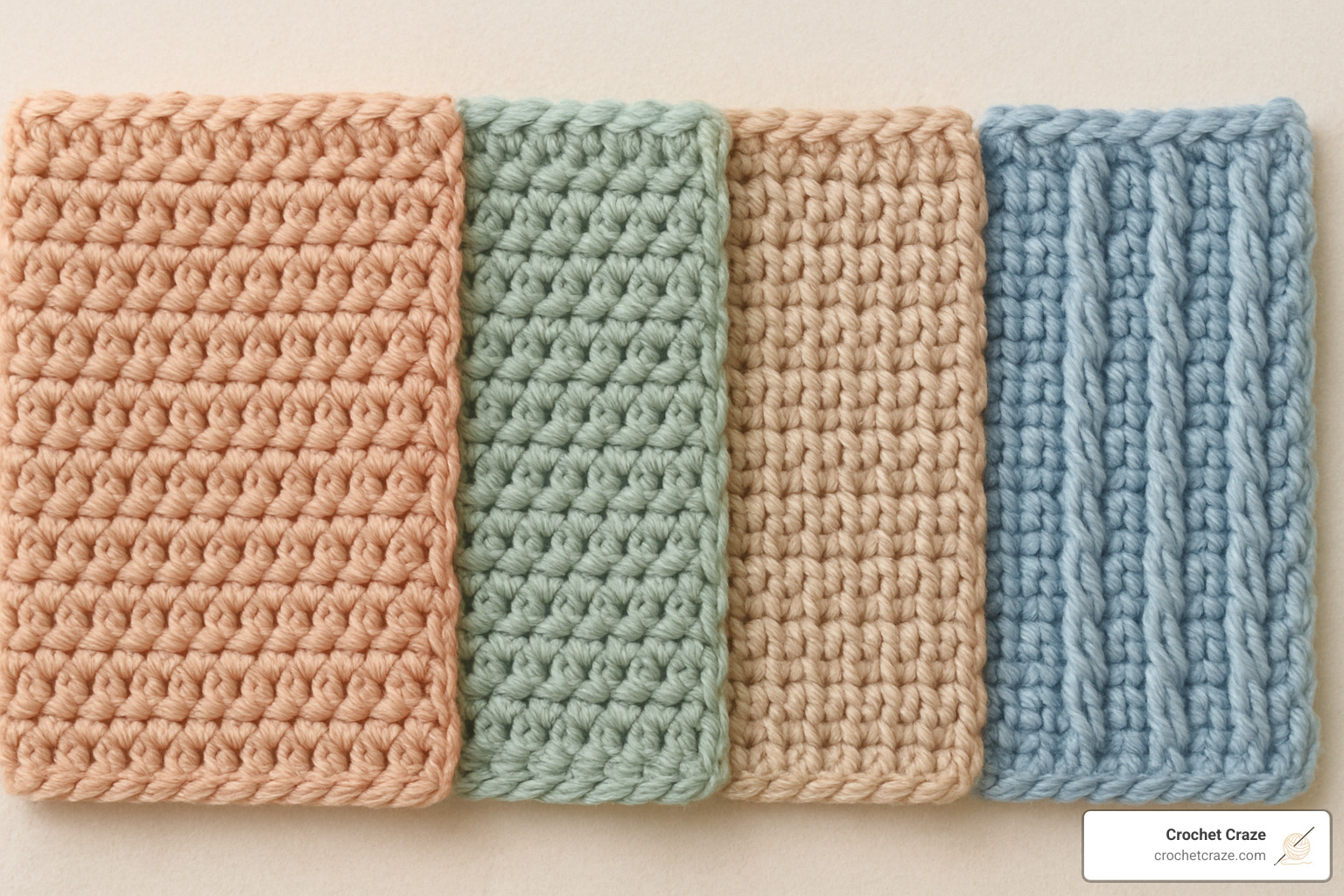
Post stitches wrap around posts of stitches from previous rows, creating raised vertical lines with incredible stretch for hat brims. Bean stitch creates small raised bumps, Waffle stitch forms a grid pattern for trapping warm air, and Wheat stitch combines yarn overs and chains for a braided appearance.
Understanding stitch behavior is key to successful hat-making. Tighter stitches like single crochet create warmer, less stretchy fabric for structured hats. Looser stitches like double crochet offer more drape and breathability for lightweight seasonal wear.
For detailed stitch abbreviations and tutorials, our Crochet Stitch Tutorials break down each technique with clear photos.
Beginner-Friendly Crochet Stitches for Hats
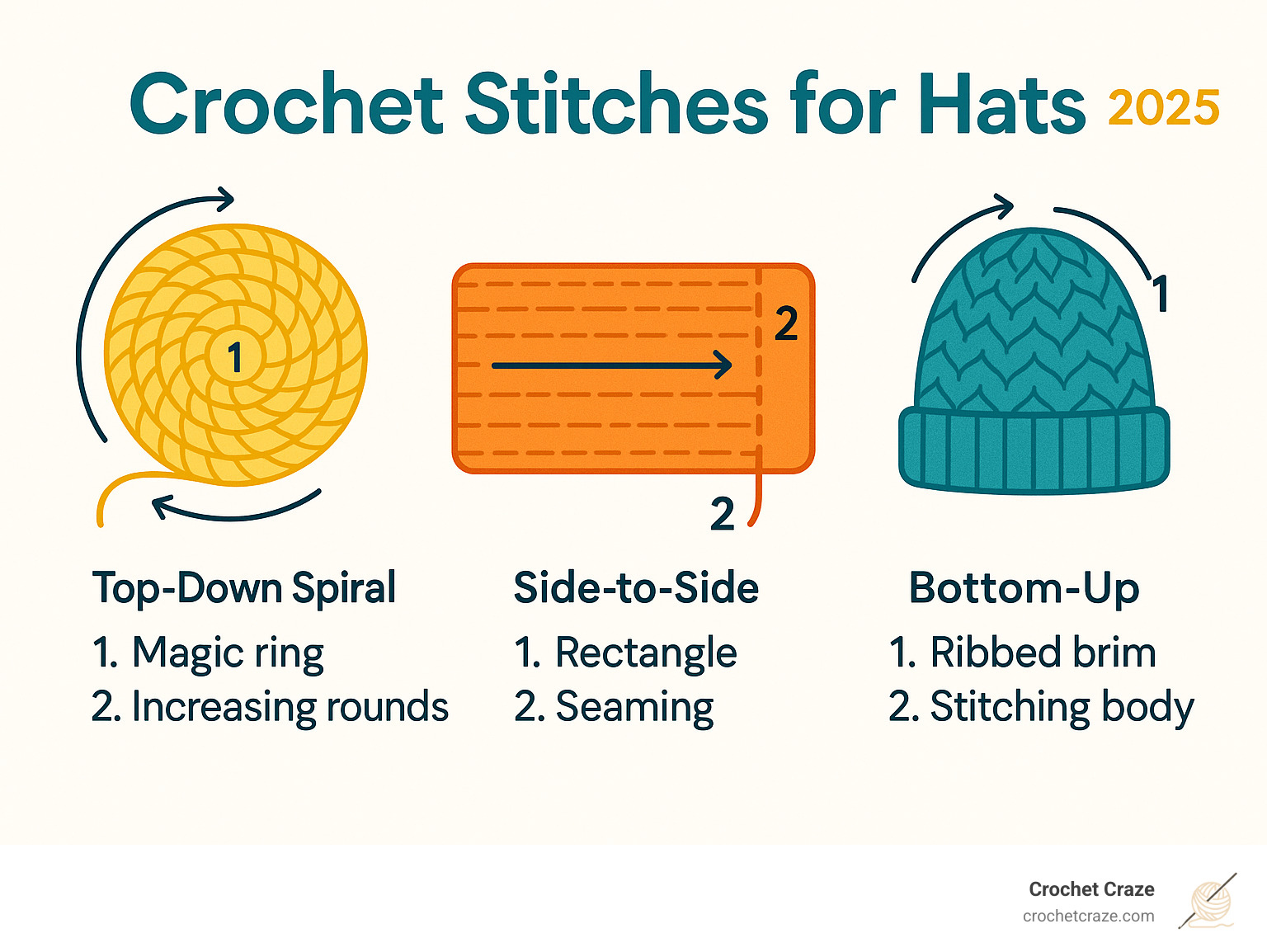
Chain and single crochet are your foundation. Once comfortable with these, you can create gorgeous beanies using the top-down method starting with a magic ring (or chain 4 and slip stitch if magic rings feel intimidating).
The top-down method is intuitive – start with 12 double crochets in your ring, then add 12 more stitches evenly in each round until your circle measures your intended head circumference (typically 20-22 inches for adults).
Basic increases follow simple math: add the same number of stitches each round as your starting count. Start with 12, add 12 more in round 2 (24 total), then 12 more in round 3 (36 total). This ensures your crown lies flat without puckering.
Keep our Basic Crochet Stitches Printable handy for quick reference.
Advanced Crochet Stitches for Hats
Post ribbing using front and back post stitches creates the stretchiest, most form-fitting hat bands. Work around vertical posts from the previous row to create pronounced ribs that stretch significantly while snapping back.
Slip stitch in back loops only creates the holy grail – fabric that truly looks and feels like knitted ribbing. Requires patience but delivers superior stretch and professional appearance.
Bean stitch and waffle stitch add thermal properties by creating air pockets that trap warm air while maintaining flexibility. Try the Frosty Air beanie quick project for practice with chunky yarn.
Choosing the Right Stitch for Different Hat Styles
The magic of crochet stitches for hats lies in perfectly matching your technique to your vision. The difference between homemade and professionally crafted often comes down to choosing the right stitch for your specific style.
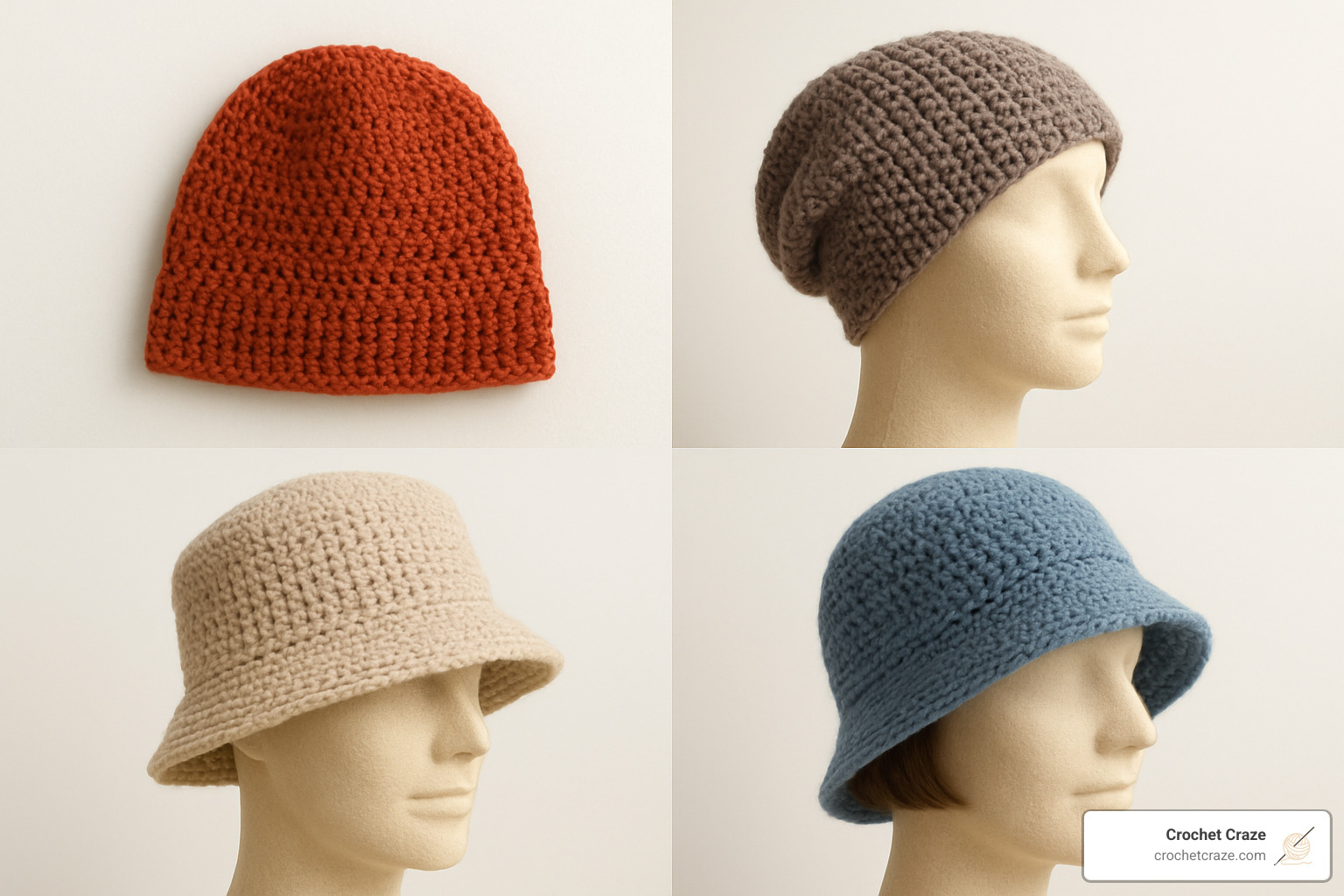
Beanies need stretchy stitches that create snug fit – half double crochet in back loops only, slip stitch ribbing, and post stitch ribbing all create essential stretch. Make your hat slightly smaller than head measurement, letting stretchy stitches expand for comfortable, secure fit.
Slouchy hats use the same stretchy foundation stitches but with extra length in the body for beautiful drape. Double crochet works wonderfully for slouchy bodies because taller stitches naturally create the effortless drape.
Bucket hats, cloche hats, and sun hats demand single crochet for firm, stable fabric that maintains shape. These structured hats need to hold their silhouette through lots of wear.
Climate plays a huge role in stitch decisions. For warm weather breathability, use stitches that create open fabric with good airflow. For cold weather warmth, choose stitches that trap air like waffle stitch or bean stitch.
Our Crochet Hats Tutorial walks you through specific techniques for each style.
Structured Hats (Bucket & Sun)
Single crochet is the foundation for structured hats. Work in continuous spirals rather than joined rounds for smooth, seamless appearance. Stagger increases – never place increases in same spots round after round to prevent hexagonal shape.
Cotton yarn pairs perfectly with single crochet for structured projects, holding shape without stretch memory that could cause brims to lose their angle. Working in spiral rounds requires attention but creates professional continuous fabric.
The Adele Bucket Hat pattern demonstrates these principles beautifully.
Fitted Hats (Beanies & Slouchy)
Ribbing worked in back loops only creates stretch that actually works. Whether using half double crochet, single crochet, or slip stitch, back loops only creates vertical ridges that stretch horizontally while snapping back.
Slip stitch rows create the most remarkable stretch possible in crochet. HDC ribbing offers perfect middle ground for excellent stretch with faster working speed.
Create elastic fit using negative ease – make hat circumference 1-2 inches smaller than head measurement. The stretchy ribbing expands to fit while creating snug feel.
Check out our Beginner Crochet Beanie Tutorial for step-by-step guidance.
Working Methods: In the Round vs In Rows
Choosing your construction method dramatically changes how your finished hat looks, fits, and feels with crochet stitches for hats.
Magic circle construction creates the cleanest crown for in-the-round hats. Seamless spirals eliminate visible seam lines for professional appearance. Joined rounds work beautifully for double crochet or complex patterns needing precise stitch counts.
Rectangle construction opens different possibilities – crochet a flat rectangle, seam short ends, then gather one edge for the crown. This method creates incredible stretch because ribbing runs the full hat circumference.
| Aspect | In the Round | In Rows |
|---|---|---|
| Speed | Faster for simple stitches | Slower due to turning |
| Stretch | Limited by construction | Excellent with ribbing |
| Seam Visibility | No seam | Requires careful seaming |
| Size Adjustment | Difficult mid-project | Easy to adjust length |
In the Round Construction
Continuous spirals work perfectly with single and half double crochet. Use stitch markers to track progress, moving the marker after each round. Even increases follow simple math – start with 12 stitches, add 12 each round for flat circles.
No-seam construction eliminates weak points and saves finishing time. Top-down control lets you try on the hat as you work for perfect fit.
Side-to-Side Construction
Slip stitch ribbing absolutely shines in side-to-side construction, creating remarkably stretchy, knit-looking fabric. HDC ribbing offers perfect compromise between stretch and speed.
Mattress seaming creates nearly invisible seams when done correctly. Knit-look finish is often easier to achieve with side-to-side construction because stitch orientation naturally mimics knitted fabric.
Texture, Ribbing & Knit-Look Tricks
When ready to move beyond basics, crochet stitches for hats with texture and ribbing create boutique-quality results.
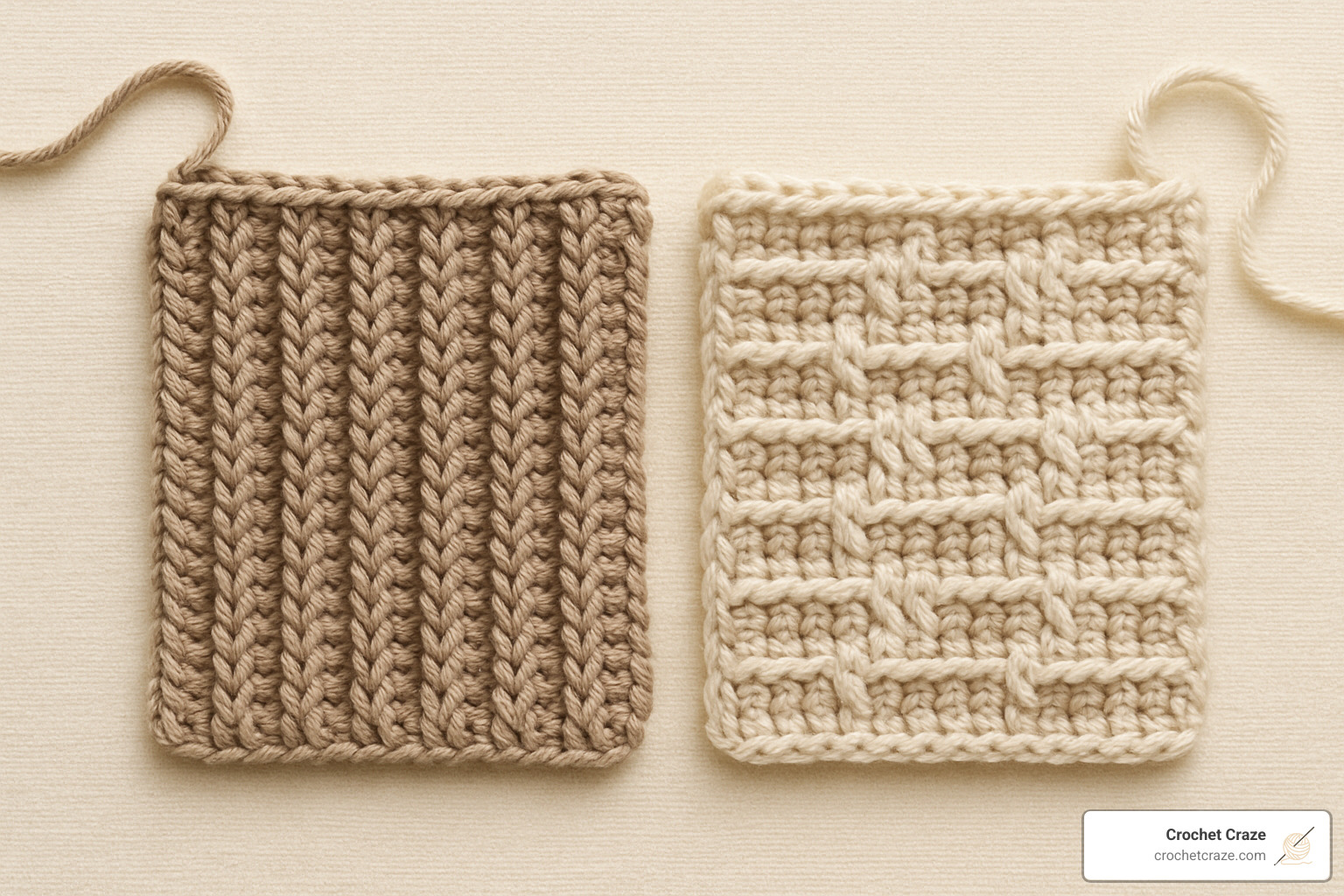
Front post and back post stitches create ribbing that actually hugs your head. Alternating FPDC and BPDC creates gorgeous raised ribs that stretch horizontally while bouncing back. Basket weave patterns use this principle in groups for over-under woven effects.
Waffle stitch creates raised squares separated by valleys that trap warm air. Wheat stitch combines yarn overs, chains, and single crochets for braided wheat stalk appearance. Honeycomb stitch uses strategic slip stitches and chains for hexagonal cells with excellent stretch.
Creating Perfect Ribbing
Half double crochet in back loops only balances stretch and speed perfectly. Slip stitch in back loops only creates the stretchiest ribbing possible, truly mimicking knitted ribbing.
Stretch testing should become second nature – gently stretch ribbing to ensure it expands to 150% of relaxed width while maintaining clear definition. Good ribbing should feel like it has plenty of give without distortion.
Our How to Do a Basic Crochet Stitch guide covers fundamental techniques for excellent ribbing.
Adding Texture Without Bulk
Spike stitches create texture by reaching back to previous rows without extra yarn. Shell stitches group multiple stitches for fan shapes – use as accent elements rather than overall patterns.
Moss stitch alternates single crochets and chains for subtle texture that’s lighter than solid single crochet. Colorwork mixing creates texture through strategic color changes rather than stitch manipulation.
Sizing, Gauge & Yarn Adjustments
Getting perfect fit with crochet stitches for hats requires understanding how measurements, yarn weights, and gauge work together.
Head measurement is your starting point – wrap measuring tape around the fullest part of head, above eyebrows and ears. Most adults measure 20-22 inches. The crown diameter formula divides head circumference by 3.14 to find target crown diameter before working straight sides.

Yarn weight dramatically affects final size and performance. #4 Worsted offers the sweet spot for most projects, #5 Chunky works up quickly for warm hats, #6 Super Bulky creates almost-instant cozy results.
Swatching prevents disappointment – create a 4-inch square using your yarn, hook, and main stitch pattern. Measure both relaxed and stretched dimensions.
For hook size guidance, check our Best Crochet Hook to Start With guide.
Troubleshooting Fit Issues
Too-tight hats usually stem from insufficient crown diameter or inadequate stretch. Too-loose hats indicate excessive crown diameter or too much stretch in ribbing.
Curling crowns signal insufficient increases – add increases gradually over several rounds. Wavy brims happen from too many increases creating unwanted ruffling.
Yarn Weight Modifications
Bulky yarn conversions typically need 75% of original stitch count. Lightweight conversions need 125-150% of original count. Cotton versus wool involves more than sizing – cotton lacks wool’s natural stretch, so consider adding ribbing sections when substituting.
Frequently Asked Questions about Crochet Stitches for Hats
What are the best Crochet Stitches for Hats if I’m a total beginner?
Single crochet is your best friend when starting – creates dense, cozy fabric that’s easy to spot mistakes in. Half double crochet gives you speed while staying simple, with lovely drape that looks professional.
Stick with worsted weight yarn (#4) and an H hook for your first hat. The top-down method makes sense – start with small circle at crown, increase until it fits around head, then work straight down.
Once you’ve mastered basics, try half double crochet in back loops only for your first ribbing trip.
How do Crochet Stitches for Hats affect warmth and stretch?
Single crochet creates the warmest hats because short, tight stitches trap air like insulation pockets. Double crochet creates cooler fabric perfect for spring/fall with larger spaces allowing airflow.
Textured stitches like waffle and bean stitch are warmth superstars, creating air pockets within the fabric itself. Slip stitch in back loops only is magical for stretch – truly feels like knitted ribbing with incredible recovery.
Post stitches create ribbing that stretches horizontally while staying stable vertically. Fiber choice matters – wool insulates with stretch memory, cotton holds shape but lacks stretch, acrylic blends offer best of both worlds.
Can I swap yarn weight without rewriting the pattern?
Absolutely! Bulky yarn substitutions need about 75% of original stitch count. Lightweight yarn substitutions need 125-150% of original count.
Gauge swatching becomes your best friend – make a 4-inch square to see exactly how your fabric behaves. The math is simple: if your gauge shows different stitches per inch, multiply all stitch counts by the ratio to maintain same finished dimensions.
You’re maintaining finished fabric characteristics – look, feel, and fit – rather than exact stitch counts.
Conclusion
Mastering crochet stitches for hats opens up creative possibilities that go far beyond keeping your head warm. From quick weekend beanies to sophisticated textured designs, you now have the knowledge to tackle any hat project with confidence.
The journey from basic single crochet circles to advanced ribbing techniques shows how each stitch serves a purpose. Single crochet creates structure and warmth, slip stitch ribbing mimics professional knitwear, and post stitches add functional stretch. Understanding these relationships means you’ll create hats that fit perfectly every time.
What makes hat crochet so rewarding is how forgiving and quick it can be. Most hats work up in just a day or two, giving you wonderful accomplishment without months-long commitment. Whether stitching donations, creating gifts, or treating yourself, these techniques ensure every project turns out exactly as envisioned.
The skills you’ve learned – managing increases for flat crowns, creating stretch through back loop techniques, understanding yarn weight effects – transfer to every crochet project you’ll make. That ribbing technique for perfect beanie brims works beautifully on sweater cuffs too.
At Crochet Craze, we’ve seen how mastering crochet stitches for hats builds confidence that transforms casual crafters into passionate crocheters. There’s something magical about creating something both beautiful and functional with just yarn and a hook.
Ready to expand your stitch vocabulary further? Our comprehensive Crochet Stitch Guide dives deeper into advanced techniques that will lift not just your hats, but every project you create. The journey in crochet never really ends – it just gets more exciting with each new stitch you master.
Happy crocheting, and remember – every expert was once a beginner who decided to keep going!