
You’re about to learn how to knit without the drama. Take a breath: nobody starts as an expert. Tens of thousands of knitters show progress is one small stitch at a time. Many beginners surprise themselves by making hats, cowls, and even original designs.
Focus on knitting essentials: simple worsted-weight yarn, a pair of comfortable needles, and short practice sessions. Read patterns fully before you begin. Practice new techniques with scrap yarn. Treat each project like a tiny, teachable experiment.
Join a local group or an online community (Zoom or Ravelry meetups) for real-time help and encouragement. Don’t compare your first hat to someone’s tenth sweater. Knit for yourself and learn to set boundaries when people ask you to make gifts.
Start with a clear, step-by-step approach: slip knot, hold yarn, cast on, knit and purl, stockinette, bind off, and weave ends. Use quick-win projects like a headband or mug cozy to build confidence. When you want focused technique guides, check practical how-to resources such as knitting techniques and tips.
Key Takeaways
- Progress happens one small stitch at a time—enjoy the journey and celebrate wins.
- Learn to knit with basic worsted yarn and comfortable needles first.
- Read patterns fully and practice new moves on scrap yarn before using good supplies.
- Short, regular sessions build muscle memory faster than marathon knitting nights.
- Join communities for support, but avoid comparing your work to others.
- Start with small projects to get confidence before tackling garments.
Getting Started: What You Really Need to Buy
To start, you need a few key items. A starter knitting kit with smooth yarn, a pair of needles, and stitch markers are essential. Keep your first set simple to focus on learning, not getting stuck.
Must-have supplies: needles, yarn, and stitch markers
Begin with one pair of needles and a skein of medium-weight yarn. The right needles and yarn make a big difference. Opt for brands like Lion Brand or Caron Simply Soft for ease. Don’t forget stitch markers, a yarn needle, and scissors for finishing touches.
Choosing quality over impulse buys
Invest in good yarn that matches your effort. Quality yarn looks better and lasts longer. Avoid cheap yarn that can shed or split. If money is tight, spend on better needles first. Good yarn makes your projects look handmade, not homemade.
Why a ball winder and stash cataloging save you time (and heartbreak)
A ball winder is key if you collect skeins. It helps you wind yarn into balls for knitting. Keep the ball band for care instructions and yardage. Use apps like Ravelry for easy yarn organization to avoid duplicates and surprises.
Notions for your grab-and-go kit
Make a travel knitting kit with stitch markers, a crochet hook, and a tape measure. Add a small pouch with a yarn needle, scissors, and a row counter. This kit is perfect for errands or travel, keeping you ready to fix mistakes.
For a quick guide on essentials and why they matter, check this beginner’s primer: knitting for beginners.
Choosing Yarn and Patterns That Won’t Betray You
Choosing yarn is like picking a friend for your project. Make sure the fiber content matches how you’ll use the item. This way, you won’t face issues like pilling or losing shape. For example, wool is great for warm items like sweaters, while cotton is better for summer clothes and dishcloths.
https://www.youtube.com/watch?v=IUnnM-HOXug
When planning your project, think about the yarn weight and how much yarn you’ll need. Worsted weight yarn is good for beginners because it’s easy to work with. Check the ply and how smooth the yarn is for better stitch definition. A three- or four-ply yarn is usually best for cables and lace.
Swatch with the needles recommended on the ball band. If your gauge is off, adjust the needle size. Too stiff? Use larger needles. Too floppy? Smaller needles are the answer. Always follow the yarn care instructions on the label to know if it can be washed or needs hand washing.
When choosing colors, avoid dye lot issues. Buy all skeins from the same dye lot for a consistent color. If you must mix lots, alternate skeins to avoid color shifts. Keep labels handy for color matching and dye lot numbers.
Textures and colorways affect your pattern choices. Smooth yarns show off stitch patterns well. Variegated yarns work best with simple stitches. Dark shades can hide details, so choose lighter colors for complex patterns.
Buy yarn with a pattern in mind to avoid running out. Patterns list yardage, recommended yarn weight, and fiber content. Always add a little extra yarn to your list. Use apps like KnitCompanion for project planning and to convert yardage between sizes.
| Question | What to Check | Why It Matters |
|---|---|---|
| What is the fiber content? | Label shows wool, cotton, alpaca, blends | Determines warmth, elasticity, and yarn care |
| Which yarn weight fits the pattern? | From lace to jumbo; worsted weight is beginner-friendly | Controls drape and final size; helps pick needles |
| How many plies? | 2–8 ply, smooth vs fuzzy | Impacts stitch definition and durability |
| Is the dye lot consistent? | Compare yarn dye lot numbers on labels | Prevents visible color shifts when you join skeins |
| Do colors need matching? | Plan color matching and alternate skeins if needed | Keeps stripes and repeats even across the project |
| How much yarn quantity is required? | Pattern yardage plus one extra skein | Stops mid-project shortages and mismatched dye lots |
Needles, Tools, and Materials: Picking the Right Combos
Your first needle haul is key to a happy knitting life. The material of your needles affects how stitches move. Metal needles make loops slide smoothly, bamboo needles offer a bit of grip, and plastic needles fall somewhere in between.
Needle types are as important as size. Circular needles are great for flat pieces and round projects, making them versatile. DPNs are perfect for socks and small items, but they can cause ladders if not used carefully. Straight needles are good for scarves and simple projects, but they limit your options.
Choosing a versatile setup is wise. An interchangeable needle set lets you switch tips and cords for different projects without buying every size. If you’re waiting to buy needles, start with a few essentials: common sizes for worsted weight, a smaller and larger size for gauge, and a long circular for Magic Loop.
Needle tips also matter for comfort. Sharp tips are best for lace, while blunt tips are better for garter and stockinette. Changing materials or tip shapes changes gauges, so keep track of your findings in your knitting notes.
Ball band info and yarn labels are treasures. They tell you about the fiber, yardage, care, and recommended needle sizes. Keep these labels and your project notebook. Note down the yarn brand, dye lot, needle size, and gauge before and after blocking. These notes can save you trouble later.
| Needle Choice | Best For | Pros | Cons |
|---|---|---|---|
| Metal knitting needles | Speed, slippery fibers, lace | Fast stitches, durable, smooth tips | Can be too slippery for slippery yarns |
| bamboo needles | Beginners, wool, sticky yarns | Warm feel, good grip, quieter | Can wear over time, slightly slower |
| Plastic needles | Budget projects, kids, crafts | Lightweight, affordable, varied colors | Less durable, tips may be dull |
| circular needles | Blankets, hats, sweaters, flat or round | Versatile, use Magic Loop, fewer joins | Cable length choice matters for comfort |
| DPNs | Socks, mitts, tight circumferences | Compact, many sizes, traditional | Risk of ladders, fiddly for beginners |
| interchangeable needle set | Frequent knitters who want flexibility | Cost-effective long term, fewer cases | Higher upfront cost if you buy full sets |
Start with a few materials and a plan to grow. Use ball band recommendations as a guide and trust your swatch. Keep yarn labels and detailed notes for future reference. This way, you can reproduce or repair your project with confidence.
Casting On and Setting Up for Success
You’ve chosen your yarn and needles. Now, it’s time to get started. Read the pattern twice and do some prep work. This way, you won’t be surprised by anything.
Highlight important parts and color-code charts. This helps you keep track when you need to pause. It’s also good to underline tricky steps.

Practice new techniques on scrap yarn first. Use the long-tail cast on for a steady tension. For a firmer edge, try the cable cast on. Use a stretchy cast on for cuffs that need to stretch.
Count your stitches after casting on. Do this twice to make sure you have the right number. This helps with consistent shaping.
Swatching is a must. Make a swatch big enough to measure gauge well. Wash and block it like your finished piece. Measure gauge across several repeats for an accurate average.
Record the needle size that worked for your swatch. This helps you later in your project notes.
Joining in the round needs careful attention. Lay your stitches flat and check their orientation. Use a contrasting marker at the start of the round. Practice joining on a small swatch first.
If you see a twist, stop and fix it. Don’t try to fix it later. This saves time and effort.
Keep your pattern with your work. Check for errata online before starting. Good prep and practice swatches save yarn and time. They make your knitting smoother and smarter.
| Setup Step | Why It Matters | Quick Tip |
|---|---|---|
| Read pattern twice | Prevents misreads and unexpected techniques | Highlight size and underline shaping notes |
| Practice cast-ons | Different cast-ons change edge stretch and look | Try long-tail cast on, cable cast on, and stretchy cast on on scraps |
| Swatch and block | Determines true knitting gauge and drape | Measure gauge after blocking and record needle size |
| Join in the round | Avoids twisted work and wasted time | Lay stitches flat, mark the start, and practice circular knitting join on a swatch |
| Count and recount | Ensures correct stitch totals and consistent shaping | Count cast-on stitches twice before proceeding |
Fixing Mistakes Like a Calm, Clever Knitter
You will make mistakes. That doesn’t mean you failed. See errors as a chance to learn and grow. A calm mindset helps you fix mistakes easily.
When to undo stitch-by-stitch and when to rip back
For small mistakes, like a dropped stitch, you can fix one stitch at a time. But if a big section is wrong, it’s better to start over. Use a lifeline to avoid losing your work.
Tools that save time and tears
Keep a crochet hook handy to fix dropped stitches quickly. A small hook is a lifesaver for lost stitches. Also, use a row counter to keep track of your work. A lifeline ribbon makes it easy to start over.
Practical checks and getting pattern help
Always check for pattern corrections before starting a big project. Designers often update their patterns to fix mistakes. If you get stuck, look up guides like this one: fix knitting mistakes.
Small habits that prevent big fixes
Finish the row before you put your work down. Use stitch markers to keep track of your place. Keep notes of where you left off and any changes. This way, picking up where you left off is easy.
Mindset moves that help you learn from errors
See each fix as a chance to learn. If a problem is hard, take a break and come back later. Practice with short sessions and easy projects to improve.
| Situation | Quick Fix | Tool | When to Use |
|---|---|---|---|
| Single dropped stitch | Pick it up and knit into place | Small crochet hook for knitting | Immediate; before it ladders |
| Wrong stitch a few rows back | Tink back stitch-by-stitch | Needles and patience | When error is localized |
| Lace or pattern repeat ruined | Frog knitting to last lifeline | Lifeline ribbon (1/8″ satin) | For multi-row errors or complex repeats |
| Lost place in large pattern | Use row counter and recheck chart | Row counter and pattern notes | During long repeats or multi-size patterns |
| Confusing instruction | Check pattern errata and community help | Designer notes and forums | Before undoing large sections |
Finishing Techniques That Make Projects Look Professional
Finishing touches can turn a simple knit into something you’re proud to wear. Using a selvage technique can help you achieve neat edges. Start each row with a slip first stitch, then knit the last stitch through the back loop. This method makes your edges clean and helps with button bands and seams.
Blocking your knitting is key to making it look its best. To block well, follow the pattern measurements, test a swatch, and choose between wet or steam blocking. Wet blocking is great for opening up lace and evening out stitch tension. Always measure your gauge before and after blocking and note it in your project journal.
Weaving in ends as you go saves time and prevents tangles. Use a tapestry needle and match the yarn color and ply. For those who prefer minimal ends, try the Russian join or spit-splice on practice swatches.
Creating an invisible seam is a skill worth mastering. Mattress stitch is perfect for side seams. For sock toes and grafted joins, the Kitchener stitch is your best friend. Practice on swatches to match your fabric’s tension.
Button bands need special care. Pin edges and pick up stitches evenly using the selvage technique. Reinforce button spots and check alignment on the blocked piece before sewing. A well-made button band can greatly improve how a sweater fits.
Working with double-pointed needles? Tighten the third stitch on each needle to avoid ladders. If ladders are a problem, Magic Loop can help. Keep your stitch tension even near the needle tips for smooth edges and easy seaming.
Practice these techniques on small swatches. Focus on mattress stitch, Kitchener stitch, and the slip-first/knit-last edge. With practice, you’ll get the hang of it and achieve professional results every time.
Top Techniques to Learn Early to Level Up Fast
Start by learning to read your knitting. This way, you can spot a slipped stitch early. Knits form Vs and purls look like tiny bars. A stitch dictionary and simple practice squares make those textures familiar fast.
When you can read your work, you catch mistakes and predict the next row without hunting through the pattern.
Practice stitch patterns on scrap yarn, casting on wide enough for repeats. For cable work, repeat multiples of the stitch count so you finish whole motifs. This habit turns confusion into muscle memory and helps you build a reference library of textures you like.
Reading and practicing stitch patterns
Use short, focused swatches to test stitch dictionary entries and tension. Count rows, note needles and yarn, then store the sample with notes. You’ll stop guessing and start choosing stitches that match drape and density for each project.
Keep a row counter and stitch markers handy. They do more than save time; they prevent mid-pattern panic and teach you to anticipate increases, decreases, and repeats.
Stretchy cast-ons, bind-offs, cable basics, and Magic Loop
Learn a stretchy cast-on and a stretchy bind-off for cuffs and hat brims so edges breathe with your fabric. Combine that with the right needle size and yarn for best elasticity.
Practice cable basics on small swatches before committing to a sweater. Smoother yarns and higher ply show cable definition better. Try cabling without a cable needle to speed up and reduce tool clutter.
The Magic Loop technique lets you knit small circumferences on a long circular needle. Many find it simpler than juggling DPNs and it helps reduce laddering when you pull the third stitch snugly. Use it for socks, sleeves, and hat crowns.
Continental vs. English: try both and keep what works
Continental knitting moves the yarn with your left hand and can be faster once you learn it. English knitting, often called throwing, feels natural to many knitters in the United States.
Trying both knitting styles builds versatility. Some projects, like stranded colorwork, benefit when you hold one color in each hand. Switching methods can also relieve repetitive motion by varying hand movements.
Russian join, carrying floats, and joining yarn seamlessly
Master joining techniques that help you join yarn seamlessly and avoid bulky tails. The Russian join and spit-splice make neat, secure joins without extra weaving. Avoid joining mid-row when possible; if you must, use joins that sit flat and discreet.
When you carry floats in colorwork, keep them tidy and even to prevent puckering. Practice carrying yarn and tensioning floats on a swatch before using the technique on a garment.
Prep your patterns by reading them once and planning color-coded charts for repeats. If you want more step-by-step beginner tips, check this practical guide for beginners to build habits that stick knitting-for-beginners.
| Technique | Why Learn It | Quick Practice Drill |
|---|---|---|
| Read your knitting | Find mistakes fast and follow patterns without constant reference | Knit 4″ garter, 4″ stockinette, then identify knits vs purls |
| Stitch patterns & stitch dictionary | Choose textures that suit projects and yarn | Make 3 swatches of different stitch patterns, label needle and yarn |
| Stretchy cast-on & stretchy bind-off | Elastic edges for cuffs, hems, and hat rims | Compare edge stretch using same yarn with two methods |
| Cable basics | Creates depth and interest in sweaters and accessories | Practice 6-stitch cable on a 6″ swatch with high-ply yarn |
| Magic Loop technique | Knit small circumferences without DPNs; reduces ladders | Make a 16-stitch sock cuff using one long circular needle |
| Continental vs English knitting | Find speed, comfort, and control that suit you | Time 5 minutes knitting English, then 5 minutes Continental |
| Russian join & joining yarn seamlessly | Avoid bulky ends and minimize weaving | Join two yarn ends with a Russian join and test pull strength |
| Carry floats | Neat colorwork backs with minimal puckering | Practice 4-color Fair Isle stripe and check tension |
Keeping Your Knitting Comfortable and Healthy
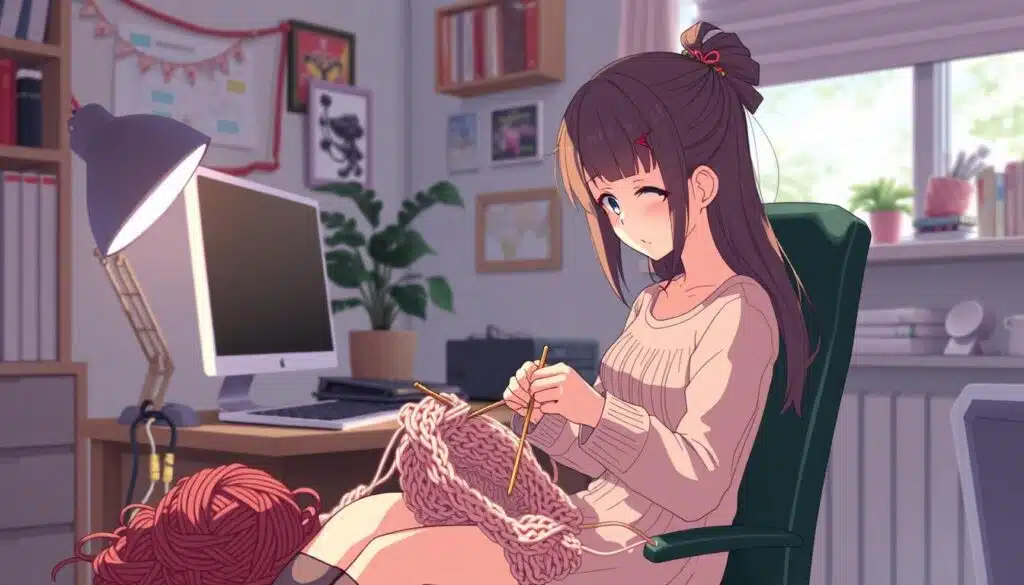
Knitting should relax you, not stress you out. Start with the basics: chair height and eye level. Keep your posture straight, shoulders relaxed, and needles in a neutral wrist position.
Good lighting is key to fewer mistakes and better eye health. Place a bright lamp behind your work or use a white pillowcase under dark yarn to improve contrast.
Lighting, posture, and wrist alignment to prevent strain
Ensure your workspace has even light without glare. Keep your work close to avoid leaning forward. Try ergonomic needles from brands like Addi or ChiaoGoo if your hands hurt. Cushioned rests and wrist supports are great for extra comfort.
Stretch breaks and habits to avoid overuse injuries
Take breaks every 20–30 minutes. Simple stretches like finger flexes, wrist rolls, and thumb pulls can help. Use small, efficient motions and change your grip to avoid strain.
When to stop knitting for the night (and why)
Stop knitting if your focus wavers, stitches get sloppy, or your hands ache. A break from knitting can help you come back refreshed. If pain persists, see a healthcare professional and consider changing tools or habits.
Make knitting therapeutic: mood, music, and the right project
Make your knitting session therapeutic by listening to calm music and choosing relaxing projects. Use mood knitting to your advantage: pick simple patterns for relaxation or cables for focus. Keep a small “comfort” project ready for tough days and practice kindness to yourself while knitting.
For more on knitting as a form of self-care, check out this guide. View knitting as a form of exercise, take breaks to stretch, and know when to stop to protect your hands and enjoyment.
| Focus Area | Quick Action | Benefit |
|---|---|---|
| Posture | Raise chair or props so your back stays straight | Reduces shoulder tension and long-term pain |
| Lighting for knitting | Use a bright task lamp and light background for dark yarn | Fewer mistakes, less eyestrain |
| Knitting stretches | Do short wrist and finger routines every half hour | Prevents hand fatigue and helps prevent RSI |
| Tool choice | Try ergonomic needles and cushioned supports | Less pressure on joints and tendons |
| Session limits | Stop knitting when tired or sore | Helps avoid overuse and preserves enjoyment |
| Mindset | Pick relaxing projects and play calming music | Enhances knitting therapy and mood knitting benefits |
How to Knit Smart: Practical Habits for Consistent Progress
Start small to keep your projects moving and your stash in order. A regular knitting routine is better than trying to do too much at once. Short, focused sessions help build muscle memory and prevent burnout.
Swatch, measure, and record your gauge every time
Always swatch and measure before starting a project. Gauge can change after blocking, so measure before and after blocking. Record the gauge and the needle size used. This saves you trouble when you come back to a pattern later.
Project notes, stash cataloging, and pattern organization (apps and notebooks)
Keep track of your knitting in a notebook or use apps like Ravelry and KnitCompanion. These tools help you store yarn details, ball bands, and photos. A stash catalog lists fiber content, yardage, and care instructions. This makes it easy to match yarn to pattern without searching through baskets.
Check your work regularly, finish rows before you pause, and small efficient movements
Make it a habit to check your knitting often to catch errors early. Finish the row before putting the needles down to avoid fabric warping. Move stitches near the needle tips every few stitches to keep gauge steady and improve knitting efficiency.
Practice deliberately: short daily sessions and targeted technique exercises
Set aside ten minutes daily for focused technique exercises. Practice cables, provisional cast-ons, or Kitchener stitch on swatches until they feel natural. This deliberate practice is faster than random time spent and leads to real progress.
| Habit | What to record | Tool examples |
|---|---|---|
| Swatch and measure | Gauge pre/post-block, needle size, swatch photo | Notebook, Ravelry, KnitCompanion |
| Project notes | Pattern name, yarn brand/color, dye lot, mods | Ball bands, app entries, tagged photos |
| Daily routine | Short sessions, targeted technique exercises, start/finish dates | Timer, row counter, stitch dictionary |
| Quality checks | Check knitting often, finish row, tension spot checks | Stitch markers, lifeline, small mirror |
Conclusion
You’ve learned the basics of knitting smart. Start by investing in quality yarn and tools. Always swatch and measure your gauge. And, read the pattern before you start.
Think of this as a friendly checklist. Practice with purpose, use lifelines when needed, and keep track of your work. This way, your next project will be even better.
Knitting is a journey that values community and patience over perfection. Celebrate your small victories and finish what you start. This builds confidence.
Use resources like absolute beginner guides and apps like Ravelry or KnitCompanion to stay organized. Remember, short, steady practice sessions are better than long, sporadic ones.
Don’t forget to take care of your body while knitting. Good lighting, posture, and regular breaks help you stay healthy and knit longer. Combine ergonomic habits with technique practice for faster, cleaner results.
Keep this beginner knitting recap handy when doubts creep in. With patience and support from others, your mistakes will turn into beautiful garments. And, you’ll have a lot of fun along the way.
FAQ
What do I really need to buy to get started?
Start with the basics: a smooth, medium-weight yarn and needles in a common size. Don’t forget a yarn needle and scissors. Add stitch markers and a crochet hook for dropped stitches.
Invest in one good-quality skein and basic notions from trusted brands. This will make learning easier.
Why should I choose quality yarn over the cheapest option?
Quality yarn behaves better: it withstands frogging and shows stitch definition. Cheap yarn can pill or break. Spend on yarn that matches your project’s needs.
Do I really need a ball winder and to catalog my stash?
Yes, if you buy more than a skein or two. A ball winder saves time. Keep ball bands for details and use Ravelry or KnitCompanion for logging.
How do I pick yarn and a pattern that won’t betray me?
Choose a beginner-friendly pattern and match the yarn weight and fiber. Worsteds are forgiving. Read the pattern fully before buying yarn.
Buy an extra skein when possible. Avoid novelty or fuzzy yarns until you’re more confident.
How does fiber content affect the finished item?
Fiber determines warmth, drape, and care. Animal fibers like wool hold shape; plant fibers like cotton are breathable. Choose based on use.
Always keep the ball band for care instructions.
What needle materials should I try and why?
Metal needles are slick; wood or bamboo are “stickier.” Plastic falls in between. Try each to see what controls your tension best.
Many beginners benefit from owning one of each type.
Circular, DPNs, or straights—which should I buy first?
Buy a pair of circulars (24″ or 32″) early. They’re versatile for flat and in-the-round work. Straights are fine for scarves; DPNs are for small tubes.
Interchangeable sets save space and let you buy tips and cords as needed.
How should I cast on and prepare before starting a pattern?
Read the pattern twice and highlight your size. Practice any unfamiliar technique on scrap yarn. The long-tail cast-on is a great beginner option.
Learn a stretchy cast-on for cuffs if needed. Always swatch and measure gauge after blocking.
How important is swatching and measuring gauge?
Swatching is non-negotiable. Even a half stitch difference can change fit dramatically. Swatch, wash or block it the way your finished piece will be treated, then measure.
Record the needle size that gave you the correct gauge in your project notes.
I twisted my stitches when joining in the round—what now?
Frogging and rejoining is the safest fix. Check your cast-on orientation carefully and use a contrasting stitch marker to mark the round start.
Practice joins on a swatch and consider lifelines when experimenting.
When should I frog, tink, or use a lifeline?
Frog (rip out) for large mistakes or twisted joins. Tink (un-knit) for a stitch or two. Use lifelines before risky sections or pattern changes.
Lifelines save hours and your sanity—especally before trying new techniques.
What small tools should be in my grab-and-go kit?
Keep stitch markers, a small crochet hook, needle sizer, tapestry/yarn needle, scissors, a tape measure, and a row counter. A compact notion case is handy for transit.
Include a spare needle or two if you plan to knit on the go.
How do I avoid ladders on DPNs?
Pull the third stitch on each needle tight when you move to the next needle, and distribute stitches evenly. Magic Loop on a long circular can reduce laddering for small circumferences.
What finishing techniques make projects look professional?
Neat selvage edges—slip first stitch, knit last through the back loop—make pickup and seaming easier. Block pieces to pattern measurements to improve drape.
Weave in ends as you go on big projects, and learn invisible seams like mattress stitch and Kitchener graft for polished joins.
How do I join new yarn without ugly ends or holes?
Use the Russian join or spit-splice for seamless joins without tails. Avoid joining mid-row if possible; if you must, use discreet joining methods and weave ends into seams later.
For colorwork, carry floats neatly and maintain even tension to prevent puckering.
How do I learn to “read” my knitting?
Practice: knits look like V’s, purls like horizontal bars. Work stitch-pattern swatches, compare to a stitch dictionary, and inspect your fabric often.
Reading your knitting helps you find and fix mistakes quickly and anticipate the next stitch without constantly checking the pattern.
Which techniques should I learn early to level up fast?
Master stretchy cast-ons/bind-offs, Kitchener stitch, basic cables, Magic Loop, and reading your knitting. Learn both Continental and English styles to increase speed and versatility.
Practice these in short, focused sessions to build muscle memory.
How do I prevent strain and keep knitting comfortable?
Good lighting, an ergonomic chair, and neutral wrist alignment matter. Take regular stretch breaks, use small daily sessions to build muscle memory, and vary hand positions.
If pain persists, try ergonomic needles and consult a healthcare professional.
When should I stop knitting for the night?
Stop if your hands hurt, you’re tired, or your attention fades—errors multiply with fatigue. If you’re stressed or medicated, choose a low-stakes project or pause.
Rest is productive: you’ll often see solutions after a break or a night’s sleep.
How should I organize project notes and stash information?
Keep ball bands with each project and record brand, color, dye lot, yardage, needle size, and gauge before and after blocking. Use Ravelry or KnitCompanion, or a simple notebook with photos.
Note start/finish dates and any pattern modifications for easy reproduction later.
Any mind tricks to stay motivated and not compare myself to others?
Treat knitting as therapy—celebrate small wins and finishes. Join friendly communities in person or on Zoom, keep your pattern with your work, and don’t compare your progress to others.
Knit for yourself, set boundaries when people ask for free garments, and enjoy the process; many designers started exactly where you are.