Absolute Beginner Knitting: 7 Powerful Reasons to Start 2025
Why Absolute Beginner Knitting is Your Perfect Creative Gateway
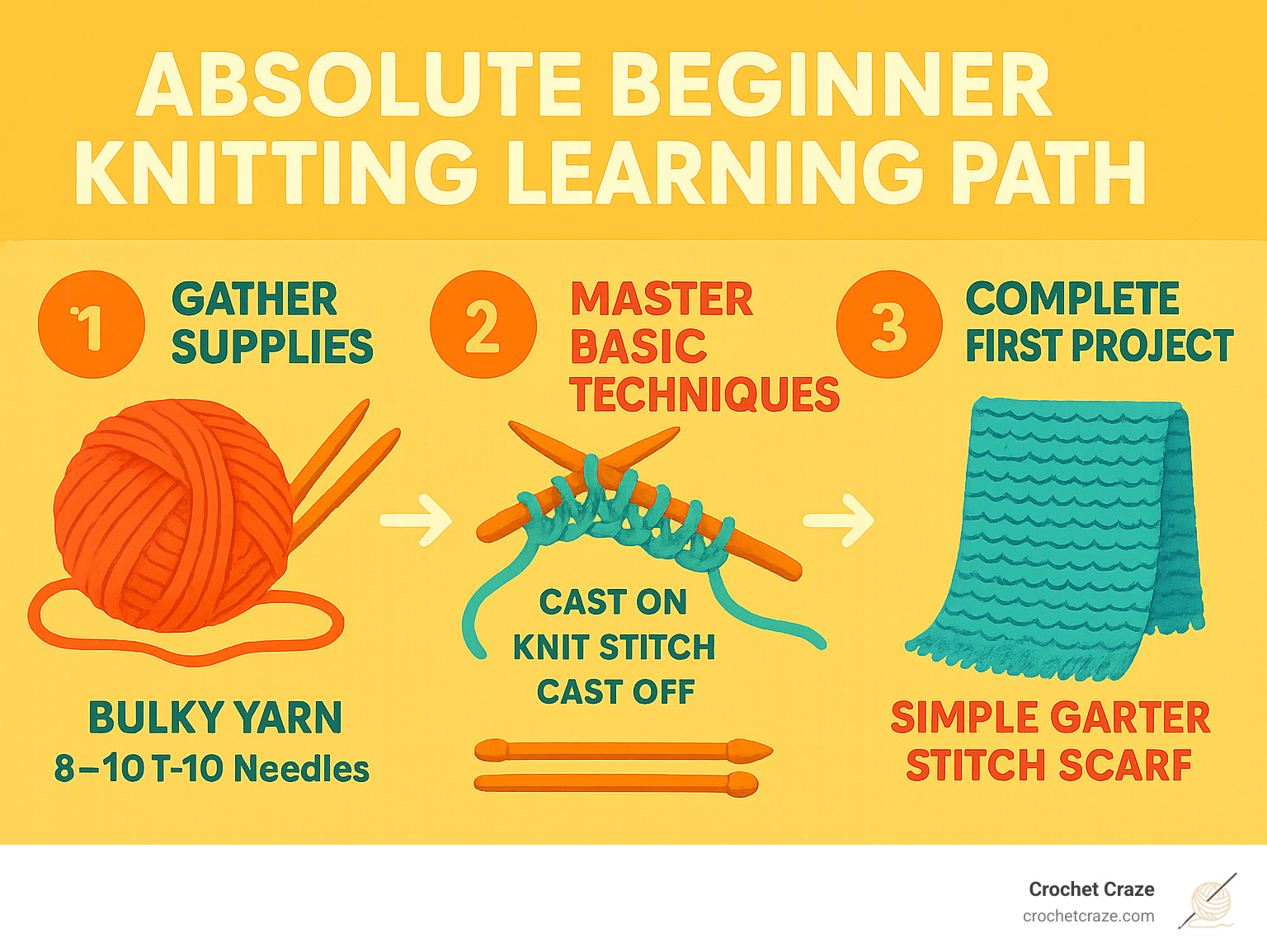
Absolute beginner knitting is surprisingly simple – you only need to master three core skills to create your first project: casting on, the knit stitch, and casting off. Here’s what you need to know:
Essential Skills for Absolute Beginner Knitting:
– Cast on – Getting stitches onto your needle
– Knit stitch – The basic loop that creates fabric
– Cast off – Securing your finished work
– Basic supplies – Bulky yarn + size 8-10 needles (under $20 total)
– First project – Simple garter stitch scarf (knit every row)
The knitting community has exploded since 2020, with over 80% of beginners finding cast on, knit stitch, and cast off the most challenging but essential first steps. The good news? As one popular instructor puts it: “It’s not hard, it’s just new!”
Starting with chunky yarn and wooden needles makes learning easier because your stitches are visible and won’t slip around. Most beginners can complete their first scarf in just a few evenings of practice.
Knitting transforms idle time into productive creativity. Whether you’re watching TV or commuting, those needles can be clicking away. The repetitive motions provide stress relief while building something tangible – it truly does feel like magic when you see fabric growing from simple loops.
I’m Sonja Huerta, and while my expertise lies primarily in crochet, I understand the learning journey that comes with mastering yarn crafts as a beginner. My experience with absolute beginner knitting has taught me that patience and consistent practice are key to building confidence with any new fiber art.
Must-know absolute beginner knitting terms:
– easy knit purl blanket pattern
– purl soho learn to knit
Why Choose Absolute Beginner Knitting?
There’s never been a better time to pick up knitting needles. The craft has experienced an incredible boom since the pandemic, with people finding what knitters have known for generations – this hobby offers something truly special.
Scientific research on craft therapy backs up what feels intuitive: the rhythmic, repetitive motions of knitting trigger the same relaxation response as meditation. Your brain literally shifts into a calmer state as you work stitch by stitch.
What makes absolute beginner knitting so appealing is how quickly you can jump in. Unlike hobbies that demand expensive gear or months of training, you can be creating something beautiful within your first evening. Just two needles, some yarn, and you’re off to the races.
The portability factor is huge too. Your knitting project becomes your constant companion – perfect for long commutes, waiting rooms, or cozy evenings at home. Those little pockets of time that used to feel wasted? Now they become opportunities to add another row to your scarf.
Benefits of Absolute Beginner Knitting
Stress melts away when you’re focused on your stitches. That repetitive motion naturally lowers your stress hormones while giving your mind something concrete to focus on. Many knitters describe entering a peaceful “zone” where daily worries simply fade into the background.
Your confidence grows with every completed row. There’s something magical about watching fabric appear from simple loops of yarn. When you finish that first dishcloth or scarf, the pride is real – you made something useful and beautiful with your own two hands.
Your brain gets a workout too. Learning the motor skills involved in knitting promotes neuroplasticity, helping your brain stay sharp and adaptable. Following patterns exercises your memory and concentration in ways that benefit you far beyond your knitting basket.
Common Myths About Absolute Beginner Knitting
“It’s too complicated for beginners” – This one makes us chuckle. Yes, you’ll see incredibly complex sweaters online that look intimidating. But absolute beginner knitting starts with just three simple techniques. Master those, and you can create dozens of useful projects.
“It costs too much to get started” – Actually, knitting is refreshingly affordable. Your initial investment covers supplies that will last for years, and the yarn for most beginner projects costs less than a fancy coffee drink.
“Only older people knit” – Walk into any yarn shop or scroll through knitting hashtags on social media. You’ll find knitters of every age creating everything from trendy crop tops to cozy blankets. The craft has shed its dusty image and acceptd modern style and techniques.
Gather Your First Supplies
Picture walking into a craft store for the first time – the yarn aisle can feel overwhelming with its rainbow of colors and textures. But here’s the secret: absolute beginner knitting success comes down to choosing just a few smart supplies that will set you up for victory, not frustration.
The magic happens when you start with bulky or chunky yarn paired with larger needles. Why? Because you can actually see what you’re doing! Those big, visible stitches make it easy to spot where your needle goes next and catch any oops moments before they become disasters.
Your first shopping trip should include 2-3 skeins of bulky weight yarn in a light color – cream, pale yellow, or soft gray work beautifully. Those dark, dramatic colors might look gorgeous on Instagram, but they’re like trying to read in a dimly lit room when you’re learning.
You’ll also want size US 8-10 straight needles, preferably made from wood or bamboo. Add some sharp scissors, a measuring tape, stitch markers, and a yarn needle for finishing touches, and you’re ready to create magic.
Choosing the Right Yarn & Needles for Absolute Beginner Knitting
Every yarn label tells a story, and learning to read it is like having a knitting GPS. Look for the little number that indicates yarn weight – this is your best friend when starting out.
Weight 4 (worsted weight) yarn is the reliable choice – versatile enough for most beginner projects and forgiving when you’re still figuring out your rhythm. Weight 5 (bulky) works up so quickly you’ll feel like a knitting superhero, perfect for that first scarf. Weight 6 (super bulky) is the sports car of yarn weights – fast, fun, and incredibly satisfying for instant gratification projects.
When it comes to needles, wood and bamboo are your allies in absolute beginner knitting. They have just enough grip to keep your stitches from sliding around like they’re on an ice rink. Metal needles might look sleek, but they’re slippery little troublemakers when you’re learning.
Circular Knitting Needles open up exciting possibilities as you grow more confident, letting you tackle both flat projects like scarves and round projects like hats with the same tool.
Building an Affordable Starter Kit
Here’s some wonderful news: you don’t need to break the bank to start your knitting journey. A complete absolute beginner knitting kit can come together for less than the cost of a nice dinner out.
Acrylic yarn becomes your best friend when you’re learning – it’s forgiving when you make mistakes, washable when life happens, and gentle on your budget. Grab two skeins in your chosen light color, plus maybe one practice skein in a different shade for testing techniques.
Bamboo needles feel warm and comfortable in your hands, unlike their cold metal cousins. They’re renewable and environmentally friendly too – a win all around.
For your basic notions, you probably already own scissors and a measuring tape. A yarn needle (those blunt-tipped beauties) helps you weave in loose ends and seam pieces together when you’re ready for that step.
Check out resources like Purl Soho Learn to Knit for additional guidance on selecting the perfect starter supplies for your knitting journey.
Master the Core Techniques
Learning absolute beginner knitting is like learning to ride a bike – once these essential techniques click, you’ll wonder why they ever seemed difficult. These skills form the foundation of every knitting project, from simple scarves to complex sweaters.
Your knitting journey starts with the slip knot, your very first loop that anchors everything else. Simply form a loop with your yarn, grab the working yarn (that’s the strand connected to your ball), and pull it through. Slide this onto your needle and you’ve officially begun knitting!
Next comes casting on, which gets your stitches onto the needle to create your starting row. The long-tail cast on is worth mastering because it creates a sturdy, stretchy edge perfect for most projects. Here’s the trick: estimate about 1 inch of yarn per stitch you need, plus 6 inches extra for safety.
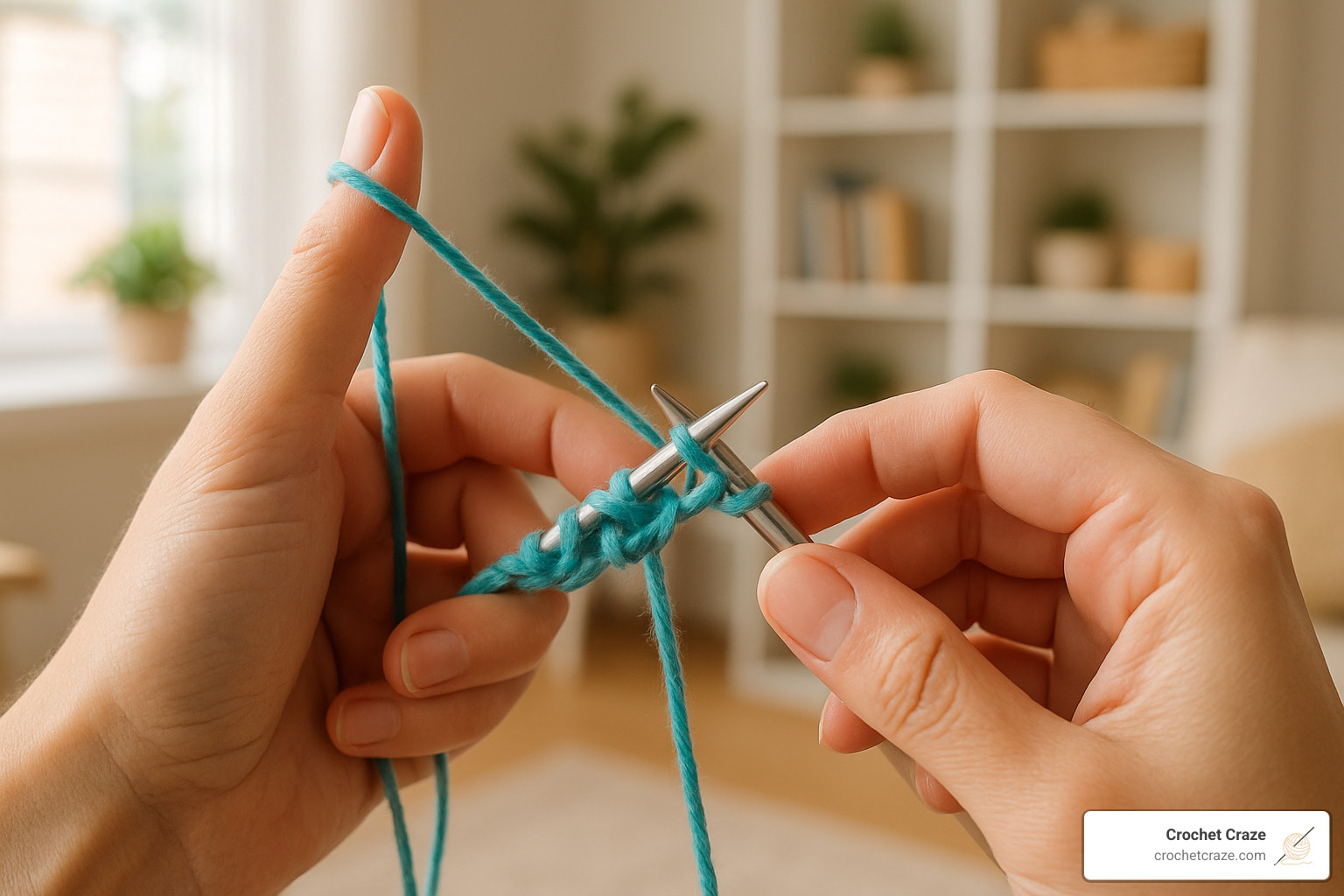
The knit stitch is where the magic really happens. Insert your right needle into the first stitch from front to back, wrap your working yarn counter-clockwise around the right needle, then pull this new loop through the original stitch. Finally, slide the old stitch off your left needle. Congratulations – you’ve just created fabric from thin air!
Tension control might be the trickiest part for new knitters. Wrap the yarn around your pinky finger and over your index finger to maintain steady control. If your stitches look like they’re strangling the needle, relax your grip. If they’re sliding around like they’re trying to escape, hold the yarn a bit firmer.
The purl stitch completes your basic toolkit. While it might feel awkward at first, it’s simply the reverse of a knit stitch. Once you can knit and purl, you can create different textures and patterns that make your projects interesting.
Finally, binding off secures your finished work so it won’t solve. Knit two stitches, then use your left needle to lift the first stitch over the second and off the needle. Continue this process until one stitch remains, cut your yarn, and pull it through that final loop.
Knit vs Purl—Understanding the Fabric
Knit and purl stitches are actually the same stitch viewed from different sides. A knit stitch viewed from the back looks like a purl stitch, and vice versa. Once this clicks, you’ll understand how all knitted fabric is created.
Knit stitches create those smooth “V” shapes on the front of your work. They’re the foundation of stockinette stitch and generally easier for beginners to master first.
Purl stitches create bumpy horizontal ridges that add texture to your fabric. While they might feel clunky initially, purling becomes just as automatic as knitting with practice. The key is keeping your yarn in front of your work instead of behind it.
Understanding these two stitches opens up a world of patterns. Garter stitch means knitting every single row, which creates horizontal ridges and fabric that lies perfectly flat – ideal for scarves and dishcloths. Stockinette stitch alternates knit and purl rows, giving you that smooth front and bumpy back combination you see on most sweaters.
For your first projects, Garter Stitch Knitting is your best friend. Just knit every row and watch your fabric grow without worrying about curling edges or complex stitch patterns.
Casting On & Off with Confidence
The long-tail cast on deserves special attention because it’s incredibly versatile and creates both your first row of stitches and a finished edge simultaneously. The biggest challenge is estimating the right tail length. Start generous until you develop a feel for the measurements.
If the long-tail method makes you want to throw your needles across the room, try the knitted cast on instead. Start with a slip knot, then knit into it but don’t slide the old stitch off. Place that new stitch back on your left needle and repeat.
When you’re ready to finish your project, the standard bind off keeps things simple. Knit two stitches onto your right needle, then use your left needle to lift the first stitch over the second and off the needle. Knit one more stitch and repeat until you have just one stitch left.
Troubleshooting Dropped Stitches & Uneven Edges
Every knitter drops stitches – it’s practically a rite of passage! The secret is catching them quickly before they ladder down and create bigger problems. When you spot a dropped stitch, take a deep breath. It’s fixable.
Use a crochet hook to ladder up the dropped stitch by pulling it through each horizontal strand above it until you reach your working row. Then place it back on your needle like nothing happened.
Uneven edges usually come from inconsistent tension or accidentally creating new stitches. Count your stitches at the end of each row to make sure you have the same number you started with.
Easy First Projects & Progress Paths
There’s nothing quite like the thrill of completing your first knitted project! The magic of absolute beginner knitting is how quickly those simple loops transform into something you can actually use and wear. Starting with the right projects builds your confidence while teaching essential skills.
Your first project should feel achievable, not overwhelming. That’s why we always recommend beginning with rectangular projects that only need the knit stitch. No complicated shaping, no confusing pattern reading, just you, your needles, and the meditative rhythm of knitting row after row.
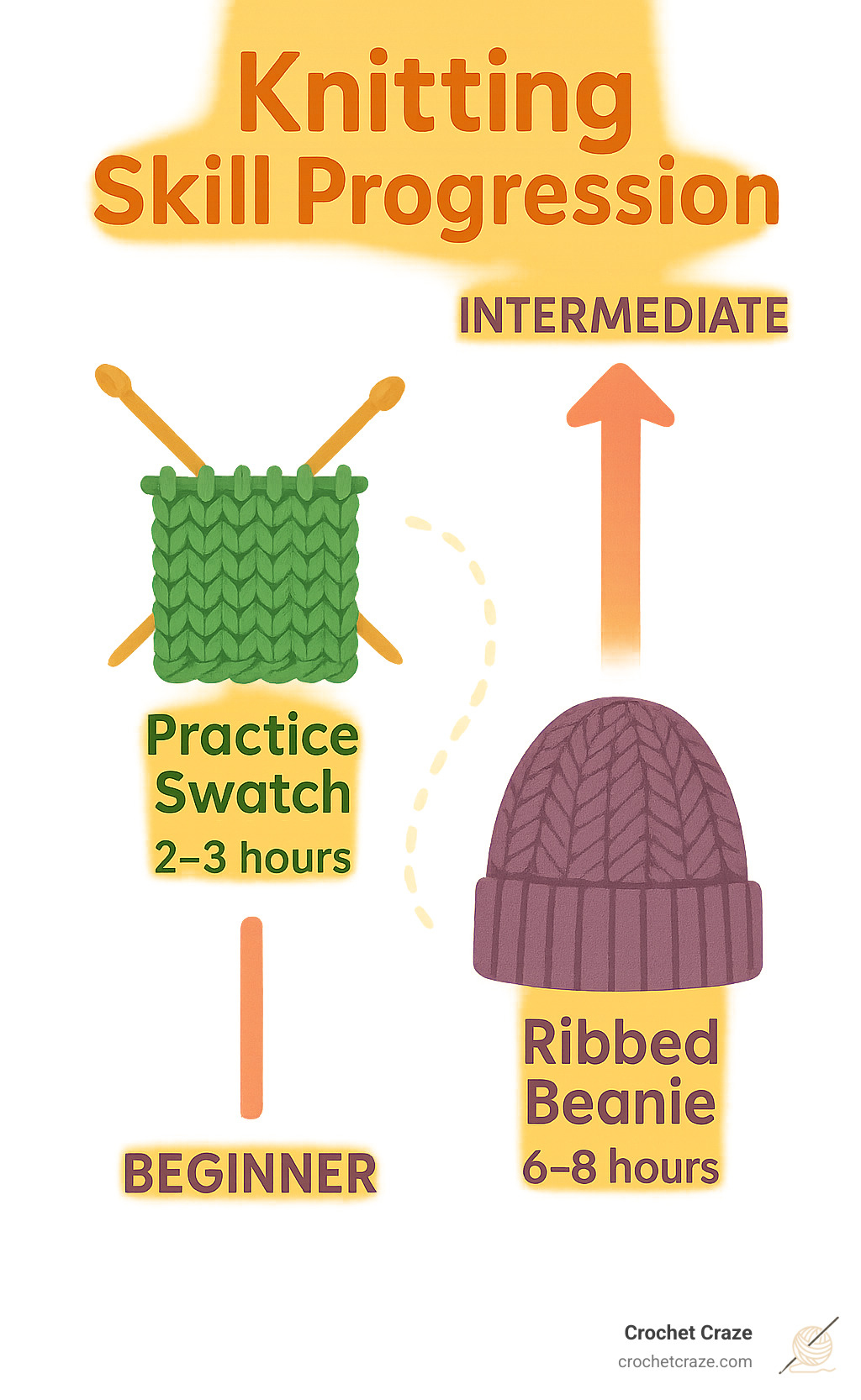
The ideal beginner progression flows naturally: Start with a practice swatch to get comfortable with your needles, then move to a dishcloth where even tension matters, followed by your first scarf that teaches project endurance. From there, a cozy cowl introduces knitting in the round, and finally a basic hat brings in shaping techniques.
Most new knitters can complete a simple scarf in 8-12 hours spread over a few weeks of evening knitting. That might sound like a lot, but remember – you’re building muscle memory while creating something beautiful.
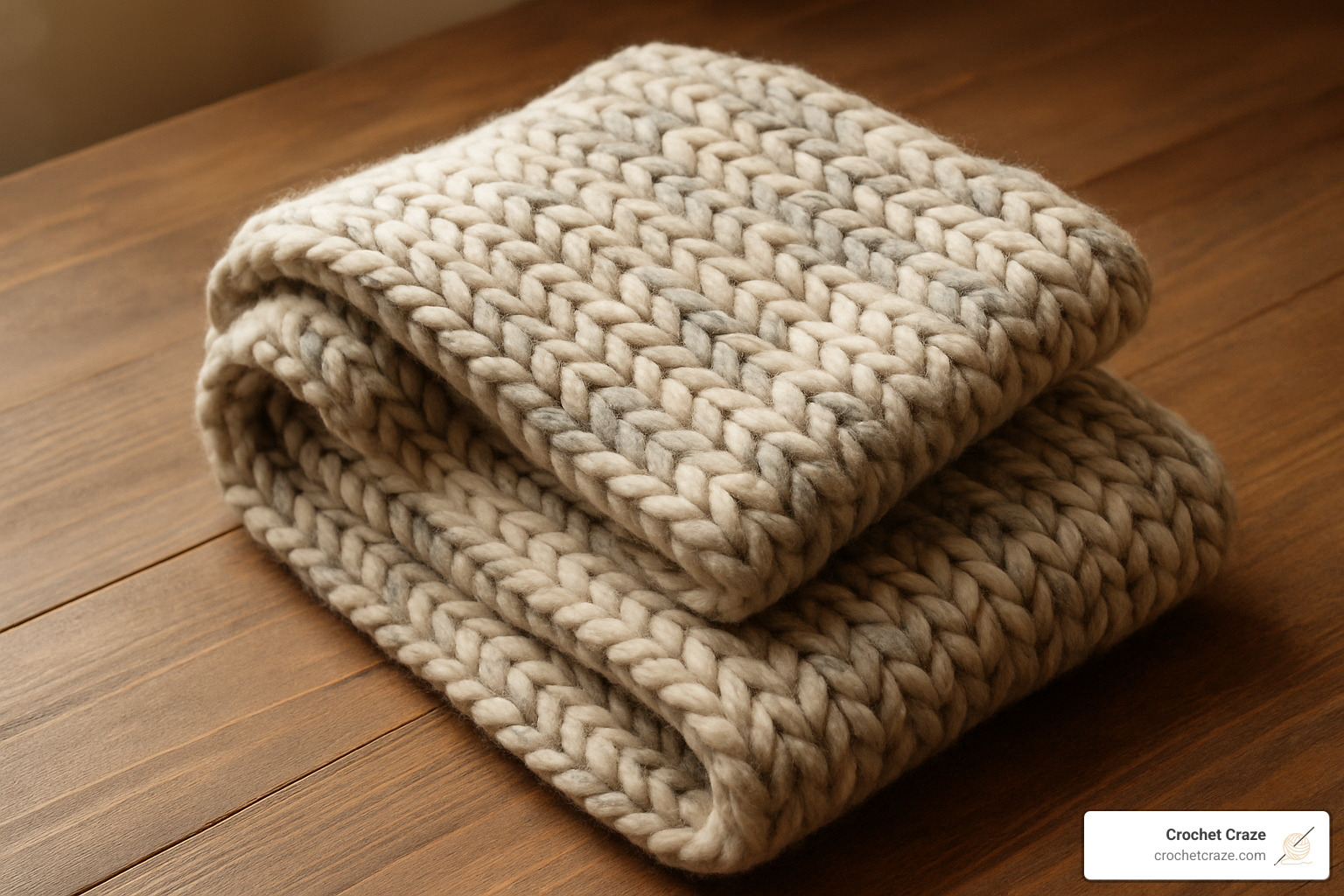
Why start with a scarf? It’s practically foolproof! You cast on once, knit until it’s long enough, then bind off. No counting rows, no worrying about size, no complex techniques. The repetitive nature helps your hands learn the motions while your brain relaxes into the rhythm.
Absolute Beginner Knitting Projects Step-By-Step
Your first garter stitch scarf makes the perfect introduction to absolute beginner knitting. Cast on about 25-30 stitches with bulky yarn and size 10 needles – this creates a scarf roughly 6 inches wide. Then simply knit every single row until your scarf measures around 60 inches long. The garter stitch pattern (created by knitting every row) lies flat naturally and won’t curl at the edges.
The beauty of garter stitch is its forgiving nature. Uneven tension? It adds character. Slightly twisted stitches? Nobody will notice. This project teaches you the fundamentals without the pressure of perfection.
Next, try a seed stitch dishcloth to introduce the purl stitch in a manageable way. Using cotton yarn and size 7 needles, cast on 35 stitches. Alternate knit and purl stitches across each row, but offset them on the next row to create a lovely textured pattern. This project typically takes 3-4 hours and gives you something practical for your kitchen.
Ready for something more exciting? A ribbed beanie introduces circular knitting and basic shaping. The ribbed brim uses alternating knit and purl stitches to create stretch, while the crown teaches simple decreases. Check out our Easy Knit Hat Tutorial for detailed guidance through your first hat.
Hats feel like a big leap forward because they’re truly wearable fashion. Expect to spend 6-8 hours on your first beanie, but the sense of accomplishment when you try it on is incredible.
For even more variety, check out these simple cowl knitting patterns on Etsy. Cowls make excellent second or third projects because they work up quickly and introduce the satisfying technique of knitting in the round.
Staying Motivated & Leveling Up
The secret to absolute beginner knitting success isn’t perfection – it’s persistence. Every knitter has dropped stitches, created wonky edges, and wondered if they’d ever “get it.” The difference between those who continue and those who give up often comes down to setting realistic expectations and celebrating small victories.
Think in weeks, not hours. Your first week should focus entirely on mastering the cast on and knit stitch. Don’t worry about speed or evenness – just get comfortable with the motions. Week two brings your first practice swatch, and week three might see you starting that first scarf.
Keep a simple project journal with photos of your progress. You’ll be amazed how much your stitches improve in just a few weeks. Many knitters love sharing “then and now” photos on social media – it’s incredibly motivating to see your growth over time.
The knitting community is genuinely wonderful. Online spaces like Ravelry offer thousands of free patterns, helpful forums where experienced knitters answer questions, and project galleries for inspiration.
Skill stacking happens naturally as you progress through projects. Your scarf teaches consistent knitting and project completion. The dishcloth adds purl stitches and square shaping. The hat introduces circular knitting and decreases. Before you know it, you’ll have a solid foundation for tackling almost any beginner pattern.
The most important advice? Start simple and stay consistent. Fifteen minutes of daily practice beats marathon weekend sessions that leave you frustrated. Your hands need time to develop muscle memory, and your brain needs time to process new skills.
Frequently Asked Questions about Absolute Beginner Knitting
New knitters always have questions – and that’s completely normal! After helping countless beginners start their knitting journey, we’ve noticed the same concerns pop up again and again. Let’s tackle the most common worries so you can focus on enjoying your new craft.
Should I learn knitting or crocheting first? This question comes up constantly, and honestly, both crafts are wonderful in their own ways. Knitting creates more structured, professional-looking fabric that’s perfect for sweaters and fitted garments. The stitches interlock in a way that produces incredibly smooth, even textures.
Crochet works up faster and mistakes are easier to fix – you can simply pull out your hook and solve back to where you went wrong. But for absolute beginner knitting, the slower pace actually works in your favor. It gives you time to really understand each stitch and build solid muscle memory.
How important is gauge for beginner projects? Here’s some good news – for your first few projects like scarves and dishcloths, gauge really doesn’t matter much. A slightly bigger or smaller dishcloth still cleans dishes perfectly fine! Your scarf will keep you warm whether it’s 6 inches wide or 8 inches wide.
However, once you’re ready for fitted items like hats or sweaters, gauge becomes your best friend. That simple 4-inch square swatch can save you hours of frustration and prevent the heartbreak of a hat that doesn’t fit.
Are there left-handed knitting techniques? Absolutely! Left-handed knitters have several options, and many successful knitters are left-handed. Some learn to knit right-handed (the needles do most of the work anyway), while others prefer mirror-image techniques.
How do I keep my tension even?
Uneven tension frustrates almost every new knitter, but here’s the secret – it gets better automatically with practice. Your hands learn to find their natural rhythm, and those wonky first rows become a distant memory.
The finger wrap method works wonders for most beginners. Thread your yarn around your pinky finger, under your ring and middle fingers, then over your index finger. This creates natural tension control without you having to think about it constantly.
Practice swatches might seem boring, but they’re tension training in disguise. Knit small squares regularly, focusing on making each stitch the same size. Don’t worry about speed – a tortoise who knits evenly beats a speedy hare with lumpy stitches every time!
What if I drop a stitch in the middle of a row?
Every knitter’s heart skips a beat when they spot that telltale loose loop dangling from their work. Take a deep breath – dropped stitches happen to everyone, even knitters with decades of experience!
Stop knitting immediately when you notice the dropped stitch. The longer you continue, the further that little escapee will “run” down your work like a ladder in pantyhose.
The crochet hook rescue method is your best friend here. Grab a crochet hook slightly smaller than your knitting needles. Insert the hook through the dropped stitch from front to back, catch the horizontal strand above it, and pull it through the stitch. Keep “laddering up” until you reach your working row, then slip that rescued stitch back onto your needle.
How do I read a basic pattern?
Knitting patterns look like secret code at first glance, but they’re actually quite logical once you crack the system. Think of abbreviations as knitting shorthand – they save space and make patterns much cleaner to read.
Common abbreviations you’ll see everywhere include k for knit, p for purl, st(s) for stitch or stitches, rep for repeat, beg for beginning, dec for decrease, and inc for increase. Most patterns include an abbreviation key, so you’re never left guessing.
Understanding repeats opens up most pattern mysteries. Asterisks () or brackets [ ] show you which sections to repeat. When you see “k2, p2; rep from * to end,” it means knit 2, purl 2, then keep repeating that knit 2, purl 2 sequence across your entire row.
Conclusion
Your absolute beginner knitting journey has just begun, and honestly, that’s the most exciting part! You now have all the tools and knowledge to transform simple loops of yarn into beautiful, practical items that will serve you for years to come.
Think about it – you started this guide knowing nothing about casting on, and now you understand how three basic techniques can open up countless creative possibilities. That first wobbly scarf you’re planning? It’s going to be absolutely perfect because you made it with your own hands.
The magic happens with daily practice. Even just fifteen minutes a day makes a huge difference. Your fingers will remember the motions, your tension will even out naturally, and before you know it, you’ll be knitting while watching TV without even looking at your needles.
Don’t rush to tackle complicated patterns right away. Master that garter stitch scarf first, then celebrate every single project milestone. Finished your first dishcloth? That’s worth bragging about! Completed a hat that actually fits? You’re officially a knitter now.
The knitting community is waiting to welcome you with open arms. These crafters genuinely love helping newcomers succeed, sharing tips, and cheering on your progress. You’ll find endless inspiration and support when you need it most.
Your knitting journey will surprise you in the best ways. Maybe you’ll find a talent for colorwork, or perhaps cables will become your specialty. Some knitters fall in love with tiny baby items, while others gravitate toward chunky blankets. There’s no wrong path – just follow what brings you joy.
We at Crochet Craze understand exactly how overwhelming it can feel to start something completely new. That’s why we’re here to support your crafting journey every step of the way, whether you’re troubleshooting your first dropped stitch or planning your tenth project.
Keep your needles clicking, celebrate every small victory, and most importantly, have fun with the process. The world needs more handmade beauty, and you’re about to add your unique touch to it.
More info about knitting for beginners
Happy knitting – we can’t wait to see what you create!