
As I sit here with my knitting needles and a ball of yarn, I’m reminded of the countless hours I’ve spent mastering the craft. For me, knitting is more than just a hobby – it’s a way to relax and express my creativity. If you’re just starting out, you might be wondering where to begin.
Understanding the basics of knitting is key to unlocking its secrets. By learning a few simple knitting techniques, you’ll be well on your way to creating beautiful, cozy projects. Whether you’re looking for knitting tips to improve your skills or just starting out, this article is designed to help you every step of the way.
Key Takeaways
- Mastering basic knitting stitches is essential for beginners.
- Understanding yarn weights and types can enhance your projects.
- Simple knitting techniques can be learned quickly with practice.
- Choosing the right knitting needles is important for comfort and quality.
- Following knitting patterns can help you create complex designs.
The Magic Behind the Needles: Getting Started with Knitting
To start knitting, you need to know the basics. Knitting’s magic isn’t just in the needles. It’s also in the tools and techniques that make your projects come alive.
Essential Tools Every Knitter Should Have
Before starting your first project, you need the right tools. Knitting needles are a must. They come in materials like aluminum, wood, or plastic, each giving a different knitting feel.
Needles: Straight, Circular, or Double-Pointed?
The type of needles you pick depends on your project. Straight needles are best for flat items like scarves. Circular needles are versatile for both flat and round projects. Double-pointed needles are perfect for small, rounded items like socks.
Notions That Make Knitting Easier
Other must-haves include yarn needles for weaving ends, scissors for cutting yarn, and stitch markers for pattern tracking. These tools make knitting more fun and easier.
Mastering the Basics: Casting On and Off
Casting on and binding off are key parts of your knitting project. They are essential for a professional finish. Whether you’re making a cozy sweater or a delicate lace shawl, starting and ending well matters a lot.
Different Cast-On Methods and When to Use Them
The cast-on method you pick can change how your project looks and feels. Two common methods are:
- Long-Tail Cast-On: Great for most projects, it makes a flexible edge. This is perfect for garments that need to stretch.
- Stretchy Cast-Ons: Ideal for cuffs, hats, and other items that need to stretch a lot.
Long-Tail Cast-On: Your New Best Friend
The long-tail cast-on is versatile and works for many projects. You start with a slip knot on your needle. Then, use your thumb and index finger to make loops that begin your project.
Stretchy Cast-Ons for Cuffs and Edges
For cuffs and neckbands that need to stretch, use a stretchy cast-on. This method casts on differently to allow for more stretch.
Binding Off Techniques for Professional Finishes
Binding off is as important as casting on. It secures your stitches and finishes your project. There are many methods to choose from, depending on the finish you want.
- Basic Bind-Off: Simple and good for most projects.
- Decorative Bind-Offs: Add elegance to your projects with decorative bind-offs.
Basic Bind-Off vs. Stretchy Alternatives
The basic bind-off works for many projects. But, for items that need stretch, like socks or hats, you might want a stretchier option.
Decorative Bind-Offs That Wow
For a fancy finish, try a decorative bind-off. Techniques like the picot or tubular bind-off can make your projects look stunning.
Knitting Techniques and Tips for Every Skill Level
Whether you’re new to knitting or have been doing it for years, knowing different techniques is key. Each method can change how your projects look and feel.
Continental vs. English Knitting: Finding Your Style
There are two main knitting styles: Continental and English. The main difference is how you hold the yarn and needles.
Speed Benefits of Continental Knitting
Continental knitting is faster. You pick up the yarn with the needle, making it quicker once you get the hang of it.
Comfort Advantages of English Throwing
English knitting is more comfortable for some. You throw the yarn over the needle, which is easier for those with certain hand or finger issues.
Tension Control: The Secret to Even Stitches
Controlling tension is vital in knitting. Uneven tension can make your projects look bad. Keeping your tension even makes your fabric flat and professional-looking.
Tension Troubleshooting for Beginners
For beginners, managing tension is hard. Try practicing with different yarns and needles to get a feel for the right tension.
Creating the Consistent Fabric Every Time
To get consistent fabric, pay attention to your tension. This is important when you switch yarn weights or colors.
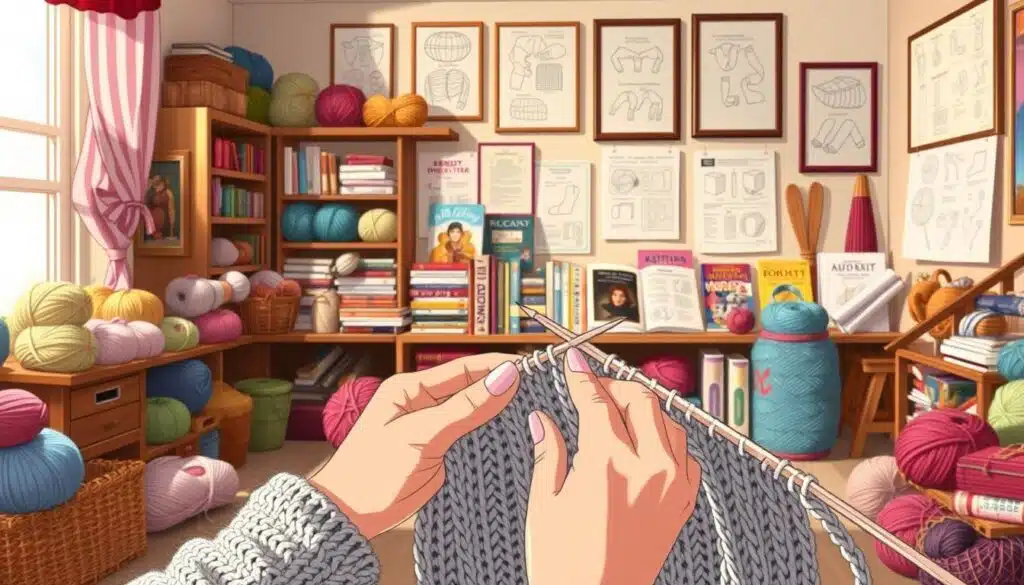
Mastering various knitting techniques and controlling tension can greatly improve your projects. As one expert says, “The key to beautiful knitting lies in the details, such as consistent tension and appropriate technique.”
“Knitting is not just about creating something with yarn; it’s about the journey, the process, and the joy it brings.”
Beyond Knit and Purl: Expanding Your Stitch Repertoire
Ready to take your knitting to the next level? Let’s explore textured stitches, lace, and cables. These advanced techniques open up a world of creative possibilities for your projects.
Textured Stitches to Add Dimension
Textured stitches add depth and visual interest to your knitting. They create fabrics that are not only beautiful but also have a unique feel.
Seed and Moss Stitch Variations
Seed and moss stitches are great for beginners. They’re easy to learn and create a subtle texture. These stitches are perfect for scarves and blankets.
Ribbing Beyond 1×1 and 2×2
While 1×1 and 2×2 ribbing are common, trying other patterns can add a twist. Experiment with different ribbing to create unique textures and elasticities.
Lace Techniques for Delicate Projects
Lace knitting adds elegance to any project. Mastering yarn overs and decreases is key to creating beautiful, delicate patterns.
Yarn Overs and Decreases: The Building Blocks
Yarn overs and decreases are the base of lace knitting. Learning to work these stitches smoothly is essential for creating lacy fabrics.
Simple Lace Patterns for Beginners
Begin with simple lace patterns to build your skills. Look for patterns that use basic yarn overs and decreases for a beautiful, airy fabric.
Cable Knitting Without Fear
Cable knitting may seem daunting, but it’s achievable with practice. Cables add depth and dimension to your knitting, making projects stand out.
Cable Needles vs. No-Cable-Needle Techniques
There are traditional cable needles and techniques without them. Try both to see which works best for you.
Basic Cable Patterns to Practice
Begin with simple cable patterns and gradually move to more complex ones. With practice, you’ll master the stitches and techniques.
Color Your World: Multi-Color Knitting Techniques
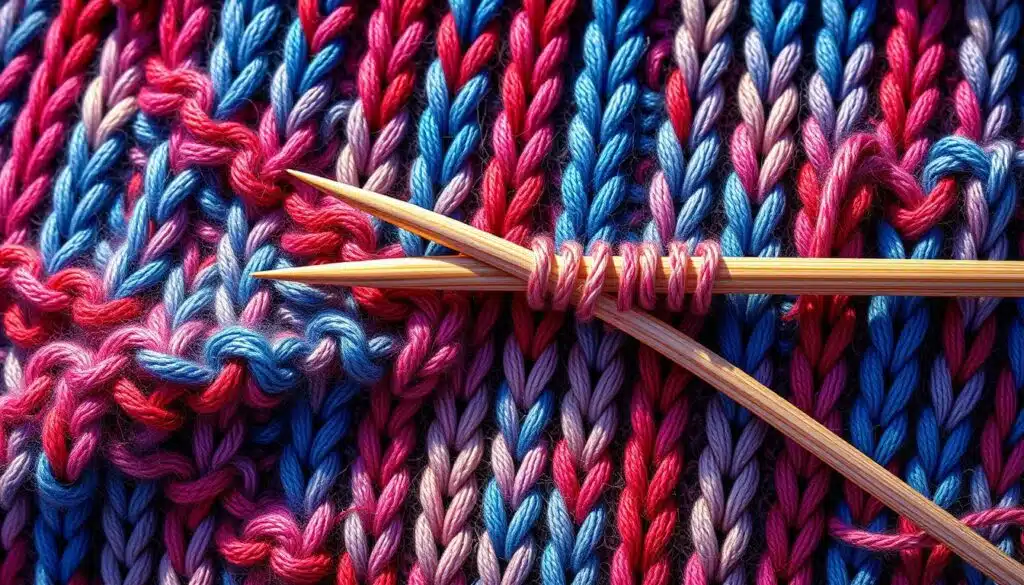
Multi-color knitting brings a new level to your projects. It lets you make designs that pop and are full of detail. Whether you’re new to knitting or have lots of experience, learning multi-color techniques can make your work stand out.
Stripes
Stripes are a great way to make your knitting more interesting. Try different stripe sizes and colors to get unique looks.
Fair Isle Knitting
Fair Isle knitting uses many colors in one row for detailed patterns. To get good at it, practice handling many colors and keeping the tension even.
Managing Colors
To get a smooth fabric, carry the unused yarn loosely up the back. Twist the yarns often to avoid long floats.
Tips for Intarsia Knitting
For a pro finish, weave in ends carefully and keep the tension even.
Shaping Your Projects: Increases and Decreases
Knitting is more than just knit and purl stitches. Knowing increases and decreases is essential. These techniques help you shape your projects perfectly. Whether it’s a garment, accessory, or home decor, they ensure a perfect fit.
Strategic Increases for Perfect Fit
Increases add stitches to your work, helping you shape your projects. There are many methods, each suited for different needs.
Directional Increases: M1L vs. M1R
Directional increases, like M1L (Make One Left) and M1R (Make One Right), add stitches without harming the fabric. For more on these, check this resource.
Invisible Increases for Seamless Shaping
Invisible increases add stitches without showing. This ensures your work looks seamless.
Decrease Techniques and Their Visual Effects
Decreases remove stitches, shaping your project. The type of decrease used can greatly change how it looks.
Left-Leaning vs. Right-Leaning Decreases
Left-leaning and right-leaning decreases slant your work. This creates balanced and symmetrical designs.
Centered Double Decreases for Dramatic Lines
Centered double decreases make dramatic lines in your knitting. They’re great for lace and detailed patterns.
Mastering increases and decreases takes your knitting to the next level. You’ll create projects that are both functional and beautiful.
Reading Patterns Like a Pro
To improve your knitting, you must learn to read patterns well. Patterns are like blueprints for your projects. They show you how to make the fabric you want. Knowing these patterns is key to making your projects look great.
Decoding Knitting Abbreviations and Symbols
Knitting patterns use special abbreviations and symbols. At first, these might seem hard to understand. But once you get them, you can handle even tough patterns easily.
Common Abbreviations Demystified
Knitting patterns use common abbreviations like “knit” (K) and “purl” (P). Knowing these is the first step to understanding patterns. For a full list, check out the Craft Yarn Council’s guide on reading knitting.
- K: Knit
- P: Purl
- rep: Repeat
- inc: Increase
- dec: Decrease
Pattern Repeats and Brackets Explained
Pattern repeats are parts of a pattern you repeat many times. Brackets group stitches together. Knowing how to read these is key to following patterns right.
Chart Reading Made Simple
Chart reading is a must for knitters. Many patterns are shown in chart form. Charts make it easier to follow complex patterns by showing stitches and rows visually.
Translating Symbols into Stitches
Charts use symbols for different stitches. Learning these symbols lets you turn the chart into actual stitches. For example, a blank square is often a knit stitch, and a square with a dot is a purl stitch.
Using chart keepers like magnetic boards or sticky notes helps you stay on track. This is very helpful for patterns with lots of rows or repeats.
By learning knitting abbreviations, symbols, and chart reading, you can tackle many patterns. This will help you make beautiful, professional-looking projects.
Troubleshooting Common Knitting Mishaps
Knitting is a hobby that brings joy and relaxation. Yet, it comes with its own set of challenges. Both new and seasoned knitters often face issues that can be upsetting.
Fixing Dropped Stitches
Dropped stitches are a common problem. But, they can be fixed with the right approach. Use a crochet hook to carefully pull the stitch back up to the needle. This method can rescue your project from disaster.
Dealing with Uneven Tension
Uneven tension can mess up your knitting’s look. To fix this, try blocking your work to even out the tension. Or, tweak your knitting method to keep the tension steady.
| Issue | Solution |
|---|---|
| Dropped Stitches | Use a crochet hook |
| Uneven Tension | Block work or adjust technique |
Advanced Techniques to Elevate Your Knitting
To improve your knitting, learning advanced techniques is key. These skills can turn simple projects into stunning pieces. We’ll cover seamless knitting, short rows, and more to boost your skills.
Seamless Knitting
Seamless knitting lets you make clothes without seams. It saves time and makes garments feel smoother.
Magic Loop vs. DPNs
Choosing between magic loop and double-pointed needles (DPNs) can be tough. Magic loop uses a long circular needle for seamless knitting.
| Method | Description | Best For |
|---|---|---|
| Magic Loop | Using a long circular needle to knit in the round. | Large projects, versatility |
| DPNs | Using multiple double-pointed needles to knit in the round. | Smaller projects, precision |
Short Rows
Short rows help shape your knitting without binding off. They’re great for fitting garments and adding details like pleats.
Using Short Rows Effectively
To master short rows, learn how to avoid holes. Techniques like wrapping and turning are key.
Steeking
Steeking means cutting your fabric to shape it. It needs precision to keep your work intact.
Learning these advanced techniques will elevate your knitting. For more tips, check out our knitting a hat tutorial.
Project Planning: From Inspiration to Completion
Starting your knitting journey? Good project planning is key. It turns your ideas into something real. Whether you’re new or experienced, a solid plan ensures your project is done right and on time.
Swatching: The Step You Shouldn’t Skip
Swatching is a must in project planning. Many knitters overlook it. But, it’s vital for avoiding future problems. It’s all about gauge.
Measuring Gauge Accurately
To get your gauge right, make a big enough swatch. A 4-inch square is a good size. After it’s done, count the stitches per inch to find your gauge.
Blocking Your Swatch for True Results
Blocking your swatch improves your gauge. Wet, stretch, and dry it to see how your project will look. For more tips, check out effective project planning strategies.
Modifications for Perfect Fit and Style
Changing patterns to fit you or your style is important. You might adjust sizes or swap yarns for the look you want.
Adjusting Patterns for Your Body
To fit a pattern to your body, measure yourself and compare to the pattern’s chart. Then, make changes for a perfect fit.
Substituting Yarns Successfully
Swapping yarns needs careful planning. Think about fiber, weight, and color to match your pattern. For winter knitting ideas, visit winter knitting patterns.
Caring for Your Knitted Treasures
Your knitted items are more than clothes; they’re precious treasures. They need care to keep their beauty and last long. Taking good care of them shows your hard work and creativity.
Washing and Blocking for Professional Results
Washing and blocking are key steps for your knitted items. Blocking makes your finished projects look professional.
Wet Blocking vs. Steam Blocking
There are two main blocking methods: wet and steam. Wet blocking soaks your item in water, then reshapes it to dry. Steam blocking uses steam to relax fibers without wetting the item. The choice depends on the yarn and desired look.
Blocking Tools Worth Investing In
To block well, you need special tools. Blocking mats or boards help pin your items. Rust-proof pins prevent damage. These tools greatly improve your blocking.
| Blocking Method | Best For | Tools Needed |
|---|---|---|
| Wet Blocking | Delicate lace, complex patterns | Blocking mats, rust-proof pins |
| Steam Blocking | Thicker yarns, wet-sensitive garments | Steam iron, blocking mats (optional) |
Storage Solutions to Protect Your Work
After cleaning and blocking, proper storage is next. How you store your items affects their life span.
Moth Prevention Strategies
Moths can harm your knitted treasures. Natural repellents like cedar or lavender help. Storing in airtight containers also protects your work.
Folding vs. Hanging Knitted Items
Folding or hanging depends on the garment and its weight. Hanging can stretch some fabrics. Folding might cause creases. Knowing the best storage for your items is key.
| Storage Method | Best For | Tips |
|---|---|---|
| Folding | Most knitted garments | Use acid-free tissue paper to prevent creases |
| Hanging | Heavy or structured garments | Use padded hangers to prevent shoulder distortion |
Conclusion: Weaving Your Knitting Journey Forward
Keep practicing as you move forward in your knitting journey. You’ve learned many techniques, from starting to finishing a project. Remember, patience and persistence are key to mastering knitting.
For more tips and patterns, check out the resources we’ve shared. Joining a knitting community can also offer support and inspiration. To improve your skills, look into advanced techniques and projects. You can find more in our guide, available here.
FAQ
What are the essential tools I need to get started with knitting?
To start knitting, you’ll need a few basic tools. You’ll need knitting needles, yarn, and scissors. A tapestry needle is also useful for weaving in ends. You might also want a measuring tape and stitch markers.
What’s the difference between Continental and English knitting styles?
Continental knitting means holding the yarn in your non-dominant hand. English knitting means holding it in your dominant hand. Try both to see which feels more natural to you.
How do I read a knitting pattern?
To read a knitting pattern, first learn the abbreviations and symbols. Then, follow the instructions step by step. Use the chart or written instructions to guide you.
What’s the best way to cast on stitches?
There are many ways to cast on stitches. You can use the long-tail, knitted, or cable cast-on. Pick the one that suits your project best. Practice until you’re comfortable with it.
How do I fix a dropped stitch?
To fix a dropped stitch, use a crochet hook or spare needle to work it back up. Then, continue knitting as usual. Make sure to tighten the stitch to prevent it from coming loose again.
What’s the best way to care for my knitted items?
To care for your knitted items, wash them in cold water. Block them to shape and store them in a cool, dry place. Avoid machine washing or drying to prevent damage.
How do I swatch for a project?
To swatch for a project, knit a sample with the same yarn and needles. Measure the gauge to ensure it matches the pattern’s requirements.
What’s the difference between Fair Isle and intarsia knitting?
Fair Isle knitting uses multiple colors in a row, carrying the yarn up the work. Intarsia knitting also uses multiple colors in a row but uses a separate yarn for each color.
How do I bind off stitches professionally?
To bind off stitches professionally, use a stretchy method like the elastic or sewn bind-off. This ensures a flexible edge that won’t pucker or distort.