
You enjoy the sound of hook on yarn and the clear pattern of a repeat. Crochet charts make this calm visual. This guide helps you understand symbols, find repeats, and pick the best patterns for clothes, blankets, and colorwork.
Books like “Crochet Every Way Stitch Dictionary” by Dora Ohrenstein and Linda P. Schapper’s collections are favorites. They offer stitch diagrams, written instructions, and photos. This way, you can learn stitches, increases, and decreases without a screen and avoid poor AI patterns.
Charts include basic stitches like slip stitch and double crochet, plus many special ones. Makers like Sarah Maker and Daisy Farm Crafts have clear tutorials. These match what you’ll see in crochet visual patterns.
Mosaic and colorwork get a special mention. The Mosaic Chart Directory has charted samples, photos, and step-by-step guides. This guide will show you how to read symbols, understand direction, and when to make your own charts.
Key Takeaways
- Crochet charts speed pattern reading and show repeats at a glance.
- Stitch books that pair photos, written rows, and charts are priceless.
- Learn common crochet stitch diagrams before tackling specialty stitches.
- Mosaic and colorwork charts help you plan geometric designs visually.
- Create your own charts to adapt stitch patterns to your projects.
Why Crochet Charts Matter for Your Designs
Planning a complex shawl or textured sweater can be tough without a clear guide. Crochet charts offer a detailed map of stitches. This makes visual planning easier, reducing the need for trial and error.
Designers like Dora Ohrenstein use charts with photos to show how stitches work. This helps you quickly see if a pattern will work as expected. It’s a big help in avoiding mistakes and making sure your design turns out right.
Visual planning for complex patterns
Charts are especially useful for patterns with repeats or mosaic colorwork. They let you see the whole design before starting. This way, you can choose the right stitches for your project.
Charts also help you test different stitch combinations before committing to yarn and time. They make swatching and decision-making faster.
How charts speed up pattern reading and reduce mistakes
Charts make it easier to follow complex patterns. They highlight repeats and joins, helping you avoid mistakes. This is especially true for mosaic and tapestry techniques.
Learning chart symbols quickly can make charts a valuable reference while crocheting. For a refresher, check out the chart guide that explains and shows examples.
Charts versus written instructions: when to use each
Written instructions are great for detailed setups and special techniques. Charts are better for showing the overall pattern and how stitches fit together. The best approach is to use both: charts for the big picture and written text for details.
- Benefit: Charts give you fast pattern readability for long repeats.
- Benefit: Written instructions guide tricky starts and finishing moves.
- Tip: Combine both to reduce crochet mistakes and speed construction.
Understanding Crochet Symbols and Chart Conventions
Charts should be easy to understand at first glance. Start by looking at the stitch chart legend. It shows how each symbol relates to a specific stitch. Books by Dora Ohrenstein and Linda Schapper have diagrams and photos to help you match symbols to textures and shapes.
Common symbol glossary: chains, single, double, treble, puff, bobble
Icons for chains and basic stitches are simple. But, puff and bobble stitches have special marks. Symbols like filled ovals, crosses, or tall T shapes represent different stitches.
Learning from trusted sources like Crochet 365 Knit Too, Daisy Farm Crafts, and Heart Hook Home is helpful. Swatching is also key to confirming the texture of a stitch.
Directionality: reading rows, rounds, and mosaic repeats
Charts can be read in different ways. Look at the legend for how to read odd/even rows and round starts. Mosaic charts are different because color blocks and slipped stitches span rows.
Mark right-side rows and note where repeats start and end. Use a removable marker for complex repeats.
Legend, repeats, and how chart scales relate to stitch multiples
A good legend defines stitch height, color blocks, and actions. It shows how one chart cell equals one stitch or part of it. Check for stitch multiples and compare chart units to written counts before starting.
Always swatch the chart to check gauge and stitch multiples. If a pattern lists a multiple of 12, map it to the chart grid. Adjust hook size or tension if needed to match written stitch count.
For a quick guide to common icons, check out this online guide at crochet symbol resources. It helps with faster, more confident chart reading.
Crochet charts for stitch dictionaries and reference books
When a stitch won’t behave, you need quick answers. Good stitch dictionaries and crochet reference books offer charts, photos, and clear notes together. This way, you can see how a pattern grows.
These resources help you judge edge behavior and gauge how textures stack. They also help decide if a stitch fits your project before you swatch dozens of repeats.
How stitch dictionaries and books use charts to explain increases and decreases
Many modern references add increase decrease charts. These charts show row-by-row shaping next to a photographed swatch. Dora Ohrenstein’s Crochet Every Way Stitch Dictionary is a great example.
It pairs straight, increased, and decreased edge variations with clear diagrams. This lets you compare shaping at a glance.
Recommended titles that pair photos, written instructions, and charts
Titles that blend visual and written cues are valuable. The Complete Book of Crochet Stitch Designs and The Complete Book of Crochet Border Designs by Linda P. Schapper are good examples. They include photos, diagrams, and stitch multiples that save time when adapting motifs.
Manuela Laitenberger’s 50 Crochet Cable Stitches books show cable diagrams with overlapping stitch representations. This is useful when reading complex textures. Tanis Galik’s Interlocking Crochet and Brenda K.B. Anderson’s The Hooktionary supply specialized motif charts. Dora Ohrenstein’s The Crocheter’s Skill-Building Workshop covers fundamentals that make chart reading easier.
Why a charted stitch library makes shifting stitch combinations easier
A charted stitch library speeds up design tests. It lets you see how increases change edge angles and how a bobble or cluster alters stitch density. This visual shortcut reduces guesswork when mixing techniques from different books.
Swatching remains essential. Use short swatches to confirm how a motif behaves in your yarn and hook. A small test keeps you from chasing fit issues later. It makes adapting ideas from stitch dictionaries into garments or homewares simpler.
Crochet charts for textured and specialty techniques
Charts are key when working with textured stitches. They make complex patterns easy to follow. You can see the height, placement, and density of the fabric at a glance.
For cables, live loops, and front post bobbles, use arrows and markers. This shows the over-and-under paths. Manuela Laitenberger and Sue Perez have great books on these topics.
Interlocking crochet charts are special because colors and directions change. Tanis Galik’s work uses photos to explain both sides. Converting these into charts makes row ends and color changes clear.
Turning puff, bobble, and crocodile stitches into charts requires standardizing cluster sizes. Note how many loops form the cluster and how it closes. This keeps your fabric even.
Use a clear legend and test symbols for height. Puff and bobble motifs need taller boxes to avoid row collisions. For a quick guide, check crochetcraze.
Make a table to compare symbol sizes and styles for each technique.
| Technique | Key chart notes | Best practice |
|---|---|---|
| Cables and live loops | Use arrows, layer markers, side notes | Photograph both fabric sides and test swatch |
| Interlocking crochet | Color-block notation, clear row boundaries | Chart both passes; label slipped and chained stitches |
| Puff, bobble, crocodile | Scaled symbols, loop counts, closure method | Standardize symbol size and annotate cluster counts |
| Front post bobble chart | Post direction and post height clearly indicated | Note hook insertion side and stitch height |
When you finish charts, add photo callouts for right and wrong sides. This helps others match tension and placement. Good charts make your work look professional.
Crochet charts for colorwork and mosaic designs
You want charts that make colorwork easy and fun. Mosaic and tapestry crochet charts look similar but ask different things. Choosing the right chart saves time and keeps your work neat.
The Hooktionary and other books show why tapestry-style grids are good for pictures. They pair photos with charts, helping you plan your work. Mosaic colorwork, on the other hand, builds patterns across rows using special stitches.
How mosaic crochet charts differ from tapestry or stranded charts
Mosaic charts use blocks and symbols for special stitches. Tapestry charts mark every stitch color because you carry yarns. This makes tapestry charts focus on row colors, while mosaic charts focus on stitch height and placement.
Designing geometric, Aztec, and nature-themed colorwork charts
When designing, pick a repeat unit that matches your gauge. Use color-blocked grids to see scale and contrast. Test swatches to check texture and color blending.
Managing color changes and floats visually on a chart
Label color changes and mark special stitches. Add indicators for float lengths and notes on twisting yarns. A small swatch helps you try managing yarn floats before starting a big project.
| Chart Type | Primary Focus | Best For | Float Handling Notes |
|---|---|---|---|
| mosaic crochet charts | Stitch placement, slipped/tall stitches | Geometric repeats, Aztec panels | Mark slipped stitches; twist color when necessary |
| tapestry crochet charts | Per-stitch color mapping | Pictorial motifs, detailed images | Plan float lengths; carry color along wrong side |
| colorwork chart design (hybrid) | Combine stitch texture and color blocks | Nature-themed scenes with texture | Use legend to show floats and stitch types |
| mosaic colorwork (technique) | Paired-row geometry and contrast | Bold repeats and architectural motifs | Limit floats; document maximum float length |
| Managing yarn floats (guidance) | Practical float control | Any multi-color project | Swatch, twist, and secure at regular intervals |
Crochet charts for garment shaping and edges
Charts help you see how a garment will look before you start. They make it easy to plan out sleeve caps, waist decreases, and raglan lines. You can also use stitch dictionaries to find solutions for shaping.
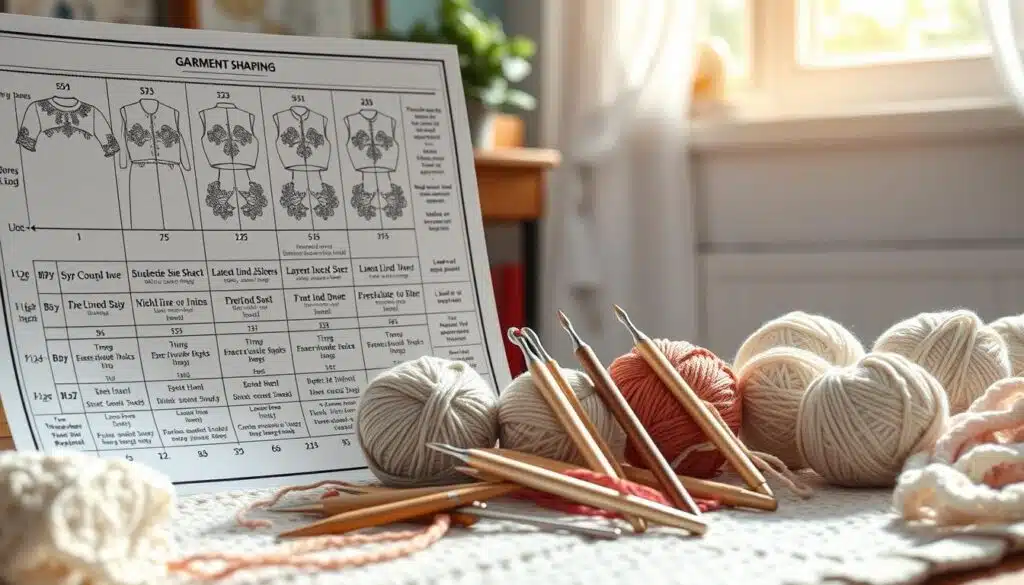
Begin with a small sketch and add increases and decreases as needed. Mark the edge stitches and seam allowances. A quick swatch lets you check your gauge and how the pattern repeats.
Border work needs clear charts too. Choose an edging that fits the fabric’s texture. Crab stitch is good for neat hems, while shell edgings add softness. Lace border charts are perfect for delicate finishes.
Books by Dora Ohrenstein and Linda Schapper offer practical tips. They show how to mix photos, written rows, and charts. This makes it easier to place shaping increases and decreases correctly.
When charting borders, include extra-row previews and clear corner diagrams. Write notes next to tricky rows for slip-stitch joins or extended picots. Photos of finished edges, with lace and crochet charts, help all makers.
Keep a small table of common edge options and their effects. List the stitch density, recommended hook size, and a note on compatibility. This helps you pick the right edging without guessing.
How to create your own crochet charts
Ready to turn written rows into clear visuals? Start with a short plan. Pick a grid that matches your stitch gauge, select a consistent symbol set, and swatch the stitch so each symbol fills the correct cell. This makes it easier when you create crochet charts for garments, motifs, or colorwork.
Choosing the right grid and symbol set
Match cell height and width to your swatch. Narrow stitches like single crochet need slimmer cells. Taller stitches such as treble demand taller cells. Use a standard symbol set for clarity so other crocheters read your work without guessing.
Many stitch books from publishers like Interweave and Stackpole include symbol legends you can emulate. If you prefer hand-drawn crochet charts, keep symbols neat, add consistent spacing, and include a legend that lists stitch height and color codes.
Translating written patterns and stitch dictionaries into chart form
Begin by mapping written rows to the grid. Mark edge stitches and repeats clearly. When translating patterns to charts, note where increases and decreases sit within a repeat and show overlapping cables as stacked symbols.
Use stitch dictionaries as models. Study how authors format diagrams for complex techniques. Swatch each stitch to confirm how it occupies grid spaces before you finalize the chart.
Tools and software, plus paper-and-pencil methods
Pick tools that fit your workflow. Dedicated crochet chart software speeds layout and symbol placement. General tools like Excel or Photoshop work for custom needs. For low-tech charm, draft hand-drawn crochet charts on graph paper, then scan and clean them for publication.
Create a simple workflow: choose symbol sets for crochet, draft the grid to match stitch multiples, mark repeats and edge stitches, add a clear legend, and test by crocheting a swatch. Export high-resolution charts for print and include photos that show both fabric sides when needed.
- Swatch to set grid cell size and check stitch behavior.
- Select a standard symbol set and draw a legend.
- Draft the chart, mark repeats, and note edge stitches.
- Test with a swatch, then refine and export for use.
Reading and troubleshooting charts while you crochet
When you pick up a chart mid-project, start by swatching. A small swatch helps you check the chart gauge, row height, and how repeats stitch together. Swatching before starting a garment saves time and avoids unraveling later.
Reading crochet charts starts with understanding direction. Rows and rounds work differently. Mark the row you are on with a highlighter, sticky tab, or a magnetic chart keeper to keep track.
If a motif looks off, compare the symbol key to a stitch library. This helps you spot any mistakes.
Swatching to check repeats and gauge
Work a repeat at least three times across your swatch. Measure the stitch and row counts against the legend and the pattern’s stated dimensions. If your chart gauge is off, try a different hook or yarn weight and swatch again.
For examples and visual notes, check a trusted guide like this chart-reading primer. It shows how increases and decreases affect edges in stitch dictionaries.
Common chart-reading mistakes and fixes
Chart mistakes often come from misreading directionality, miscounting repeats, or mismatching stitch heights. When you spot an error, frog back to the last confirmed repeat rather than guessing forward. Re-mark repeats and write a brief row note if the chart confuses you.
Colour and mosaic charts can be tricky. Misinterpreting color-change rows causes float issues and uneven tension. For mosaic or colorwork errors, unravel to the last correct color block and rewrite that section in plain text to follow along more easily.
How to adapt charted patterns to your project size
To adapt chart to size, start by identifying the stitch multiple in the legend. Calculate your foundation chain as (multiple × repeats) plus edge stitches. Swatch in the stitch used by the chart to confirm the chart gauge before you change anything.
For garments, map shaping lines from charted repeats and add seam allowances. If increases or decreases on a chart alter the edge, refer to stitch dictionaries and books to find a compatible shaping stitch that preserves the look.
| Problem | Quick Check | Fix |
|---|---|---|
| Directionality confusion | Are row numbers on the right or left? Is it rows or rounds? | Rotate the diagram for left-handed work or re-label rows; highlight odd/even row direction. |
| Repeats miscounted | Do stitch counts match your swatch and the chart legend? | Frog to last correct repeat, re-mark repeat blocks, then rework slowly. |
| Mismatched stitch heights | Does the visual texture match photos or stitch samples? | Swap stitch (e.g., double for treble) or consult stitch dictionary for similar symbol shapes. |
| Colour floats tangled | Are floats long across rows in mosaic or tapestry sections? | Secure floats, carry yarn at regular intervals, or re-chart the colour sequence into rows. |
| Wrong finished measurements | Does your swatch match the pattern’s stated gauge? | Change hook or yarn, or increase/decrease repeats to match desired dimensions. |
Where to find high-quality charted patterns and resources
For reliable charted crochet patterns, look for sources with clear photos, legends, and tested notes. Good books and creator libraries save time and prevent guessing. Choose resources that show swatches and step-by-step photos with their charts. This way, you can match gauge and stitch texture before starting a project.
Books with strong chart support and visual indexes
Find titles that mix visual indexes with charts and written rows. Recommended books include Crochet Every Way Stitch Dictionary by Dora Ohrenstein, The Complete Book of Crochet Stitch Designs by Linda P. Schapper, and The Crocheter’s Skill-Building Workshop by Dora Ohrenstein. For interlocking and mosaic techniques, check Interlocking Crochet by Tanis Galik and cable-focused resources from Manuela Laitenberger and Sue Perez. These books teach stitch behavior and offer tested examples for easy swatching.
Online pattern shops, mosaic directories, and designer libraries
Many designers post charted patterns with photos and downloadable PDFs. Creators like Crochet 365 Knit Too, Daisy Farm Crafts, Heart Hook Home, and Maker bloggers provide clear photo tutorials and stitch references. Yarn companies and magazines, such as Lion Brand and Simply Crochet Magazine, publish patterns with verified charts that work in real projects.
The Mosaic Chart Directory from Les Laines Biscotte compiles 75 mosaic charts with photos and beginner refreshers. It’s a top mosaic pattern directory for geometric colorwork. You can also find curated pattern lists and designer libraries on sites that host community collections. For a consolidated pattern reference, visit a trusted compilation like crochet pattern guides that point to tested sources and visual indexes.
Using charts from trusted sources to avoid AI-generated pattern pitfalls
AI tools can draft patterns fast, but they sometimes miss real-world tension, shaping, or stitch counts. To avoid AI crochet errors, prefer publishers and designers who include photos, clear legends, and written rows beside charts. Rely on established brands and names that publish test-knitted or test-crocheted projects.
If you want extra reassurance, compare a chart against a photo swatch or video tutorial. Maker communities such as Crochettes offer lessons and live challenges where you can see patterns worked up by real hands. Practical habit: cross-check any new chart against a trusted reference, like a stitch dictionary or a recognized tutorial, before starting a large piece. For yarn and beginner guidance that complements chart learning, see a practical resource like yarn guides for beginners.
| Resource Type | Example Titles & Creators | Why it helps |
|---|---|---|
| Stitch dictionaries and technique books | Crochet Every Way Stitch Dictionary; The Crocheter’s Skill-Building Workshop | Detailed stitch diagrams, charts, and swatches for accurate interpretation |
| Specialty technique books | Interlocking Crochet (Tanis Galik); cable guides by Manuela Laitenberger | Focused chart conventions for complex textures and shaping |
| Designer blogs and tutorial sites | Crochet 365 Knit Too; Daisy Farm Crafts; Heart Hook Home | Step-by-step photo tutorials, downloadable charts, and swatch guidance |
| Mosaic and colorwork directories | Les Laines Biscotte’s Mosaic Chart Directory | Curated modern geometric designs with charts and beginner refreshers |
| Community and membership platforms | Crochettes and established designer libraries | Live lessons, challenges, and peer feedback that validate charts |
| Publishers and magazines | Lion Brand, Simply Crochet Magazine | Professionally edited patterns that pair written instructions with charts |
Crochet charts and pattern writing for designers
You want patterns that feel like a friendly teacher, not a secret code. Mixing charts with clear text and photos helps everyone learn. Dora Ohrenstein and Linda Schapper show how to mix charts, text, and images well.
Combining charts, written instructions, and photo tutorials for clarity
Begin each pattern with a quick guide. Explain what the chart shows and where to find written instructions. Include photos for tricky parts.
Formatting charts for publishable patterns and stitch books
Keep legends simple and near the chart. Mark important parts clearly. For print and PDF, use high-res charts and a printed key on the same page.
Tips from experienced designers on presenting cable and interlocking chart techniques
Use different views for cable charts. Include an annotated diagram, a close-up photo, and a one-line cue. Look at Manuela Laitenberger and Sue Perez for tips on live loops and intertwined stitches.
Use a checklist for publishing. Proof charts by crocheting swatches and test patterns with different testers. Include right- and wrong-side photos when needed. Give written row equivalents for everyone.
A short table can help you decide what to include with each pattern.
| Element | Purpose | When to include |
|---|---|---|
| Chart | Visual stitch map for fast pattern reading | Complex repeats, colorwork, cables |
| Written rows | Accessible step-by-step guidance | Beginners, accessibility needs, pattern testers |
| Step photos | Clarifies technique and stitch order | Overlapping stitches, live loops, unusual placements |
| Legend & stitch key | Decodes symbols and abbreviations | Every chart; place near the diagram |
Follow designer tips by keeping your voice consistent. Label the difficulty and explain edge and shaping sequences. This makes your crochet pattern writing better and helps readers feel confident.
Conclusion
A good crochet charts summary is key. It gives you access to reliable stitch libraries by authors like Dora Ohrenstein and others. These books help you avoid the hassle of bad AI patterns and offer valuable photos and diagrams.
They make it easier to decide on your design. Use these resources first for consistent, tested guidance.
Next, build your confidence with swatching. Practice basic stitches like puff and shell. This will help you read and write charts better.
Swatches make mastering crochet charts easier. Before starting a project, test stitch combinations and tensions. This saves you from the trouble of unraveling later.
For colorwork and mosaic projects, check out visual directories like the Mosaic Chart Directory. These resources pair clear charts with photos and notes. This makes complex color repeats easier to manage.
When you mix written steps, photos, and charts, your pattern becomes more accessible. Your next steps should be practical: choose trusted books, swatch well, and combine charts with clear written cues and photos.
If you need a quick refresher on reading patterns, visit how to read crochet patterns without getting lost. Now, go create something amazing—your charts will support you.
FAQ
What makes crochet charts valuable for your designs?
Charts give you a visual roadmap of texture and repeat flow. They show how increases and decreases work in a finished piece. This helps you decide between different stitch patterns quickly.
Charts also reduce mistakes and make color placement obvious. This is especially helpful for mosaic or geometric work.
How do charts speed up pattern reading and reduce mistakes?
Charts condense repeated sequences into visible units. This makes repeats, borders, and symmetry stand out. You’re less likely to miscount rows or lose track of a multiple.
For mosaic or multi-row color motifs, charts show color blocks. This prevents float errors. Use a highlighter or magnetic chart keeper to track position and swatch to confirm the chart matches the stitch height.
When should you use charts versus written instructions?
Use charts for visual planning, complex repeats, and colorwork maps. Use written rows when stepwise setup or nuanced finishing notes are critical. The best approach is to combine both: charts for visual repeats and written notes for tricky row setups.
What are the common symbols I’ll see in crochet charts?
Expect symbols for chain, slip stitch, single/US single (sc), half double (hdc), double (dc), treble (tr), and specialty marks. Cable and front/post actions often use overlapping or stacked icons. Always consult the chart legend because authors vary symbol sets.
How do you read directionality in rows, rounds, and mosaic repeats?
Read odd/right-side rows left-to-right and even/wrong-side rows right-to-left. Rounds are usually read continuously in one direction with a marked start. Mosaic charts often span paired rows of color and must be read with the mosaic convention.
Blocks represent slipped or chained actions across multiple rows. Follow the legend’s row-pair notes carefully.
What should a chart legend include and how do chart scales relate to stitch multiples?
A clear legend defines each symbol, stitch height, and color block meaning. It should list the stitch multiple and show how chart units map to stitch counts. Legends may also note reading direction, repeat markers, and float or carry rules for colorwork.
How do stitch dictionaries and books use charts to explain increases and decreases?
Good stitch books pair diagrams, photos, and written rows to show straight, increased, and decreased edge variations. Charts visualize how shaping changes edge angles and spacing. This lets you preview how a stitch will behave in garments or blankets.
Authors like Dora Ohrenstein and Linda P. Schapper include both written instructions and charted diagrams.
Which books reliably pair photos, written instructions, and charts?
Recommended references include Crochet Every Way Stitch Dictionary (Dora Ohrenstein), The Complete Book of Crochet Stitch Designs and The Complete Book of Crochet Border Designs (Linda P. Schapper), 50 Crochet Cable Stitches (Manuela Laitenberger), Interlocking Crochet (Tanis Galik), The Hooktionary (Brenda K.B. Anderson), and The Crocheter’s Skill‑Building Workshop (Dora Ohrenstein). These titles combine photos, diagrams, and legends that help you translate symbols into real fabric.
Why does a charted stitch library make shifting stitch combinations easier?
A visual library lets you compare stitch heights, texture density, and edge behavior quickly. When mixing a waistcoat panel with a shell border or converting a stitch for a garment, you can match multiples and gauge visually. This makes borrowing shaping solutions easier.
How do you chart cables, live loops, and front post bobbles?
For overlapping techniques, use stacked or overlapped symbols and add arrows or layer markers showing stitch order. Note how many loops form a cluster for bobbles/puffs. Include photos of both fabric sides for live‑loop cables.
Always define the sequence in the legend so a crocheter knows which post to work around first.
How are interlocking crochet and mosaic techniques represented on charts?
Interlocking crochet is often shown with color-reversal illustrations or dual grids showing both sides. Some books use written-only instructions augmented by photos. Mosaic charts use color-blocked grids indicating slipped and chained stitches across paired rows.
Legends must label stitch heights and slipped actions so the chart reads like a color map rather than a stranded chart.
How do you translate puff, bobble, and crocodile stitches into readable symbols?
Standardize cluster symbols and annotate how many loops are pulled and how the cluster closes. Use a consistent icon size and add a short written note in the legend: number of loops, hook action, and closing method. Whenever technique alters the back appearance, include a photograph of the wrong side.
How do mosaic crochet charts differ from tapestry or stranded charts?
Mosaic crochet builds patterns with chains and varying stitch heights, not by carrying multiple yarns across the row. Charts show solid color blocks and slipped-stitch markers instead of float lines. You’ll read some mosaic charts in paired-row logic rather than per single row, so pay close attention to the legend’s row-pair instructions.
How do you design geometric, Aztec, or nature-themed colorwork charts?
Start with a repeat unit that matches your gauge, use a color-blocked grid to map contrast and silhouette, and choose a stitch multiple that fits the motif. Swatch motifs at the chosen gauge to confirm scale. For motifs with diagonal geometry (C2C-style) or Aztec repeats, plan border units and seam allowances so the pattern sits cleanly on garment panels.
How should charts show color changes and floats to manage yarn visually?
Label color changes clearly in the legend, mark maximum float lengths, and show where to twist yarns or carry color on the wrong side. Use color-block cells for mosaic charts and include written notes on float management—especially important for mosaic vs tapestry techniques to avoid unnecessary yarn carrying.
How do you chart increases, decreases, and shaping lines for garments?
Charts let you map how a stitch repeat behaves near edges. By drawing shaping lines on the chart and comparing straight vs increased edge motifs, you can plan armhole, neckline, and sleeve shaping visually. This lets you adjust multiples before touching yarn.
Many stitch dictionaries show increased/decreased edge variations specifically for this purpose.
What’s the best way to chart borders and lace edgings for finished pieces?
Use a separate, scaled grid for the border showing corner treatments and edge stitch counts. Pair the chart with step-by-step written rows for corners. Include photos of the border in context so crocheters can compare edge look and confirm gauge before attaching to garments or store-bought items.
Can you give examples of border books that combine photos, written rows, and charts?
Linda P. Schapper’s Complete Book of Crochet Border Designs is a prime example. It pairs diagrams, photos, and written instructions that show how borders behave on finished edges. This visual + written combination makes adapting borders to blankets and garments straightforward.
How do you choose the right grid and symbol set when creating your own charts?
Pick a grid cell size that matches your stitch height-to-width ratio (test by swatching) and select a standard symbol set used in reliable references. Keep symbol shapes distinct, include stitch-height notes in the legend, and use color coding for mosaic or tapestry charts. Consistency is the key to readable charts.
What’s the process for translating written patterns and stitch dictionaries into chart form?
Determine the stitch multiple and swatch to confirm cell mapping. Map each written stitch to a symbol, place edge and repeat markers, and draft the chart on graph paper or software. Add a legend, test by crocheting the charted swatch, and revise symbol spacing or grid scale as needed.
Which tools and software are useful versus paper-and-pencil methods?
Spreadsheet programs, stitch-chart software, and raster editors work well for publishable charts; graph paper and pencil remain excellent for initial drafts and fast iteration. Export high-resolution PDFs for publication and include accompanying photos of swatches and both fabric sides when the technique affects the back.
How do you swatch a chart to check gauge and repeats?
Crochet a swatch large enough to contain a full repeat plus edge stitches. Measure stitch and row gauge, check fabric drape and stitch density, and confirm how increases/decreases change edge angles. If the swatch doesn’t match intended scale, adjust hook size, yarn, or chart grid mapping.
What are common chart-reading mistakes and how do you fix them?
Common problems are misreading directionality, miscounting repeats, and mismatching stitch heights. Fixes: re-mark the chart rows, translate a tricky segment into written row notes, frog to the last correct repeat, or swatch again with clearer legend annotations. For mosaic charts, double-check paired-row logic to avoid float issues.
How do you adapt charted stitch patterns to your project size?
Calculate the pattern multiple from the legend, add edge or border stitches, and adjust the foundation chain accordingly. Swatch to confirm gauge, then scale repeats to match garment panels or blanket dimensions. For shaping, map chart repeats onto garment pieces and include seam allowances and extra rows for ease.
Which books and online resources offer high-quality charted patterns?
Trusted books include works by Dora Ohrenstein, Linda P. Schapper, Manuela Laitenberger, Tanis Galik, Brenda K.B. Anderson, and Sue Perez. Online, look to Mosaic Chart Directory (Les Laines Biscotte) for mosaics and creators such as Crochet 365 Knit Too, Daisy Farm Crafts, Heart Hook Home, and The Spruce Crafts for tutorials and swatch photos. Prefer sources that pair charts with photos and written instructions.
How do you avoid low-quality or AI-generated chart patterns?
Favor tested patterns from reputable publishers and established designers. Check for swatch photos, clear legends, both-side fabric images for techniques that affect the wrong side, and multiple tester feedback. Books and directories that include step photography and technique refreshers are safer bets than anonymous, unvetted uploads.
How should designers combine charts, written instructions, and photo tutorials for clarity?
Provide a chart for the visual repeat, written row equivalents for tricky setup or row pairs, and step-by-step photos for any technique that alters the back (cables, live loops, interlocking). Include a full legend, note stitch heights, mark repeats and borders, and offer downloadable high-res PDFs alongside sample swatches to proof the chart.
What formatting tips help make charts publishable in stitch books and patterns?
Use consistent symbol sets, clear repeat markers, readable grid scales, and a nearby printed legend. Include difficulty levels, corner and shaping examples, and at least one photographed swatch. For cables and interlocking techniques, show overlapping diagrams and both-side photos to reduce confusion.
What tips do experienced designers give for presenting cable and interlocking chart techniques?
Break overlapping sequences into numbered steps, add arrows showing stitch order, and include side-by-side photos of each stage. Test all diagrams with real swatches, have multiple testers try the chart, and offer written row equivalents for accessibility. Clear legends and sequence arrows save readers from guesswork.
Where can you find mosaic directories and curated stitch libraries?
Mosaic Chart Directory (Les Laines Biscotte) compiles dozens of mosaic designs with charts, photos, and written instructions. Stitch libraries and motif books like The Hooktionary offer compact charted motifs. Also check reputable pattern shops and established designers’ libraries for curated, tested chart collections.
How should you proof charts before publishing or using them in a project?
Crochet a test swatch from the chart, have one or more testers follow the chart only, and compare the charted swatch to a written-row equivalent. Verify edge treatments, corner behavior, and colorwork floats. Include photos of right and wrong sides when technique affects the back and revise legends for any unclear symbols.