Want perfect stitches? Measuring a gauge swatch in the round is the key. It stops the guessing game and ensures a perfect fit. Ever made a sweater that grew or a sleeve that puckered? It was probably because you used a flat swatch instead of a circular one.
Discover why in-the-round swatching is essential. Learn simple tricks from Elizabeth Zimmerman’s I-cord ideas to magic loop and small-tube methods. These can save you from costly rework.
This article teaches you to measure gauge in the round for a perfect fit. You’ll learn how to choose yarn and needles. Plus, you’ll discover three swatching techniques: I-cord/RS-only, small tube with magic loop or DPNs, and a large-circumference tube.
Find out when to block, how to measure, and how to fix tight small-circumference tension. By the end, you’ll know how to create a reliable circular gauge. You’ll also learn how to record it for future projects.
Key Takeaways
- Swatching flat can mislead you; circular gauge reflects real project tension.
- Measure gauge in the round to avoid sizing disasters in sleeves and bodies.
- Try I-cord, magic loop, or a large tube to match your pattern’s circumference.
- Block and measure consistently; note needle material and stitch pattern.
- Record needle size, yarn, and circular gauge so you can reuse the result later.
Why swatching matters for circular knitting
Before starting a sweater or hat, take a minute to think about swatching in the round. A small swatch saves time, yarn, and your pride. It lets you see how your yarn works when knitting all rounds, giving you a true project feel.
How gauge affects fit and finished measurements
Gauge is not just a number; it affects your project’s fit. Even small changes in gauge can alter the size of your sweater or hat. This can make your project too small or too big.
Matching gauge before you start ensures your project fits right. This saves you from ripping out your work and wasting expensive yarn.
Differences between flat and in-the-round stockinette
Flat stockinette alternates knit and purl rows. In-the-round stockinette is all knit. Many knitters knit and purl differently, affecting the fabric’s size and feel.
Patterns by Ysolda Teague and Purl Soho often highlight this. Using needles that worked for flat swatches might not work for in-the-round. Test both methods, like for sleeves or mitts, to avoid issues.
Common sizing disasters avoided by proper swatching
Swatching prevents common sizing problems in knitting. Skipping a swatch can lead to mismatched sleeves and body. Tight sleeves often come from tension on small needles.
A good swatch helps you pick the right needle size for sleeves and body. This ensures your project fits well, avoiding reknitting and wasted yarn.
For a guide on basic gauge swatches, check out this primer at knitting gauge swatch. It’s a quick reference for testing needles, yarn, and methods.
| Issue | Cause | Swatch fix |
|---|---|---|
| Sleeve too tight | Small-circumference tension on DPNs or magic loop | Swatch sleeves in the round; try larger needle for cuffs |
| Body too large | Flat swatch shows looser knit than round work | Swatch in-the-round to confirm gauge and adjust needle size |
| Inconsistent drape | Different stitch tension between knit and purl rows | Compare flat vs round stockinette to choose best needle |
| Wasted yarn | Skipping a round swatch and misgauging early | Make a small tube swatch to avoid reknitting and excess use |
Preparing to knit a gauge swatch in the round
Before starting, decide on the yarn and needles. If possible, use the same yarn as your project. This ensures accurate results. Brands like Brooklyn Tweed Loft are good choices.
Choosing the right yarn and needles for your project
Needle choice is key. Use the same material as your project. This includes wood, metal, or carbon. Remember the needle size and material for later.
Deciding how many stitches and rows to swatch
Think of your swatch as a measurement square. Cast on about 30 stitches for a 4″ gauge. This size helps avoid edge distortion.
Make your swatch tall, around 6″. This way, you can ignore the first and last inch. A bigger swatch is safer and more accurate.
Wondering how big to swatch? Bigger is better. Count stitches in the middle for accuracy. Measure multiple rows to average out variations.
Noting needle material and stitch pattern for accurate comparison
Record everything: needle size, material, stitch pattern, and if swatched in the round. Use a yarn scrap or knot for easy reference. Note any textured stitches for future comparisons.
For a practical guide on circular swatching, visit Purl Soho’s circular swatching guide. It offers a simple method for in-the-round stockinette. It also explains how to measure true circular gauge.
Techniques to swatch in the round
Before you start knitting, learn about three key methods. Each one offers a different balance of speed, reuse, and realism. Choose the one that fits your project and your patience.
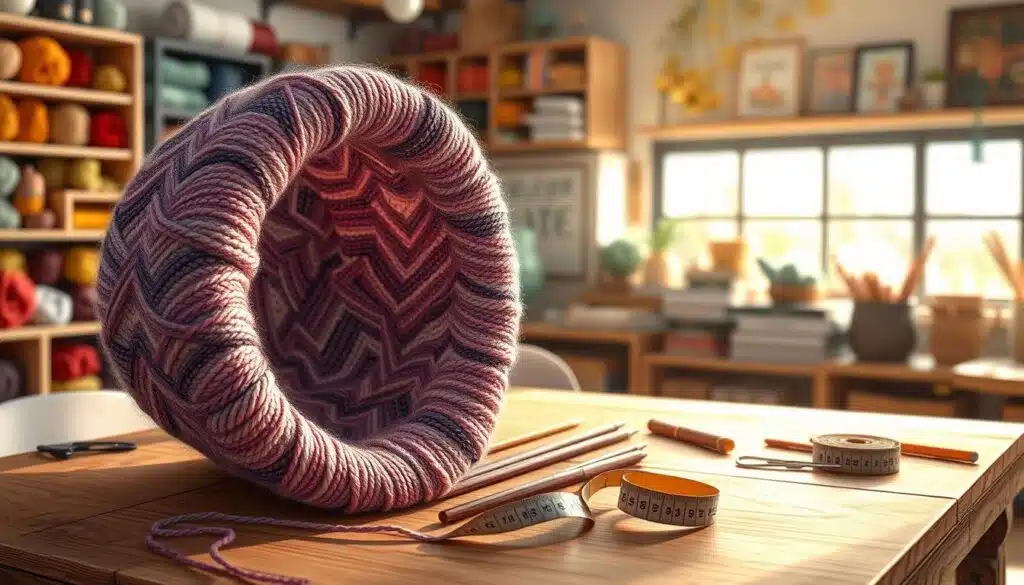
Small tube method with magic loop or DPNs
Start by casting on about 6 inches of stitches. Then, join them and knit in the round until the tube is 6 inches tall. After binding off, cut the tube open to block it flat. This method gives a quick look at stitch density.
Pros: It’s easy and fast. Cons: Magic loop or DPNs can make the swatch tighter than the actual project. Also, you can’t reuse the yarn because you cut the tube.
For a quick guide on magic loop, check out magic loop knitting. It has tips on controlling tension.
Working RS-only rows without joining (I-cord style)
Cast on to a circular needle but don’t join. Knit every row as a right-side row. Slide the stitches along and let the yarn strand loosely across the back. This method mimics in-the-round tension without a tube.
Pros: It captures in-the-round tension and is reusable. Cons: Edges are sloppy, and stitches at the start and end might be loose. This makes measurements near the edge unreliable.
Large-circumference tube to mimic full project tension
Use a 16″ or 24″ circular needle. Cast on enough stitches for a wide tube. Knit until you have a swatch big enough to measure comfortably. This swatch gives the most accurate sense of your tension.
Pros: It avoids tightness from small-circumference swatches. Ysolda and other designers recommend it for accurate gauge checks. Cons: It takes more time and yarn.
| Method | Ease | Accuracy for in-the-round tension | Yarn reuse | Common drawback |
|---|---|---|---|---|
| Small tube (magic loop/DPNs) | High | Moderate | No | Tightening on small circumference |
| RS-only swatch (I-cord style) | High | Good | Yes | Sloppy edges affect measurements |
| Large tube swatch (16″ or 24″) | Low | Best | Yes | Time and yarn intensive |
Use these swatching techniques as needed for your project. A magic loop swatch is quick for stitch count. An RS-only swatch lets you reuse yarn. A large tube swatch is best for garments where fit is critical.
How to make an I-cord style swatch for circular gauge
Want a quick way to test your round knitting? An I-cord swatch is perfect. It shows how your knitting will look without the hassle of tiny needles. Follow this guide for a simple RS-only swatch that many knitters love.
Cast-on, optional garter edging, and sliding stitches technique
Cast on the needed stitches on circular or double-pointed needles. Add a few rows of garter stitch for stability. Then, slide stitches to the other needle instead of turning. Knit back across to mimic the I-cord feel.
Leaving loose loops or strands across the back and when to cut
Move the yarn from left to right to create a loop on the back each row. You can leave these strands or cut them for a flat swatch. Cutting might use extra yarn, and slippery fibers like cotton might lose stitches.
Why Elizabeth Zimmerman’s messy I-cord trick works for many knitters
Elizabeth Zimmerman’s I-cord trick is popular because it feels like real in-the-round knitting. Knitters often knit and purl differently. A RS-only swatch feels more like sleeves, yokes, and hats than a flat swatch. The messy back doesn’t affect the stitch gauge, making it a great fit test.
Try an I-cord swatch before making a full garment. It gives you a true gauge and saves time and trouble when shaping.
Practical tips for measuring your swatch
You want a reliable number, not a guess. Start by treating the swatch like the finished garment. This helps you decide whether to block or measure it as-is.
Blocking: when and how to prep the fabric
Wet block if your pattern calls for it. Pin the piece to the intended dimensions and let it dry fully. Steam-block if the fiber tolerates heat, using a pressing cloth and light pressure.
If you used a small tube method with waste yarn, you can wet block without cutting. Slip stitches back onto needles after drying to check fit. This keeps your yarn intact while you confirm measure gauge.
Cutting open a tube versus measuring it intact
Cut swatch when you need a flat piece for precise counting. Many woolen yarns behave well when cut. You trade off convenience for the loss of the yarn.
Leave the tube intact if the fiber is slippery or the project yarn is precious. Use waste yarn or long strands to flatten the tube temporarily. This lets you measure rows and stitches without risking dropped loops.
Where to measure and how to average counts
Avoid the first and last inch of the swatch. Edges pull and stretch differently than the center. Focus on the central area for accurate numbers.
- Mark three separate 4″ (10 cm) zones across the middle.
- Count stitches in each zone and count rows the same way.
- Average the three results to report your measure gauge.
Use a thin needle to separate fuzzy rows when you measure rows and stitches. Record needle size, yarn brand, and method immediately so you can reproduce results later.
| Step | When to use | Pros | Cons |
|---|---|---|---|
| Wet block swatch | Natural fibers and washable blends | Shows final fabric behavior, flattens texture | Time-consuming, needs drying space |
| Steam block only | Heat-tolerant synthetics and superwash wool | Quick, controlled shaping | Risk of shine or flattening texture |
| Cut swatch flat | When precise flat measurement is needed | Easy to count, very accurate | Consumes yarn, risk with slippery fibers |
| Measure tube intact | Precious yarn or slippery stitches | Preserves yarn, avoids dropped stitches | Harder to count, may distort stitch spacing |
| Use waste yarn method | Want to block without cutting | Combines flat results with yarn preservation | Requires extra steps to replace stitches |
Troubleshooting inaccurate circular gauge results
You tried a round swatch and the numbers don’t match your sweater pattern. Don’t panic. Start by checking a few usual suspects so you can get back to knitting with confidence.
Small-circumference tightness from magic loop or DPNs
Short needle tips and cramped loops can make your swatch tighter than the body of the garment. If a tight magic loop or DPNs are giving you a denser fabric, swap to a larger needle or try a large-circumference tube to mimic project tension.
You can also use an I-cord style, right-side-only swatch to avoid the small-circumference effect. Ysolda and designers like Andrea Rangel warn that sleeves often sit tighter, so test the method that matches the way you’ll knit the final piece. For more on swatching in the round, see this practical guide from Ysolda.
Edge distortion from RS-only swatches and how to avoid it
RS-only swatches are great for matching round knitting, but they make messy edges. Those first and last inches will flare or stretch, producing swatch edge distortion that ruins measurements near the sides.
Make your tube wide so you measure the stable center area. Trim or cut center strands to flatten the swatch, but don’t use edge stitches for gauge. If you must measure an uncut tube, ignore the outer two or three stitches on each side.
Fiber-specific issues when cutting or unravelling swatches
Different yarns behave differently when you cut or unwind a swatch. Sticky woolen-spun yarns usually stay put after cutting. Slippery cottons may ladder or drop stitches, creating unraveled yarn issues if you snip them.
If you plan to reuse the yarn, avoid cutting the tube. Measure it as-is or keep long strands. To restore kinky yarn after unravelling, wind it into a loose hank, steam or spritz it, let it dry, then rewind into a tidy ball.
| Problem | Cause | Quick Fix | When to use |
|---|---|---|---|
| Tighter-than-expected gauge | Short needles or tight tension with magic loop/DPNs | Use larger needles, knit a larger tube, or RS-only I-cord swatch | When your swatch shows more sts per inch than the pattern |
| Swatch edge distortion | Right-side-only rows create loose first/last inches | Make wider swatch and measure center; trim or cut center strands | When edge stitches look uneven or skewed |
| Unraveled yarn issues | Slippery fibers or cutting tube edges | Measure tube without cutting; restore yarn with hanking and steaming | When you want to reuse yarn from the swatch |
If you want a step-by-step demonstration or alternative approaches to avoid common pitfalls, check this troubleshooting resource for circular swatches at crochet troubleshooting.
Recording and reusing swatch information for future projects
Make it a habit to jot down swatch details right after you finish. Note the needle size, material, yarn brand and color, stitch pattern, and if it was swatched in the round or flat. If you like, you can write on the swatch itself. Use a contrasting scrap or weave a labeled paper through the cast-on edge.
How to mark needle size, yarn, and pattern on the swatch
Mark needle size with a permanent pen on a small tag or a yarnovers/k2tog marker. This way, you won’t damage the fibers. Andrea Rangel says to mark it right away, as memory can fail even the best knitters. Also, note the stitch pattern and any special edge treatment, and remember if you used bamboo or stainless steel needles.
Reusing yarn from an uncut swatch and how to restore kinky yarn
If the tube is intact, move the live stitches back onto the needle and keep knitting. If you need to unravel, wind the yarn into a loose hank or loop it over a chair. Steam it lightly or spritz with water, then let it dry fully. This will relax the twists and make the yarn smooth again.
Notes to keep for colorwork or stranded projects
Keep track of whether you used stranded patterning, floats length, and which yarn dominated a motif. Stranded work can act differently in the round, so note that choice. Keep a small labeled sample for future comparison. For more tips, check out this stranded colorwork guide.
Store your swatches in a binder or box with labeled envelopes. This makes it easy to find examples when planning a new project. You can reuse swatch yarn if a project changes, or use past samples to guide color dominance and tension without re-swatching.
gauge swatch in the round
Looking for a gauge swatch in the round? You’re in for tips on circular knitting. This includes advice on all-knit rows, magic loop tension, and I-cord tricks. It’s all about getting your stitches right and finding the right content.
Why the exact phrase matters for your knitting and SEO
Using the exact phrase leads you to trusted designers like Ysolda Teague and Andrea Rangel. They offer methods that match in-the-round tension, which is different from flat knitting. If you want patterns and troubleshooting that fit your needs, say the phrase when you search.
Comparing methods and choosing the one that matches your knitting style
Small tube swatches are fast and neat, but some knitters find them tighter on magic loop or DPNs. The RS-only I-cord style shows true in-the-round tension but has messy edges. A large-circumference tube is closer to your project but takes more time and yarn.
To pick a swatching method, think about how you hold your needles and if you can cut the swatch. If you prefer DPNs or magic loop, try both small and large tubes. For clean edges, consider a cut-open swatch after blocking.
Real-world examples: sleeve vs. body swatching and what knitters report
Many knitters notice a difference between sleeve and body gauge. Sleeves, being small, often fit tighter. At Purl Soho, better sleeve fit came from using I-cord or RS-only swatches. Andrea Rangel’s students sometimes adjust needle size between sleeve and body to match tension.
If you see a consistent bias, adjust needle size or choose a swatching method that mirrors your project. Keep track of your results to get a good fit next time. Use SEO-friendly notes to find your past experiments quickly.
Conclusion
Swatch like a grown-up by swatching as you’ll knit the project. Try to match the real working tension. If magic-loop or DPNs pinch, use the I-cord/RS-only method or knit a large tube.
Watch three clear demonstrations on different techniques at three ways to swatch when knitting in the round. This will help you choose the best method for you.
Final swatching tips: cast on at least 1.5× the number of stitches you expect over 4″ (10 cm). Make your swatches tall, around 6″ (15 cm). Block them before measuring the central area.
Measure multiple 4″ sections and average them. Avoid counting edge inches. Mark needle size, yarn, and your method on the swatch.
Keep a note about fiber behavior when you cut or reuse yarn. Some fibers kink or relax and need a gentle steam or soak. This short swatch summary is your insurance policy against frogging a sweater later.
Use Elizabeth Zimmerman’s messy I-cord trick for accuracy without wrestling tiny needles. Or knit the giant tube if patience is your superpower.
FAQ
Why does swatching in the round matter for circular projects?
Swatching in the round is key for perfect stitches. Knit and purl tensions vary among knitters. A flat swatch might mislead you.
In-the-round stockinette, all knit rows, changes stitch and row density. This can affect fit, like sleeves being too tight. Swatching in the round prevents sizing disasters.
How exactly does gauge affect finished measurements?
Gauge affects stitch and row density. A half-stitch difference can scale up across a sweater. This changes bust, sleeve circumference, and hat depth.
Small gauge errors lead to big measurement errors. Proper in-the-round swatching avoids refashioning and yarn waste from brands like Brooklyn Tweed Loft.
What’s the key difference between flat and in-the-round stockinette?
Flat stockinette alternates knit and purl rows. In-the-round stockinette is all knit rows. This changes fabric hand and stitch size.
Purl-soaked edges and tension differences are common when swatching flat but knitting in the round. This can affect drape.
What sizing disasters can proper swatching help me avoid?
Proper swatching prevents sleeve/body mismatch. It avoids tight sleeves from small-circumference tension. It also ensures garments have consistent drape.
Designers and teachers at Purl Soho and Ysolda report that using a flat swatch for a round project can lead to reknitting sleeves or entire sweaters.
How do I choose yarn and needles for a swatch?
Use the same yarn and needle material as your project. Needle material affects tension. Use the same needle size or test adjacent sizes for sleeve vs. body.
Swatch with the brand you plan to use, like Brooklyn Tweed or Cascade. This ensures accurate results.
How many stitches and rows should I swatch?
Cast on at least 1.5× the desired stitch count over 4″ / 10cm. For a 20 sts/4″ target, cast on ~30 stitches. Knit tall—about 6″ / 15cm—so edges don’t skew central measurements.
A wide, tall swatch avoids relying on the distorted first and last inches created by RS-only or I-cord methods.
How do I note needle material and stitch pattern so I don’t forget?
Immediately write needle size, needle material, yarn brand/color, stitch pattern, and swatch method in a notebook or on a tag pinned to the swatch. Tie a small yarn scrap or work a yarn-over marker into the swatch to mark which needle you used. Recording these details prevents the “which needle was that?” panic later.
What is the small tube method with magic loop or DPNs?
Cast on the stitches that match the project’s circumference (about 6″ / 15cm worth), join in the round using magic loop or DPNs, and knit until the tube is ~6″ / 15cm tall. Bind off and either cut open to block flat or measure as a tube. It’s straightforward, but many knitters tighten on small circumferences and get a tighter gauge than they get on the body.
How does the RS-only I-cord (Elizabeth Zimmerman) style swatch work?
Cast on on a circular needle and don’t join. Work every row as a right-side row by sliding stitches to the other end and knitting, leaving the yarn strand loose across the back. This reproduces in-the-round tension without tiny needles. Edges are messy, so make a big swatch and measure the central area.
What is the large-circumference tube method and why use it?
Use a 16″ or 24″ circular needle and cast on enough stitches to create a wide tube that feels like your normal knitting—this avoids the small-circumference tightness from magic loop or DPNs. It’s often the most accurate reflection of project tension but requires more knitting time and yarn.
How do I make an I-cord style swatch step by step?
Cast on the desired number of stitches on a circular needle. Optionally knit a few rows of garter to stabilize the bottom. Instead of turning, slide the work to the other end and knit again so every row is knit-side-facing. Leave the strands across the back loose. Knit until the swatch is tall enough, then block.
When should I leave loose strands or cut the swatch?
Leave loose strands across the back if you might reuse the yarn or you’re using slippery fibers like cotton. Cut the tube open if you want a flat piece for precise measuring and the yarn will hold (sticky wools are usually fine). If you cut, keep extra yarn because cut swatches can’t be rewound into the original skein without some fuss.
Why does Elizabeth Zimmerman’s messy I-cord trick give accurate gauge?
It recreates the all-knit-row tension of in-the-round stockinette without the small-circumference pressure that comes with DPNs or magic loop. The messy strand across the back doesn’t affect internal gauge, so you get a close match to how the finished piece will behave.
When and how should I block a circular swatch?
Block the way you’ll treat the finished garment. Wet-block and pin to size, or steam-block for delicate fibers. If you used a small tube and cut it open, block flat. If you used waste yarn to hold stitches, you can wet-block without cutting and then put stitches back on needles if gauge is correct.
Should I cut open the tube or measure it as-is?
Cutting makes flat measurement easier but sacrifices the yarn. Measuring the tube preserves yarn but can be fiddly. For sticky wools, cutting is usually safe. For slippery yarns, avoid cutting or use waste yarn so you can lay it flat without losing stitches.
Where on the swatch should I measure and how do I average?
Avoid the first and last inch—edges are distorted. Count stitches and rows across several central 4″ / 10cm sections, then average those counts to get stitches-per-inch and rows-per-inch. Use a needle to separate fuzzy rows if needed. Record all numbers with needle size and method.
Why does the exact phrase “gauge swatch in the round” matter?
It pinpoints the task: testing gauge for circular knitting. That phrase pulls up targeted advice—Elizabeth Zimmerman’s I-cord trick, magic loop pitfalls, and recommendations from Purl Soho, Ysolda, and Andrea Rangel—so you get solutions that match round-specific issues instead of generic flat swatch tips.
How do I choose between small tube, RS-only I-cord, and large-circumference methods?
Weigh pros and cons. Small tube is quick but may tighten. RS-only I-cord reproduces in-the-round tension without tiny needles but gives messy edges. Large-circumference tube is the least finicky and often most accurate, though it takes more time and yarn. Match the method to how you hold needles and whether you can afford to cut the swatch yarn.
Are there real-world reports about sleeve vs. body swatching?
Yes. Many knitters report sleeves being tighter than bodies and end up using larger needles for sleeves. Purl Soho, Ysolda, and Andrea Rangel document cases where switching swatch method or needle size fixed fit problems. If you see consistent differences, adjust your needles or swatch method.