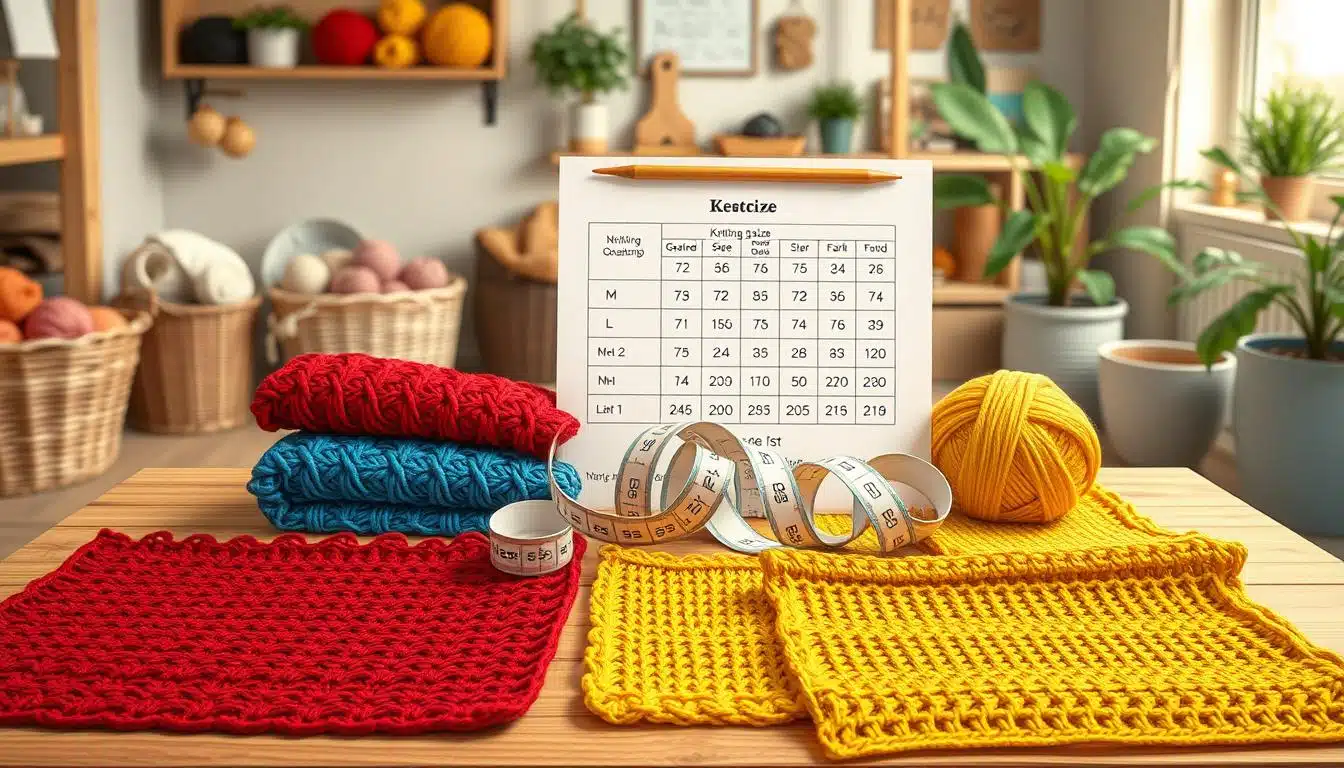
You want your sweater to fit perfectly, like it was made just for you. This guide helps you achieve that by using your body measurements and choosing the right knitting ease. It also includes reliable schematics and the correct gauge for knitting.
Before starting your project, compare the finished garment measurements from the pattern to your own. Look at chest/bust, sleeve length, back waist length, cross back, upper arm, armhole depth, waist, and hip. This helps avoid any surprises.
Good fit in knitting comes from three key things: accurate measuring, choosing the right ease, and a true swatch that matches the pattern’s gauge. Trusted sources like Purl Soho suggest measuring garments you love and keeping an ease worksheet. This helps you remember your preferences.
Key Takeaways
- Use finished garment measurements to compare patterns directly to your body or a favorite sweater.
- Decide on knitting ease before you start — it defines how the garment will drape and feel.
- Make a proper swatch so your gauge for knitting matches the pattern and avoids size surprises.
- Measure chest/bust, waist, hip, and key lengths to choose the right size confidently.
- Refer to schematic drawings in patterns to visualize how measurements map to the finished piece.
knitting size guide
Want your garments to fit perfectly? Start here. This guide shows you how to measure your body and accessories. You’ll learn about ease, gauge swatching, and reading pattern schematics.
What this guide covers
This guide covers essential measurements and why they matter. You’ll learn about body and accessory measurements, ease, and how to read patterns.
- Step-by-step measuring for body and accessories.
- Definitions of negative, zero, and positive ease with recommendations.
- How to read pattern schematics and compare finished measurements.
- Gauge swatching for stitch and row gauge plus simple math to convert stitches to inches.
- Choosing pattern sizes, adjusting length and shaping, and useful tools and worksheets.
For standardized sizing references, check the Craft Yarn Council’s sizing resource.
Why size matters more than you think
Small errors can add up quickly. A small change in stitch gauge can change the circumference of your knit by hundreds of stitches.
For example, a 250-stitch chest can grow from about 47.6″ to 55.5″ with small gauge shifts. Row gauge changes can affect shaping and length in ways you might not notice until you bind off.
Designer-modeled ease may not match your comfort level. Knowing how to read finished measurements and pattern schematics helps you choose the right size for your style and movement needs.
How to use this guide with your favorite patterns
Measure a beloved sweater flat—armpit to armpit—then double that number to get chest width. Record those numbers on an ease worksheet so you can match them to pattern finished measurements.
Compare your body plus preferred ease to the pattern’s finished circumferences. Circle or highlight the chosen sizes on the pattern schematics so you and your future self avoid second-guessing mid-knit.
| Step | Action | Why it matters |
|---|---|---|
| Measure favorite garment | Armpit-to-armpit, lay flat, double for chest | Gives a real-world target to match finished measurements |
| Record body + ease | Write down body measurement and preferred ease on a worksheet | Makes size selection consistent across patterns |
| Check gauge | Swatch for stitch and row gauge, wash and block swatch | Prevents surprises in width and length |
| Use pattern schematics | Highlight chosen size on schematic and note finished measurements | Saves time when shaping or adjusting length |
| Adjust and knit | Alter stitch counts for length or upper-arm changes before starting | Keeps shaping proportional and avoids large rework |
How to take body measurements for knitting
Getting the fit right starts with a few clear measurements. If you learn how to measure for knitting the first time, you’ll save yarn, time, and frustration. Keep a soft tape, wear similar undergarments to what you’ll wear with the finished piece, and ask a friend to help when you can.
Essential measurements: chest/bust, waist, hip
For most patterns, the chest measurement is key. Measure around the fullest part of the bust, tape snug but not tight. Patterns and ease calculations use this measurement as the baseline.
Record the waist and hip measurement for fitted garments. Measure the waist at the natural narrow point just above the belly button. Measure hips at the widest part of the lower hips. Use these when patterns call for waist and hip shaping or for tunics that sit below the waist.
Arm, sleeve, and cross-back measurements for accurate shaping
To get sleeve length measurement right, take center back neck-to-wrist with the arm straight. This helps with sleeve cap shaping and overall sleeve fit.
Measure back waist length from the base of the neck to your natural waist to decide rise and shaping placement. For set-in sleeves and yokes, add a cross-back measurement from shoulder to shoulder across the back.
Check upper arm and armhole depth when patterns specify fitted arms. Measure upper arm around the widest part above the elbow. Measure armhole depth from shoulder edge down to the armpit.
Head, hand, and sock measurements for accessories
Hat fit depends on head circumference knit hats size. Measure around the forehead where the hat will sit; keep the tape snug for accurate fit.
For gloves and mitts, measure hand circumference around the palm excluding the thumb, wrist circumference, and hand length from wrist to the tip of the middle finger.
Get precise sock measurements by recording foot circumference at the widest part, total foot length from heel to longest toe, and sock height from the turn of heel to the top. Good sock measurements stop a floppy cuff and a riding-down heel.
Tips for measuring yourself versus measuring a garment you love
Having a helper improves accuracy, specially for chest measurement and cross-back. If you must self-measure, use a mirror and re-check numbers twice.
Measuring a favorite garment gives an easy template. Lay the item flat and measure armpit-to-armpit, then double that for chest. Do the same for waist and hip widths. Compare those finished garment numbers to your body measurements to choose the best ease for the design.
If you want more guidance on standards and grading for knitwear designers, see this practical sizing chart and explanations sizing reference for knitwear. It follows common craft yarn council conventions and offers metric and inch guidance for grading patterns.
Understanding ease: positive, zero, and negative
Ease is a simple math problem that affects how clothes fit and feel. It’s the difference between the garment’s size and your body’s size. Knowing this lets you pick the perfect fit for your next knitting project.
What positive ease looks and feels like
Positive ease gives you room to move. A classic sweater might have 2″–4″ of extra space. For a looser fit, go for 4″–6″. And for something really big, choose more than 6″.
Positive ease is great for big, comfy cardigans or pullovers. Use soft yarns like Malabrigo or Brooklyn Tweed. This makes your project cozy and easy to wear.
When zero ease is the right choice
Zero ease means your garment fits you like a glove. It’s perfect for tees, cropped tops, or fitted cardigans. This style hugs your body closely.
For a sleek look, choose light yarns like Rowan Cotton or Cascade 220 Sport. Zero ease keeps your garment looking neat and intentional.
Negative ease: when snug is the goal
Negative ease makes your garment smaller than your body. It stretches to fit. Use it for tight-fitting knits like ribbed sweaters or fitted hats.
Negative ease works best with stretchy yarns. Make sure to test how well your yarn stretches. This is important for keeping your garment in shape.
How to pick ease based on garment type and yarn weight
Think about what you want your garment to do. For something to layer over, choose more positive ease. For a tight top, go for zero ease. And for a snug fit, negative ease is the way to go.
The type of yarn you use affects ease too. Bulky yarns look thick but might not need as much positive ease. This is because they create a thick outer layer.
When picking ease for sweaters, consider the look you want. A chunky yarn might look big but fit closer. So, you might need less positive ease.
For more tips and patterns, check out this guide on inclusive knitting patterns.
| Fit Type | Ease Range (inches) | Ideal Uses | Yarn Weight Notes |
|---|---|---|---|
| Negative Ease | -2″ to -4″ | Fitted sweaters, hats, socks | Works best with elastic or ribbed fabric; bulky yarns may reduce required negative ease |
| Zero Ease | 0″ | Tees, cropped tops, body-skimming cardigans | Light to sport weight yarns keep silhouette neat |
| Classic Positive | +2″ to +4″ | Everyday sweaters, relaxed cardigans | Worsted and DK give predictable drape |
| Loose Positive | +4″ to +6″ | Slouchy pullovers, roomy layers | Choose drapey fibers like alpaca blends for best effect |
| Oversized | +6″ and up | Trend-driven oversized sweaters and coats | Bulky yarns create volume; adjust positive ease to avoid excessive bulk |
Using schematics and finished garment measurements
Schematics are like a quick guide that saves time and confusion. They show how to build the garment, the shape of the sleeves, and exact sizes for each size. Before starting, look at the drawing to see if it’s knitted flat or in the round and where to start shaping.
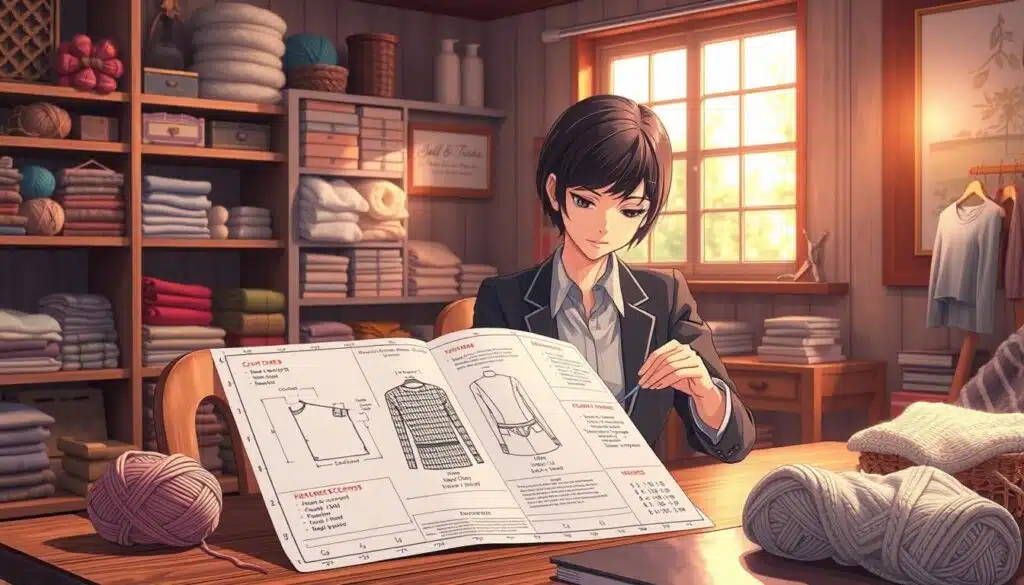
First, match the finished garment measurements to your body and favorite sweaters. Look for chest circumference, back waist length, hip length, and sleeve length on the diagram. Add your preferred ease to your measurements, then compare them to the schematic. This is key to choosing the right size.
Want a quick check? If a pattern says “to fit actual chest 32–34 inches with 4–6 inches of ease” and shows a finished chest of 38–40 inches, choose the size that gives you the desired ease. This way, you avoid math mistakes during knitting.
Measuring a favorite sweater makes things easier. Lay it flat, measure from armpit to armpit and double it for chest. Do the same for waist and hip widths. Compare these measurements to the pattern schematic to ensure a good fit. This method is often better than using body tape alone.
Use a highlighter or pen to mark the size numbers on the drawing you plan to knit. Circle the finished chest, length, and sleeve numbers to stay focused during knitting. This simple trick helps avoid mistakes with schematics.
If you need more clarity, treat the pattern schematics guide like a checklist. Note the finished chest circumference, overall length, sleeve cap, and underarm depths. Then, check off each item against your measurements. This method turns complex charts into a practical guide for a sweater that fits perfectly.
Gauge: the make-or-break step
Gauge is key to getting the right fit. It measures stitches and rows to ensure your sweater fits perfectly. Before starting, make a swatch carefully. This step can save you hours of redoing your work.
Stitch gauge versus row gauge — why both matter
Stitch gauge affects the width of your garment. It determines the circumference and how many repeats you need for sleeves or the chest. Row gauge, on the other hand, controls the height. It affects waist shaping, armholes, yokes, and sleeve length. Both are important for achieving the right fit.
How small gauge differences translate to big size changes
Even small gauge changes can make a big difference. For example, a pattern with 250 stitches at 5 sts/in results in a 50″ chest. But if your stitch gauge is 5.25 sts/in, the chest size drops to 47.6″. Going to 4.5 sts/in increases it to about 55.5″. A small change in gauge can affect your fit by inches.
Row gauge changes have the same impact vertically. If you miss the row gauge, your waist or armhole will be off. This can change the look and feel of your garment more than you think.
What to do if your swatch gauge doesn’t match the pattern
Start by adjusting your needles. Use larger needles for fewer stitches per inch, and smaller needles for more. Try the yarn suggested in the pattern if possible. You can also change your tension to tighten or loosen your stitches.
If needles and yarn don’t solve the problem, recalculate. Multiply your desired finished inches by your stitch gauge to find the target stitch count. Choose the nearest pattern size or adjust the shaping to match that count.
Here are some swatch tips: work the same stitch pattern as the garment, make a swatch at least 6″ square, and block it like the finished piece. Record both stitch gauge and row gauge per 4 inches for accurate comparison. For more troubleshooting help, check out crochet troubleshooting.
| Issue | Quick fix | When to recalc |
|---|---|---|
| Tighter stitch gauge than pattern | Use larger needles, relax tension, try listed yarn | If stitches remain denser after needle change |
| Looser stitch gauge than pattern | Use smaller needles, pull yarn firmer, try a firmer yarn | If fabric stays too open for shaping |
| Row gauge off (too many rows) | Use larger needles for taller rows or change yarn weight | If armhole and waist placement shift noticeably |
| Row gauge off (too few rows) | Use smaller needles for shorter rows or adjust pattern lengths | If desired body length misaligns with shaping |
| Swatch is mismatched | Recalculate target stitch count to fix gauge mismatch | When you prefer your yarn or needle choice over pattern yarn |
Choosing a pattern size: combining measurements, ease, and gauge
Choosing the right size is like solving a math problem with yarn. First, get three things: your body measurement, how much ease you want, and a good swatch. These three things help you pick the right knitting pattern size without guessing.
How to add your preferred ease to your chest measurement
Measure your chest at its widest point. Choose whether you want less, the same, or more ease. Add your body measurement to the ease you prefer. For instance, a 45″ chest plus 5″ of positive ease equals a 50″ target circumference.
Look for a pattern size whose finished chest matches your target. This ensures a good fit.
When to size up or down for bulky yarns
Bulky yarn makes fabric thicker, changing how it fits. You might need to size up for comfort or reduce positive ease to avoid a boxy look.
If you love the yarn, check your swatch gauge. Adjust the finished circumference instead of forcing the pattern gauge. This approach helps when sizing bulky yarn is key.
Using a favorite sweater as a sizing template
Measure a well-fitting sweater from armpit to armpit. Double that number for the finished chest. If the sweater’s weight matches your yarn, use it as a template.
Use this measurement as a check against your body plus ease calculation. It helps confirm your target size.
If your swatch gauge is different but you like the fabric, calculate stitches for your desired circumference. Multiply stitch gauge by target inches. Choose the pattern size with the closest chest stitch count. Follow its shaping and lengths for the best fit.
Adjusting patterns for length and shape
Want clothes that fit perfectly? Plan your changes before starting. First, check your row gauge and the pattern’s measurements. Small tweaks can change waist shape, sleeve length, and more.
Altering body length, back waist length, and tunic length
Measure from your neck to your natural waist for back waist length. Use this number and your row gauge to adjust rows. This ensures waist shaping is just right.
For tunics, add about 11″/28cm from the waist. Kids’ tunics drop about 2″/5cm. Men’s garments might only need 1–2″ change from back hip length.
Modifying sleeve length and upper-arm circumference
Measure your arm from armpit to wrist. Use this measurement and your row gauge to adjust rows. This changes sleeve length.
To change upper-arm size, adjust stitch counts above the elbow. Make sure these changes match sleeve cap and armhole shaping.
How changes can affect shaping and appearance
Changing pattern length or stitch counts may require new math for shaping. Adjusting back waist length moves darts and waist shaping. These changes can affect how the garment looks, so test on a swatch.
Keep a list of your math. This helps you reverse-engineer the pattern later or apply changes to other projects.
Special considerations by garment type and yarn weight
You want your garments to look like you planned them, not the other way around. Think about how fabric drape and stitch texture affect a sweater’s look. For a classic sweater fit, aim for 2″–4″ of positive ease.
If you like oversized styles, add 4″ or more. This helps prevent lace and soft fibers from losing their shape.
Cardigans look different depending on how you wear them. Decide if you want a buttoned, close-worn fit or a relaxed, open drape. A smaller finished circumference works better for buttoned styles.
For open-front looks, add extra positive ease. This lets the fabric fall and flatter your silhouette.
Hats and small pieces need a different approach. Use negative ease for hat sizing to keep them snug. Measure head circumference and subtract 2″–4″ based on rib elasticity and yarn spring.
The same logic applies to socks and gloves. Design negative ease to match rib bounce and wearer comfort for a reliable fit.
Chunky yarns change the game. Bulky yarns mean the finished fabric takes up more room on the outside. Thick stitches can make the interior feel smaller.
Choose either less positive ease or a larger finished circumference to preserve the intended internal space.
Swatching is key. Make a fabric sample in your chosen stitch and compare it to a tape-measured sweater or mannequin. Note how drape, density, and exterior bulk affect measurements. This comparison helps keep your finished piece close to your vision.
| Garment | Recommended Ease | Key Adjustment | Why it matters |
|---|---|---|---|
| Sweater (classic) | +2″ to +4″ | Pick drapier yarn for flow; reduce ease for dense stitch | Balances comfort with shape and stitch visibility |
| Sweater (oversized) | +4″ or more | Use soft, open fibers or lace for better hang | Prevents bulky collapse and keeps silhouette intentional |
| Cardigan (buttoned) | +0″ to +3″ | Fit for layers; test button closure on swatch | Ensures wearable closure without gaping |
| Cardigan (open) | +3″ or more | Allow extra positive ease for drape | Creates flattering front fall and movement |
| Hat | -2″ to -4″ | Match rib elasticity and head shape | Keeps hat secure and comfortable |
| Socks & Gloves | -5% to -10% of circumference | Consider foot/hand anatomy and stretch | Prevents sagging while allowing movement |
| Bulky projects | Reduce listed positive ease or up size | Swatch for inside vs outside circumference | Accounts for lost interior space in thick fabric |
Tools, worksheets, and swatch strategies
Begin with a simple ease worksheet for knitting. Write down your body measurements and details from your favorite sweaters. Note the chest, waist, and hip widths, and any shaping.
Ease worksheet: record your measurements and favorite garments
Use a printable worksheet to compare garments and target ease. Note your preferred ease for each measurement. This helps you choose the right size quickly, whether shopping patterns or swapping yarn brands like Lion Brand or Berroco.
For loop yarn projects, charts and downloads from Ilovemyblanketshop are useful. They provide loop counts and swatch sizes specific to your yarn. Follow a short guide to get worksheets and conversion charts that match your yarn.
How to swatch for both stitch and row gauge
Knitting a proper swatch prevents pattern panic. Make it at least 6″ x 6″. Use the garment stitch pattern and block it as planned. Count stitches across 4″ and rows per 4″ in the center to avoid edge distortion.
If you work cables or lace, swatch the full repeat. This ensures cables settle and lace opens properly. This extra effort improves fit and saves you from reknitting sleeves later.
Simple calculations to convert stitches to finished inches
Once you have stitch and row numbers, you can quickly calculate sizes. To calculate stitches per inch, divide stitches counted over your measured width by that width. Use this rate to convert stitches to inches or to figure required cast-on counts.
| Task | Formula | Example |
|---|---|---|
| Calculate stitches per inch | Stitches counted ÷ inches measured | 18 sts ÷ 4″ = 4.5 sts/in |
| Convert stitches to inches | Stitch count ÷ sts per inch | 225 sts ÷ 4.5 sts/in = 50″ |
| Convert inches to stitches | Desired inches × sts per inch | 50″ × 4.5 sts/in = 225 sts |
| Rows needed for length | Desired inches × rows per inch | 10″ × 7 rows/in = 70 rows |
These quick math steps let you adapt patterns without guessing. If a pattern lists 250 stitches and you want to check finished width, divide to convert stitches to inches using your own gauge.
Try the loop yarn worksheets pack for structured downloads. It includes swatch charts, printable graph paper, and stitch coloring pages for planning. This set has multiple swatch sizes for testing 10 x 10 and larger areas for loop yarns.
Keep a small swatch notebook or digital file with your stitch and row gauges per yarn and needle. Knowing how to swatch makes sizing stress-free and confident.
Loop yarn tools and charts and inclusive pattern resources can speed up the process when you need brand-specific data or charting help.
Conclusion
Fit is all about measuring right, knowing your comfort level, and checking your gauge. Start by measuring yourself and a sweater you like. Use a measuring worksheet and always swatch to get your gauge.
Small changes in gauge can make a big difference in size. So, adjust your needles, yarn, or pattern if needed.
Think of schematics as your guide. Mark the size you want to knit and check the finished measurements against your body. Remember, bulky yarns make fabric look bigger than it feels.
If you want to change the length or shape, keep your row and stitch counts handy. This way, your adjustments will be smooth.
This guide is all about trusting your measurements, not just pictures. Follow these tips to find the perfect fit. Use our needle-size chart for quick checks and explore inclusive patterns to grow your skills.
FAQ
What does this knitting size guide cover?
This guide helps you measure your body for knitting. You’ll learn to measure your chest, back, and sleeves. It also covers how to adjust patterns and use tools like swatches.
Why does size matter more than I think?
Small mistakes can add up. The way you knit affects the size of your garment. It’s important to match your body measurements with the pattern’s size for a good fit.
How do I use this guide with a favorite sweater or pattern?
Measure your favorite sweater’s chest and waist. Then, compare these measurements with the pattern’s. This helps you choose the right size for your knitting project.
How do I measure my chest/bust, waist, and hips correctly?
Measure your chest at its fullest point. Use a snug tape. Measure your waist and hips at their widest points. Wear similar clothes for accurate measurements.
What arm and sleeve measurements matter for accurate shaping?
Measure your arm from shoulder to wrist. Also, measure your upper arm and armhole depth. These measurements help shape your sleeves correctly.
How should I measure head, hand, and sock sizes for accessories?
For hats, measure your head’s circumference. For gloves, measure your hand and wrist. For socks, measure your foot and height. These measurements ensure a good fit.
Any tips for measuring myself if I’m alone?
It’s best to have someone help. If not, measure a garment that fits you well. Lay it flat and measure from armpit to armpit. Wear similar clothes for accurate measurements.
What is ease and how do I choose positive, zero, or negative ease?
Ease is the difference between your body measurement and the garment’s size. Choose based on the garment type and your preference. Positive ease is for loose fits, zero for body-hugging, and negative for snug fits.
How do I pick ease by garment type and yarn weight?
Choose more positive ease for loose sweaters and less for tight ones. Bulky yarns need less positive ease due to their thickness.
How do I read schematics and finished garment measurements?
Schematics show the garment’s dimensions and construction. Compare these with your measurements plus ease. Highlight the size you’ll knit for quick reference.
Why should I trust finished measurements more than “to fit” ranges in a pattern?
“To fit” ranges are based on the designer’s model. Finished measurements are the actual sizes. They give a more accurate fit.
What’s the difference between stitch gauge and row gauge—and why do both matter?
Stitch gauge affects width and circumference. Row gauge affects length and shaping. Both are important for a good fit.
How do small gauge differences affect finished size?
Small gauge changes can significantly alter the size. For example, a quarter-stitch difference can change the chest size by about 3 inches.
My swatch doesn’t match the pattern gauge. What are my options?
Try different needles or yarns. Recalculate the stitch count based on your gauge. Always swatch in the same pattern and block it.
How do I add my preferred ease to my chest measurement to pick a size?
Measure your chest and decide on the ease. Add or subtract the ease from your chest measurement. Choose the pattern size closest to your target.
When should I size up or down for bulky yarns?
Bulky yarns make the fabric thicker. You may need less positive ease or a larger circumference for comfort. Swatch and compare to find the right fit.
How do I use a favorite sweater as a sizing template?
Measure your favorite sweater’s chest and waist. Compare these measurements with the pattern’s. This helps you choose the right size for your knitting project.
How do I alter body length, back waist, or tunic length without breaking shaping?
Use your row gauge to adjust the length. Add or subtract rows before or after shaping. Be careful not to disrupt the proportions.
How do I modify sleeve length and upper-arm circumference?
Convert sleeve length changes to rows using your row gauge. For upper-arm circumference, calculate the target stitches and distribute increases/decreases evenly.
Will changing lengths or stitch counts affect the look of the garment?
Yes, altering rows or stitches changes the garment’s shape and look. Always review schematics and recalculate shaping if needed.
How should I approach sweaters and cardigans differently from hats and gloves?
Sweaters and cardigans use positive ease for drape. Hats, socks, and gloves use negative ease for snugness. Cardigans require deciding on worn-closed or worn-open ease.
How do I account for bulky and chunky yarn beside changing ease?
Bulky yarns make the fabric thicker. You may need less positive ease or a larger circumference for comfort. Swatch and compare to find the right fit.
What should an ease worksheet include and how do I use it?
Record your body measurements and preferred ease. Note your favorite sweater’s measurements. Use it to quickly choose sizes and reproduce fits you love.
How do I swatch properly for both stitch and row gauge?
Knit a swatch at least 6″ x 6″ in the same pattern as your garment. Block it and count stitches and rows in the central area. Measure stitches per inch and rows per inch after blocking.
How do I convert between stitches and finished inches or vice versa?
Simple math: desired finished inches × stitch gauge (sts per inch) = target stitch count. To get finished inches from a stitch count, divide stitch count by your stitch gauge. Use row gauge the same way to convert lengths into row counts for shaping adjustments.
What are the most common mistakes knitters make about size and fit?
Skipping row gauge, ignoring finished measurements, and trusting model photos over schematics are common mistakes. Not accounting for bulky yarn thickness or personal preference also causes sizing issues.
Any quick practical tips to avoid sizing mistakes?
Always swatch and block in the stitch pattern you’ll use. Measure both stitch and row gauge. Compare finished schematic numbers to your body+ease target. Highlight the size you’ll knit for quick reference. Keep an ease worksheet. When in doubt, measure a well-fitting sweater in a similar yarn and use it as a template.