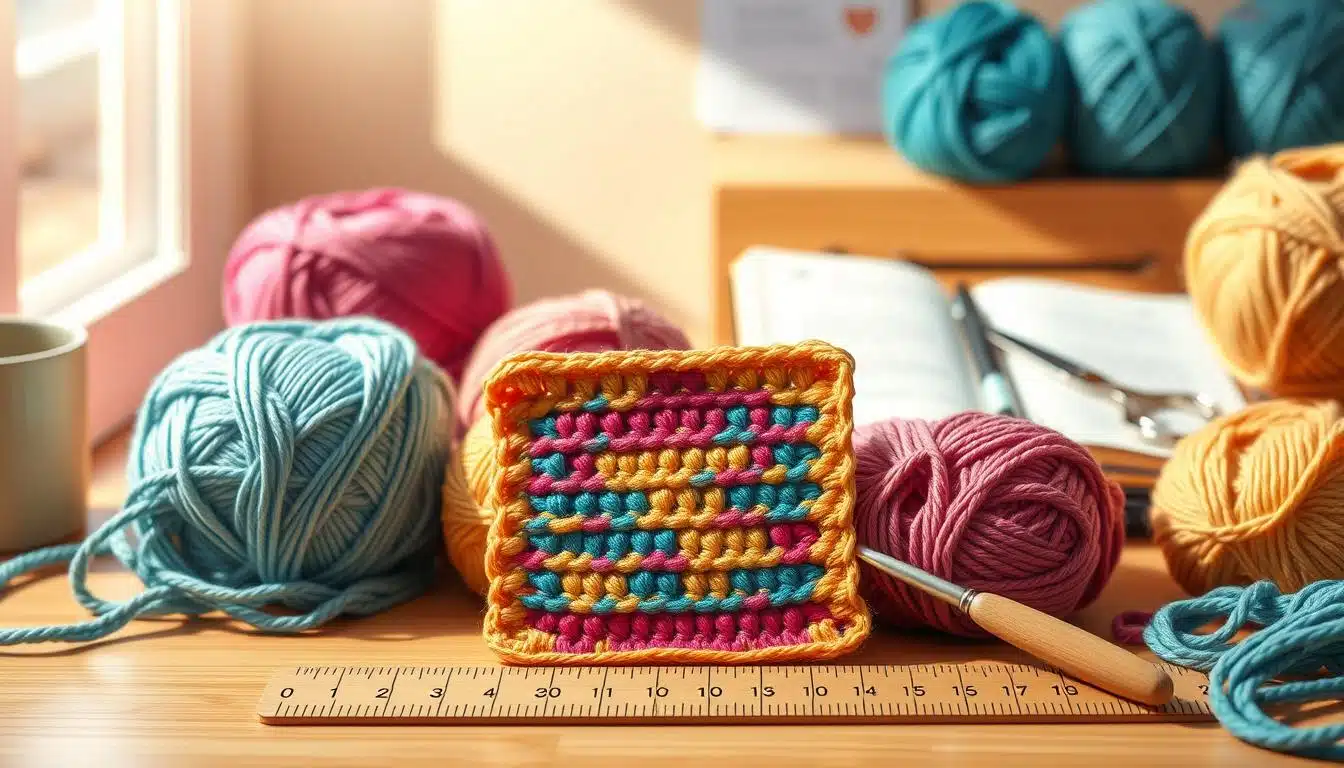
If you’ve skipped swatching before, you’re not alone. But that sweater-that-fell-off-the-shoulder fiasco shows why gauge matters. This guide will teach you what gauge is, why it’s important, and how to measure it. This way, your finished pieces will actually fit.
Gauge is like a map between the pattern and reality. Even with the right hook and yarn, your tension might differ from the designer’s. So, learning to match gauge is key for perfect crochet fitting and drape. For example, a sample swatch might read 13 hdc x 10 rows = 4″; this simple measurement is crucial.
Some projects can handle loose or tight stitches — like blankets and rugs. But wearables need precision. Learn the basics, practice your tension, and use a gauge swatch to avoid rework. For a visual guide and more tips, check out Crochet Gauge 101 and Crochet Troubleshooting.
Key Takeaways
- Gauge is stitches and rows per inch; measure the middle 4″ of a swatch for accuracy.
- Wearables require matching gauge; loose or tight gauge affects fit and drape.
- Use a consistent hook and yarn, but adjust hook size if your gauge doesn’t match.
- Short swatching saves time and yarn compared to ripping out a full project.
- Reference trusted tutorials for stitch-specific gauge tips and advanced adjustments.
What is gauge in crochet and why it matters
Gauge is like a fingerprint for your crochet fabric. It shows how many stitches and rows you get with a certain yarn and hook. Designers give gauge as stitches per inch and rows per inch to help you get the right size.
Definition of gauge
Gauge, or tension, is how big your stitches are with a specific hook and yarn. Annie’s Catalog explains it simply: gauge is the number of stitches and rows per inch in a swatch. Your personal tension can change this number, so a swatch helps you see if your work will match the designer’s size.
When gauge is crucial versus when it’s optional
Gauge is very important for fitted items like sweaters and hats. If you ignore it, your sweater might be too small or your hat too tight. That’s why patterns often highlight the gauge in the Materials & Notes section, like “3 stitches and 3 rows = 1″ in hdc.”
But for items where size doesn’t matter, like blankets or rugs, gauge is less critical. You might still want to pay attention to how it feels and how much yarn you use. But the exact size isn’t as important.
How gauge affects fit, drape, and yarn usage
Gauge is key for the fit and drape of your crochet. If you match the pattern’s gauge, you’ll get the right shape and fabric feel. If your stitches are too small, your fabric might be stiff and lack drape. Too large, and it could be floppy and lose its shape.
Gauge also impacts how much yarn you use. A denser swatch means more yarn for the same item. You need to match both stitches per inch and rows per inch to get a reliable fit.
crochet gauge guide
Getting gauge right is all about finding the small line in a pattern. It tells you how many stitches and rows make a specific size. This small detail can save you hours of work.
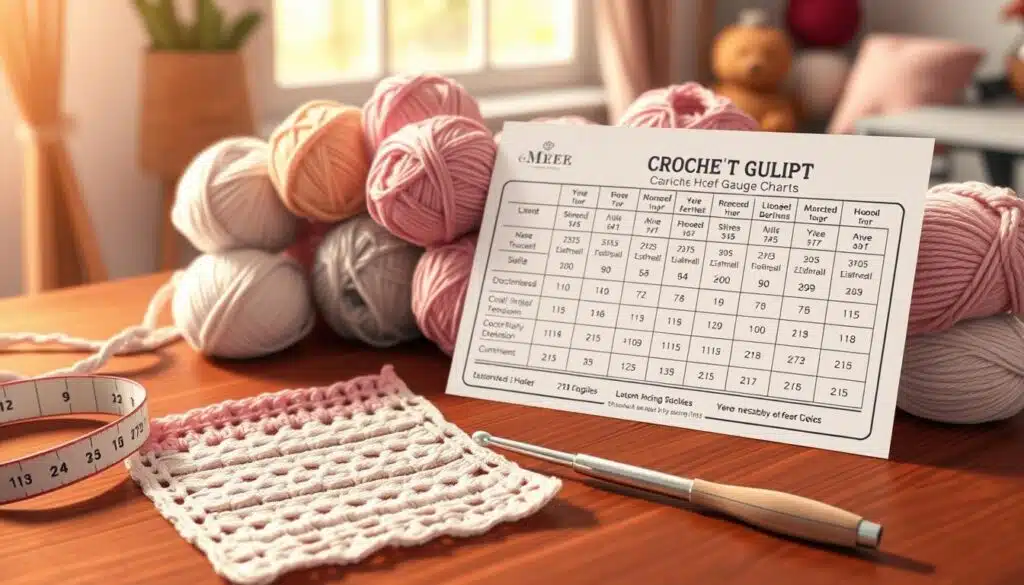
What a complete gauge listing looks like in patterns
A full gauge note includes three key things: the stitch, the count, and the measurement. A pattern gauge example might read like this: stitches x rows = measurement. It also names the stitch used, like sc, hdc, or dc.
Some designers give extra tips for the swatch. They might tell you which row to measure or if to block first. When you see multiple numbers, they often refer to different parts of the item.
Interpreting complex gauge listings (stitch-specific or round-based)
Complex patterns might list a stitch-specific gauge or a round-based gauge for circular work. For stitch-specific gauge, you must match the exact stitch named. A half-double crochet is different from a double crochet in height.
Round-based gauge shows rounds per diameter or rounds per inch instead of rows. If a pattern uses round-based gauge, measure the flat circle across its center after the specified number of rounds to confirm size.
Locating gauge information in patterns
To find gauge in a pattern, check the Materials, Notes, or the top of the first page. Patterns from brands like Lion Brand and Red Heart often place gauge near yarn and hook info. Independent designers might have a separate Swatch or Gauge section.
If you find more than one gauge statement, read each carefully. Multiple gauges usually mean the pattern has pieces with different textures or construction methods.
How to make an accurate gauge swatch
Think of a swatch as a mini rehearsal for your project. It shows stitch size, drape, and color behavior. It also gives you confidence to start your project. Use the yarn and hook from the pattern, plus one size up and down. Also, have a smooth ruler or gauge tool ready.
Materials and size for a reliable swatch
Start with the yarn and hook the pattern suggests. Chain about 20 stitches to get a feel for the fabric. Aim for a 6×6 inch swatch for the best results. A 4×4 inch square can also work but might show edge issues.
Try a 20-chain half-double crochet swatch for 12–14 rows. This size gives you enough fabric to measure accurately. For round projects, use a tube swatch or the first rounds as your test. For detailed steps, check out the crochet gauge swatch guide.
Swatch pattern examples
Choose a simple pattern to avoid confusion. For example, start with Ch 20, then hdc in the third chain from the hook. Continue this pattern for Rows 3–13. Measure the middle 4 inches to get your gauge.
If your pattern has textured stitches, use a swatch that mirrors that texture. For interlocking crochet, remember that chain spaces count as stitches. Work enough repeats to match the finished piece’s texture.
Blocking and pinning before measuring
Always block your swatch like you will finish your project. Use water, steam, or a spritzer to shape it. Pin the edges gently to keep them straight without stretching.
Let the swatch dry completely before measuring. For garments, hang the swatch with a small weight to see how it settles. After drying, measure the center with a ruler, ignoring the edges.
| Purpose | Recommended swatch size | Simple pattern |
|---|---|---|
| Flat garments | 6×6 inches | Ch 20, hdc rows 2–13 |
| Round projects | Tube or first rounds | Work in rounds matching pattern stitch |
| Textured stitch check | 6×6 inches | Repeat stitch pattern for 8–12 repeats |
How to measure and calculate gauge correctly
Getting gauge right can feel magical when it works and mysterious when it doesn’t. Start by making a generous swatch. Then, block or pin it, and measure the center area where the fabric settles. This helps avoid edge distortion and saves time and yarn.
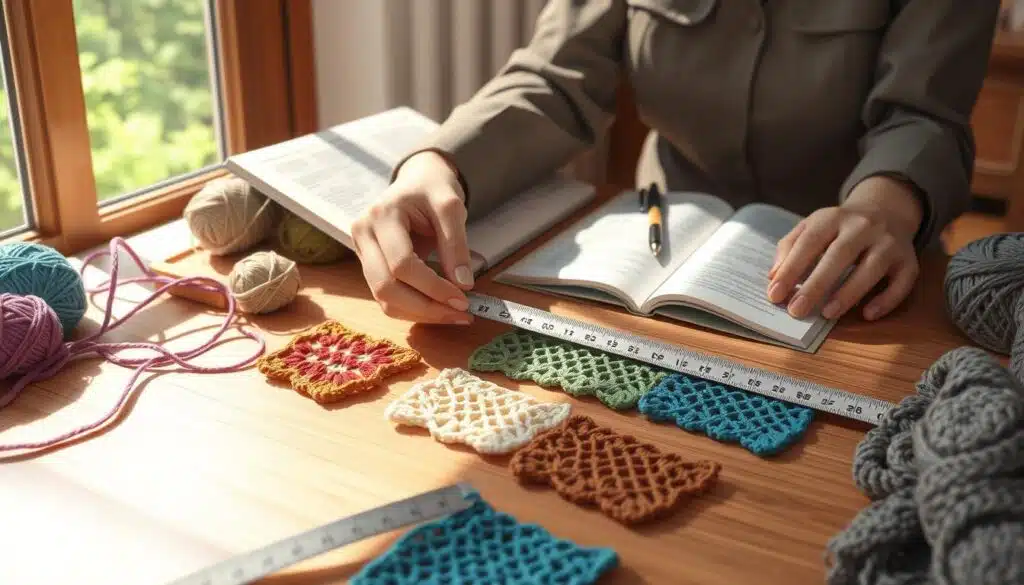
Tools you need
For accurate swatch work, use a reliable gauge ruler or tape measure. A clear plastic gauge plate, a small sewing tape, or a rigid ruler from brands like Singer or Clover works well. Align the zero line with the edge of a stitch and count across the measured span.
How to record gauge and notation
Measure the inside 4 inches of your pinned swatch for best accuracy. Count stitches horizontally and rows vertically in that 4″ span. Write your gauge like this: __ stitches x __ rows = 4″. This notation matches what patterns expect, making math later easier.
Keep a swatch log with yarn, hook, hook brand, and the exact gauge notation you recorded. If you change hook size, note the new gauge for quick retesting and comparison.
Common measuring mistakes to avoid
Don’t measure too close to the swatch edge. Also, avoid measuring an unblocked, relaxed swatch unless you want surprising differences after washing and pinning. Many people match the stitch count but miss the row count due to tension habits; check both dimensions.
If your stitch count matches but rows don’t, try a different hook or adjust tension and retest. For troubleshooting tips and quick fixes, see crochet troubleshooting for practical examples and common pitfalls when measuring crochet gauge.
| Step | What to measure | Tool | Why it matters |
|---|---|---|---|
| Make swatch | Large sample, at least 6″ square | Any yarn and hook in your project | Gives room for edge effects to settle |
| Block/pin | Center area, flattened | Gauge ruler or pinned board | Prevents fabric relaxation from changing counts |
| Measure stitches | Horizontal count across 4″ | Tape measure for swatch or gauge ruler | Matches pattern stitch gauge |
| Measure rows | Vertical count in same 4″ | Rigid ruler or tape measure for swatch | Ensures correct length and drape |
| Record | __ stitches x __ rows = 4″ | Notebook or project app | Clear gauge notation speeds future adjustments |
How to adjust your gauge: hooks, yarn, and tension
Want your sweater to fit perfectly? Small tweaks can make a big difference. This section shows you how to adjust your crochet gauge for a better fit.
Changing hook sizes to correct stitch and row gauge
If your swatch has too many stitches per inch, your gauge is tight. To loosen stitches, try a hook one size larger. For tighter stitches, go down a size. Different materials like metal hooks can also affect your hand tension.
Adjusting row gauge can be a bit tricky. Taller stitches mean more rows, while shorter stitches mean fewer. You can change row height by using taller stitch variants without redoing the whole pattern.
Using different yarn weights or fiber blends
Yarn substitution is key when you love a fiber but not the gauge. Two worsted yarns can have different results. For example, Red Heart Super Saver and Lion Brand Vanna’s Choice may use the same hook but have different stitches per inch.
If your yarn is thinner than the pattern suggests, use a larger hook or a slightly heavier yarn. Test a swatch before starting your project. Keep notes on which yarn and fiber work best for you. Always retest after making any changes.
Altering tension and stitch technique
Your hand tension greatly affects your work. Pulling the yarn too hard after drawing up a loop can compress rows. Try lifting the loop or finishing stitches with less pull to increase row height. Pay attention to your stitch technique and make deliberate changes to adjust row gauge.
If adjusting tension is easier, try holding the yarn differently or using alternate methods. Small changes in your technique can affect both width and drape.
For quick fixes, this guide offers step-by-step solutions to test on a swatch. If you still can’t get it right, check out a detailed troubleshooting post for more ideas at crochet gauge problems.
| Problem | Likely Cause | Practical Fix |
|---|---|---|
| Swatch too small (too many sts/in) | Tight tension or small hook | Change hook size up 1 or 2 sizes; relax tension; try a smoother metal hook |
| Swatch too large (too few sts/in) | Loose tension or large hook | Change hook size down; tighten your hold; test a firmer yarn |
| Width correct but too many rows | Compressed row height from tugging | Practice letting the loop sit taller; use taller stitch variants; check yarn weight |
| Width correct but too few rows | Excessive lift while finishing stitches | Lower lift action; switch to a stitch with less height; retest swatch |
| Can’t match gauge after changes | Combination of yarn, hook, and habit | Try yarn substitution, change hook material, and adjust stitch technique together |
Measuring gauge for special stitch patterns and textures
Working with textured or lace stitches requires a different approach than single crochet. You’ll need to make a swatch that matches the pattern’s stitch unit. This method saves time and avoids surprises.
Gauge for clustered and textured stitches
Clustered or puff stitch patterns change both stitch width and row height. Count the cluster units, not individual dc, as the pattern suggests. For example, a granny stripe might list 15 dc x 9 rows = 4″ or 5 clusters x 9 rows = 4″. Choose the cluster count that fits the garment’s shape.
When measuring cluster work, count the spacing across several repeats. Measuring just one motif can be misleading due to edge distortion.
Gauge for lace and openwork (drape-sensitive pieces)
Lace depends on drape as much as stitch size. Make a larger swatch, block it like the finished piece, then measure. Always measure after full finishing to get accurate results.
Be mindful of yarn slip and fiber content. Slippery fibers stretch more and can change lace crochet gauge. Adjust hook size or yarn until the blocked drape matches the pattern’s feel.
Gauge for circular and motif-based patterns
Circular patterns often list diameter after a set number of rounds, not stitches per inch. Measure the diameter across several central rounds to check gauge. For motifs, count repeats across a measured width to confirm gauge.
If you need quick corrections, change hook size in small steps. Keep notes on which swatch matched which hook and blocking method. A well-organized swatch library helps avoid costly mistakes.
Need help fixing a tricky swatch or mistake? Try this guide for quick fixes and tips.
Practical tips and troubleshooting for faster results
When a project is behind schedule, you need quick fixes. Start with small, practical moves to save time and keep results predictable. A few targeted tricks can get you back on track without redoing the whole pattern.
Quick fixes when you’re short on time
If your swatch is too small, try a larger hook or a heavier yarn. Relaxing your grip can also help loosen tension. For a swatch that’s too big, use a smaller hook or a lighter yarn. Tightening your yarn in your non-hook hand can also help.
When width is right but rows are off, check your loop pulling. Pulling each row tight shortens row height. Lifting loops taller increases rows per inch. Practice these motions to avoid endless re-swatches.
Keeping a swatch library for future projects
Build a swatch library with labeled snippets from past projects. Include yarn label, hook, stitch, and finished measurements. A well-kept swatch library turns guesswork into quick reference, helping you start new patterns faster.
Keep one or two scrap projects handy. They’re perfect for testing different hook materials like bamboo or metal. Switching hook material can tame your gauge without changing yarn weight.
When math and pattern adjustments are unavoidable
Sometimes you must adjust crochet pattern shaping to match a different gauge. If you want a different finished fabric, you have three choices: pick a different pattern size, accept some fit variation, or do the math to rechart the garment. Gauge math is the only accurate route when precise sizing matters.
Basic gauge math starts with stitches per inch and rows per inch. Multiply those by the garment dimensions to get new stitch and row counts. If pattern shaping is complex, consider drafting a simple schematic before you cut into expensive yarn.
| Problem | Quick fixes | When to do gauge math |
|---|---|---|
| Swatch too tight | Use larger hook, heavier yarn, relax tension | When garment must match exact measurements |
| Swatch too loose | Use smaller hook, lighter yarn, tighten tension | When fit or drape will alter silhouette |
| Width okay, rows wrong | Adjust loop height and tug; re-block swatch | If row count affects sleeve length or body length |
| No time to swatch | Use a trusted swatch from your swatch library or choose larger finished ease | Only for low-risk accessories; not for fitted garments |
| Using different yarn | Test on small motif; try different hook materials | When gauge math will rechart pattern piece counts and shaping |
Yarn behavior, drape, and substitution considerations
Before you swap a skein, take a breath and a quick swatch. Yarn behavior can surprise you once fabric grows off the hook. A labeled weight gives a starting point, but the real feel comes from density, fiber, and strand structure.
Understanding yarn weight versus yarn density
You might think two yarns labeled DK or worsted are the same. But yarn weight vs density shows they’re not. Labels show a weight category and yards per ball, yet yards per gram can differ. Wraps Per Inch (WPI) helps you measure strand thickness when numbers lie.
Use the yardage and gram info on the label to compare density. A denser yarn can feel thinner but weigh the same, so gauge and drape shift. This matters when you want a garment to hang like a scarf or sit structured.
Fiber content and ply effects on finished fabric
Fiber content impact changes everything from stretch to wash behavior. Animal fibers like merino wool will spring and felt differently than cotton or acrylic. Plant fibers like cotton give firmness and breathability. Man-made fibers such as acrylic can be resilient and easy-care.
Yarn ply works with fiber to shape stitch definition and strength. Single-ply yarns drape softer and can bloom, while multi-ply yarns hold crisp stitches. For instance, a one-ply gradient like Red Heart Unforgettable may substitute for certain DKs without altering drape too much, but check your swatch first.
Evaluating drape and hand, not just numbers
Drape evaluation means judging fabric on blocked swatches, movement, and how it feels against skin. Slippery fibers like silk and bamboo will settle and lengthen in wear. Stiffer fibers and textured acrylics keep shape and resist sagging.
Make small test pieces, wear them, and carry them in a bag to see real-world behavior. If you need a quick primer on fiber categories before testing, visit yarn and fiber guide for a fuller reference.
| Trait | Typical Effect | What to test in a swatch |
|---|---|---|
| High density | Smaller loops, firmer fabric | Measure WPI, blocked gauge, hand |
| Low density | Looser fabric, more drape | Row gauge after blocking, stretch |
| Animal fibers | Elasticity, warmth, felting risk | Wash and dry test, elasticity |
| Plant fibers | Stability, less give, breathable | Block and measure after wetting |
| Man-made fibers | Durable, easy-care, varied drape | Wear test, heat sensitivity check |
| Single-ply | Soft hand, potential halo, gentle drape | Stitch clarity, pilling tendency |
| Multi-ply | Clear stitch definition, firmer fabric | Gauge consistency, strength test |
Conclusion
Gauge is key because it affects how well your crochet fits and looks. Before starting, make sure your swatch is just right. This guide helps you understand the importance of gauge and how to achieve it.
Start by measuring your stitch and row gauge. Then, adjust your hook size or yarn weight as needed. For clothes, getting the gauge right is crucial. But for decorations, you might be able to get away with a bit of variation.
Here are some useful tips for gauge: swatch in the actual stitch pattern, block and pin your swatch, and measure again after any changes. Remember, yarn weight, fiber, and ply can also impact your project’s look and feel.
Make swatching a regular part of your crochet routine. Keep a collection of swatches for future projects. Swatching well is essential for success in crochet. If you’re unsure, ask for help in the pattern comments or crochet communities.
FAQ
What exactly is gauge in crochet?
Gauge, or tension, is how many stitches and rows you get in a certain length of fabric. It’s usually written as “stitches x rows = 4″ (10 cm). Designers use it so your finished piece matches their size and drape.
When do you absolutely need to match gauge, and when can you skip it?
You must match gauge for fitted garments like sweaters and hats. For blankets and bags, exact gauge is less critical unless the pattern requires it. Always swatch when unsure.
How does gauge affect fit, drape, and yarn usage?
Gauge controls the size and how the fabric hangs. Too-tight gauge makes pieces smaller and stiffer. Too-loose gauge makes them oversized and may use more yarn. Drape depends on stitch spacing, fiber, and ply.
What does a complete gauge listing look like in a pattern?
A typical listing is “14 sts and 18 rows = 4″ in single crochet” or “13 hdc x 10 rows = 4″.” Some patterns show 1″, 2″, or 4″; circular patterns might list rounds = diameter. The stitch used is always part of the statement.
How do you interpret complex gauge listings like clusters or rounds?
If a stitch is textured or clustered, the pattern may measure by stitch unit. For round-based gauges, measure the diameter after the specified number of rounds. Always follow the pattern’s measurement instructions.
Where in the pattern should you look for gauge information?
Check the Materials & Notes or the beginning of the pattern. Gauge lines often appear with the yarn and hook recommendations. If multiple parts of the project use different stitch patterns, you may see several gauge statements.
What materials and swatch size give a reliable gauge reading?
Use the pattern-recommended yarn and hook or a close equivalent. Chain enough stitches (15–20 or more) so the swatch is wide enough for your hand to settle into the rhythm. Work 10–15 rows or follow the pattern’s swatch instructions. Measure the central area—away from edges—for a stable reading.
Can you give simple swatch pattern examples?
A common sample: with a 6mm hook and medium-weight yarn, ch 20, hdc in the 3rd ch from hook and across, ch 2, turn, hdc across for 11 rows total. Measure the inside 4″ and record stitches x rows = 4″ (example shown often as 13 hdc x 10 rows = 4″). Follow the pattern’s specified stitch when provided.
Should you block or pin your swatch before measuring?
Yes. Many fibers relax after resting or blocking. Pin or steam/block the swatch the same way you’ll treat the finished piece, then measure in the middle. Unpinned or unblocked swatches often give misleading stitch and row counts.
What tools do you need to measure gauge accurately?
Use a tape measure, a clear ruler, or a gauge plate. A blocking board and pins help produce consistent readings. Gauge rulers with 4″ squares are handy. Align the edge of a stitch/row with the zero line and count across the measured span.
How should you record your gauge?
Note it as “__ sts x __ rows = 4″ (10 cm), stitch type, hook size, yarn brand/weight, and any blocking. Keep the swatch and write the date and project name on a label. A swatch library saves time when substituting yarns later.
What common measuring mistakes should you avoid?
Don’t count at the swatch edge—measure the center. Don’t skip blocking/pinning if the finished item will be blocked. Avoid measuring before your tension has settled; make enough rows so your hand relaxes into the stitch. And be careful to count the correct stitch unit if the pattern measures clusters or rounds.
How do you fix stitch gauge that’s too loose or too tight?
If you have too few stitches per inch (fabric is loose/large), switch to a smaller hook. If you have too many stitches per inch (fabric is tight/small), go up a hook size. Try different hook materials—metal, aluminum, or bamboo can change grip and speed, and thus gauge.
What about row gauge—how do you change that?
Row gauge is trickier. To increase row height (fewer rows per inch), pull loops taller, use taller stitch variants (e.g., replace sc with hdc where appropriate), or use a larger hook on the body but a hook that maintains row height for borders. To decrease row height, tighten tension or use a smaller hook. Practice and small test swatches will show the effect.
Can changing yarn weight or fiber help match gauge?
Yes. Swapping to a heavier or lighter yarn will affect both stitch and row counts and drape. Fiber and ply matter—wool behaves differently than cotton or acrylic. Use Wraps Per Inch (WPI) and yardage to compare density. Sometimes a one-ply yarn will substitute better than a multi-ply even in the same weight category.
How do special stitch patterns and textures affect gauge?
Textured stitches, clusters, and beans change stitch width and row height. Patterns may specify measuring cluster units instead of individual stitches. Swatch the exact stitch pattern and block it—texture often stabilizes after washing and blocking, and that changes counts and drape.
What should you do for lace or openwork gauge (drape-sensitive pieces)?
Make larger swatches and block them exactly how the finished piece will be treated. Evaluate drape and hand, not just stitch counts. Slippery fibers like silk or bamboo will relax more and may need tighter initial tension to avoid saggy garments.
How do you measure gauge for circular or motif-based patterns?
Follow the pattern’s instructions—measure diameter after the specified number of rounds for circular gauge. For motifs, count motif units across a measured span or measure the size of one completed motif and calculate how many fit across the garment dimension.
Any quick fixes when you’re short on time but gauge is off?
Fast options: change hook size, switch to a different yarn of similar appearance but different density, or pick a different size in the pattern. If you must proceed without matching gauge on a garment, be ready to rechart with stitch math or accept imperfect fit.
How useful is keeping a swatch library?
Very useful. A stash of labeled swatches with yarn, hook, and gauge saves time when substituting yarns or repeating projects. You’ll also learn how different hooks and fibers change your personal tension over time.
When is changing the pattern math unavoidable?
If you cannot match gauge and still want the same final measurements, you’ll need to recalculate stitch counts, shaping, and yardage. That requires pattern-writing or advanced gauge math skills. Otherwise choose a different size or yarn that lets you match gauge.
How do yarn weight, density, ply, and fiber affect finished fabric beyond stitch counts?
Yarn weight gives a general category, but density (yards per gram), ply, and fiber determine drape, elasticity, and how the fabric behaves after blocking. A denser yarn in the same weight can make a firmer fabric. Ply affects stitch definition and strength; fiber affects stretch, shrinkage, and hand.
How do you evaluate drape and hand, not just numbers?
Block and handle your swatch. Wear or drape the swatch over a shoulder or mannequin to judge movement. If the fabric hangs too stiff or too limp, try a different fiber, change hook size, or adjust stitch spacing until the feel matches the design intent.
Any last practical troubleshooting tips?
Always swatch before committing. Measure the center of a blocked swatch. Try different hooks and materials if you can’t match gauge. Keep notes and labeled swatches. If width is right but rows are off, focus on stitch height and tension adjustments rather than just hook size.