You’re about to learn cable knitting without drama. Cables are just stitches moved to look like a rope or braid. You move a group of stitches to a holder or needle, then work the next ones. This simple trick is key to making cozy hats and blankets.
Think in pairs when doing cables. Hold stitches back for a right twist (C6B), or front for a left twist (C6F). For a basic 6-stitch cable, slip 3 stitches back, knit 3, then knit the 3 held ones. An 8-stitch left twist works the same way—slip 4 to the cable needle, hold in front, knit the next 4, then knit the held 4.
Crossings repeat every few rows. For some 6-stitch cables, it’s every 6th row. For tighter 4-stitch twists, it’s every 4th row. Once you get the rhythm, cable knitting becomes calming and predictable. This guide will help you start with simple projects like a cabled headband or a chunky blanket.
Key Takeaways
- Cables form by holding stitches and working adjacent ones to create a twist.
- Use a cable stitch holder or a spare double-pointed needle as your cable holder.
- Holding stitches to the back makes a right-leaning cable; holding to the front makes a left-leaning cable.
- Common repeats: many 6-stitch cables cross every 6th row; smaller cables cross more often.
- Beginner cable stitches need only knit and purl—great for starting projects like hats and blankets.
Why cable knitting is a must-learn skill for knitters
Learning cable knitting adds a powerful tool to your knitting skills. It transforms flat fabric into textured, sculpted pieces with just a few tools. This skill is great for adding texture, structure, and visual interest without complex shaping.
What makes cables look complex (and why they’re easier than they seem)
At first, braided columns might seem daunting. But, cables are simple: they just reorder stitches to create twists. By slipping stitches to a cable holder or double-pointed needle, then knitting and working them, you get those rope-like effects.
Understanding cable complexity explained makes patterns easier. Changes in stitch count, front or back crossing, and how often you cross affect the look. Once you get the hang of front-versus-back crossing, many stitch combos become easy to repeat.
Where you’ll see cables: garments, blankets, hats, and trendy home goods
Cables are everywhere. You’ll find them on sweaters from L.L.Bean and classic Aran sweaters, chunky throws on Etsy, cozy hats, and decorative pillows. Designers use them to add focal points, warmth, and drama to garments, blankets, and small items.
Seeing cables on garments helps you pick projects that match your skill level. A headband or scarf with a single cable is a great way to start before tackling a full sweater or blanket.
Benefits of mastering cables: texture, structure, and design options
Mastering cables brings many benefits. They add visual depth without bulky seams. Cables also give fabric body, keeping hats and collars in shape. Plus, they let you mix motifs like braids, ropes, and honeycombs for endless designs.
Learning cables opens up creative possibilities. You can play with stitch counts and crossing frequency to control density and rhythm. This turns simple stitch patterns into unique pieces you’ll love wearing and giving.
Essential tools for cable knitting: needles, cable needles, and yarn
You want your cables to stand out and your knitting to be smooth. Start with the basics: needles, a cable stitch holder, and the right yarn. This simple kit saves you time and stress.
Choosing the right needle size and type for your yarn
The needle size affects your cable’s look. Pick a size that matches your yarn and desired drape. For clear cables, use larger needles with heavier yarns.
Needles come in metal, wood, and bamboo. Metal is fast and smooth, while bamboo grips slippery yarns. Choose based on your yarn and knitting speed for neat cables.
Cable needles versus double-pointed needles as cable holders
A cable needle is made for holding stitches during crosses. They come in different sizes and materials. Some have grooves to keep stitches in place.
Double-pointed needles can also hold stitches if you don’t have a cable needle. Choose one slightly smaller than your project needles. Try knitting directly from it to find what works best for you.
Best yarns for beginner cables: fiber, weight, and color contrast
The best yarn for cables shows off the twists. Single-color yarns like Lion Brand Wool-Ease work well. Choose a weight that’s easy to manage.
Start with solid colors and avoid fuzzy yarns. This makes texture and mistakes easier to see. Keep a small set of supplies ready: a spare DPN, a tapered cable needle, and a trusted swatch yarn.
For a quick guide on cable needles, visit Brooklyn Tweed’s cable overview. It compares designs and techniques.
| Item | Why it helps | Quick tip |
|---|---|---|
| Working needles | Controls gauge and overall look | Match material to yarn for smooth knitting |
| Cable needle | Holds stitches securely during crosses | Choose a slightly smaller diameter than project needles |
| Double-pointed needle | Serves as cable needle alternatives in a pinch | Use a DPN with the same material as your needles for consistent tension |
| Worsted or super-bulky yarn | Shows cables clearly, easy to manipulate | Single-color wool blends work best for definition |
| Spare swatch yarn | Lets you test needle size for cables and cable patterns | Make a small sample before committing to a project |
Basic stitch knowledge you need before cabling
Cables start with simple stitches. Mastering knit and purl is key. If you can switch between K and P easily, you’re ready to create stunning cables.
Knit and purl fundamentals that form cable backgrounds
Stockinette and reverse stockinette are common backgrounds for cables. Practice knitting one row, then purling the next. Slipping stitches purlwise is also important.
Try a small swatch of K2, P8, K2 to see how it works. This practice helps with stitch memory and tension control, essential for neat cables.
Reading stitch abbreviations used in cable patterns
Cable pattern abbreviations might seem tough at first. But K means knit, and P means purl. For example, 4/4 LC means slip 4 to a cable needle, then knit the next 4, and the 4 from the cable needle.
Learn abbreviations like LC and RC, along with numbers. A line like K2, P8, K2, 4/4 LC tells you what to do. Keep a cheat sheet handy for new charts.
How stitch markers and gauge affect cable appearance
Stitch markers help you avoid counting mistakes. Place them two stitches from each side of your cable panel. This keeps cables centered and correct.
Gauge is important for cables. Tighter gauge makes cables compact and crisp. Looser gauge makes them relaxed and less defined. Adjust your needle size to match the pattern’s gauge.
| Topic | Practical Tip | Why it matters |
|---|---|---|
| Knit and purl basics | Swatch K2, P8, K2 for 24 rows | Shows how cable panels sit within a background |
| Cable pattern abbreviations | Keep a list: K, P, LC, RC, 4/4 LC | Speeds reading and reduces errors on the first pass |
| Stitch markers for cables | Place markers to bracket cable stitches | Keeps cables aligned and eases pattern repeats |
| Gauge and cables | Adjust needle size until cable swatch matches pattern | Ensures correct cable density and garment fit |
Understanding how cable stitches work
A cable is like a small rebellion in your knitting. You move stitches out of order, set them aside, then work the ones next to them. After that, you bring the held stitches back to create a twist. This simple move is what makes cable stitches special and gives your fabric a braided look.
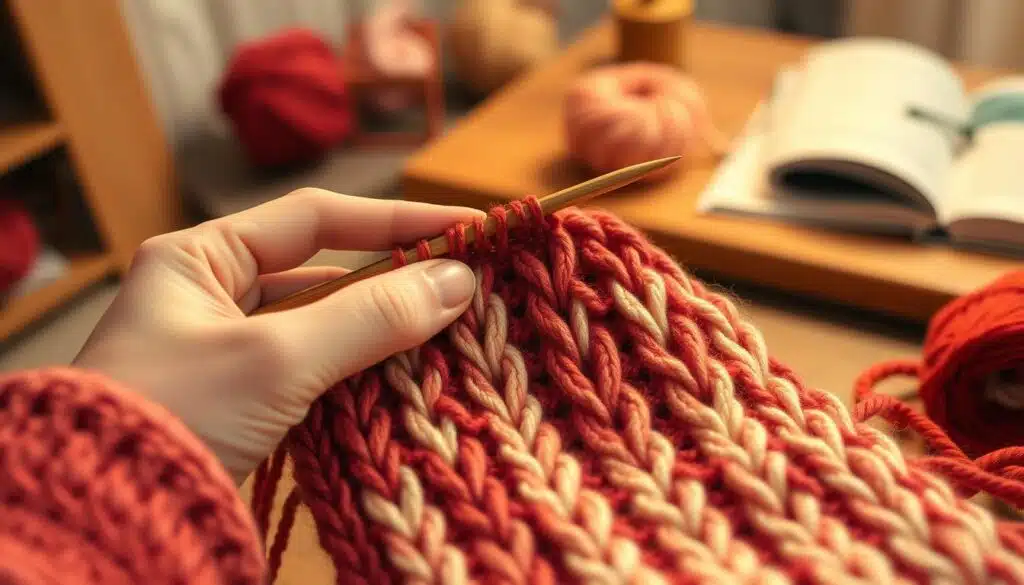
The basic idea is easy. You move a group of stitches onto a holder, then knit the next ones. After that, you go back to the held group. This overlap is what makes the twist visible.
For a left-leaning twist, hold the stitches in front. For a right-leaning twist, hold them in back. This choice decides the direction of the twist in your cable.
The core concept: working stitches out of order to create a twist
First, pick the stitches you want to move. Slip them onto a cable needle. Then, knit the next stitches as the pattern says. Finish by knitting the held stitches, making them pass in front of or behind the others. This is what creates the twist.
How holding stitches in front or back changes the lean of a cable
Stitches held in front make the cable lean to the left. Patterns might call this C6F or 4/4 LC. Holding them in back makes it lean to the right, often called C6B. You can try both on a swatch to see how it changes the look and feel.
Frequency of cable crossings and how it affects pattern density
The frequency of cable crossings affects the design’s look. A 6-stitch cable crossed every sixth row creates a steady column. A 4-stitch cable crossed every fourth row looks tighter and more textured. The space between crossings and the number of stitches crossed change how bold or subtle your design is.
For planning, check out textured stitch examples. They offer ideas on spacing and scale for cable stitch mechanics.
| Cable Type | Stitches Crossed | Typical Cross Interval | Visual Effect |
|---|---|---|---|
| 4-stitch cable | 4 | Every 4 rows | Compact, high texture |
| 6-stitch cable | 6 | Every 6 rows | Balanced, classic column |
| 8-stitch cable (left twist) | 8 (4/4 LC) | Every 8 or 6 rows | Bold, pronounced braid |
| Mixed-size cables | Varies | Staggered intervals | Complex texture, rhythmic interest |
cable knitting tutorial
Ready to try your first cable? This guide is a clear, witty tutorial. It makes learning simple. You’ll need needles, a cable needle or DPN, and a pattern that shows when to cross.
Step-by-step: preparing to work your first cable row
Find the cable section in your pattern and count the stitches. Place stitch markers to mark the cable. Use a cable needle slightly smaller than your working needle for neat tension.
Detailed actions: slipping stitches purlwise and placing on a holder
When the pattern calls for a C6B or C6F, slip the specified number of stitches purlwise. This means insert the right needle as if purling and move the stitches without twisting them. Put those slipped stitches onto your cable needle or DPN as needed, and position the holder at the back for a right-leaning cross or at the front for a left-leaning cross.
Finishing the cross: knitting held stitches and continuing the row
Knit the next group of stitches from the left needle, then work the held stitches off the cable needle. You can knit them directly from the holder or slide them back onto the main needle first if that feels easier. After you finish the cross, keep knitting the row exactly as the pattern directs; the next cable cross will come on the indicated row, often every fourth or sixth row.
If you want more diagrams and deeper practice, check a reliable resource like Brooklyn Tweed’s cable primer for examples and variations to try after you master these cable holder steps.
How to make a basic right-leaning and left-leaning cable
Ready to master twisting stitches? Here are simple steps for both back-cross and front-cross moves. You’ll also find tips for fixing common mistakes. Practice slowly and keep a lifeline nearby.
Right-leaning method (back-cross)
First, slip the needed stitches purlwise to a cable needle. Let them hang at the back. Then, knit the next stitches from the left needle as instructed. Finish by knitting the stitches from the cable needle.
This order makes the right-leaning twist. Use these steps for back cross or C6B/C4B moves.
Left-leaning method (front-cross)
Slip the same number of stitches purlwise to a cable needle. Move that needle to the front. Next, knit the following stitches from the left needle, then the held ones.
This makes the strands tilt left. The left-leaning cable tutorial is similar, but you hold the stitches differently.
Precise tips for smooth crossings
- Always slip stitches purlwise to avoid twisting them mid-cross.
- Keep consistent tension on the cable needle for a neat twist.
- Choose one method for knitting from the cable needle for uniform look.
Common beginner mistakes and quick fixes
Twisting when you slip is common. If you see a twisted stitch, fix it by rotating it and replacing it. Dropped stitches can mess up a cross, but a small crochet hook or tapestry needle can fix it fast.
For bigger mistakes, insert a lifeline before starting the cable. If a mistake keeps happening, rip back to that row instead of unpicking. These tips will help you fix mistakes while practicing.
Worked example: a simple 6-stitch cable you can try now
Ready to try a 6-stitch cable? This guide will help you start, place markers, and finish the first twist. It’s easy to follow, so you can enjoy the rhythm of stitches and the twist.
Pattern setup: cast on, stitch markers, and cable placement
Cast on a number that frames a cable panel. Start with 12 stitches for practice. This gives you two cable panels to compare.
Place stitch markers two stitches in from each edge. This isolates the cable. Then, work a few rows of stockinette or 1×1 rib to frame the panel before your first cable row.
Row-by-row walk-through for the first cable repeat
Work your row until you reach the cable section. Slip the first 3 stitches purlwise to a cable needle. Hold the cable needle to the front for a left-leaning twist or to the back for a right-leaning twist.
Knit the next 3 stitches from the left needle, then knit the 3 held stitches from the cable needle. This reorder creates the twist that defines the motif.
For a quick visual and extra tips, check out a clear how-to link for the spiral version: 6-stitch spiral cable instructions. Use it as a guide when practicing your first few repeats.
How often to repeat the cable cross for best definition
For crisp definition, repeat the cable cross every 6th row. Set your cable repeat frequency before starting. This ensures even texture across the panel.
If you prefer a more subtle twist, space the crosses farther apart. For bold, tightly packed spirals, stick to the six-row rhythm.
To level up, search for a concise C6B tutorial. It will show the back-hold maneuver step by step. After a few repeats, you’ll be confident in using a 6-stitch cable in various projects.
Worked example: an 8-stitch left twist cable pattern
This guide shows you how to make an 8-stitch cable pattern that leans left. You’ll learn a 4/4 LC tutorial and see a left twist cable example. It covers setup, the cross, and timing for repeats. Follow each step, get your needles ready, and try a swatch to see how it looks with different row intervals.
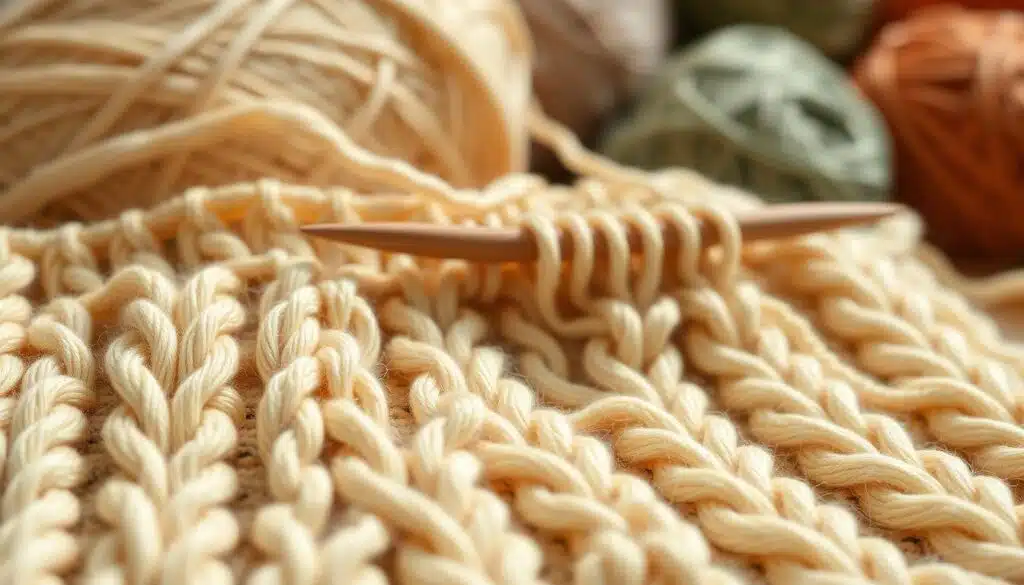
First, cast on 12 stitches. Put markers two stitches from each edge to center the 8-stitch cable. Then, do two setup rows to make a stockinette band: Row 1: knit across. Row 2: K2, P8, K2. Keep repeating these rows before trying the first cable cross.
Use the following h3 headings as quick how-tos and reference points for what comes next.
Setting up stitch counts and markers
Check your marker placement after casting on. The K2 edges frame the cable well. For wider borders, add more edge stitches but keep the cable center eight stitches wide. This keeps the 4/4 LC tutorial instructions correct.
Sliding stitches to the cable needle and holding in front
When you hit the cable row, move the first four stitches of the cable section to a cable needle. Hold it in front of your work. Knit the next four stitches from the left-hand needle. Then, go back to the cable needle and knit the held four stitches. You can knit them directly from the cable needle or slip them back to the left needle and knit there. Both ways make the same left twist cable example.
Repeats and rows between cable crosses
Changing how often you cross affects the twist tightness. Try crossing every 8th or every 10th row to see the difference. The example uses nine rows of stockinette between cable rows for a relaxed look. Another option is the author’s pattern that repeats rows 6–15 for a longer interval and steady rhythm. Use those cable repeat instructions to mark your pattern and track progress.
| Element | Example | Effect on Fabric |
|---|---|---|
| Cast-on | 12 sts | Gives K2 edge + 8-stitch cable + K2 edge for balance |
| Setup Rows | Row 1: knit; Row 2: K2, P8, K2 | Forms clear stockinette ground before the first cross |
| Cabling Move | 4/4 LC (hold 4 sts in front, knit 4, then knit held 4) | Creates a left-leaning eight-stitch twist |
| Spacing Options | Cross every 8, 9, or 10 rows | Tightens or relaxes cable definition |
| Marker Placement | Place markers 2 sts in from each edge | Keeps cable centered and stable |
| Alternate Finish | Knit held sts from cable needle or return to left needle | Both give identical left twist cable example outcome |
Chart reading and written instructions for cable patterns
Think of a cable chart as a map. Each square represents a stitch or crossing. Once you get the hang of it, symbols become easy to understand.
When you see a symbol, ask three questions. How many stitches are involved? Is it a front or back cross? And which stitches move first? This habit helps you understand any cable pattern.
Written instructions and chart symbols work together. For example, a 4/4 LC means you slip four stitches to a cable needle, hold in front, knit the next four, then knit the held four. This makes following the pattern smooth.
Patterns often use C6F and C6B shorthand. C6F means a left-leaning six-stitch cross: slip three to a cable needle, hold in front, knit three, then knit the held three. C6B is the opposite, holding the three stitches in back. Knowing these makes reading patterns quick and easy.
To track cable repeats easily, mark your chart. Use a highlighter for the repeat block and sticky notes for your current row. Place stitch markers on your needles to mark cable sections, so you never lose your place.
If you like a quick reference, write a tiny key beside your chart. Include common moves like 4/4 LC, C6F, and C6B. This helps you stay on track and enjoy the pattern.
Troubleshooting common cable problems
Don’t panic if your cable work goes wrong. Small changes or a missed step can mess up your twist. Check your needle size and how often you cross stitches. Often, changing these can fix the problem without starting over.
What to try if your cables look loose, tight, or uneven
If cables look loose, try using a smaller needle for the cable columns. Tightening your tension on crossing rows can also help. For loose cables in a finished piece, block it lightly to relax the fabric while keeping the twists defined.
For tight cables, switch to a larger needle or space the crossings farther apart. This lets the stitch pattern breathe.
How to repair dropped cable stitch without ripping everything back
To fix dropped stitches, use a crochet hook to follow the vertical ladder of purl bumps up to the cable row. Place the rescued stitch back into its original column to keep the twist correct. Use a lifeline before complex sections to make repairs easier.
Practicing this will make fixing dropped cable stitches less scary.
When and how to blocking cables for best definition
Blocking cables makes twists stand out and smooths uneven tension. For bulky yarns, a light wet-block or steam-block usually works well. Follow the yarn maker’s care instructions to avoid over-blocking. After blocking, cables often look sharper and more even.
| Problem | Quick Fix | When to Use |
|---|---|---|
| Loose-looking cable | Switch to smaller needle for cable columns; tighten crossing tension; light blocking | Visible gaps between twists; relaxed fabric |
| Tight, puckered cable | Use larger needles; increase rows between crossings; gentle steam-block | Twists pull fabric in; loss of drape |
| Dropped stitch inside a cable | Pick up with crochet hook via purl ladders; return stitch to correct column; use lifeline | Single or few rows dropped; complex stitch ordering |
| Uneven cable height | Check slipped stitches for twisting; maintain consistent tension; rework affected repeat if needed | Irregular twist definition across repeats |
| Flat-looking cables after knitting | Wet-block or steam-block per yarn care; avoid over-flattening bulky yarns | Texture lost after finishing; cables not popping |
Simple projects to practice your cable knitting skills
Start with projects that make you feel good, not stressed. Use chunky yarn and big needles to see the texture quickly. This makes learning to hold stitches and read crossings easier and more fun.
Beginner-friendly: cabled headband and chunky scarf
A cabled headband is great for beginners. It has a simple pattern and uses a small number of stitches. You can learn it fast and make something useful in one evening. Try using Lion Brand Wool-Ease Thick & Quick with US 13–17 needles for quick results.
A chunky scarf is also a good choice. It uses the same cable pattern over and over. This helps you get better at knitting and makes the scarf look nice.
Next steps: hats and blankets using repeated cable motifs
When you’re ready for more, try making hats or blankets. Use simple 6-stitch or 8-stitch cables. The Traveling Cable Hat is a great idea for this. It lets you use different shapes and sizes easily.
For bigger projects, try cable blankets. Use wide panels of the same cable pattern. A big, chunky throw is a great way to show off your skills and keep things simple.
How to adapt cables into your own patterns and mix textures
To make your own patterns, change how many stitches cross or how often. You can also mix cables with other stitches for a unique look. Just adjust the size to fit right.
Use cable panels in sweaters or place them between markers. For more tips, check out Brooklyn Tweed’s Cable Knitting 101. Then, try making your own designs.
| Project | Skill focus | Suggested yarn/needle |
|---|---|---|
| Cabled headband | Short repeats, 2/2 crosses | Wool-Ease Thick & Quick, US 13 |
| Chunky scarf | Repeat rhythm, consistent tension | Super bulky yarn, US 15 |
| Traveling cable hat | Transfer motif to circular shaping | Worsted or bulky, US 7–11 |
| Super chunky throw | Panel repeats and finishing | Super chunky, US 17 |
- Choose one simple pattern and use it over and over to build confidence.
- Count rows using the little hole beside each cross to keep track of repeats.
- Practice both right- and left-leaning crosses so your fabric reads balanced.
Conclusion
You’ve learned how cables are made by reordering stitches. This includes using a cable holder or double-pointed needle. Holding stitches to the front or back creates left or right leans.
This summary covers the basics of 6-stitch and 8-stitch cables. It also talks about crossing frequency and why slipping stitches purlwise keeps rows tidy. With a little practice, you can create a braided, textured fabric that looks advanced but feels easy to work with.
Want to learn cabling faster? Use bulky yarn and large needles. Lion Brand Wool-Ease Thick & Quick and a US 15 are good choices. Start with a simple cabled headband or a chunky scarf.
Try the 8-stitch left twist (4/4 LC) once you’ve mastered a 6-stitch cable. This approach makes projects manageable and helps build confidence.
Repetition and timing are key: crossing every 4th, 6th, or 8th row changes the fabric’s density and look. Use lifelines for longer repeats and block finished pieces to enhance definition. For more tips, check out knitting techniques and tips.
In short, this tutorial shows that with attention to stitch order, yarn choice, and practice, you can go from novice to confident cabler. Keep projects small, track your crosses, and view mistakes as part of the learning process. Your next cabled piece will be a reward for your patience. Happy knitting, and enjoy the twist.
FAQ
What is cable knitting and why should you learn it?
Cable knitting creates a textured fabric by rearranging stitches. You slip stitches onto a cable needle, then work the next ones. This simple move makes your knitting look amazing, perfect for many projects.
Why do cables look so complex when the technique is simple?
Cables look complex because they twist and overlap stitches. But it’s just a matter of slipping stitches and knitting them in a different order. Once you get it, it’s easy.
Where will you commonly see cables used?
You’ll see cables in many places. They add interest to blankets, hats, scarves, and more. They’re great for making your knitting stand out.
What benefits do cables add to your knitting projects?
Cables add texture and depth to your knitting. They make your fabric more interesting and stable. You can adjust them to fit different projects.
What tools do you need to start cabling?
You’ll need a cable needle or a spare double-pointed needle. Also, your usual needles, stitch markers, and yarn. Many use a DPN as a cable holder.
How do you choose needle size and yarn for beginner cables?
Use bulky yarns and large needles for easier cables. A solid yarn helps show the twist better. Worsted to super-bulky yarns work best.
Do you need to know special stitches to cable?
No, you just need to know how to knit and purl. Cables are worked in stockinette or rib, so you’re good to go.
What do common cable abbreviations mean (like C6F, C6B, 4/4 LC)?
Abbreviations tell you how to move stitches. C6F means slip 3 stitches to the front, then knit the next 3. C6B is the opposite. 4/4 LC means slip 4 stitches to the front, knit 4, then knit the 4 held stitches.
How does holding stitches in front vs. back change the cable?
Holding stitches in front makes the cable lean left. Holding them in back makes it lean right. It’s all about which stitches you work first.
How often should you cross a cable row?
It depends on the pattern. A 6-stitch cable might cross every 6th row. Experiment to get the look you want.
How do you prepare to work your first cable row?
Start by casting on the right number of stitches. Place markers to bracket the cable. Work a few rows of stockinette to set up the cable.
What’s the correct way to slip stitches for a cable?
Slip stitches purlwise to the cable needle. This way, they don’t twist. Then, knit the next stitches, and return to the cable needle to knit the held stitches.
Do you knit held stitches directly from the cable needle or slide them back first?
You can do either. Knitting directly from the cable needle is common. Choose what feels right for you.
How do you work a basic 6-stitch cable step-by-step?
Work to the cable section. Slip 3 stitches purlwise to a cable needle and hold in front. Knit the next 3 stitches, then knit the 3 held stitches. Continue until the next cable row.
How do you work an 8-stitch left-twist (4/4 LC) example?
Cast on and mark the 8-stitch cable. Slip 4 stitches to the cable needle and hold in front. Knit the next 4 stitches, then knit the 4 held stitches.
How many rows should you leave between cable crosses in an 8-stitch pattern?
It varies. Some patterns use nine rows between cable rows. Others cross every 8th or 10th row. Experiment to find the look you like.
How do cable chart symbols translate to needle moves?
Each symbol shows how many stitches cross and whether they go in front or back. Read the symbol to know what to do: slip stitches purlwise, hold front/back, knit the next group, then knit the held group.
What mistakes do beginners commonly make and how do you fix them?
Beginners often slip stitches twisted or drop stitches. Fix dropped stitches with a crochet hook. Use a lifeline for complex sections.
Why does my cable look loose or too tight, and how do you correct it?
Tension and needle size affect your cables. If they’re loose, try a smaller needle or tighten your tension. If too tight, go up a needle size. Changing crossing frequency can also help.
When and how should you block a cabled piece?
Blocking makes your cables even and look better. Wet-block or steam-block according to your yarn’s care instructions. For bulky yarns, light blocking is usually enough.
How do you fix a dropped stitch inside a cable without ripping back far?
Use a crochet hook to ladder the stitch back up. Then, return it to the needle in the correct column. Be careful to place it back in its original lane.
What small projects are best for practicing cables?
Start with a cabled headband, chunky scarf, or small swatch. Bulky yarns and large needles make it easy to see progress. Once you’re confident, try hats and blankets.
How can you adapt cables into your own designs?
Change the number of crossed stitches or the crossing frequency. Mix cables with ribs or seed stitch. Swap a plain column for a cable panel. Adjust gauge and placement as needed.
Any tips for tracking cable repeats and charting progress?
Use stitch markers and row counters. Highlighters or sticky notes help mark chart repeats. These tools keep you on track and prevent mistakes.