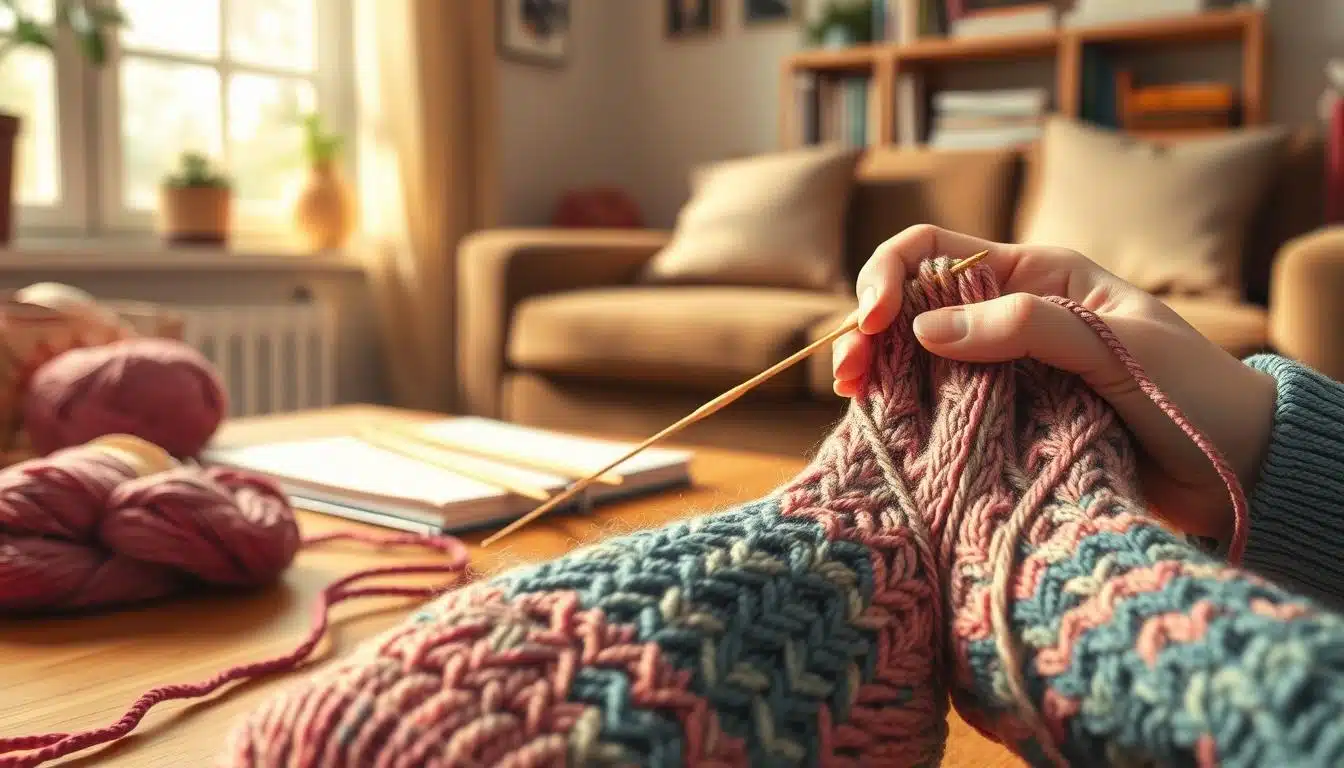
If you’ve ever looked at hand-knit socks and thought, “I could never do that,” don’t worry. This guide will teach you magic loop sock knitting with a simple pattern. It’s perfect for beginners, using fingering, sport, or worsted yarn.
Magic loop makes knitting socks easier by using one long circular needle instead of double pointed needles. You divide stitches and loop the cord to use the free tip. Whitney Van Nes and Laura Ferguson at Purl Soho have great tutorials. SummerLee Design Co. also offers step-by-step lessons.
This beginner guide combines easy steps with helpful tips. It includes yardage guidance, recommended needle sizes, and video tutorials. This way, you can learn magic loop with confidence and style.
Key Takeaways
- Magic loop sock knitting uses one long circular needle to replace double pointed needles.
- This guide focuses on a basic top-down socks pattern ideal for beginner sock knitting.
- You can use fingering, sport, or worsted yarns—adjust yardage and needles according.
- Reliable video tutorials from Purl Soho and SummerLee Design Co. make it easier to learn magic loop.
- The article combines clear steps and pattern notes so you can follow a knitting socks tutorial and build skills fast.
Why Choose Magic Loop for Sock Knitting
Want to make sock knitting easier? Try the magic loop method. It uses a long circular needle to knit small circles without juggling four needles. This method keeps your stitches neat and your hands free, which is great for learning to shape heels and toes.
Advantages over double pointed needles
One big plus of magic loop over DPNs is fewer dropped stitches. With a 32″ circular, your stitches are on a single, long cable. This reduces laddering and makes spotting mistakes easier.
Changing yarn weights is also easier with magic loop. Patterns for fingering, sport, or worsted weight work well with this method. You just need to pick the right needle size, and you can knit the same design without learning new tricks.
When magic loop makes socks easier
Working long cuffs or ribbing is easier with magic loop. The continuous cable ensures even tension across rounds. This makes ribbing stretchier and more comfortable at the cuff.
Trying on a sock as you knit is also simpler with magic loop. The continuous cable lets you slip the work on your foot to check fit. This makes adjusting leg length and gusset decreases less of a guess and more confident.
Common misconceptions dispelled
Some think magic loop is only for experts. But it’s not. Tutorials from Purl Soho and SummerLee Design Co. show beginners how to start. A short practice session will help you get used to working with the cable and finding the active tip.
Another myth is that you need special needles. But most knitters get great results with a standard 32″ circular. For a quick guide on circular needles, check out this circular needle guide to see how the cord and tips work together.
- magic loop vs DPNs: cleaner rounds, fewer ladders, one tool to master.
- advantages of magic loop: easy sizing checks, smooth tension, works across yarn weights.
- why use magic loop for socks: less needle juggling, faster learning curve, good for top-down patterns.
Essential Materials for Top-Down Socks
Before starting, make sure you have everything you need. Top-down socks require yarn, needles, and tools to keep your project organized. Choose items that fit your skill level and the type of sock you want to make.
Yarn choices: fingering, sport, and worsted weight options
You can use fingering, sport, or worsted yarn for this pattern. The sample needs 436 yards (400 meters). You can use any of these weights by adjusting needle size and gauge. Fingering makes a light sock, sport a thicker one, and worsted a sturdy sock.
Needle selection: 32” circulars and recommended US sizes
Magic Loop needs long needles. Use 32-inch circular needles to form the loop. For fingering, use US 1 (2.25 mm) or US 2 (2.75 mm). For sport, use US 3 (3.25 mm). For worsted, use US 6 (4 mm). These needles help you work in the round without issues.
Tools and notions: stitch markers, tapestry needle, measuring tape
Get the right tools to avoid problems during your project. You’ll need stitch markers for repeats and gusset points, a tapestry needle for weaving, and a measuring tape for foot length. Also, have scrap yarn for holding stitches and a yarn swift or ball winder if using skeins.
Understanding Gauge and Sizing for Comfortable Socks
Getting the right fit starts with a few simple tests. Think of sock gauge as the fingerprint of your fabric. It tells you how many stitches per inch your yarn and needles produce. Accurate sock sizing keeps the foot snug without cutting off circulation or sagging in the heel.
How to swatch for sock circumference and leg length
Swatching for socks means knitting a sample in the same stitch pattern you’ll use. Knit a small round or flat square, then block it the way you will the finished sock. Measure stitches per inch across the width to set your sock circumference. Count rounds per inch to plan leg length.
If your stitches are tighter than the pattern, try larger needles; if looser, go down a size.
Converting pattern yardage: 436 yds/400m guidance
The pattern baseline lists 436 yds conversion to 400 meters. That yardage is your starting point for a standard pair. Fingering yarn will stretch that yardage the farthest. Sport weight will give a shorter sock. Worsted weight will make the thickest, shortest pair.
If you add extra cuff or a longer leg, plan for extra yardage before you start.
Adjusting for foot size and yarn weight
To change size, use your swatch to recalculate cast-on stitches. Multiply your desired circumference by stitches per inch from your swatch. Round to a stitch count that fits the pattern’s repeat if needed.
When switching yarn weight, pick the needle size recommended earlier in the article, then swatch again. Tweaking stitch counts and leg rounds lets you tailor fit for kids, adults, or wide feet without guessing.
- Swatch after blocking for the most reliable sock gauge.
- Recalculate cast-on using your measured stitches per inch to nail sock sizing.
- Use the 436 yds conversion as baseline; add yardage for bigger adjustments or heavier yarn.
Casting On and German Twisted Cast-On Tutorial
Begin your sock with a neat, elastic edge. The German Twisted cast-on makes a tidy, springy cuff. It’s great for knitting in the round with Magic Loop.

Why this cast-on shines for socks
The German Twisted cast-on gives a firm base without choking your stitches. It creates a slight decorative ridge. This ridge keeps ribbing from sliding and gives the sock stretch.
Step-by-step cast-on tips
- Start with a slip knot and hold the yarn for a clean wrap; this sets a stable starting point.
- Make the German Twisted cast-on by looping the yarn and twisting the working strand around the thumb loop. Place stitches on the right-hand needle. Follow a video tutorial if you prefer moving visuals; transcripts from Purl Soho help if you like to read along.
- Count your stitches, then slide them onto the 32″ circular and position the cord for Magic Loop. Place a marker at the beginning of the round to avoid losing your start.
Tension tips to avoid a too-tight or too-loose cuff
If you tighten when casting on, try one size larger needle for the cast-on or use a slightly larger needle for the first round, then switch down. That simple swap often fixes a stiff cuff without changing the pattern.
If the cuff feels sloppy, tighten your initial tension or use the pattern’s recommended needle size and retest. You can always pick up the leg stitches and work a round of tighter ribbing to firm the edge if needed.
Practical setup advice for Magic Loop
- After casting on, divide stitches evenly on the cord and pull the loop to create the gap; this helps keep the start of the round neat.
- If you run into an awkward twist at the start, drop the needles, untwist the tube, then rejoin—much faster than trying to fix a twisted cuff in place.
- Keep cast-on tips Magic Loop in mind: clear markers, even stitch distribution, and one relaxed practice cuff will save you headaches later.
Follow these steps to make German Twisted cast-on socks that sit comfortably and look crisp. A little practice makes the cast-on stretchy and pairs well with Magic Loop knitting. This makes the rest of the project more fun.
magic loop sock knitting
You’re about to learn a simple way to knit socks on a long circular needle. This intro covers the basics so you can start without worry. It includes magic loop basics, how to position needles, and quick fixes you can use right away.
Basic concept explained: dividing stitches and looping the cord
Magic Loop starts with casting on to a 32″ long circular needle. You pull a loop of cord between two groups of stitches. This way, each needle tip holds half of the stitches.
Knit one half while the other rests on the cord. Then, slide stitches along the cord to free the next tip. The trick is keeping the split points steady.
Use stitch markers to mark the beginning of round and the split. This keeps your rounds true and prevents twists. Magic Loop is great for top-down construction, making socks from cuff to toe easily.
How to position the needles and cord for smooth knitting
Hold the active needle in your dominant hand. Point the cord loop away from the working stitches. Pull enough cord to form a comfortable loop, not a tangled mess.
Keep yarn and tip aligned to avoid a twisted sock. If your first round feels tight, try loosening the first stitch or swap to a slightly larger needle for the cuff round. SummerLee Design Co. recommends a few practice rounds to settle into the rhythm from cuff to leg.
Troubleshooting common magic loop snags
Twisted cast-on: Check the work before joining. Spread the stitches on both needles and look for a twist in the tube. Fixing this early saves time.
Tight first stitch after sliding: Loosen tension or knit that stitch through the back loop. You can also use a larger needle for the first round then switch back.
Catching cord bumps: Smooth the cord with your finger as you slide stitches. If bumps persist, change to a different brand of circular; some cords glide better than others.
| Problem | Cause | Quick Fix |
|---|---|---|
| Twisted sock tube | Stitches joined with a twist | Spread stitches, untwist, rejoin and mark split points |
| Tight stitch at split | Tension change when sliding | Loosen first stitch, use larger needle for round one |
| Cord bumps catching stitches | Low-quality cord or uneven tension | Run finger along cord, try a different circular brand |
| Uneven gauge between halves | Needle position or pulling too hard on cord | Keep needles aligned, relax your hands, practice with scrap yarn |
If you want a visual refresher or fixes for small mistakes, check this helpful guide on common knitting errors at fix knitting mistakes. Practicing a short sample will make how to magic loop feel natural and reduce the need for magic loop troubleshooting.
Knitting the Cuff and Leg with Magic Loop
Begin at the cuff and work your way down the leg. Use fingering, sport, or worsted yarn for different looks. Make sure your stitches are straight when starting Magic Loop for a smooth row.
Choose a cuff style that fits your needs. A 1×1 rib is great for snug ankles. A 2×2 rib works well with thicker yarns and keeps things balanced.
For a stretchy cuff, use ribbing. More rounds make it firmer, while fewer make it softer. Count your repeats to ensure the pattern fits right.
Ribbing options for snug, stretchy cuffs
Decide between 1×1 or 2×2 ribbing based on your yarn. Test how the ribbing springs back after washing. For neat edges, try a German twisted cast-on and watch a Magic Loop cuff tutorial.
Working the leg: length, patterning, and simple texture ideas
Choose your leg length based on earlier measurements. Short cuffs are sporty, long ones are luxurious. Add simple patterns like slipped-stitch columns or twisted stitches for interest.
When designing leg patterning socks, keep patterns small. Test a full repeat before committing. This saves time and keeps your project fun.
Video tutorial recommendations for visual learners
Watch Purl Soho’s videos for Magic Loop setup and German twisted cast-on. SummerLee Design Co.’s Magic Loop sock series offers clear, focused tutorials. Find the Purl Soho guide at Purl Soho Magic Loop two-at-a-time.
| Feature | Best For | Notes |
|---|---|---|
| 1×1 Rib | Fingering weight, snug cuffs | High elasticity, classic look, good recovery after wear |
| 2×2 Rib | Worsted or thicker yarns | Better visual balance on chunky yarns, stable cuff edge |
| Mock-Cable Cast-On | Dressier socks, clean edge | Creates neat finish, slightly firmer than standard cast-on |
| Slipped-Stitch Texture | Small repeats, leg patterning socks | Produces surface interest without bulk, reads well on small circumference |
| Eyelet Rows | Lightweight, decorative legs | Adds breathability and visual rhythm, check repeat counts |
Heel Options and How to Knit a Top-Down Heel
Choosing a heel shape for a top-down sock is like picking dessert: it’s fun but important. You want it to fit well, last long, and look good with your yarn. The top-down heel magic loop method offers neat shaping and the chance to change techniques if needed.
First, decide if you want speed or extra strength. The short-row heel is quick and smooth. The heel flap and gusset method adds extra strength where you need it most. Both work well with magic loop, so you can keep knitting in the round.
Short-row heel basics using magic loop
The short-row heel uses short rows to create a snug cup. On magic loop, you knit in the round while making turns on half the stitches. This avoids the need to pick up extra stitches later.
Be careful with the wraps and pick them up on the return passes. Make sure the wraps are neat so the sock feels seamless. You can add a small reinforcement, like a slipped stitch row, for extra durability.
Heel flap and gusset method adapted for magic loop
To do a heel flap and gusset with magic loop, treat the cord as two needles. Knit the flap back and forth on half the stitches. Use a firm slip-stitch pattern for extra strength if needed.
Pick up stitches along each side of the flap, then join to knit the instep and sole. Use magic loop to decrease for the gusset. This method lets you customize the fit and add reinforcements where needed.
Choosing the right heel for fit and durability
Go for a short-row heel for speed and a sleek look. Choose heel flap gusset magic loop for extra strength and adjustable fit. Think about the yarn: nylon blends with a slip-stitch flap last longer, while natural fibers may compress differently.
If you’re not sure, try both on a gauge swatch. Or knit one sock with a short-row heel and the other with a heel flap to compare. For more tips and visual help, check out a trusted tutorial on sock knitting tips.
| Feature | Short-Row Heel | Heel Flap & Gusset |
|---|---|---|
| Speed | Fast to knit; fewer steps | Slower; requires picking up and decreasing |
| Fit | Sleek, conforms quickly to heel cup | Highly adjustable for different foot shapes |
| Durability | Moderate; can be reinforced with slipped rows | High when slip-stitch flap and nylon blends are used |
| Magic loop handling | Works in-the-round; watch wraps and turns | Work flap flat on half stitches, then rejoin to decrease |
| Best for | Quick projects, seamless look | Boot socks, heavy wear, precise fit |
Shaping the Foot and Managing Stitch Counts
After the heel, you start a new phase. This is where math and fit come together. Keep your swatch numbers close. They help you figure out how many rounds for the foot and how many decreases to get back to your original count.
Decreasing for a neat instep
To shape the instep neatly, decrease stitches evenly. You can use k2tog on one side and ssk on the other. Mark the edges to keep your pattern on the top of the foot while moving stitches to the sole.
Gusset decreases with Magic Loop
Using Magic Loop for decreases is similar to double pointed needles. Manage the long circular so decreases align with markers. This keeps the decreases even on both sides.
Check fit as you go
Try on the sock after the gusset decreases and again after a few rounds. Compare it to your swatch and the wearer’s foot. If it’s too short, add full rounds before starting the toe. This ensures the right length without having to rip it out.
- Recount stitches after heel work to confirm totals match your calculations.
- Use stitch markers to mark decrease boundaries and instep pattern repeats.
- Fit-check periodically; adjust foot rounds to match desired foot length.
Finishing the Toe and Kitchener Stitch Closure
You’re almost there. The toe finish turns a tube of knitting into a wearable sock. A clean Kitchener stitch toe gives you a seamless, comfortable join that slides into shoes without rubbing. If you’d prefer, there are tidy alternatives that look professional.
Preparing for the graft
Decrease to your pattern’s final stitch count, commonly 8, 12, or 16 stitches total. Split live stitches evenly on two needles so each side has the same number of stitches. Keep the tension from the last rounds consistent with the rest of the sock to avoid a puckered edge.
Step-by-step Kitchener stitch tips
Thread a tapestry needle with the yarn tail that matches your project color. Use the rhythm of knit, purl, knit, purl on the two needle beds. Work slowly at first and practice the sequence on scrap tubes until the motions feel natural.
Follow a trusted demonstration to learn the exact hand movements. For a clear video walkthrough, check out the Purl Soho tutorial for pacing and close-up technique: Kitchener stitch video.
Adjust tension every few stitches. You are creating an extra row of knitting, not sewing a seam. If the graft looks loose, tighten slightly; if it puckers, ease up. Practice on samples until your graft matches the surrounding fabric.
Alternative toe finishes
If you prefer not to graft, try a three-needle bind-off for a sturdier join or a simple gathered finish with a yarn tail for speed. An afterthought toe or short-row toe gives a different silhouette and can be more comfortable for certain foot shapes.
Each method changes the look and feel of the finished sock, so pick the one that suits your comfort needs and aesthetic. Test your chosen finish on a swatch before committing to the pair to ensure the fit and appearance meet your expectations.
Blocking, Care, and Making Your Socks Last
After you finish knitting, it’s time to make your socks look perfect. You can lightly wet-block or steam-block to even out the stitches. This helps set the shape of your socks.
Use sock blockers if you have them. If not, shape by hand and lay them flat to dry. This keeps the cuff and foot measurements just right.
Every type of fiber needs different care. Always check the yarn label before washing. For quick tips, visit sock knitting tips for care routines.
For everyday care, turn your socks inside out and wash them gently. Superwash items can go in the machine. Non-superwash wool should be hand-washed in cool water with wool soap.
Always dry socks flat, away from heat. This prevents felting or shrinking. Never tumble dry unless the label says it’s okay.
Think about adding extra durability from the start. Techniques like slip-stitch heel flaps and duplicated stitches can help. They add strength without changing the look.
To make heels and toes last longer, use a thin nylon thread with your yarn. Or, use a slightly heavier yarn for the sole. These methods strengthen the areas that wear out first.
When washing sock yarn, follow the manufacturer’s instructions. Superwash wool can handle machine washing. But untreated wool needs hand-washing, cool water, and careful drying to keep its shape.
| Care Step | Best for Superwash | Best for Non-Superwash |
|---|---|---|
| Washing | Gentle machine cycle, cool water | Hand-wash, cool water, mild wool soap |
| Drying | Dry flat, avoid heat | Dry flat, reshape while damp |
| Blocking | Steam or wet-block, use sock blockers | Wet-block gently, dry flat to shape |
| Reinforcement | Hold nylon thread with yarn or use plied nylon | Slip-stitch heel flap, duplicated stitch, heavier sole yarn |
| When to Wash | After several wears; spot clean as needed | Spot clean; full wash less often to avoid felting |
Small finishing touches can make a big difference. With careful blocking and simple care, your socks will last longer. For extra durability, consider adding a nylon thread or a reinforced heel flap.
Troubleshooting and Common Beginner Mistakes
Starting with magic loop sock knitting can be tricky. Small snags seem big. This guide helps you fix common problems quickly. Stay on track and keep your confidence up.
Fixing laddering and tension issues between needles
Ladders often appear where needles meet. To avoid them, pull the first stitch tight or start with a smaller needle. If you already have a ladder, use a needle to pick up the loose strands and spread the tension.
To fix a ladder, weave a small stitch or drop a few rounds to redo them. Use a lifeline before tricky parts to avoid ripping back in a panic.
Dealing with twisted stitches and uneven gauge
Twisted stitches usually come from not checking the cast-on. Lay your work flat to ensure all stitches face the right way. If you find twists, open the loop and fix them before continuing.
Uneven gauge might not show up until the sock is half done. Swatch again with a different needle size if your tension changes. For small issues, block the socks and check again. For big problems, reknit small parts instead of fixing the whole thing.
When to rip back versus when to tweak a fix
Rip back for big mistakes like wrong stitch counts or a broken heel. These affect the sock’s fit and can’t be fixed with small changes.
For cosmetic issues like small ladders or odd stitches, try tweaking. Use stitch markers and lifelines to practice without losing your work.
Every mistake is a chance to learn. Purl Soho’s resources are great for fixing techniques and smoothing out transitions. Keep your tools handy, relax, and remember even pros make mistakes sometimes.
Conclusion
You’ve learned the basics of magic loop sock knitting. This includes casting on and finishing with the Kitchener stitch. You’ll need a 32″ circular needle, about 436 yards of yarn, and some tutorials from designers like SummerLee Design Co. and Purl Soho.
This guide shows Magic Loop is a great alternative to double pointed needles. It gives the same results but with fewer needle changes. You can also try two-circular-needle techniques, but many prefer Magic Loop’s clean setup and steady rhythm. For a detailed guide, check out Tincanknits’ Magic Loop overview.
When you’re ready for more, start with a simple top-down pattern. Practice the German Twisted cast-on and follow a short-row or heel-flap tutorial. Remember to check your gauge and fit as you work. This habit will save you time and make your socks feel like they were made just for you.
FAQ
What is Magic Loop and why should I use it for socks?
Magic Loop uses a long circular needle to knit small circles. It replaces double-pointed needles, keeping all stitches on one needle. This makes working on cuffs, legs, heels, and toes easier and neater.
Can beginners learn Magic Loop, or is it only for experienced knitters?
Beginners can definitely learn Magic Loop. Purl Soho and SummerLee Design Co. offer step-by-step video tutorials. Start with scrap yarn to practice before making your first pair of socks.
What yarn weights work with the top-down Magic Loop sock pattern?
The pattern works with fingering, sport, or worsted weight yarns. It uses 436 yards (400 meters) as a baseline. Choose any weight, adjusting needles and gauge as needed.
How much yarn do I need?
You’ll need about 436 yards (400 meters) of yarn. If you change the cuff or leg length, add more yarn. Heavier yarns use more yarn, so plan ahead.
Which needle sizes should I use for Magic Loop socks?
Use a 32” (80 cm) circular needle. For fingering/sport, try US 1, 2, or 3. For worsted, use US 6. Choose the right size for your yarn’s gauge.
What tools and notions do I need beyond yarn and a long circular?
You’ll need stitch markers, a tapestry needle, and a measuring tape. Also, scrap yarn or stitch holders for saving stitches. A ball winder or yarn swift might be useful if working from skeins.
How do I swatch for sock circumference and leg length?
Knit a small swatch in the round or flat. Measure stitches per inch after blocking. This helps calculate cast-on stitches for the desired circumference. Also, measure rounds per inch to estimate leg length.
How do I convert the pattern yardage for different sizes or lengths?
Use 436 yds / 400 m as a baseline. Add yardage for size or length changes. Remember, heavier yarns use more yarn per inch.
What’s the German Twisted cast-on, and why use it for socks?
The German Twisted cast-on creates a firm, elastic edge. It’s perfect for socks because it stays snug. Video tutorials show how to do it and start Magic Loop.
Any tips to avoid a too-tight or too-loose cuff?
Use a slightly larger needle for a tight cast-on. For a sloppy cuff, tighten your initial tension or drop a needle size. Always mark the start of round after casting on.
How exactly do I set up Magic Loop—dividing stitches and handling the cord?
Cast on all stitches to your 32” circular. Arrange stitches so half sit on each tip, then pull a loop of cord. Slide unused stitches onto the cord for knitting the other half.
How should I position needles and cord to avoid twisting or catching the cord?
Keep working yarn and active needle aligned to avoid twist. Pull enough cord for a comfortable loop. Smooth the cord when sliding stitches and use markers for orientation.
What common Magic Loop snags should I expect and how do I fix them?
Expect twisted cast-ons and tight stitches after transitions. Fix by checking for twists and loosening tension. Practice on scrap yarn to build confidence.
Which cuff ribs work best for different yarn weights?
For fingering, 1×1 or 2×2 ribbing works well. For worsted, use wider ribs like 2×2. Ribbing keeps the sock snug and adds texture.
How can I add simple texture to the leg while keeping socks manageable in small circumference?
Use slipped-stitch motifs, eyelets, or small cable repeats. Keep repeats compatible with your stitch count. Avoid large charts in small circumferences.
Which video tutorials are most helpful for Magic Loop socks?
Purl Soho and SummerLee Design Co. offer excellent tutorials. They cover materials, cast-on, cuff, leg, and positioning in progressive lessons.
What heel options work well with Magic Loop top-down socks?
Short-row heels and heel flap & gusset work well. Short-row heels are seamless. Heel flap & gusset is more durable and involves working the flap back-and-forth.
How do you knit a heel flap on Magic Loop?
Work the heel flap back-and-forth on half the stitches. Treat it like flat knitting. Then pick up stitches along the flap edges and proceed with gusset decreases.
Which heel should I choose for fit and durability?
Choose a reinforced heel flap & gusset for durability. Short-row heels are quicker but may fit differently. Reinforce heels/toes with slip-stitch patterns or a reinforcing thread.
How do I manage stitch counts and decreases for the instep and gusset?
Decrease using k2tog and ssk along gusset lines. Use stitch markers to mark decrease boundaries. Keep track while working on the divided Magic Loop setup.
When should I try the sock on during construction?
Try the sock on after gusset decreases and a few early foot rounds. This confirms width and leg length before toe shaping.
How do I prepare for Kitchener stitch on a Magic Loop toe?
Decrease to the final stitch count specified in the pattern. Arrange live stitches evenly on two needles. Check tension on the final rounds matches the rest of the sock. Use a tapestry needle and matching yarn tail for grafting.
Any tips for successful Kitchener grafting?
Follow a video demonstration to learn the rhythm. Alternate knit and purl motions on live stitches. Practice on scrap yarn to get comfortable. Keep tension consistent and secure your tail ends well.
What are good alternatives to Kitchener stitch if I don’t want to graft?
You can use a three-needle bind-off, a gathered finishing method, or an afterthought/short-row toe. Choose based on your preferred look and comfort.
Should I block my socks, and how?
Yes—lightly wet-block or steam-block to even stitches and set shape. Use sock blockers if you have them or shape by hand and dry flat. Blocking helps leg and foot measurements stay true and evens stitch appearance.
What’s the best way to care for finished socks?
Follow the yarn manufacturer’s care instructions. Superwash wool can usually be machine-washed on gentle; non-superwash wool should be hand-washed and dried flat. Store socks clean and dry to preserve fibers.
How can I reinforce heels and toes for longevity?
Reinforce with a slip-stitch heel flap, duplicate-stitch reinforcement, or hold a plied nylon thread with your working yarn. You can also knit the sole/heel in a sturdier yarn or add a second strand for reinforcement.
How do I fix laddering between needle halves?
Prevent ladders by tightening the first stitch after each transition. Use a slightly smaller needle for the first round or pull the first stitch snug. To fix existing ladders, pick them up with a needle and redistribute the slack or rework a few rounds if needed.
What if my gauge is uneven or stitches are twisted?
Check for twists before joining the cast-on. If gauge is off, re-swatch at a different needle size and re-calculate cast-on stitches. For persistent tension issues, block and reassess or unravel and reknit small sections. Lifelines make ripping less painful while you learn.
When should I rip back versus tweak a small problem?
Rip back when structural errors affect fit—wrong stitch count, misplaced gusset decreases, or a flawed heel. Tweak when issues are cosmetic and won’t change fit, like a small ladder or a localized tension change. Use lifelines when practicing to make ripping easier.
Can I knit two socks at a time using Magic Loop?
Yes. Once you’re comfortable with the technique, Magic Loop can be adapted to knit two socks at a time on one long circular. Purl Soho’s tutorials and other advanced guides show how to manage two sets of stitches for simultaneous knitting.
Any final setup reminders before I cast on?
Make sure you have a 32” circular in an appropriate US size, about 436 yards (400 m) of yarn, stitch markers, a tapestry needle, and a measuring tape. Watch the German Twisted cast-on and Magic Loop cuff videos, practice on scrap yarn, and then cast on confidently—Magic Loop really does make sock knitting friendlier.