
Seamless knitting is appealing because it has fewer ends to weave and smoother shoulders. It makes your sweater look like a pro made it. Instagram is full of examples and tips that make you want to try it.
But, there are challenges too. Patty Lyons at Modern Daily Knitting offers practical advice on common issues. She shows how to fix holes under the arm and upside-down stitches. Her “More Is More” method is easy to follow, whether you’re making a top-down or bottom-up sweater.
This article will guide you through seamless sweater patterns. You’ll learn about top-down raglan and circular yoke methods. It also offers quick fixes for common problems. You’ll get practical tips and techniques to make your next sweater a success. For a simple example, check out this garter stitch sweater on this page.
Key Takeaways
- Instagram is a rich source of visual inspiration and mini tutorials for seamless knitting.
- Top-down sweater and bottom-up sweater options each have trade-offs for fit and finishing.
- Patty Lyons’ “More Is More” pickup method tackles underarm holes effectively.
- Raglan sweater and circular yoke styles are excellent entry points for seamless projects.
- You’ll save time and get cleaner results by learning a few pickup and decrease tricks early.
Why choose a seamless sweater pattern for your next knit
Choosing a seamless pattern has many benefits. You get a sweater that fits perfectly, like it was made just for you. Social media shows how seamless garments move smoothly on real people, proving they’re comfortable.
One big advantage is that you don’t have to spend hours sewing. With seamless knitting, you can try it on as you go. This means you can change the fit and style easily, without having to rip it out.
Seamless sweaters also look better under other clothes. They don’t have bulky seams, so they layer well. This makes them hang nicely and don’t catch or bunch up.
Another plus is that they’re easy to take with you. You don’t need a lot of space or tools to work on them. This makes it easy to knit on the go, whether on a bus or at a café.
Here’s a quick comparison to help you choose:
| Feature | No-sew sweater | Seamed sweater |
|---|---|---|
| Fit adjustments mid-project | Easy with try-on as you go | Harder; changes require unpicking |
| Finish time | Minimal thanks to finishing-free knitting | Extra hours for sewing and seaming |
| Layering comfort | Smoother edges and wearable drape | Possible bulk at seams |
| Project portability | Compact, fewer tools needed | Less tidy; more finishing supplies |
| Overall handfeel | Comfortable knitwear with seamless lines | May show seam joins and tension shifts |
Understanding top-down versus bottom-up seamless techniques
Choosing how to knit a sweater is like picking yarn. It’s a personal choice. Many people love top-down or bottom-up knitting. They share their projects on Instagram, using hashtags like #topdownraglan.
Top-down raglan: quick shaping and easy try-ons as you go
Top-down raglan is quick and satisfying. You start at the neck and work down. This makes it easy to fit as you go.
But, there are downsides. The neck edge might be weak. Patty at Modern Daily Knitting explains how this can cause sleeve issues.
Bottom-up and circular yoke approaches: when they shine
Bottom-up knitting is about building a strong base. You make the body first and then add sleeves. This makes seaming easier.
It’s great for projects with bold colorwork. The circular yoke looks clean. Bottom-up is also good for travel, as you can carry small pieces.
How construction choice affects sleeve pickup and underarm issues
How you knit affects the sleeves. Top-down raglan can make the underarm stitches look wrong. This is a common problem.
Bottom-up knitting avoids these issues. It makes the end of the sweater easier to work with. For a detailed comparison, check out this breakdown.
Try different things to find what works for you. Experiment with how you pick up stitches. Use stable yarns like SweetGeorgia Mohair Silk DK. For a guide on sweater knitting, click here.
Essential tools and yarn choices for a flawless seamless sweater
Choose tools that make your work smooth, not stressful. You’ll need reliable circular needles for most projects. The magic loop method is great for sleeves and small areas. Keep double-pointed needles handy for tight spots or if you prefer them.
Needles and small-circumference strategies
Long circular needles and the magic loop method are key. They help avoid extra seams and bulky joins. This keeps the tension even and lets you check the fit as you work.
When it gets tight, switch to DPNs or a second pair of circular needles. This makes the transition smoother.
Choosing yarn weight and fibers
Match the yarn weight to the pattern’s gauge, not just the length. Worsted and DK are good for beginners. They’re forgiving. Fingering weights are perfect for fitted styles because they drape well.
Think about wool vs. blends. Pure wool blocks well and rebounds. Blends offer durability and softness. Superwash yarns are great if you need easy care.
Notions and helpers that save time
Use stitch markers for increases, raglan lines, and needle joins. Stitch holders and a tapestry needle help with neat sleeve joins and ends. Strong blocking tools are vital for even stitches and setting the garment’s shape after finishing.
With the right needles, magic loop, yarn, and notions, your seamless sweater will look great. It will also last through wear and washing.
Common pitfalls with seamless sweaters and how to avoid them
Reaching the tricky part can turn a lovely top-down yoke into an underarm gap. Spotting problems early makes repairs easy and keeps your knitting joyful. Use these quick checks after pickup and before long rows.
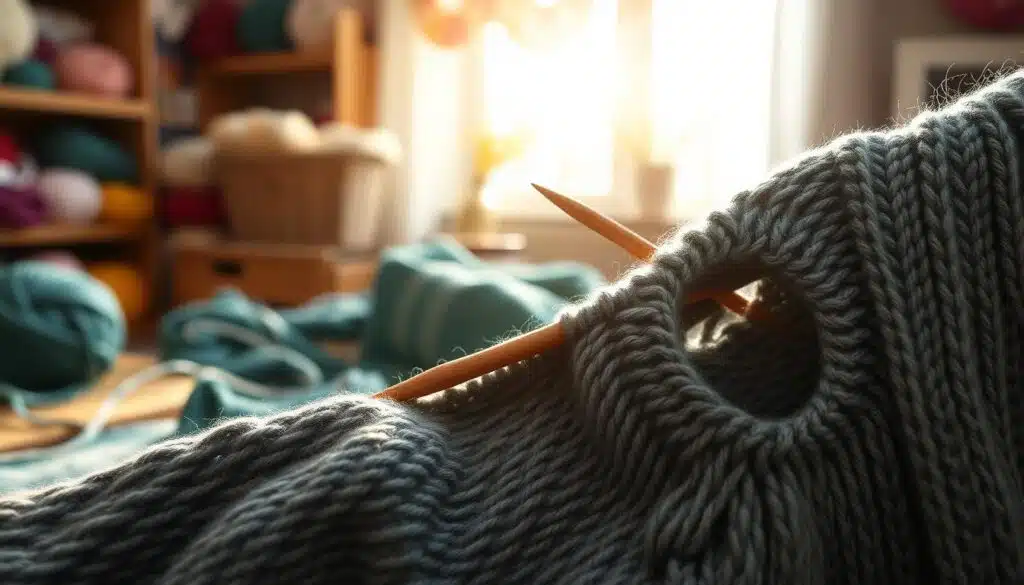
Holes under the arm in top-down sweaters: why they happen
Top-down pitfalls often start at the cast-on shelf under the arm. When you pick up stitches directly over that edge, two loose strands create a shallow tunnel. This tunnel opens into noticeable gaps after a few rows and when you wear the sweater.
Stitch direction confusion when picking up from cast-on edges
Picking up across a cast-on can flip stitch orientation so the legs look flipped or “upside-down.” Instagram clips and tutorials from seasoned makers show how a misoriented stitch can read as a twisted stitch. Take a moment to test the first few picked-up loops and rotate them if they sit backward.
Tension issues and simple checks to catch them early
Tighter knitting won’t reliably close an underarm gap. Modern Daily Knitting expert Patty Lyons explains that the fix needs a pickup and decrease sequence, not just hardening your grip. Run quick knitting tension checks: measure a 4-inch swatch, compare picked-up stitch size to the body, and try a mini-row of decreases before committing.
Do this: inspect underarm after pickup, test stitch orientation by comparing loop direction to the body stitches, and perform knitting tension checks right away. Catching problems here saves hours of ripping later and keeps your seamless sweater looking sharp.
Fixing the dreaded underarm gap using proven pickup methods
Stop worrying about the gap under your arm. A few steps can fix it. You can pick up extra fabric and remove it without leaving a mark. This method keeps your armhole gap-free and the join neat.
The “more is more” method involves adding extra stitches at each corner. First, pick up the two loose strands. Then, pick up one extra stitch over the cast-on V. This gives you room to work and prevents a tunnel of missing stitches.
Follow a clear sequence to avoid mistakes. Start by attaching your yarn at the first full V after gathering loose strands. Work around the underarm, taking one stitch more than the pattern calls for. Keep the tension elastic; too tight causes pulling, too loose leaves slack.
Once you have the extra stitches, remove them with careful decreases. Use k2tog decreases and modified ssk in a pattern to twist and lock the strands. Do k2tog through the front loop, then a modified ssk to mirror and balance the join.
Here is a simple plan to follow while you work:
- Pick up two loose strands at each corner without knitting them.
- Pick up one extra stitch over the cast-on V at the corner.
- Attach yarn at the first full V and pick up underarm stitches, taking one extra overall.
- Work a sequence of k2tog decreases and modified ssk to remove added stitches.
- Check the join for elasticity and hide any remaining loop with a final tidy decrease.
For a quick check, tug the sleeve seam gently. The underarm should lie flat and stretch with the fabric. Repeat the sequence and rhythm if you see a small gap. With practice, the more is more pickup becomes second nature.
| Step | Action | Why it works |
|---|---|---|
| 1 | Pick up two loose strands at corner | Secures fabric edges and captures stray fibers before joining |
| 2 | Pick up one extra stitch over cast-on V | Provides slack to prevent a hole when you attach the sleeve |
| 3 | Attach yarn and pick up underarm stitches (one extra) | Keeps tension even and allows space for decreases |
| 4 | Work k2tog decreases alternating with modified ssk | Removes added stitches while twisting strands to close gaps |
| 5 | Tidy final join and test elasticity | Ensures the underarm lies flat and the armhole looks seamless |
Shaping sleeves and armholes for a professional finish
Get ready to tame that armhole join for a boutique look. First, you’ll learn to orient picked-up stitches neatly. Then, you’ll pick decreases that close gaps without puckering. For more, short rows or a split yoke can reshape the fit cleanly.
Picking up sleeve stitches with correct orientation
When picking up sleeve stitches, check each stitch’s orientation before adding it to the needle. If a stitch looks backward, twist it or reorient it first. A single reorient step can prevent a row of backward-looking stitches later.
Work slowly at first to set the rhythm. Your neat edge will reward your patience.
Using k2tog, modified ssk, and twisted decreases to close gaps
Start with simple k2tog to draw the extra strands toward the shoulder. Use modified ssk for a gentler, left-leaning decrease. Try twisted decreases for a tighter finish.
Patty at Modern Daily Knitting shows a smart sequence. Work a k2tog on the two loose strands, then a modified ssk near the marker. Follow with k2togs to remove the rest. Test on a scrap before applying to the sweater.
When to use short rows or split yoke shaping for improved fit
If repeated pickup fixes don’t work, it’s time to change the shaping. Short rows can adjust the armhole depth on one side. A split yoke gives independent shaping for front and back shoulders.
Both techniques let you tailor fit instead of forcing stitches to mask a structural mismatch.
Seamless sweater pattern variations to match your style
If you love classic shoulders but hate sewing, you’re in luck. You can choose from a casual raglan seamless sweater, a bold yoked sweater, or a set-in lookalike. Each option changes how you shape and join the underarms, yet keeps knitting portable and fun.
Raglan, yoked, and set-in sleeve lookalikes
The raglan method uses four decrease lines for a seamless sweater. This makes it easy to adjust as you go. Many designers on Instagram show how raglans stay forgiving in fit and easy to try on.
A yoked sweater is perfect for colorwork or decorative rounds. You knit the body and sleeves to the armpit, then join and decrease. Adjust stitch counts to keep the yoke balanced.
For a set-in look, knit the body as a tube and use three-needle joins at the shoulders. Pick up sleeves around the armhole or graft them in after. This method gives a sleeker shoulder line with minimal seams.
Texture and stitch pattern ideas that work well in seamless knits
Stitches like seed stitch, simple cables, and small lace panels work well in seamless knits. Choose stitches that read vertically or evenly across rounds to avoid disrupting motifs.
Combine texture with a yoked sweater by placing motifs between decrease columns. This keeps colorwork and texture tidy. For cables, plan repeats to align across the body and sleeves before joining.
Customizing length, ease, and neckline without re-writing the whole pattern
Customizing sweater length is easy in seamless styles. Decide how much body to add or subtract before the armhole, then knit to your preferred hem height. Use the same idea for sleeve length by trying on as you go or measuring against a favorite sweater.
Want a different neckline? Swap rib depth or pick up fewer stitches for a higher crew. Patty Lyons and Modern Daily Knitting offer tips for adding extra stitches under the arm and then removing them cleanly. This lets you make styling changes without compromising the join.
For more on variations and the math behind seamless yokes, check this field guide: field guide to seamless sweaters.
Troubleshooting while you knit: quick fixes and preventative tips
Small mistakes can feel like a big deal when you’re in the middle of a project. But, you can fix many issues without starting over. Use a lifeline, check if you’re in the right orientation, and decide if you need to rework the row or fix it directly.
How to correct picked-up stitches that look backwards
If a picked-up stitch looks wrong, start by unpicking a few stitches. Then, make sure the loops on your needle are facing the right direction. For tough spots, use a scrap yarn to remove the loop and pick it up again correctly.
Always use a lifeline before picking up long rows of stitches. Community knitters on Instagram show that fixing mistakes quickly saves time. These small steps help fix issues without messing up the rest of your work.
Fixing tension inconsistencies mid-row or post-blocking
Tension issues are common. If you see uneven tension, stop and adjust the yarn on your needles. Pull a few stitches on either side of the problem to even it out. If it’s over several rows, you might need to reknit that part after setting a lifeline.
Blocking can also help. Try wet-blocking or steam-blocking the area and pin it to shape. Modern Daily Knitting shows that blocking can even out your work and hide small flaws. Use selective blocking as a tool for fixing tension issues.
When duplicate stitch helps and when better pickup/decrease can avoid it
Duplicate stitch is great for quick fixes of small holes or worn spots. Patty from Modern Daily Knitting says it’s good for cosmetic repairs, but it’s not a permanent solution. It might not prevent holes from forming in the long run.
To avoid holes at joins, pick up more stitches and shape them carefully. This method reduces the need for duplicate stitch and makes the join look better.
A quick action checklist you can use live
- Place a lifeline before risky shaping or long pickups.
- If a picked-up loop looks backward, unpick a few stitches and reorient the stitch.
- Use gentle blocking for tension fixes before reknitting anything.
- Prefer strategic pickup and decreases over duplicate stitch to prevent knitting holes.
Finishing touches that make your seamless sweater look handmade-chic
You’ve put in the hard work. Now, it’s time to add the final touches. Start by pinning and shaping your sweater. Choose an edge treatment that matches your yarn. And don’t forget to clean it properly.
Blocking strategies to even out stitchwork and close any remaining gaps
Blocking changes your sweater’s look. Use steam or wet-blocking, depending on the yarn. Pin it gently to shape. This will relax your stitches and fix any gaps.
For inspiration, look at before-and-after blocking photos on Instagram. Or check out patterns that show how to block different sweater styles, like those at 10 Easy Sweater Patterns.
Edge treatments: ribbing, rolled hems, and lifted bind-offs
Edges should match your sweater’s style. Ribbing adds bounce to cuffs and hems. Rolled hems are soft and casual for lightweight yarns.
Lifted bind-offs are great for necklines. They’re elastic and neat, fitting well against your collarbone.
Care labels, washing, and maintenance for long-lasting wear
Proper care keeps your sweater looking good. Treat wool with care. Hand wash it when needed, or use a gentle cycle with cool water. Always dry it flat.
Simple care extends your sweater’s life. Fold it instead of hanging to avoid stretched shoulders. Add a care tag with washing instructions for future wearers.
Conclusion
Seamless sweaters offer cleaner lines, quicker finishes, and a snug fit. Instagram’s community feeds are great for visual tips and demos. They keep your creativity flowing and motivation high.
Use Patty Lyons’ decrease sequence from Modern Daily Knitting to dodge common underarm issues. This trick helps you get a no-hole underarm look.
Keep your knitting tools simple. The right circular needles, stitch markers, and tension checks are key. Patient blocking also makes a big difference. These tips ensure your joins are smooth and polished.
For a quick refresher or inspiration, check out a guide like knitting a sweater. It shows both the techniques and the finished results.
Start with small experiments to build your knitting confidence. Try different short-row tweaks or texture panels. This way, you can manage mistakes and learn as you go.
Combine the wisdom from Instagram with proven methods and neat finishes. Your next seamless sweater will look like it was made by a pro.
FAQ
What makes a seamless sweater pattern worth choosing for your next knit?
A seamless sweater is sleek and comfy. It has fewer steps to finish. You get clean hems and no bulky seams.
Top-down styles let you try on as you go. You can adjust the length or fit easily. Bottom-up or circular yokes are great for decorative colorwork and fitted waistbands.
Instagram is full of real-world examples. They show how seamless pieces look and move on different body types.
How do top-down and bottom-up seamless techniques differ, and how does that affect your project?
Top-down raglan is fast and portable. It’s perfect for easy shaping and try-ons. Bottom-up and circular yoke methods are great for ornate yokes and precise waistband shaping.
Construction choice affects sleeve pickup. Top-down can create upside-down-looking stitches and gaps. Bottom-up avoids this but may need more finishing planning.
Which needles and tools should you have on hand for a flawless seamless sweater?
Use long circular needles and the magic loop method for bodies and sleeves. Keep double-pointed needles (DPNs) handy for small circumferences or emergencies. Bring stitch markers, stitch holders or scrap yarn, a tapestry needle, blocking mats and pins.
Instagram tutorials often tag needle sizes. Match the recommended size to your yarn and gauge.
What yarn choices give you the best drape and durability for seamless garments?
Wool and wool blends are great for elasticity and memory. Superwash options are easier to care for but may change drape. Choose yarn weight for the pattern—fingering to DK for drapey sweaters; worsted for structure.
Consider fiber content for wear. Alpaca is warm and halo, cotton is breathable. Always swatch for gauge and drape before committing.
Why do holes appear under the arm in many top-down seamless sweaters?
In top-down construction, picking up stitches can leave two loose strands and a gap. The stitch orientation flips, and picking up directly over the V can open a hole. Tighter tension alone usually won’t fix it.
Instagram “help me” photos and Patty Lyons’ Ask Patty explanation both show this is common—and fixable—if you use a better pickup sequence.
What is the “More Is More” pickup strategy and why should you try it?
The “More Is More” method (Patty Lyons) picks up extra stitches and the two loose strands at each corner before attaching yarn. You pick up one more stitch than you cast on, then work a prescribed decrease sequence—k2tog, modified ssk (kssk through the back loop), and repeated k2togs—to remove the extras while twisting and closing the loose strands.
The result is a tidy underarm with no hole, and it holds up nicely to blocking.
Can you give a short step-by-step for Patty Lyons’ pickup sequence?
Pick up the two loose strands at each corner first (insert needle back-to-front then front-to-back) but don’t knit them yet. Attach your working yarn at the first full cast-on V, then pick up the underarm stitches—one more than you cast on. Work the decrease sequence: k2tog over the two loose-strand stitches, then a modified ssk near the side marker to twist and nest the stitches, followed by k2tog repeats to remove the extra picked-up stitches.
This closes the gap cleanly without visible bandages.
Which decreases work best to close the underarm neatly?
Use k2tog across the paired loose-strand stitches, then a modified ssk (worked through the back loop to twist) at the inner side to nest decreases, and follow with successive k2tog to eliminate extra picked-up stitches. Twisted decreases help twist loose strands into place. Instagram reels show how these decreases tighten the join visually and by touch.
What if picked-up sleeve stitches look backward or upside-down—how do you correct that?
If a picked-up stitch looks backward, you can reorient it before placing it on your needle by turning the loop so the working leg faces the right direction, or unpick and repick the stitch correctly. Short corrective sequences are often shown in Instagram tutorials. If it’s widespread, consider slipping the stitch to a holder and repicking with attention to the loop orientation.
How can you spot and fix tension problems early in seamless knitting?
Inspect the underarm immediately after pickup and before working many rounds. Do a quick try-on to check drape. If tension looks loose, don’t just tighten needles—re-evaluate pickup orientation and count. Use lifelines or try a few rounds, then unpick and redo a short section if needed. Swatch and gauge checks always save grief later.
When is duplicate stitch an acceptable fix and when is it masking a bigger problem?
Duplicate stitch can hide a tiny hole, but it often leaves visible bumps and doesn’t solve the structural cause. Patty Lyons calls duplicate stitch a bandage—use it sparingly for tiny cosmetic fixes. Prefer the More Is More pickup and proper decreases to prevent holes in the first place. If you’ve already finished, duplicate stitch can be a last resort for small spots.
Should you ever pick up fewer stitches to avoid gaps?
No—picking up fewer stitches usually creates a gap. The proven approach is to pick up more (one extra) and then decrease. That gives you material to work into tight decreases and twist the loose strands so the underarm sits flat. Instagram posts and Patty Lyons’ method both validate this counterintuitive but effective tactic.
Are there alternative shaping options if the underarm or sleeve fit is off?
Yes. If basic pickup/decrease fixes don’t give the fit you want, consider short rows to tweak armhole depth, a split yoke for different ease distribution, or adding positive/negative ease in the sleeve cap. These shaping choices can produce a better foundation so pickups don’t have to do all the heavy lifting.
What finishing techniques best complement a seamless sweater?
Block your sweater to even tension and mellow any tiny gaps—Instagram before/after blocking photos are dramatic. Use lifted bind-offs for stable necklines, ribbing for flexible cuffs and hems, or rolled hems for a casual edge. Weave in ends neatly and press/lightly steam if the yarn allows.
How should you care for your finished seamless sweater to keep it looking great?
Follow the yarn label: hand wash or gentle machine cycle for most wools, reshape and dry flat to maintain drape, and store folded to avoid shoulder stretching. Superwash yarns tolerate machine wash better but may change hand and drape. Regular gentle care preserves your handiwork.
Where can you find visual help and community examples to inspire or troubleshoot your seamless sweater?
Instagram is a goldmine—search hashtags like #topdownraglan, #yokedsweater, and #seamlesssweater for reels, progress shots, and tagged needle/yarn info. Community posts often include step-through photos and short clips that show pickups, magic loop techniques, and real-world fit photos you can use to assess drape and styling.
Which keywords should you look up or tag on social media to find relevant seamless-sweater help?
Use tags and search terms like top-down raglan, yoked sweater, magic loop, underarm pickup, pick up stitches, k2tog, ssk, twisted decrease, More Is More pickup, Patty Lyons, Modern Daily Knitting, blocking, lifted bind-off, and seamless sweater. These will surface both inspirational makes and technical tutorials that align with the pickup and finishing methods discussed here.