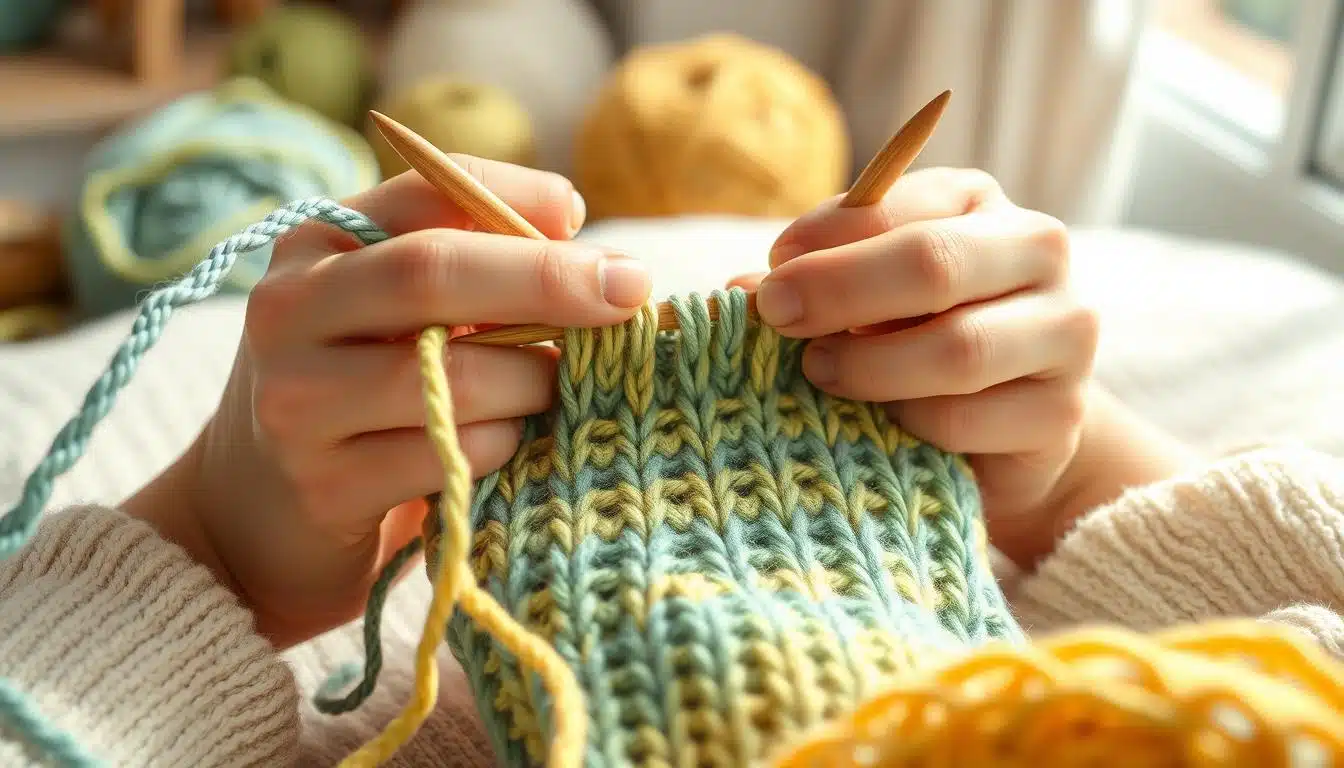
Welcome to learning continental style purling. This guide is for knitters who want to purl faster but keep their stitches neat. You’ll find tips on technique, tool recommendations, and project ideas like simple knit cardigans.
Instagram is full of short videos and photos showing how to purl. If you like written instructions, check out this tutorial on continental knitting.
This guide suggests yarns from DROPS and Scheepjes for your practice swatches. DROPS Paris and DROPS Safran are great for cotton swatches. DROPS Nepal or DROPS Snow are perfect for warm pieces. Scheepjes Catona is ideal for finer work.
Continental purling is a small change that makes a big difference in speed. This guide promises clear instructions, useful tools, and projects that are easy to wear. Next, we’ll explore why continental purling is faster and how to make it comfortable for long sessions.
Key Takeaways
- Continental style purling streamlines the purl stitch continental for faster, more efficient knitting.
- Instagram and short video demos are excellent for visual learners practicing motion and tension.
- Affordable yarns like DROPS Paris, DROPS Nepal, and Scheepjes Catona are ideal for practice swatches.
- This guide balances technique, tool choices, and wearable project ideas such as neutral cardigans.
- You’ll learn faster purling without sacrificing stitch quality or comfort during long knitting sessions.
Why Choose Continental Style Purling for Faster Knitting
You’re looking for a way to knit faster and ease your wrists. Continental style purling uses your left hand to move the yarn. This makes your motions smaller.
Social clips on Instagram show how it saves seconds per row. These seconds add up, making it great for repeat pieces.
Speed advantages compared to English and Combined styles
Continental vs English purling shows a big difference in motion. English purling needs bigger hand swings. Combined styles might have extra steps.
Continental keeps the loop tight and quick. This means you knit faster, which is a big plus for most knitters.
Ergonomics and reduced hand movement for long sessions
Ergonomic knitting is all about small, consistent moves. Continental reduces wrist rotation and limits yarn travel. This means your hands get tired less on long projects.
You’ll feel less strain during long sessions. You’ll also pause less to shake out tension.
How continental purling fits into modern knitting habits and capsule crafting routines
Modern knitters value time, cost, and wearability. Capsule knitting projects like neutral cardigans or scarves benefit from a fast method. Using affordable yarns like DROPS Paris or Scheepjes Catona keeps costs down while you build speed.
Faster knitting continental makes finishing staples for your capsule wardrobe easier. It saves you time and effort.
| Aspect | Continental | English | Combined |
|---|---|---|---|
| Typical hand motion | Small, finger-led | Large, wrist-led | Mixed, variable |
| Ease of switching between knit/purl | Fast transitions | Slower transitions | Depends on hybrid |
| Suitability for long sessions | High — ergonomic knitting benefit | Moderate — more fatigue | Variable — may inherit drawbacks |
| Best for capsule knitting projects | Yes — speeds repeat work | Less ideal for speed | Selective use |
| Learning curve | Moderate, rewarded by speed | Easy for beginners | Moderate to steep |
Getting Started: Tools, Yarn, and Needle Choices for Continental Purling
You’re ready to try continental purling and knit faster. First, pick the right tools and yarn for a smooth practice. Changing needle type and yarn can make a big difference.
Best needle materials for smooth yarn pickup (metal, bamboo, acrylic)
Choose needles that fit your hand and yarn. Metal needles are fast and good for smooth fibers. Bamboo needles are great for cotton or mohair, helping with stitches.
Acrylic or plastic needles are a good middle ground. They’re light and easy on your wallet.
When looking for needles, feel the tip and surface with your yarn. Sharp tips are good for tight stitches. Rounded tips are better for delicate yarns.
Yarn recommendations based on fiber content — cotton, wool, alpaca, blends
Start with smooth, single-ply yarns for even tension. Cotton and mercerized cotton show stitches well. Wool and blends are good for even tension.
Alpaca and mohair are soft but hide mistakes. Use neutral colors for practice. Lighter shades help see stitches.
Using DROPS and other popular yarns as practice options
DROPS and Scheepjes yarns are great for practice. DROPS Paris and Scheepjes Catona are good for cotton projects. DROPS Snow Uni Colour and DROPS Nepal are for warm garments.
Save DROPS Air or DROPS Kid-Silk for delicate textures later.
| Yarn | Fiber | Best Use | Approx. Price (USD) |
|---|---|---|---|
| DROPS Paris | 100% cotton | Practice swatches, dishcloths, summer garments | $1.80 |
| Scheepjes Catona | 100% mercerized cotton | Sturdy practice swatches, colorful accessories | $2.55 (sale) |
| DROPS Snow Uni Colour | 100% wool | Warm garments, clear stitch definition | $2.20 |
| DROPS Nepal | 65% wool, 35% alpaca | Textured sweaters, cozy projects | From $2.25 |
| DROPS Belle / Safran | Blends: cotton/viscose/linen / 100% cotton | Summer tops, textured practice | Varies |
Match needle materials with your yarn. Metal needles are fast with DROPS Paris. Bamboo needles work well with Scheepjes Catona.
Acrylic needles are budget-friendly with DROPS Paris. Try different needles to find the best for you.
Keep it simple with small swatches in neutral colors. This helps with tension. Try different needles to see what works best for you.
How to Hold Your Yarn and Needles in Continental Purling
Getting a good continental yarn hold is all about small, careful steps. Look at Instagram close-ups from real knitters to see different ways to wrap your yarn. Changing where you wrap the yarn can affect the size and feel of your stitches.
Try using DROPS cotton, DROPS Nepal, or Air to see how different yarns change your control.
Finger placement and tension control techniques
Your index finger is key for controlling tension. Let the yarn go over your index and under your thumb for stability. If your stitches are too tight, loosen the wrap. If they’re too loose, tighten it a bit.
Try wrapping the yarn once around your index for more control, which is helpful with cotton. Cotton has less stretch than wool.
Use short rows to test changes in your finger placement. Look for even loops and consistent stitch height. Try different needles, like metal for smoothness or bamboo for grip, to see how they affect your tension.
Common holding variations and how they affect stitch formation
The yarn-over-index method gives quick feed and finer tension. Wrapping the yarn around your pinky makes your stitches more elastic and can soften purl ridges. Each way changes how your stitches spring and drape, which is important for matching sleeve and body gauge in a capsule wardrobe piece.
Below is a quick comparison to help you pick a hold that fits your project and yarn choice.
| Hold | Effect on Tension | Best For |
|---|---|---|
| Yarn over index | Finer, more consistent tension | Lightweight cotton and gauge-critical pieces |
| Looped around pinky | More elastic, forgiving tension | Bulky wool, textured stitches |
| Index over, thumb stabilizing | Balanced control with stable stitch formation | Sweaters and cardigans needing matched gauge |
Adjusting for left-handed and right-handed knitters
If you knit left-handed, mirror the same wraps for effective left-handed continental purling. Mirror the index wrap and thumb placement so your purl tension matches right-handed results. Many left-handed knitters find it helpful to copy video clips, then slow them down to match hand motions.
For side-by-side comparison of knitting styles and smooth switching between grips, check a concise guide like the one at continental vs English knitting. Use small swatches in DROPS yarns to fine-tune finger placement continental techniques until your tension control purling feels natural.
Mastering the Continental Style Purling Technique
Ready to improve your knitting rhythm? Start with a clear motion and practice daily. These steps break down the purling technique into small actions. Repeat them until you get it right.
First, bring the yarn forward. Use your right-hand needle to hook it from back to front. Then, rotate the needle so the loop slides onto it smoothly. This simple sequence is the heart of continental purling.
Practice in short sessions. Aim for 10-minute drills, five days a week. Start slow for accuracy, then speed up in five-row sets. Use affordable yarns like DROPS Paris or Scheepjes Catona for swatches. This way, you can fix mistakes without wasting expensive yarn.
- Position yarn in front and relax your fingers.
- Hook yarn with the right needle tip from back to front.
- Rotate the needle to draw the loop through the stitch.
- Slip the old stitch off the left needle and settle the new stitch on the right.
Video and photo practice are key. Short Instagram clips can help you get the timing right. Pause and mimic, then replay at half speed. Use images that match your needle size and fiber for a realistic practice.
Make your drills specific. Try these purling drills: five rows at slow pace, five rows at comfortable pace, five rows slightly faster. Repeat with stockinette and 1×1 rib to mimic real garment rows. This builds muscle memory for scarves, cardigans, and small projects.
If you spot a run of knit stitches where purls should be, you likely missed a purl. To fix missed purls, ladder down carefully to the error. Pick up the dropped loop with a crochet hook or needle, and re-form the purl stitch without losing surrounding tension. Using wool like DROPS Snow helps you see stitch definition while you troubleshoot.
Uneven tension solutions start with small relaxations. Loosen your grip on the yarn and reset finger placement between rows. Try wrapping the yarn around a different finger or shifting the yarn path across your palm. Re-knit a short practice swatch, then compare tension and adjust needle size if needed.
| Practice Focus | Drill | Goal |
|---|---|---|
| Hooking motion | 10 minutes daily; slow to steady | Precise loop pickup every time |
| Tempo building | 5x row sets: slow, medium, fast | Increase speed without dropped stitches |
| Pattern mimicry | Stockinette and 1×1 rib swatches | Transfer skill to real projects |
| Fix missed purls | Ladder down and rework loop | Correct error without ripping back |
| Evening tension | Relaxation exercises and needle swap | Smoother stitch appearance across rows |
Tension and Gauge Control When Purling Continental
Get ready to tame that sneaky tighter purl. In continental purling, your purl stitches often pull in more than your knits. This creates uneven fabric and surprises at the fitting stage. You want a consistent gauge for wearable pieces like a capsule wardrobe cardigan.
How tension differs between knit and purl stitches
When you purl continental, your yarn passes in front and gets hooked with a different motion than the knit stitch. This change in path nudges the yarn tighter around the needle. You might notice purl rows sit higher and look denser when you compare them side by side.
If your purl rows are tighter, try loosening the finger that holds the yarn. A small slack makes a big difference. Practice a few lines and watch how the fabric evens out.
Blocking, swatching, and measuring gauge
Start with swatching continental: knit at least a 4×4 inch square. Use the same needles and yarn you plan to wear in the finished piece. For realistic results, choose a neutral yarn such as DROPS Paris or a recommended DROPS blend.
After you finish, block the swatch following the fiber’s care instructions. Blocking knit gauge evens stitches and shows the true stitch count per inch. Measure across the middle of the swatch for accuracy.
Adjusting needle size and yarn choice to match pattern gauge
If your blocked swatch reads too few stitches per inch, try a smaller needle. If you have too many stitches per inch, go up a needle size. Adjusting needle size may be all you need to reach pattern tension.
Fiber choice matters. Cotton tends to sit tighter, while alpaca and some wool blends drift looser. Use DROPS yarn specs to compare recommended needle sizes and fiber behavior before you commit to a full project.
| Issue | Quick test | Fix |
|---|---|---|
| Tighter purl rows | Compare an unblocked knit row vs. purl row | Loosen yarn finger, swatching continental, or go up 0.5–1 US needle size |
| Stitch gauge too dense after blocking | Measure blocking knit gauge across 4 inches | Use a larger needle or switch to a looser fiber like an alpaca blend |
| Stitch gauge too loose | Count stitches per inch on blocked swatch | Try a smaller needle or tighter yarn such as cotton |
| Uneven tension between rows | Inspect row contrast in swatch | Practice tension continental purling drills, then re-block and re-measure |
Keep your swatches, note needle sizes and yarn batches. That habit saves time and keeps your garments fitting the way you planned.
Continental Style Purling in Colorwork and Stranded Knitting
Continental purling colorwork makes motifs crisp and yarn untangled. Start by placing your dominant yarn on your index finger and the contrast on your ring finger. This method makes switching colors in stranded knitting easier.
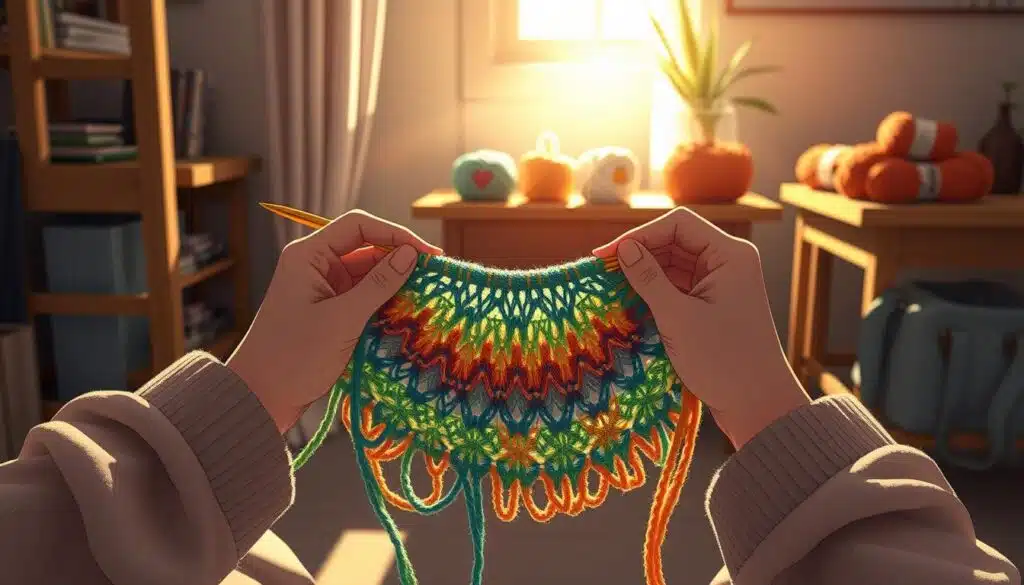
Watch short clips on Instagram for tips on tensioning two yarns. These clips show how to carry and anchor yarns. Try small drills to build muscle memory for purling two colors.
Managing multiple yarns with continental tensioning
Set a clear tension rule for each hand. Place one yarn over your index finger and the other over your ring finger. Keep the working yarns untwisted to avoid snagging.
If floats are more than five stitches, catch them gently. Anchor floats by twisting the yarns together behind the work every few stitches. This keeps the back tidy and prevents snagging.
Float control and avoiding yarn snags in DROPS-style fibers
Choose fibers with good grip for stranded work. Wool blends like DROPS Nepal and DROPS Snow work well with floats. Slippery fibers like DROPS Paris need looser floats and careful purling to prevent splitting.
When using cotton or slick singles, test your floats on a swatch. Pinch a mock seam and slide your hand along the floats. If stitches catch, loosen your tension and anchor more often.
Tips for fair isle, jacquard, and mosaic knitting with purling
For fair isle, keep color changes predictable and limit stranded length. Use neutral palettes for wearable yokes. This makes the pattern easy to wear with everyday outfits.
Mosaic and jacquard are great for continental purlers because they use slipped stitches and shorter floats. Practice pattern rows slowly until your hands learn the rhythm. For more tips, check out stranded colorwork knitting tips.
- Anchor floats: twist yarns every 4–6 stitches on garments.
- Alternate tension: test different finger wraps until your purl rows look even.
- Pick fibers wisely: choose wool blends for resilience and stitch clarity.
Fixing Mistakes and Common Continental Purling Errors
Making mistakes is part of learning to knit and continental purl. This guide helps you fix twisted purls, dropped stitches, and uneven tension. Don’t worry, just grab a crochet hook or some scrap yarn and fix it.
How to spot and fix a twisted purl
A twisted purl has the wrong leg leading. If a stitch leans or the V looks wrong, it’s twisted. To fix it, slide the stitch onto the left needle, rotate it, and place it back.
For tight stitches, use a small crochet hook to untwist without dropping other loops.
Correcting a dropped stitch continental-style
If a stitch drops, start laddering down to that row and pick it up with a crochet hook. For hard ladders, run a lifeline first, then work the stitch up with the hook.
When correcting a dropped stitch, pull the ladder through each rung. This ensures the stitch is correct before placing it back on the needle.
Placing lifelines and using scrap yarn
Lifelines are great for keeping your work safe. Thread scrap yarn through your stitches every few inches or before a tricky part. If you mess up, rip back to the lifeline and start again.
Use cheap yarns like DROPS Paris or Scheepjes Catona for practice and lifelines. This way, mistakes won’t cost much.
Rescuing tension without ripping back rows
For uneven rows, try gentle fixes before ripping. Block-and-relax can help many fibers. Soak the piece, shape it, and watch the stitches settle.
You can also use a tapestry needle with matching yarn to even out stitches. These methods save time and keep your work intact.
Practice tips and quick workflow
Practice slowly with scrap yarn, cast on, and rip back, then repeat. Try different continental purl versions until you find what works best for you.
Watch short Instagram clips for visual tutorials and compare methods on forums like a continental troubleshooting thread.
| Problem | Quick Fix | Tool | When to use |
|---|---|---|---|
| Twisted purl | Rotate stitch on needle or use crochet hook to untwist | Crochet hook, left needle | Single twisted stitches or tight purls |
| Dropped stitch | Ladder down and pick up with hook; use lifeline if present | Crochet hook, scrap yarn | Any dropped stitch that spans few rows |
| Uneven tension | Block, run a tapestry needle to even, or loosen yarn hold | Tapestry needle, water/blocking tools | Across a row or localized tight/loose areas |
| Frequent errors while learning | Place lifelines frequently and practice with cheap yarn | Scrap yarn, safety pin | Swatches, cardigan fronts, capsule wardrobe pieces |
Combining Continental Purling with Other Techniques
Mixing continental purling with other methods speeds up and refines your knitting. Short videos on Instagram make learning easy. Watching hands move helps you master switching continental English smoothly.
Begin with basic steps for switching. Carry the unused yarn along the back or front, depending on the stitch. Keep your tension even and let your fingers guide the yarn transfer. Practice changing grips between rows until it feels natural.
Use practice yarn like DROPS Paris or DROPS Snow to test new techniques. These yarns highlight stitch definition and elasticity. You can see how continental brioche textures bloom and how continental cables sit in stockinette in small swatches.
Integrate continental purling with brioche and cable work by assigning roles. Use continental purling for long, repetitive sections to save energy. Save English-style throws for fiddly starts, tight cast-ons, or when you need to create a specific tension quickly.
Here are practical moves to try:
- Bring the yarn forward or back in one smooth motion when you switch styles.
- Anchor tension with a finger loop for continental brioche so the slipped stitches stay even.
- When working continental cables, hold cable stitches on a needle and purl continental on surrounding rows to speed reversal rows.
Decide when hybrid approaches improve flow by weighing time and accuracy. If your project is a neutral cardigan for a capsule wardrobe, use continental purling for body panels. Reserve English or hybrid knitting techniques for decorative edges. This saves time while keeping accents crisp.
Lastly, debug transitions by filming yourself. Compare your clip to short tutorials from known brands and designers you trust. Repeating short drills will make the switch seamless, so your projects look intentional and professional.
Practice Projects to Hone Your Continental Purling Skills
Start with small, easy projects. They help you get faster and more confident. Look for projects that focus on the purl stitch, without complex patterns.
Try simple exercises like swatches and timed drills. Make dishcloths that you can finish in one evening. These projects help you practice and keep track of your progress.
Simple swatches and tension exercises using common yarns
Cast on 30–40 stitches and knit 20 rows. Then, measure and repeat with different needles and yarns. This shows how tension changes.
Quick accessories: dishcloths, scarves, and knit cardigans in neutral tones
Dishcloths are great for checking tension and neat edges. Scarves help you practice rhythm. Start with a simple cardigan to work on consistent gauge and finishing.
Using affordable yarn options like DROPS Paris and Scheepjes Catona for practice
Use cheap yarns that show stitch detail well. DROPS Paris cotton is good for dishcloths. Scheepjes Catona is great for small accessories. For small garments, try DROPS Snow or DROPS Nepal for clear stitch definition.
Follow a free video or a focused guide to improve your purling. Check out Purling Tips: How To Purl Continental for tips on pacing and tension.
| Project | Size | Recommended Yarn | What to Practice |
|---|---|---|---|
| Swatch | 10×10–20×20 cm | DROPS Paris | Gauge, needle size, tension |
| Dishcloth | 8×8 in | Scheepjes Catona | Edge neatness, consistent purling |
| Scarf | 6×50 in | DROPS Snow | Rhythm, long-row tension |
| Cardigan prototype | Sample size | DROPS Nepal | Seaming, finishing, consistent gauge |
Keep a log of your practice. Note the needle size, yarn, and your thoughts after each session. Over time, you’ll improve and tackle bigger projects with ease.
Ergonomics and Comfort: Knitting Posture for Continental Purlers
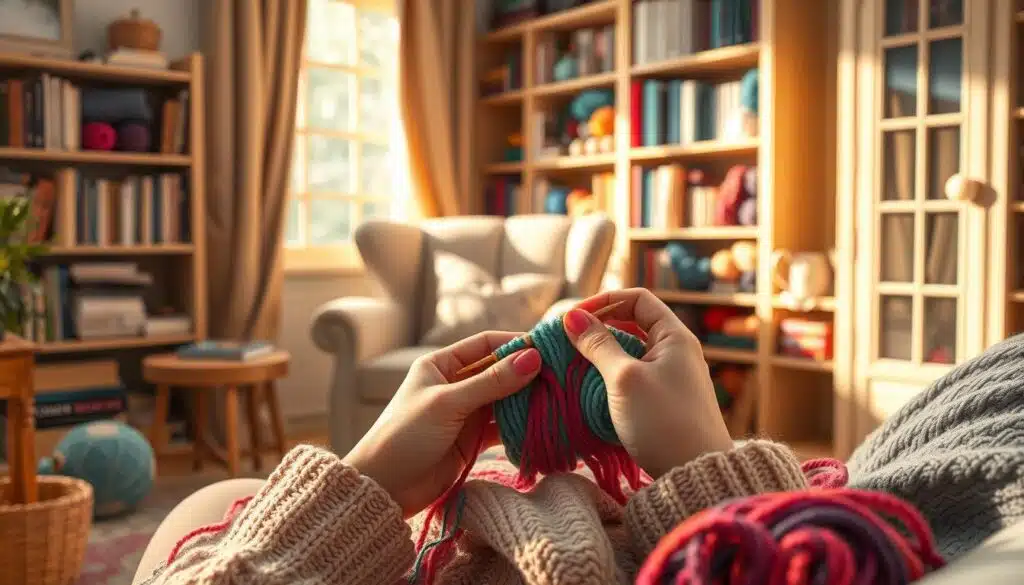
Enjoy long knitting sessions without sore shoulders or numb fingers. A good setup keeps your shoulders relaxed, wrists neutral, and eyes comfortable. This lets you focus on your stitch rhythm, not aches.
Small changes to your chair, lighting, and lap support make a big difference. These changes are key when you practice continental purling for hours.
Setting up your comfortable knitting station
Start with a supportive chair that has good lumbar support and an adjustable seat height. Place your feet flat on the floor so your knees form a right angle. Keep your work at a height that lets your forearms rest lightly on your thighs or a lap cushion.
This prevents hunching and promotes proper knitting ergonomics continental practice.
Lighting and accessories that help
Use adjustable task lighting to brighten stitch detail without harsh shadows. A daylight bulb helps you see color and texture when working with DROPS Paris or Scheepjes yarns. Use a project bag or lap desk to stabilize needles and yarn.
These small aids support knitting posture purling while making it easier to switch positions.
Breaks, stretches, and timing
Plan short sessions of 15–30 minutes with a brief break between blocks. Stand, walk, and do wrist flexor and extensor stretches to prevent knitting strain. Add gentle shoulder rolls and neck turns to release tension.
Swap to a different project or a lighter yarn to avoid long marathons.
Simple stretches to use between rounds
- Wrist flexor stretch: extend one arm, palm up, and gently pull fingers back with the other hand for 15–20 seconds.
- Wrist extensor stretch: extend one arm, palm down, and pull fingers toward you for 15–20 seconds.
- Shoulder rolls: slow circles forward and backward for 10 repetitions each direction.
- Chest opener: clasp hands behind your back and lift slightly to counteract hunching.
Choosing chairs, lighting, and extras
Look for ergonomic chairs from Herman Miller or Steelcase for investment-level support. A simple adjustable desk lamp with a daylight LED is enough for most projects. Keep a small foam cushion or a folded towel for lap support to stabilize your needles.
These choices help prevent knitting strain and keep your pace steady.
Quick checklist to optimize your setup
| Item | Why it helps | Action |
|---|---|---|
| Supportive chair | Maintains neutral spine and reduces shoulder tension | Choose adjustable height and lumbar support |
| Adjustable task lighting | Improves stitch clarity and reduces eye strain | Use a daylight LED near your work area |
| Lap cushion or lap desk | Stabilizes needles and keeps forearms supported | Position to lift work to elbow height |
| Project rotation | Breaks repetitive motion for joints | Alternate small and large projects using affordable yarns |
| Timed breaks | Prevents fatigue and reduces strain buildup | Set a timer for 15–30 minute knitting blocks |
Adopting these measures tightens your focus on technique while keeping comfort first. Good knitting posture purling habits help you enjoy continental speed without later aches. Treat your setup like a craft tool; the right comfortable knitting station will keep you knitting longer and happier.
Advanced Continental Purling Tips and Speed Tricks
Want to knit faster without losing stitch quality? Start with a five-minute warm-up. Watch quick clips from advanced knitters on Instagram. Notice their finger paths and rhythm.
Try finger-looping continental to reduce hand movement. Loop yarn around your index finger. This makes the motion smooth and efficient.
Before tackling a purl-heavy chart, spend two minutes on pattern reading. Mark repeat anchors and note flipped stitch symbols. This helps you purl smoothly without getting lost.
Choose yarns that are fast to knit with. Wool blends like DROPS Nepal are clear and forgiving. Cotton yarns like DROPS Paris or Scheepjes Catona are good for practice. Save mohair-silk blends like DROPS Kid-Silk for accents, as they add texture but slow you down.
Before a long purl section, use a simple checklist:
- Set needle material for slip: metal for slick yarns, bamboo for more grip.
- Mark pattern repeats with a removable stitch marker.
- Try a short trial row using finger looping continental to test tension.
Work smart with a quick yarn-evaluation table. Compare fiber feel, speed, and best uses. This helps you pick the best yarns for speed.
| Yarn | Fiber Characteristics | Speed Potentia | Best Use |
|---|---|---|---|
| DROPS Nepal | Wool-alpaca blend; slightly rustic loft | High — glides with clear stitches | Staple sweaters, quick cardigans |
| DROPS Paris | Mercerized cotton; durable, smooth | Medium-High — steady for practice | Dishcloths, summer tops, swatches |
| Scheepjes Catona | Egyptian cotton; vibrant, strong | Medium — great for tight gauge practice | Accessories, sample pieces |
| DROPS Kid-Silk | Mohair-silk; airy halo, delicate | Low — slower but decorative | Shawls, accents, lightweight trims |
End each session with three minutes of slow knitting. This solidifies muscle memory for speed techniques. Small, steady practice is better than sporadic marathons.
Conclusion
Continental style purling is fast, ergonomic, and perfect for a capsule wardrobe. You can use simple tools and affordable yarns like DROPS Paris or Scheepjes Catona. Short Instagram drills help keep you motivated and improve your speed and stitch consistency.
As you practice, focus on small wins. These include steady tension, clean stockinette, and avoiding twisted stitches. Use a practical yarn palette like DROPS Snow and DROPS Nepal. This way, mistakes won’t hurt your budget.
Combine deliberate practice with an ergonomic setup and social learning. Follow visual tutorials and quick drills to build muscle memory. For more context or personal notes on purl variations, check out this discussion: continental purling observations.
Remember these knitting tips: practice regularly, choose the right yarns, and use methods that reduce strain. Doing so will help you master continental purling. You’ll create wearable cardigans and scarves that are stylish, without sacrificing speed or quality.
FAQ
What is continental style purling and why should you learn it?
Continental style purling is a way to knit where you hold the yarn in your left hand. You use your fingers to control the tension. This method is faster and easier on your hands than other styles.
It’s great for making lots of simple items like cardigans. This is because it saves time and effort.
How much faster is continental purling than English or combined styles?
Continental purling is quicker than other methods. Time-lapse videos show how fast it is. It’s faster because you move your hands less.
With practice, you’ll see how much time you save. This is true for big projects like scarves or cardigans.
Which needle material works best for continental purling?
Choose needles that feel right with your yarn. Metal needles are good for fast knitting with smooth yarns. Bamboo or wood needles work better with slippery yarns.
Start with cheap needles to practice. Changing needles can change how your stitches look and feel.
What yarns do you recommend for learning continental purling?
Use easy-to-work-with yarns for practice. DROPS Paris and Scheepjes Catona are good for swatching. They’re cheap and easy to fix if you make mistakes.
For clear stitches, try DROPS Snow or DROPS Nepal. DROPS Belle or DROPS Safran are great for summer projects. Save mohair/silk blends for when you’re more confident.
How should you hold the yarn and needles for consistent purl tension?
Hold the yarn with your left hand. Use your left thumb to keep the needle steady. Move your right needle smoothly to create a purl stitch.
Adjust how tight you wrap the yarn for different yarns. This keeps your stitches even.
What common yarn-holding variations affect stitch size?
Holding the yarn differently changes how tight your stitches are. Wrapping it over your index finger makes them tighter. Looping around your pinky makes them looser.
Some knitters wrap under their index or use multiple fingers. Try different ways to find what works best for you.
How do left-handed knitters adapt continental purling?
Left-handed knitters do the same thing but with their right hand. They use their left needle to purl. Watch videos to learn how to hold your hands.
What’s the step-by-step motion for a continental purl?
Bring the yarn to the front. Use your right needle to approach the stitch from right to left. Hook the yarn from back to front, then rotate the needle.
Practice slowly at first. Short videos can help you get the rhythm right.
How should you structure practice drills to build muscle memory?
Practice for 10 minutes a day. Start with 5 rows at a comfortable pace, then 5 rows trying to be smoother. Repeat this 5 times.
Time yourself and try to beat your time each day. Use cheap yarns like DROPS Paris for practice.
Why do my purl rows look tighter than my knit rows, and how do I fix it?
Purl stitches often look tighter because of how you hold your hands. Swatch a 4×4 inch sample and block it. Measure your stitches and rows.
Try using a larger needle for purl rows. Loosen your grip or practice relaxing it. Blocking and steam can also help even out your tension.
How do I swatch and check gauge for a garment like a cardigan?
Knit a swatch that’s at least 4×4 inches in the stitch pattern you’ll use. Block it like you will finish the garment. Measure your stitches and rows.
Compare these measurements to the pattern’s gauge. Adjust your needle size or yarn choice as needed.
Can you use continental purling for colorwork and stranded knitting?
Yes. Hold one yarn over your index and the other over your ring or pinky. This keeps the tensions separate. Wool blends are good for colorwork because they don’t snag.
Anchor long floats every few stitches. Watch videos for tips on hand positioning.
How do you manage floats and avoid yarn snags in colorwork?
Keep floats loose but not too long. Anchor them every 4–6 stitches. Choose yarns that handle floats well, like wool blends.
Practice on small swatches to find the right tension for floats.
What’s the easiest way to fix a twisted purl or a dropped stitch?
Identify the problem stitch. Twisted purls have the wrong leg leading. Rotate the stitch on the needle or use a crochet hook to fix it.
Use lifelines when trying new techniques. This way, you can easily go back to a safe point if you make a mistake.
Should you use lifelines when practicing continental purling?
Yes, use lifelines on wearable projects like cardigans. They save you time and frustration when you need to rip back. Affordable yarns like DROPS Paris or Scheepjes Catona are good for swatching.
How do you rescue tension issues without ripping back entire rows?
Try running a tapestry needle or crochet hook across a few stitches to tighten them. Steam or block the area to relax fibers. For small fixes, ladder down to the mistake and reknit just those stitches.
If many rows are off, a lifeline makes fixing them easier.
How do you switch smoothly between continental and English styles within one project?
Read the row ahead to know when purl-heavy sections are coming. Move the yarn to the other hand and re-tension when switching. Many knitters use continental for most stitches and English for tricky parts.
Practice switching on swatches to avoid pauses in your knitting.
Can you combine continental purling with brioche and cable techniques?
Yes. Use continental for simple rows and switch to English for tricky parts. Continental is faster for basic stitches, letting you focus on complex patterns.
What are simple practice projects to develop continental purling?
Start with 8×8 inch dishcloths or 4×4 inch swatches in DROPS Paris or Scheepjes Catona. Move to scarves in DROPS Snow or DROPS Nepal, then try a simple cardigan. These projects help you practice and make useful items.
How should you set up your knitting station for long continental purling sessions?
Sit in a supportive chair with good lumbar support. Use bright task lighting and stabilize your project with a lap cushion or bag. Take breaks every 20–30 minutes to stretch and change yarn types.
What stretches and posture tips reduce strain while purling?
Simple wrist stretches and shoulder rolls help. Keep your elbows close to your body and shoulders relaxed. Change hand position often. Short, frequent sessions with affordable yarns are best for practice.
What advanced tricks speed up continental purling without losing stitch quality?
Learn finger-looping to move your hands less. Read pattern repeats ahead of time to prepare for purl-heavy rows. Choose yarns that are smooth and easy to knit with, like wool blends.
Save mohair or silk blends for when you’re more confident and want a softer look.
How do you choose yarns for speed vs. stitch definition?
For speed and clear stitches, pick wool or wool-blend yarns. DROPS Snow and DROPS Nepal are good choices. For durable items and practice, use cottons like DROPS Paris and Scheepjes Catona.
For a soft, airy look, use mohair blends like DROPS Kid-Silk. These are slower to knit but worth it.
Where can you find video demos and community tips for continental purling?
Instagram has lots of short videos on continental purling. Search hashtags and follow experienced knitters for tips. Practice with inexpensive yarns to get the hang of it.