
If you’ve ever wanted to make yarn sparkle, beaded knitting is for you. It turns simple items like shawls and scarves into dazzling pieces. You’ll learn to add beads to your stitches, making them shine.
There are many ways to add beads, like using a crochet hook or a beading needle. Brands like Crystal Palace Yarns offer patterns for these projects. You can also find unique designs on Etsy.
Projects range from light shawls to bold necklaces. You’ll learn essential techniques from guides and tutorials. This way, your beaded knitting will look amazing.
Key Takeaways
- Beaded knitting adds shine and texture to garments and jewelry.
- You can use a crochet hook, pre-stringing, or a beading needle for placement.
- Seed beads knitting with Miyuki beads suits fine lace and delicate trims.
- Brands like Crystal Palace Yarns and Artyarns are good sources for beaded projects.
- Yarns such as silk-cashmere and mohair blends provide ideal drape for beaded lace.
Introduction to beaded knitting: why beads transform your knits
Beads add more than just sparkle to your knitting. They bring weight, texture, and tiny focal points. This makes your scarf shimmer, your shawl have weighted edges, or your cuff have small accents.
Beaded knitting changes how your knitting looks and feels. A bead stitch can make your fabric feel like a watch chain. Beads can catch light, contrast with bulky yarns, or add texture to trims.
The history of beaded knitting is rich and surprising. It dates back to old techniques in Europe and the Middle East. Today, it’s popular thanks to seed beads and online platforms like Ravelry and Etsy. Craftsy and other makers have made it easy for everyone to try.
This post will guide you with practical tips. You’ll learn about tools, methods, and stitches. There are project ideas, tips for fixing mistakes, and advanced techniques like wire knitting.
By the end, you’ll see how beads are more than just decoration. They’re a design choice that changes your knitting.
Essential tools and beads for beaded knitting projects
Make your beaded knits shine with the right tools. Match bead size to yarn type. Use size 6/0 and 8/0 beads for worsted to fine yarns. For heavy embellishments, go for larger beads and strong yarn.
Choosing seed beads vs. glass beads vs. specialty beads
Miyuki seed beads are great for uniform looks. They’re perfect for lace-weight yarn. Czech glass beads offer wide color ranges and sparkle. Metal and crystal beads add shine but require strong yarn.
For dense designs, consider hole size and bead diameter. A quick guide on materials and techniques is available here.
Needles, crochet hook, and tools for adding beads
Choose needles that match your pattern gauge. Use US 2½–4 (3.0–3.5 mm) for light yarns. A 0.6 mm steel crochet hook is good for adding beads.
Don’t forget beading tools like bead threaders and magnifier lamps. Store beads in bags or jars to avoid spills.
Pre-stringing beads vs. on-the-fly beading: pros and cons
Pre-string beads for designs with many beads per row. It’s faster and keeps beads evenly spaced. But, it takes time upfront and requires accurate bead counts.
On-the-fly beading is better for occasional beads or flexibility. The crochet-hook method adds beads as you knit. It’s slower but flexible. Choose pre-stringing for dense patterns and on-the-fly for scattered accents.
| Choice | Best use | Typical tools |
|---|---|---|
| Miyuki seed beads | Fine lace, consistent looks, best beads for knitting detailed patterns | Beading needle, fine thread, pre-string beads |
| Czech and glass beads | Color variety, sparkle, medium-weight projects | 0.6 mm crochet hook, bead storage, magnifier |
| Specialty metal/crystal beads | Focal points, weighted edges, jewelry-style knits | Sturdy yarn, larger needles, beading tools knitting like pliers for spacers |
Remember, choose smooth yarns for beadwork. Check yarn for knots before stringing. For more on bead knitting history and techniques, see the linked overview above.
Basic beading techniques every knitter should master
Adding beads to your knitting can change everything. Your choice of method depends on bead size, project size, and how many beads you need. Here are three reliable ways to place beads exactly where you want them.
Slip-stitch bead method
The slip-stitch bead method uses a small crochet hook to add beads to your knitting. It’s quick and great for adding beads now and then without pre-stringing. It’s perfect for trying out designs or adding sparkle to hats or cuffs. Use a 0.75–1.5 mm steel hook with smooth seed beads for the best look.
Crochet hook beading
Crochet hook beading is easy and forgiving. You can pick a bead, place it on a stitch, and then knit. It’s fast and doesn’t require much planning. It works well with fingering or sport weight yarn for a handwoven look.
Pre-strung beads technique
The pre-strung beads technique involves threading beads onto yarn before starting. It’s ideal for bead-heavy shawls and lace where beads need to be evenly spaced. You can count beads and plan your yarn, which is helpful for patterns with lots of beads. Make sample counts to know how many beads each repeat needs and how much extra stringing you’ll need.
Beading needle for knitting
For tiny seed beads like Miyuki Delicas, use a fine beading needle and strong thin thread. A beading needle lets you put beads in places regular yarn can’t. Pull the needle through the stitch to anchor the bead, making it snug. This method is great for jewelry-grade details or fine accessory work.
| Technique | Best use | Tools | Speed |
|---|---|---|---|
| Slip-stitch bead method | Occasional beads, samples, trims | Small crochet hook, bead strand | Fast |
| Crochet hook beading | On-the-fly placement, flexible designs | Fine crochet hook, seed beads | Fast to moderate |
| Pre-strung beads technique | Bead-heavy shawls, consistent counts | Pre-strung yarn or thread, planning tools | Slower prep, fast working |
| Beading needle for knitting | Tiny seed beads, jewelry-grade detail | Fine beading needle, strong thin thread | Moderate to slow |
Beaded knitting stitches and patterns you can try
You want sparkle and structure in equal measure. This section offers compact, practical options. You’ll find a lace-forward bead stitch pattern, delicate filigree knitting with beads for shawls, and tidy bead trims knitting ideas for edges and cuffs.
Bead stitch basics: The bead stitch is a 4-row lace repeat often worked in multiples of seven stitches. It creates a columned fabric that looks like interwoven bead strands when beads are added. Typical moves include knit, purl, K2tog, P2tog, P2tog tbl, yarn over, slip, and pass slipped stitch over. Use lifelines for safety when you try charted repeats.
A sample approach is to mark the seven-stitch repeat on your chart and place beads on designated yarn-over edges. This adds weight and sparkle while preserving the lace flow. Advanced knitters will appreciate how the bead stitch pattern plays with negative space and texture.
Filigree projects: Filigree knitting with beads suits shawls and cowls that need light drape and a hint of glam. Patterns such as Arabesque-style or enter-the-dragon inspired motifs pair well with silk-cashmere or mohair-silk blends. Use needles in the US 2½–4 range to keep lace open while keeping beads snug.
Place beads at motif centers or along the YO edges to enhance blocking and add subtle weight. Working beads into charted lace requires patience, but the result is an elegant, jewel-like fabric that hangs beautifully.
Trims and edgings: Bead trims knitting offers fast couture upgrades for scarves, cardigans, and cuffs. Simple bind-offs with beads, beaded picot edges, and bead-stitched picot bind-offs give garments a polished finish without complex lace work.
Try adding beads to cuff rows or the last few bind-off stitches to dress a plain sweater. Tutorials and short practice swatches will help you master placement and tension before you commit to a full garment.
Mix small sample swatches: one in the bead stitch pattern, one in filigree knitting with beads, and one with bead trims knitting. Compare drape, bead placement, and yarn choice to decide which method suits your next project.
Designing unique patterns with beads
Begin with a solid plan to avoid sagging in your beaded knitting. Sketch the repeat and choose your yarn. Test a small swatch to ensure everything works well.
Charts help mark where to place beads. For charted beaded lace, use a symbol for each bead type. Note rounds for pre-stringing. Mark beads on yarn-overs or slipped stitches for motif repeats.
Consider multiples when planning repeats. Many bead motifs need counts like seven or nine for symmetry. Lay out repeats on paper or in software before starting.
Think about bead weight when designing shawls and wraps. Beads can make a shawl hang beautifully or unevenly. Use lighter seed beads in the lace and heavier beads for borders or focal points.
Choose yarns that support beads without losing shape. Silk and silk blends work well. Mohair adds halo and softness for a floaty drape. Always swatch with beads and block the sample to judge final hang.
Create focal areas with intention. Place bead clusters at crescent points, along borders, or at motif centers. Keep the rest of the fabric lighter to avoid a droopy piece.
Plan bead counts for symmetry. Pre-calc how many beads each repeat, edge, and cluster will need. When pre-stringing, annotate your chart with bead counts per round for even tension.
For bead motif knitting, try contrast: matte yarn with sparkly beads. Experiment with small clusters, single-line borders, and spaced bead stitches. See what complements your stitch pattern without overloading the fabric.
Beaded knitting for jewelry and accessories
You can turn a simple knit into wearable art with a few careful choices. Use fine cashmere, silk, or fingering-weight yarn with Miyuki seed beads or small glass beads. This makes slinky necklaces and refined cuffs.
Denser bead placement gives jewelry-like stiffness. Sparse beads keep the fabric soft and drapey for everyday wear.
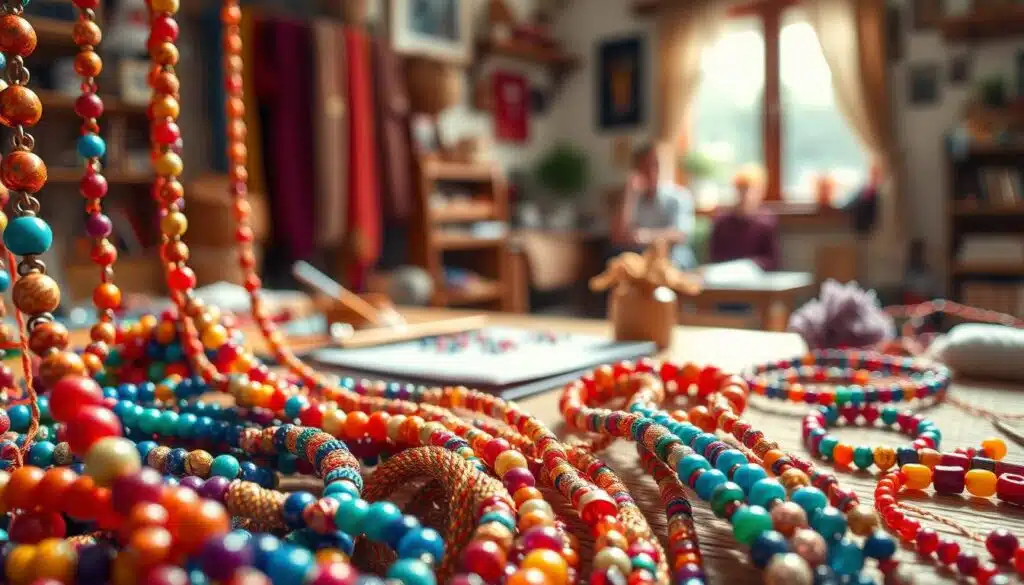
Knitted bead necklaces and cuffs: yarn and bead pairings
Choose yarn and beads with matching scale. A lightweight yarn plus size 11/0 or 12/0 seed beads produces delicate, elegant results. This makes the jewelry look like it’s made of knitted beads, not craft samples.
Fingering yarn with glass beads creates crisp stitch definition for beaded cuffs knitting. Cashmere or silk feels luxurious against skin, perfect for a necklace that sits like a ribbon.
Beaded earrings and lightweight wire-knitted jewelry techniques
For sculptural pieces, use thin wire with tiny seed beads. Wire holds its shape, so you can make hoops, drops, or geometric components that last. Techniques drawn from wire crochet and bead crochet let you build lightweight pieces.
These pieces read as wire knitted jewelry while staying comfortable to wear.
Turn knits into wearable jewelry: blocking, finishing, and closures
Block gently to set shape without soaking metal beads that might tarnish. Use professional findings—lobster clasps, magnetic closures, and jump rings—to make your pieces feel finished. Reinforce end stitches with stitching or a short length of wire.
This protects the beadwork during wear and aids in finishing beaded knits that must withstand daily use.
Troubleshooting common beaded knitting problems
Creating beaded projects should be smooth, but sometimes issues arise. This guide will help you tackle bead slipping, fix mistakes in lace, and learn how to wash your beaded knits. This way, your work will last longer.
Preventing bead slippage and uneven tension
Start by making a swatch with beads to see how they affect your tension. If beads slide, try a smaller size or tighten the stitch. Use lifelines in lace repeats to protect your work from tension changes.
Match the bead hole size with your yarn. Miyuki and Toho beads work well with fingering and lace yarns. For heavier yarns, use size 6/0 beads. Test needle sizes with beads to keep stitches even and prevent slipping.
Fixing mistakes with beads in lace and bead stitch patterns
If you find an error in a beaded lace, pause and use a lifeline. This way, you won’t have to frog too much. Use a fine crochet hook or dental floss threader to move beads without breaking yarn.
Pre-strung beads are easier to move back if needed. For place-bead methods, return the stitch to the left needle and rework the sequence. This keeps the lace pattern intact while fixing the beads.
Care, washing, and longevity of beaded knits
To wash beaded pieces, hand-wash in cool water with mild detergent. Avoid agitation to prevent bead damage. Lay pieces flat to dry on a towel to prevent distortion.
Metal and crystal beads can tarnish if wet. Dry them quickly and store flat or rolled to prevent snagging. For more on bead placement, check this practical guide with visual notes.
| Problem | Quick Fix | Preventive Step |
|---|---|---|
| Beads sliding down rows | Tighten the stitch before sliding bead; move bead to locked position | Choose smaller bead size; test bead + yarn on a swatch |
| Uneven tension near beads | Block gently after finishing; use lifeline when working repeats | Swatch with beads; adjust needle size to compensate |
| Misplaced bead in lace | Use crochet hook to remove and re-place bead; unpick to lifeline if needed | Place beads as instructed (PB) and mark chart repeats |
| Yarn damage from beading tool | Trim and secure fibers, replace bead if yarn weak | Use a fine hook or SuperFloss; avoid sharp tools that shred |
| Tarnish or bead degradation | Air-dry fully and buff metal beads gently | Store flat; keep away from moisture and perfumes |
Project ideas and pattern resources for beaded knitting
Ready to make your stash shine? Start with small projects that boost your skills and confidence. Choose ones that teach you about bead placement, tension, and how beads affect fabric without taking too long.
Beaded shawls and cowls inspired by popular patterns
Try making shawls like Enter the Dragon or designs by Stephen West and Evelyn A. Clark. Use silk-cashmere or mohair blends to make them. This helps you practice spacing and weight, keeping lace light and flowing.
Scarves, cuffs, and small mindless projects for bead practice
Go for garterbands, beaded edge scarves, or cuff bracelets. They’re great for mastering repetitive motions. These projects are perfect for practicing pre-stringing and slip-stitch without complex shapes. They’re also great for gifts.
Where to find free and paid patterns, Ravelry and independent designers
Look for beaded knitting patterns on Ravelry, Etsy, and designer websites. Use curated collections to compare different patterns. This helps you find the right one for your project. For more ideas, check out creative project collections that also include beading.
Ravelry is a great place to start for beaded patterns. It has filters and user projects. Mix that with magazine issues and independent designers for step-by-step guides. This combination speeds up your learning and keeps your project list exciting.
Advanced techniques and creative experiments
Want to explore new ideas in knitting? Mix yarn with metal and unusual materials. Knitting wire with wool creates firm shapes that hold their form well. Adding wire knitting beads gives your work a shiny, structured look, perfect for cuffs, collars, or unique jewelry.
For a three-dimensional look, group beads tightly to resemble small flowers on your fabric. Bead clusters knitting works best with careful planning. Place heavier beads on edges to keep the fabric flowing smoothly while maintaining the lace’s delicacy.
Adapting complex lace charts to include beads requires a detailed plan. Your trusted bead stitch guide should offer step-by-step instructions and repeat counts. Use markers and lifelines to keep track of your work, and knit a swatch to check the fit and placement.
Try modular knitting: create a wire-bordered motif as a detachable accent or sew beads into a yoke. For a structured approach to colorwork with beads, consider the Domestika course on designing with colored beads. It offers step-by-step techniques and a sweater project to adapt. Design and Knit with Colored Beads
When combining elements, balance is key. Too many heavy beads can distort the shape of your garment. Use bead stitch guidance to align motifs, save bead clusters for highlights, and alternate plain rows to keep the fabric flexible.
Don’t be afraid to experiment and document your work. Advanced beaded knitting lets you mix different materials and scales, from subtle to bold. Your next piece could be wearable art or refined jewelry, depending on how you blend wire, beads, and traditional knit structures.
Beaded knitting for beginners: starter projects and tips
Ready to add sparkle without a meltdown? Beaded knitting for beginners is perfect for beginners. Start with a simple project, learn one bead placement method, and repeat until you feel comfortable.
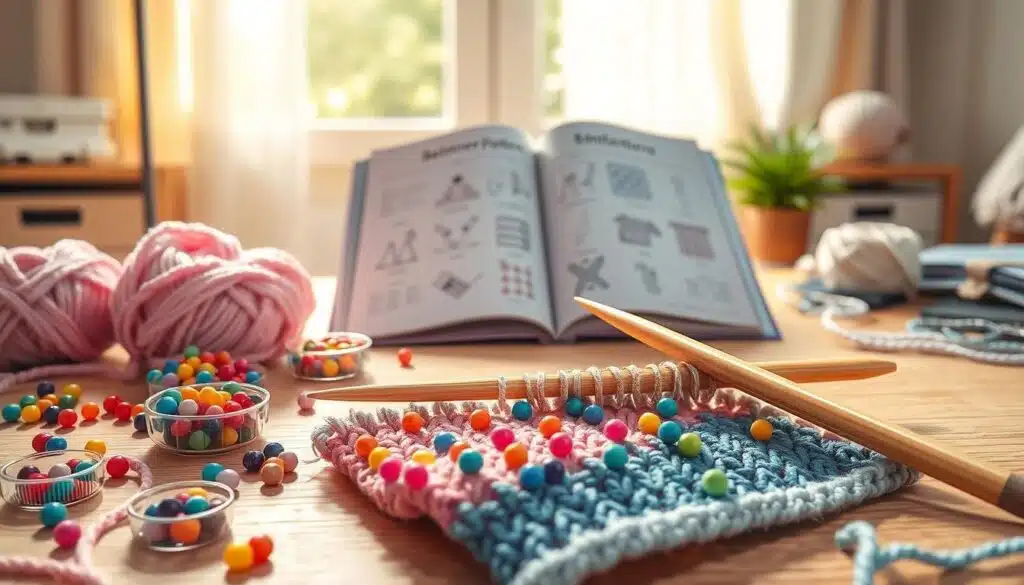
Begin with a small, satisfying project. A beaded edge scarf or a beaded garter band is great. You work straight rows, place beads only on the bind-off or a single edge row, and finish with a piece you can wear the same day.
Simple first projects: beaded edge scarf or beaded garter band
Choose a fingering or light fingering yarn and pick a neutral color to show off beads. Use size 6/0 or 8/0 seed beads from Miyuki or Czech suppliers for smooth, even results. Cast on a narrow band, knit garter stitch for practice, then add beads to the last few rows or bind-off.
These beginner beaded projects let you focus on bead placement, tension, and rhythm without battling shaping or lace charts. You get a polished edge and a quick confidence boost.
Step-by-step practice drills: pre-stringing, slip-stitch placement, and lifelines
Pre-string 10–20 beads onto your yarn. Slide them along, place one with a crochet hook onto a single stitch, then repeat across a short swatch. This drill trains your hand and eye.
Practice slip-stitch placement on 6–12 stitch swatches. Work the stitch pattern, add a bead, and keep going. Use lifelines before any long repeat. A lifeline saves you time and keeps mistakes from turning dramatic.
Recommendations for bead sizes, needle sizes, and yarn pairings for beginners
For smooth workflow, choose seed beads in 6/0 or 8/0. Try fingering or light fingering yarn in silk blends or merino for easy bead sliding and good drape. Test a tiny swatch to decide needle size.
Typical lace needle sizes for beaded projects are US 2½–4 (3.0–3.5 mm). You may go one size up or down based on your swatch. These adjustments lock in gauge and keep beads sitting neat.
Keep these beginner bead knitting tips in your toolkit: pre-string for steady rows, choose smooth yarn for bead movement, and use lifelines before complex work. Small practice pieces add up to big skills.
Conclusion
Beaded knitting adds texture, weight, and sparkle to clothes and jewelry. Learn the basics like the crochet-hook slip-stitch and using a beading needle. Choose beads and yarns that mix drape with durability.
Start with small motifs and beaded trims. Then, move on to complex lace like the bead stitch. This will help you build confidence and keep your stitches even.
Want to try beaded knitting? Begin with swatching to check tension and drape. Pick a simple project like a beaded edge scarf or cuff. Use lifelines for tricky bead stitches.
Look for patterns on Ravelry or Etsy for ideas. Watch video stitch tutorials for step-by-step help. This will help you improve your skills and work faster.
When you’re ready for more, focus on finishing and caring for your beaded pieces. Handle them gently and wash by hand. Dry flat and store them carefully to avoid damage.
With regular practice and experimenting with bead placement, you’ll create beautiful, lasting pieces. Start small and watch your skills grow.
FAQ
What makes beaded knitting special?
Beads add sparkle and texture to knitting. They change how a piece looks and feels. Beads can make lace-like patterns or create focal points.
They also add weight, which changes how the fabric drapes. This makes shawls, cowls, and scarves look unique.
Is beaded knitting a modern trend or historically rooted?
Beaded trimming has been around for a long time. But today, it’s popular thanks to easy-to-find beads and online resources. Places like Ravelry and Etsy make it easy to find patterns and beads.
Designers on YouTube and in magazines keep the craft exciting. They share new ideas and techniques.
What will I actually learn from a beaded knitting guide?
You’ll learn about tools and methods. You’ll learn how to use seed beads and glass beads. You’ll also learn about different stitches and how to fix common problems.
There are tips for making jewelry and experimenting with new techniques. It’s a guide to making beautiful beaded projects.
How do I choose between Miyuki seed beads, Czech glass beads, or specialty beads?
Miyuki seed beads are good for small projects. They have uniform size and tiny holes. Czech glass beads add color and sparkle.
Specialty beads like metal or crystal add weight and shine. But they need stronger yarn and bigger needles.
What tools do I need for adding beads to knits?
You’ll need a small steel crochet hook and fine beading needles. You’ll also need thin thread for seed beads. Use your project needles for knitting.
Good lighting and bead storage are also important. A bead threader can be helpful too.
Should I pre-string beads or add them on the fly?
Pre-stringing is best for heavy bead patterns. It’s fast and ensures even distribution. But it takes time and requires accurate bead counts.
Adding beads on the fly is better for occasional beads. It’s quick and doesn’t require pre-stringing. Choose pre-stringing for dense lace and slip-stitch for scattered beads.
How does the slip-stitch method with a crochet hook work?
Use a tiny crochet hook to pick a bead and slide it onto the stitch. It’s quick and doesn’t require pre-stringing. It’s great for placing occasional beads.
Many short video tutorials show how to do it efficiently.
How do I place pre-strung beads in the right spot while knitting?
Slide beads along the yarn into position as you reach their target stitch. Plan bead counts and strand layout in advance. This is important for lace or motif repeats.
Pre-stringing multiple identical strands helps maintain symmetry. This is useful for items like shawls that need consistent bead counts on both sides.
When do I need a beading needle and thread instead of threading beads onto yarn?
Use a fine beading needle and thin thread for tiny Miyuki seed beads. The bead is anchored to the stitch by passing the needle and thread through the stitch and seating the bead. This gives precise placement and is ideal for jewelry-grade filigree.
What is the bead stitch and why might I choose it?
The bead stitch is a 4-row lace repeat. It yields an organic, interlaced pattern resembling bead strands. It uses common lace moves and benefits from lifelines due to its complexity.
It’s perfect for shawls and fabrics where beads emphasize columns and motifs.
Which yarns work best for beaded lace shawls and cowls?
Choose yarns with drape and strength. Silk-cashmere, mohair-silk blends, and fine fingering or lace-weight yarns are favorites. They show beads and block beautifully.
Mohair adds halo and softness but can hide beads. Silk blends give sheen and slide beads nicely.
How do beads affect drape and tension?
Beads add weight, which enhances drape but can alter gauge and tension. Lighter seed beads keep fabric delicate; heavier glass or crystal beads add substantial weight.
Always swatch with beads to test tension and drape. Be prepared to adjust needle size or yarn choice.
How can I create strong focal points with beads?
Concentrate beads in clusters, motifs, or along borders. Place bead clusters at crescent points, motif centers, or edges to draw the eye. Plan bead counts for symmetry and block carefully to emphasize focal areas without overburdening the fabric.
What are good beginner projects for practicing beaded knitting?
Start small: beaded bind-offs, beaded edge scarves, a beaded garter band, or a cuff. These let you practice pre-stringing, slip-stitch placement, and tension control without complex shaping.
Mindless projects with repetitive rows are great for bead rhythm.
How do I prevent beads from slipping or causing uneven tension?
Match bead hole size to yarn, use an appropriate bead size (6/0 or 8/0 for fingering yarn), and swatch with beads. Insert lifelines in lace repeats to protect work.
If tension tightens when beads are added, try a slightly larger needle or a smoother yarn to help beads slide.
I misplaced a bead in a lace repeat—how do I fix it?
Use lifelines to rip back safely. If you don’t have a lifeline, carefully unpick to the error and use a crochet hook to remove the bead, then re-place it correctly.
For pre-strung beads, slide beads back along the strand as needed. For tiny seed-bead attachments with thread, re-sew the bead into place.
How should I care for beaded garments so they last?
Hand-wash gently in cool water, avoid agitation, and dry flat. Keep metal and crystal beads dry to prevent tarnish.
Store flat or rolled to prevent snagging and minimize stress on bead attachments. Reinforce ends and closures when finishing jewelry or frequently handled items.
Where can I find beaded knitting patterns and inspiration?
Look on Ravelry and Etsy, in knitting magazines, designer websites, and Pinterest collections. Indie designers and yarn shops like Crystal Palace Yarns and Artyarns often publish beaded shawls and cowls.
Video tutorials and StudioKnit-style stitch guides are invaluable for technique demos.
Can I combine beading with wire knitting or mixed-media elements?
Yes. Wire knitting and bead crochet combine well with knitted beads for sculptural jewelry and accents. Use wire for structural pieces like earrings, and pair it with seed beads for lightweight, wearable art.
Mixed-media elements broaden textural and structural options.
What are textural techniques using beads—clusters, weighted edges, sculptural elements?
Cluster beads for 3D motifs, add heavier beads to hems for weighted edges that enhance drape, and experiment with sculptural elements using wire or denser bead placements.
Balance weight across the piece to avoid distortion and test designs in small swatches.
What bead sizes and needle sizes do you recommend for beginners?
Start with size 6/0 or 8/0 seed beads (Miyuki or Czech) and fingering or light fingering yarn. Typical needle sizes for beaded lace are US 2½–4 (3.0–3.5 mm).
Use smooth yarns like silk blends or merino for easier bead sliding and better drape.
How many beads might a typical beaded shawl use?
It varies widely—light trims may use a few dozen; dense beaded shawls can use several hundred to over a thousand beads. Plan counts before pre-stringing and consider dividing beads into multiple strands for symmetry and manageability.
Any tips for finishing beaded jewelry—closures, blocking, and longevity?
Use professional jewelry findings—clasps and jump rings—to finish knitted necklaces or cuffs. Block gently without soaking delicate metal beads. Reinforce ends with sewing or wire where beads meet closures to prevent slippage, and choose tarnish-resistant beads or seal metal beads when appropriate.
How do I integrate bead placement into stitch charts and repeats?
Annotate charts with bead symbols or note bead rounds in the written instructions. For repeats like the bead stitch (multiples of 7), plan beads on specific yarn-overs or slipped stitches to echo the motif. Annotated charts help when pre-stringing and ensure repeat consistency.
Where should I practice special drills like pre-stringing, slip-stitch placement, and lifelines?
Make short practice swatches: slide 10–20 beads onto yarn and place them by slip-stitch, then knit a few rows to test tension. Repeat slip-stitch placements until the rhythm feels natural. Insert lifelines before attempting multi-row bead stitches to make correction simpler.