Ever felt stuck with a pattern full of abbreviations? Crochet symbols offer a quicker way. A clear crochet symbol chart lets you see stitch flow and repeats easily. This means you spend less time figuring it out and more time crocheting.
The Craft Yarn Council symbols are now common in many patterns. Once you learn them, they become as easy as US stitch abbreviations. This visual approach maps each row or round stitch-by-stitch. It bridges language gaps, making international designs easier to work with.
This guide is like your own shorthand for clarity. You’ll learn why a single symbol often mirrors how a stitch looks on your work. You’ll see why charts pair well with written directions and where to check the pattern key. If you want patterns to feel quicker and more intuitive, mastering a crochet symbol chart is a smart step. Start by skimming a standard key or download the Craft Yarn Council PDF. Try following a single round of a motif to see how the pieces align.
Key Takeaways
- Crochet symbols let you visualize stitch placement and flow quickly.
- The Craft Yarn Council symbols are widely used and easy to learn.
- A crochet symbol chart reduces language barriers in international patterns.
- Charts work best when paired with the pattern key and written notes.
- Start small: follow one round of a motif to build confidence.
For a practical walkthrough and downloadable symbol key, see this helpful resource on how to read crochet chart symbols from Yarnspirations.
Why Crochet Symbol Charts Make Patterns Easier for You
More patterns from Lion Brand and Red Heart now include charts. These symbols make it easy to see stitches at a glance. This saves time and helps you spot repeats quickly.
The visual advantage for right- and left-handed crocheters
Most charts are made for right-handed crocheters. But, left-handed crocheters can flip them or read rows in reverse. This makes it easier to follow the design.
Charts for left-handed crocheters save time. They help avoid mistakes and keep stitch counts correct without trial and error.
How charts complement written instructions and reduce confusion
Charts and written instructions work well together. They offer both views for clarity. Written lines guide on tension and yarn changes, while charts show stitch placement and repeats.
This combo cuts down on mistakes. You can spot errors by comparing chart and written rows. Your work will look better and your tension will be even.
Language-proof patterns: reading international designs without translation
Charts are like a universal language. They help you follow designs from Japan and Europe without needing to translate. With practice, you can quickly understand these patterns.
Using charts for visual learning speeds up your crochet. It also opens up a world of designs from around the globe.
Practical takeaways you can use right away:
- Use charts alongside written directions to boost accuracy.
- Flip or mirror charts when working left-handed to match your hand movement.
- Practice reading simple international charts to expand your pattern library.
| Feature | Chart Strength | Written Pattern Strength |
|---|---|---|
| Speed of reading | Fast visual scan of repeats and placements | Slower due to linear instructions |
| Clarity for stitch placement | High; shows exact stitch locations | Moderate; relies on verbal cues |
| Ease for left-handed crocheters | Requires reversing but very effective once adapted | Works naturally if written for left-handers |
| Use with international patterns | Excellent; benefits of crochet charts shine here | Challenging without translation |
| Best for visual learning | Ideal for visual learning crochet | Better for stepwise learners who prefer words |
Understanding the Standard Crochet Symbols Used by the Craft Yarn Council
Charts can look like secret codes. The Craft Yarn Council symbols make them clear. These symbols give you a quick guide to stitches, so you can crochet faster.
Start by learning a few key marks. The chain symbol is an oval. The single crochet symbol is often an X or plus sign. T-shaped marks with slashes show double or treble stitches.
Dots, hooks, and hatch marks are for slip stitches, post stitches, and yarn-overs.
Here’s a list of main symbols you’ll see in patterns. Keep it handy while crocheting.
- Chain — chain symbol: oval (ch)
- Slip stitch — dot or small filled circle (sl st)
- Single crochet — single crochet symbol: X or + (sc)
- Half double crochet — short T with a hatch (hdc)
- Double crochet — T with one slash (dc)
- Treble — T with two slashes (tr)
- Double treble — T with three slashes (dtr)
Charts show how stitches look on the right side of your work. Post stitches have a hook shape for front-post or back-post placement. Cluster and shell symbols show grouped loops for texture.
Even with standard charts, always check the pattern key. Designers might change symbols, swap terms, or add custom marks. A quick look at the legend can save you from mistakes.
For a reliable stitch chart, visit a trusted guide. For a handy reference, try this stitch guide.
| Symbol | Common Mark | What to Look For |
|---|---|---|
| Chain | Oval | Used for starting rows, turning chains, and chain spaces |
| Single crochet | X or + | Dense stitch; check if designer uses sc for US or UK alternate term |
| Half double crochet | Short T with hatch | Mid-height stitch; often used for texture and balance |
| Double crochet | T with one slash | Common height for fabric with drape and openwork |
| Treble / Double treble | T with multiple slashes | Taller stitches; slashes show yarn-overs and stitch height |
| Slip stitch | Dot | Join, move, or tighten edge without height |
| Post stitches | Hook at base of symbol | Shows front-post or back-post insertion for raised texture |
How to Read Stitch Placement and Direction in Charts
Charts show how stitches will look on the right side of your work. This makes it easier to match textures or colors. Before starting, look for starting arrows, row numbers, and color cues to keep your place.
Row charts versus round charts
Row-based patterns are read from the bottom up. Right-side rows are numbered on the right, so you read right-to-left on those and left-to-right on wrong-side rows. Round charts are worked from the center out. Right-handed people often work rounds counterclockwise.
Using arrows, numbers, and color cues
Chart directional arrows show where to start and the flow of each row or round. Row numbers help keep things in order when there are repeats or color changes. Designers might use color blocks or letters for color changes. Look for bold marks or arrows first to avoid backtracking.
Recognizing front and back loop indicators
Stitch placement symbols are at the base of each stitch. The front loop symbol looks like a small U, pointing to work into the front loop only. The back loop symbol is an inverted U, indicating to insert behind the front loop.
Post stitches and special placements
When you see a hook shape at the bottom of a symbol, it means a post stitch. This wraps around the post of a stitch instead of into the top loops. This visual clue helps you place front-posts or back-posts correctly.
Practical checklist for smooth reading
- Locate starting arrows and the first row number before you begin.
- Note whether the chart is row or round so you can follow row vs round charts correctly.
- Watch chart directional arrows and side cues to read the right way for each row or round.
- Scan each symbol’s base for front loop symbol or back loop symbol clues.
- Mark color changes and post-stitch hooks to avoid surprises mid-project.
crochet symbols
You deserve a chart that feels like a friendly map. Start by learning simple symbol-to-stitch chart matches. This way, you won’t guess where to insert your hook. The visuals mirror real stitches: ovals are chains, X or + marks single crochet, and T shapes with slashes show double and treble heights. A clear key saves time when you follow a pattern from Lion Brand or Red Heart.
Common symbol-to-stitch matches
Look for the chain symbol as an oval that links spaces. Single crochet appears as an X or a plus sign and squares the fabric quickly. Half double, double, and treble crochets use T shapes with one or two hatch marks to show yarn-overs and stitch height. When a chart lists round numbers, match that start point to your beginning chain so your rounds stack correctly.
Cluster, shell, popcorn and puff visuals
Grouped stitches use converging stems. A cluster symbol shows several vertical lines joining at the bottom, which means work stitches together into one base. Shells are fan-shaped sets of vertical lines that spring from a single point and create scallops.
Popcorn and puff stitches get dense, bolder marks on a popcorn stitch chart so you spot bulges in the fabric. The cluster symbol and compressed shapes let you place multiple loops into one stitch or chain space with confidence.
Post stitches and hook notation
Post stitch symbols tell you to work around the post of a stitch instead of the top loops. You’ll see a small curved hook or a looped mark circling a vertical line; that is your cue for front-post or back-post moves. Spotting the post stitch symbol on a chart prevents misplaced texture when you create ribbing or cables in a sweater panel.
If you want a compact guide that pairs these visuals with clear labels, check the Wispy Willow chart and Craft Yarn Council resources at crochet symbol references. Use that reference when a chart uses nonstandard icons so you never misread a special stitch.
Navigating Complex Charts and Special Notations
Complex charts can seem overwhelming, but they’re easier to understand when broken down. Start by finding the bracketed areas, which show the pattern’s main structure. Once you’ve identified a repeat block, counting becomes simple, and mistakes are easier to spot.
Reading repeats, brackets, and multiple-stitch clusters
Brackets and repeat symbols guide you through the chart. Some charts include “repeat” notes for clarity. When you see vertical lines at the top, they often mean stitches combined, like sc2tog or dc3tog. Count these as one stitch when you’re keeping track.
Understanding yarn-over indicators and hatch marks for stitch height
Hatch marks on T-shaped symbols show how many yarn-overs to do. These marks help you tell a double crochet from a treble quickly. Learning to read these marks will help you place increases and tall stitches correctly.
Notations that don’t show chain-space vs. stitch insertion—when to check the written notes
Charts often don’t show if you should work into a stitch or a chain hole. Chain space notation is rare in dense charts, so check the written notes if you’re unsure. In Granny-square patterns, clusters usually go into chain spaces, but the key will confirm this.
Key takeaways: treat stitch repeats like musical measures, repeat them until you feel confident. Count after each section. Use the legend to understand custom cluster groupings and watch for hatch marks for stitch height. If chain space notation is missing, your written instructions will guide you.
Practical Examples: Granny Squares, Doilies, and Motifs
Here’s a quick guide to help you understand charts. You’ll learn how granny squares start from the center, doilies grow in rings, and motifs need written notes. This will make your crochet projects easier.
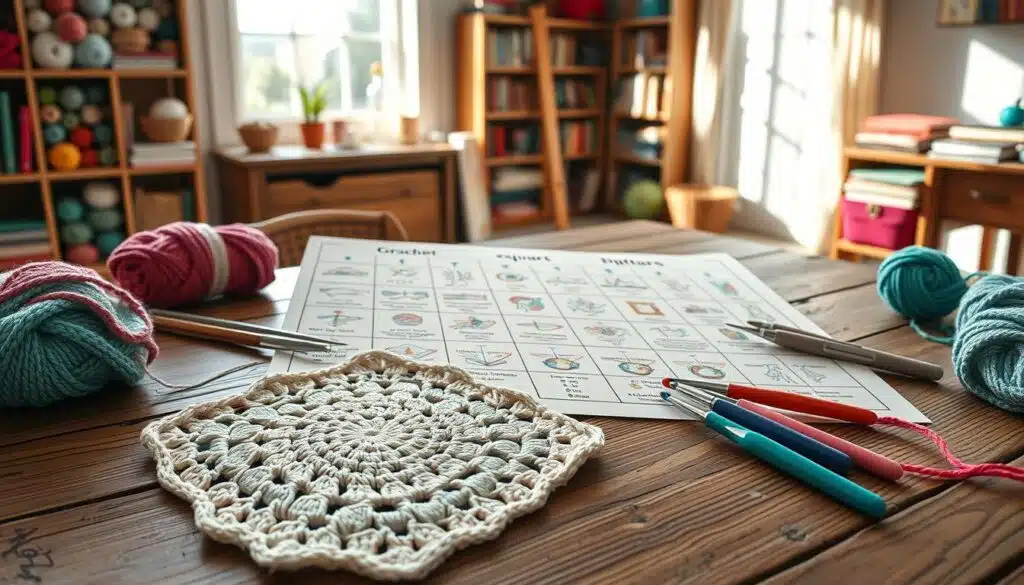
Step-by-step for a basic center-out granny project.
First, find the center ring or magic circle on the granny square chart. Look for ovals that represent chains and T-shaped symbols for double crochet. Follow the chart for the first round, then move outward, watching for clusters in chain spaces.
Tracking rounds and increases in circular doilies.
The doily chart shows each round as a ring. Look for round numbers and arrows for direction. Increases are marked as more stitches; count them at the end of each round to avoid mistakes.
Using a motif crochet chart alongside written notes.
Use the motif chart with brief written notes for clarity. Read the chart out loud to understand each step. This helps you stay on track and solve any confusion about chain spaces.
Here are quick tips to use now: find the start, count chains and stitches, track round numbers and increases, and check the chart with written instructions for chain spaces.
Tools and Techniques to Make Chart Reading Easier
Reading a complex crochet chart should be easy, not a challenge. Using digital and physical tools helps you stay on track. They help you spot repeats and finish rows without getting lost.
Digital helpers that actually speed you up
The Pattern Keeper app and other crochet chart apps are great. They let you zoom in, pan around, and mark rows as you go. You can color-code repeats and add custom markers to keep track of your progress.
Small physical items with big payoff
Stitch markers are a simple but effective tool for tracking your stitches. Use row counters to mark each row as you finish it. A magnifier helps with small threads, and printed copies let you annotate without changing the pattern.
Photograph and annotate to guard your focus
Take a photo of your chart before starting. Use your phone’s markup tools to highlight repeats and mark rows. This keeps your place and reduces distractions. Keep a backup image for different color schemes or notes.
Practical setup and workflow tips
- Open a crochet chart app and load the pattern image so you can zoom while your hands work.
- Place stitch markers at repeat boundaries and at the start of rounds to avoid miscounts.
- Use a row counter for long repeats and photograph the chart after marking each finished round.
- Print one copy to annotate and keep a clean original for reference.
Use a digital tracker like the Pattern Keeper app with classic tools like stitch markers and row counters. Photograph and annotate charts when needed. This approach keeps you confident and lets the yarn speak for itself.
Common Challenges and Smart Fixes When Symbols Mislead You
When a chart seems like a foreign language, slow down and check the pattern key. The key is there because symbols show how stitches look on the right side. If a symbol looks odd, find its definition before guessing.
If you see a symbol you’ve never seen, use online symbol libraries and community help. Haak Maar Raak guides and similar resources can help quickly. You can also ask in Reddit or Facebook groups, or watch a YouTube tutorial that shows the stitch.
Decoding rare or custom symbols
Start with the pattern key, then search symbol libraries. If nothing matches, post a clear image to a community and describe the symbol. This helps you decode custom symbols without wasting yarn.
Spotting and correcting chart errors
Compare stitch counts on the chart to your fabric. Use simple math: count stitches per round or row and match them to the pattern. If counts don’t match, you may need to fix crochet chart errors by adding or removing stitches.
How to reverse a chart for left-handed crocheters
Charts are usually for right-handed crocheters. To work left-handed, mirror the chart in your head or flip it physically. Practice on a small swatch before tackling a full project.
Keep a running stitch count as you work. This habit helps you catch mistakes early and gives data to correct errors. If a pattern lacks clarity, cross-check written notes and the key. When in doubt, a quick search or a community question often saves hours of frogging.
For a concise guide that breaks down diagram reading step by step, consult a visual resource that complements written instructions. This helps reduce language barriers and makes it easier to decode charts from other traditions. A helpful walkthrough is available at this diagram guide, and practical fixes for related mistakes are discussed at Crochet Craze.
| Problem | Quick Fix | When to Ask for Help |
|---|---|---|
| Unknown symbol in chart | Check pattern key, search symbol libraries, watch a short tutorial | If libraries and key disagree or symbol looks custom |
| Stitch count mismatch | Recount rounds/rows, apply simple math to find missing/extra stitches | When fixes alter pattern repeats or shaping |
| Unclear chain-space vs. stitch insertion | Refer to written instructions or test both on a swatch | If swatch results change gauge or shape significantly |
| Chart drawn for right handers | Flip chart or mirror mentally and work a practice swatch | When pattern has directional shaping or asymmetry |
| Custom cluster or puff symbols | Find video demos and mark up the chart with numbers | If cluster technique affects fit or drape |
Practice Projects to Build Your Confidence with Charts
Start small and smart. Short pieces help you learn symbol shapes and repeat markers. This way, you avoid long rows’ drama. Beginner crochet charts help you make fewer mistakes and work faster.
Try simple chart practice projects like coasters, dishcloths, and bookmarks. A crochet coasters chart usually has only a few rounds. You can finish one in an evening and test reading symbols aloud as you work.
Work patterns that include both written steps and charts. Cross-checking written instructions with charted rows helps you map the symbols to actual stitches. Read each row out loud: it trains your hands and your eye to follow chart flow.
After a few small wins, move to medium projects that use repeats. Blankets and garment panels often rely on blanket chart repeats. Practice blocks first, then join them into a larger piece to learn how repeats stack and how stitch counts must remain steady.
Use these focused exercises to internalize common motifs. Mini motifs and bookmarks teach you placement rules. Chart practice projects such as dishcloths teach you to spot repeat boundaries and to keep tension even across repeat blocks.
Keep a short log of mistakes and fixes. Note where a repeat shifted or where you misread a symbol. That quick record will speed up later work on larger items that depend on consistent repeats and accurate stitch counts.
| Project | Skill Focus | Time Commitment | Why it Helps |
|---|---|---|---|
| Coaster (crochet coasters chart) | Reading rounds, simple repeats | 1–2 hours | Short rounds let you master symbol pace and finishing techniques |
| Dishcloth | Row direction, edge consistency | 2–4 hours | Longer rows teach stitch placement and how written notes match charts |
| Bookmark | Small motifs, turning chains | 30–60 minutes | Fast practice for motif repeats and reading single-row charts |
| Sampler Block | Combining motifs, checking counts | 3–6 hours | Teaches how small charts map into larger panels and blanket chart repeats |
| Baby Blanket Panel | Scaling repeats, joining blocks | 8–15 hours | Shows how repeat blocks tile and where to watch stitch totals |
Exploring Global Chart Styles and Expanding Your Skills
You want to get better at reading charts and explore patterns from all over. Start by learning Japanese crochet charts. They are known for being precise and needing little text.
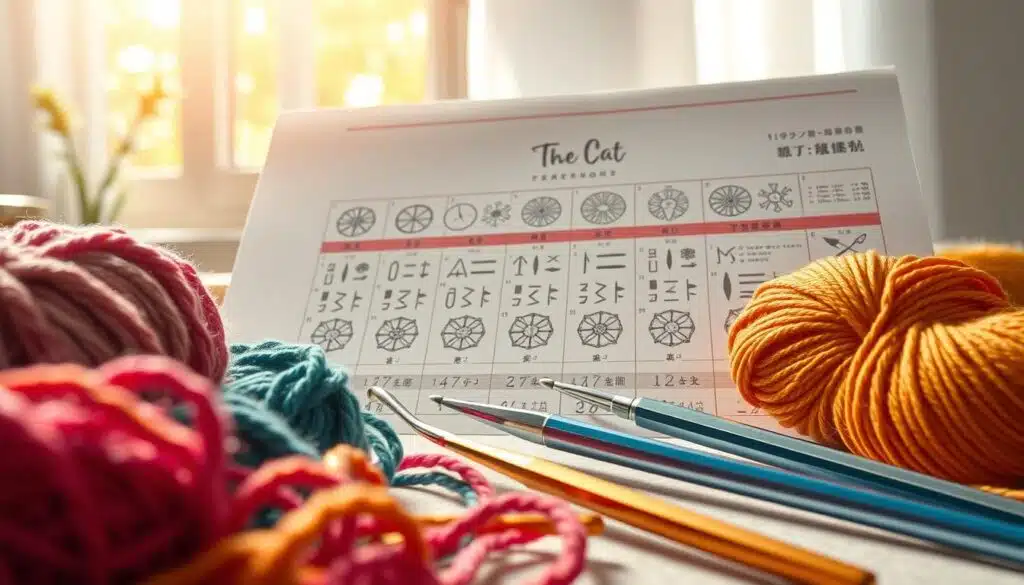
Why Japanese visuals help you learn faster
Japanese crochet charts are all about clean layouts and detailed lace motifs. They use symbols to show stitch placement clearly. This helps improve your tension and stitch memory.
Decoding UK vs US crochet symbols
UK vs US crochet symbols can be confusing if you don’t know the difference. A UK double crochet is the same as a US single crochet. Always check the legend first. Keep a quick reference guide handy and practice until it becomes easy.
Practical resources and active crochet communities
Joining crochet communities can really help you learn. Sites like Reddit, Facebook groups, and designer pages offer pattern swaps and help. Video channels like Secret Yarnery also provide step-by-step guides. For more tips, check out how to read crochet charts.
Tools and tiny habits that make a big difference
Take photos of charts, highlight important parts, and use apps to track rows. Start with small motifs from Japanese books. Then, look for the same motif in patterns from other countries to see how symbols differ.
Next steps for steady growth
Focus on understanding legends and look for UK vs US symbol differences before starting. Use tutorials and join groups when you’re stuck. With time, you’ll become more confident in adapting patterns from Japan, the UK, and more.
Conclusion
Standardized symbols from the Craft Yarn Council make charts easy to understand. Always check the pattern key to ensure you’re on the right track. These symbols are like portraits of stitches, guiding your hook and the fabric’s look.
Charts are perfect for those who learn better by seeing. They work well with written instructions. To get better at crochet symbols, read charts out loud, mark rows, and check stitch counts often.
Start with simple projects like coasters and dishcloths. Practice mirror and round charts to improve your skills. Use digital tools and join communities to learn more. With practice and the Craft Yarn Council standard, mastering crochet charts becomes fun and easy.
FAQ
What are crochet symbol charts and why should you learn them?
Crochet symbol charts are visual guides that show each stitch using icons. They make reading patterns faster and clearer. Once you learn the Craft Yarn Council’s symbols, charts become as easy to read as abbreviations.
Do charts work for both right- and left-handed crocheters?
Charts are made for right-handed crocheters, showing stitches on the right side. Left-handed crocheters can flip the chart or read it in reverse. Many also make a flipped copy to avoid confusion.
How do charts complement written instructions?
Charts give a big-picture view of stitch placement. Written instructions spell out the sequence and details. Use both to see repeats and shaping, and written notes for unclear parts.
What are the core symbols I should memorize first?
Start with the basics: oval = chain (ch), dot = slip stitch (sl st), X or + = single crochet (sc). Also, learn symbols for decreases, clusters, shells, and post stitches.
Why do symbols look the way they do?
Symbols resemble the stitch on the right side of the work. Ovals for loops, T-shapes for taller stitches, and hatch marks for yarn-overs. This visual help makes translating icons to actions quick.
How do I read row charts vs. round charts?
Row charts are read from the bottom up, alternating direction. Round charts start in the center, working outward. Look for arrows and bold marks to confirm direction.
What do hooks or curves at the base of a symbol mean?
Those hooks indicate post stitches. A small curve shows you’re to crochet around the post of the stitch. Base-of-stitch marks show front or back loop only insertions.
How do I handle repeats, brackets, and cluster symbols?
Repeats are often bracketed or boxed on the chart. Count stitches in one repeat and multiply to confirm totals. Clusters and shells appear as multiple vertical lines. Use the legend and written notes to confirm how many stitches join together.
What if a chart doesn’t show whether to work into a chain space or a stitch?
If the chart omits that detail, check the written pattern. Many granny-square and motif charts assume experienced crocheters know when a group sits in a chain space. When in doubt, count stitches, compare with the written instruction, or consult the pattern key—don’t guess, or you’ll lose the geometry.
How can I spot chart errors or mismatches with my fabric?
Count your stitches frequently and compare totals to the chart’s expected stitch count. If numbers don’t add up, isolate the problematic row or round. Check the pattern key for special notations, and consult online symbol libraries or crochet communities like Reddit and Facebook groups to see if others found the same issue.
Are Craft Yarn Council symbols universally used?
The Craft Yarn Council’s standardized symbols are widely adopted and clear, but designers sometimes tweak or use regional conventions. Always read the pattern key because some charts use custom symbols or different terminology (US vs UK terms). A downloadable PDF of the standardized symbols is available from the Craft Yarn Council for reference.
How do hatch marks indicate stitch height?
Hatch marks across a T-shaped symbol represent yarn-overs. One hatch typically means double crochet (dc), two hatches for treble (tr), etc. Counting hatch marks helps you decode stitch height at a glance—very useful for tall lace or textured motifs.
What are practical tools to keep your place on complex charts?
Use a combination of digital and physical tools: row-tracking apps (Pattern Keeper-style), PDF zoom and annotation, stitch markers, row counters, magnifiers, and printed copies you can mark up. Photograph the chart and annotate on your phone to highlight repeats or problem areas.
How should I practice reading charts if I’m a beginner?
Start small—coasters, dishcloths, bookmarks, and mini motifs are perfect. Choose patterns that include both written instructions and charts so you can cross-check. Read charts aloud as you work (for example, “chain nine, sc in 3rd chain from hook…”) to build the habit and muscle memory.
Are Japanese crochet charts different or better?
Japanese charts are prized for precision and minimal text. They use clear, consistent symbols and excellent layout, making them ideal for lace and detailed motifs. They often require fewer written notes, which is great if you rely on visual instruction—just watch for US/UK terminology differences in accompanying text.
How do I handle UK vs US terminology when using charts?
Most symbols map to US terms, but some designers use UK conventions. Remember that a UK double crochet equals a US single crochet, and cross-reference with a conversion chart when needed. Always check the pattern key and, when in doubt, consult cross-reference resources like Dabbles and Babbles or reputable crochet blogs.
What online resources and communities help with symbol decoding?
Use online symbol libraries (for example, Haak Maar Raak-style guides), YouTube tutorials (channels like Secret Yarnery), Reddit crochet communities, and Facebook groups. Designers’ websites and Ravelry pattern notes are also great for clarifying custom symbols and real-world tips.
Can charts be color-coded and how do color cues work?
Yes. Color or letter coding in charts indicates yarn-color changes, different sections, or separate strands. Legends explain the coding. Use colored highlighters or digital layers to match yarn changes to chart sections for faster, error-free knitting—sorry, crocheting.
How do I reverse a chart for left-handed crocheting?
You can mirror the chart by flipping it horizontally in an image editor or printing a mirrored copy. Or, read the chart inside-out: work rows or rounds in the opposite direction and swap right/left row numbering. For complex motifs, a flipped copy is less error-prone.
Any tips for working with complex motif charts like doilies and granny squares?
Locate the center/start mark, confirm round numbering and arrows, and track increases visually—doilies expand outward so increases appear as wider stitch groupings. For granny squares, identify chain spaces where clusters sit and count clusters per side. Combine chart reading with written instructions to resolve chain-space ambiguity.
How do digital tools improve chart reading?
Apps let you zoom, mark completed rows, and keep a persistent pointer on the active line. PDF readers with annotation help you highlight repeats. Photographing and annotating charts on your phone gives quick access and lets you track progress without marking the original pattern.
What’s the best way to learn and remember symbol meanings?
Practice consistently with small projects and mixed-format patterns. Memorize core symbols, then add clusters, post stitches, and special motifs gradually. Read charts aloud, count stitches often, and use cheat sheets of the Craft Yarn Council symbols until you don’t need them anymore.
How do I decode unfamiliar or custom symbols in a pattern?
First, consult the pattern key. If it’s missing or unclear, search online symbol libraries, ask in crochet forums, or contact the designer. Cross-reference stitch counts and test a small swatch to confirm your interpretation before committing to the full project.
Any quick rules to avoid mistakes when following charts?
Always check the pattern key, verify stitch counts per row/round, mark repeats and completed rows, and use stitch markers where repeats start and end. When symbols don’t show chain-space insertion, refer to the written notes. Small swatches catch errors early and save you frog-time later.