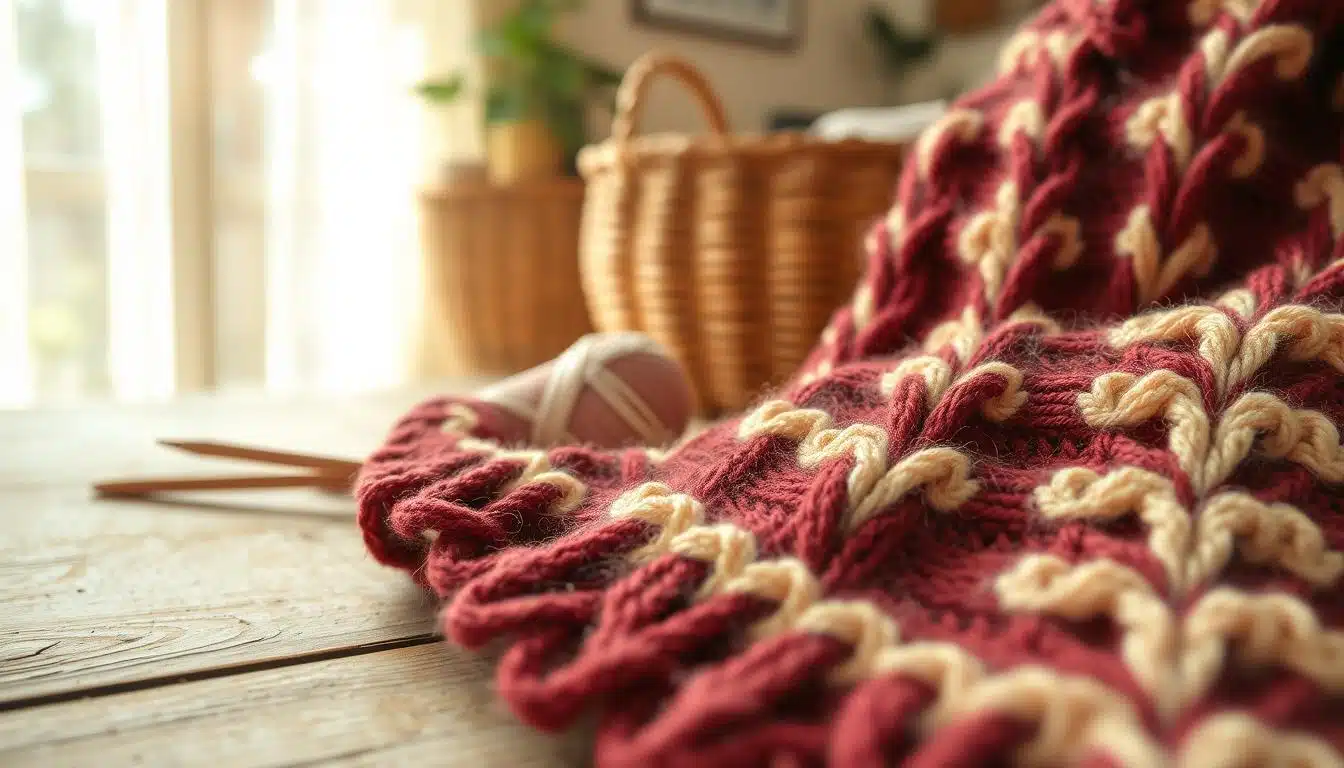
Ever wondered how to add bold twists and texture to your knitting? The knit cable technique is your fast pass to serious style. It’s simple: you work stitches out of order by slipping half onto a cable needle. Then, you hold them to the front or back, knit the same number from the left-hand needle, and knit the held stitches to create the twist.
This basic move is at the heart of any cable knitting tutorial. It makes cables surprisingly achievable for beginners.
Think of a basic sequence: slip 2 stitches onto a cable needle, knit the next 2 stitches, then return and knit the 2 held stitches. This small ritual creates the braided look people love on sweaters, hats, and scarves. If you prefer video help or a practical demo, reputable resources like Purl Soho offer clear visual guides on cable technique. Crochet Craze also collects useful knitting tips that complement this cable stitch guide.
Tools matter. Cable needles come in U-shaped, bent, and straight varieties. A bent needle can keep loops from sliding off while you practice. If you’re testing how to knit cables, double-pointed needles work as a makeshift holder. Smooth, plied yarns and wool show cable definition best, so swatch first before committing to a large project.
Key Takeaways
- The knit cable technique means working stitches out of order to form twists.
- Start with an easy slip-2, knit-2 sequence to learn the motion.
- Cable needles (bent, U-shaped, straight) help; DPNs are an alternative.
- Use smooth, plied yarns or wool for best cable definition.
- Practice swatches and short projects before tackling sweaters or large items.
Why You’ll Love Cable Knitting: Beauty, Texture, and Versatility
When you see a cable, you know it’s something special. A simple twist turns flat fabric into ropes and braids. This texture makes scarves, hats, and pillows look handcrafted, which everyone loves.
Textured knitting makes your accessories and clothes look like they were meant to be. On a beanie or the Big Alps Beanie style, rope cables stand out. On cushions and blankets, cables add depth that lasts through daily use.
What might seem fancy is actually easy to start. Beginners often begin with a short rope cable and a few turning rows. You don’t work cables every row, making it easy to follow. Video tutorials from Twice Sheared Sheep show how one twist can change everything.
Cable projects range from quick to lasting. Try a mug cozy or a classic cable hat when you’re short on time. Once you’re more confident, move on to cardigans and sweaters. Potter Craft’s 400 Knitting Stitches and stitch books help you try new things safely.
Left- and right-leaning twists give different looks. Mirror them on a sweater to frame the neckline or stagger them on a blanket for movement. If you’re looking for ideas, write down a few cable sweater ideas and think about yarn and needle choices before starting.
Start with small swatches and short projects to build confidence. You’ll learn how tension affects the twist and how background stitches highlight the cable. Ready, set, twist—your next favorite cable project is closer than it looks.
Essential Tools for Cabling: Choose the Right Needles and Notions
To make cabling easy and fun, you need a small toolkit. A cable needle is key for holding stitches while you twist. Choose one that fits your style for neat cables every time.
U-shaped, straight, bent — pros and cons
U-shaped cable needles keep stitches secure, perfect for those who value safety. Straight needles are simple and quick, ideal for those who prefer fast work. Bent needles, like those in kits, trap stitches for a smooth twist.
Alternatives to a cable needle
Want a different tool? Double-pointed needles (DPNs) can act as cable needles. They’re easy to find in your stash and are a great backup.
Recommended yarn types and why smooth, plied yarns work best
Yarn choice is key for clear cable twists. Smooth, plied yarns are best for this. Wool and other animal fibers add spring and memory, making cables stand out. Cotton, on the other hand, can make cabling stiff.
For more on essential tools, see this guide: essential knitting tools you can’t live. Try different needles and yarns to find what works best for you. Small tests can teach you more than many tutorials.
Understanding Cable Anatomy: How Crossed Stitches Create Texture
Cables are like magic, with a touch of geometry. Imagine moving stitches to a cable needle, then knitting the next ones. This simple action creates a twist, answering what a cable stitch is.
What a cable actually is
A cable is made by crossing stitches, making one set go over another. You can use a U-shaped needle or a bent one. The key is to split the stitches in half for even twists.
Background stitches vs. cable columns
Background stitches frame the cables, using stockinette, reverse stockinette, or rib. The right background makes the cables stand out. Narrow cables need tight backgrounds, while wide ones need calm ones.
Turning row cable explained
Stitches are crossed only on turning rows, not every row. These moments are the active twists. Plain rows in between prevent bunching and add rhythm. Swatching helps see how width and background interact.
- Slip the correct number of stitches to the cable needle to set the twist.
- Hold the cable needle front for a right-leaning twist, back for a left-leaning twist.
- Work plain rows between turning rows to balance texture and avoid congestion.
How to make a simple cable: easy step-by-step demo
Want to create a beautiful rope cable easily? This quick guide shows you how to make a simple cable. You’ll learn the basic steps and get tips for using a cable needle. Soon, you’ll be making cables like a pro.
Begin with a garter or stockinette fabric. Then, move to the cable area. Keep your tension even for a neat twist. For a visual guide, check out Brooklyn Tweed’s cable basics.
Step-by-step: slip stitches to a cable needle, knit, and replace
Follow these four steps for a basic 4-stitch cable.
- Slide 2 stitches onto a cable needle, slipped purlwise to keep tension even.
- Knit the next 2 stitches from the left needle.
- Slide the 2 held stitches back onto the left needle in order.
- Knit those 2 stitches
Demonstration for a basic 4-stitch cable (cb4/cf4) using exact actions
For a cb4 tutorial (cable back), slip 2 stitches onto the cable needle and hold them at the back of your work. Knit the next 2 stitches from the left needle. Return the 2 held stitches to the left needle and knit them. The twist will slant to the right.
For cf4 instructions (cable front), slip 2 stitches onto the cable needle and bring them to the front. Knit the next 2 stitches on the left needle, then knit the 2 from the cable needle. This makes a left-leaning twist.
Tips to keep stitches from slipping off the cable needle
Choose a cable needle that suits your style. A bent or U-shaped cable needle grips better. A double-pointed needle works when you’re in a pinch. Keep the cable needle close to the needles in use and keep a slight tension on the held stitches.
Practice the slip/hold/knit sequence on a small swatch until your hands remember the motion. Small holes beside the twist show where you crossed stitches; use that as a row-counting cue while you build your cable confidence.
| Action | cb4 (C4B) | cf4 (C4F) | Needle tip |
|---|---|---|---|
| Slip to cable needle | Slip 2 purlwise, hold back | Slip 2 purlwise, hold front | Bent or U-shaped CN grips best |
| Knit from left needle | Knit next 2 stitches | Knit next 2 stitches | Use slightly smaller CN or DPN as makeshift |
| Return & knit | Slip back and knit 2 from CN | Slip back and knit 2 from CN | Keep CN close to work; maintain tension |
| Result | Right-leaning rope column | Left-leaning rope column | Repeat every 4th row for stacked cables |
Reading Cable Abbreviations: Decode Patterns with Confidence
Learning a few simple rules can help you overcome pattern anxiety. Cable abbreviations follow a logical pattern: a letter, a number, and a direction. Once you understand the pattern, you’ll work faster and make fewer mistakes.
Common shorthand includes C + number + F or B. The number tells you the total stitches in the cable. Divide it by two to find out how many to slip.
For example, C4B means slip two stitches, hold them to the back, then knit two. Next, knit the two from the cable needle. A cf6 would be slip three, hold front, knit three, then knit three from the cable needle.
Patterns often list variants like C4F, C4B, C2F, and C2B. Learning these will help you decode most charts and written directions. Tutorials and stitch dictionaries offer more practice if you need it.
Here’s a quick guide to reading cable patterns:
- Read the abbreviations key before starting the row.
- Split the number to find how many stitches to slip.
- Remember if stitches are held front or back; this affects the lean.
- Check if the pattern uses purls in the cable or on wrong-side rows.
Many designers include full instructions like “Cable 6 front (k3, k3)” in the pattern notes. These notes are key to understanding stitch order, whether to purl, and any special rules.
If you come across an unfamiliar abbreviation, check it against common lists. This habit ensures your knitting stays smooth and your swatches look neat.
Mastering Direction: Cable Front and Cable Back Explained
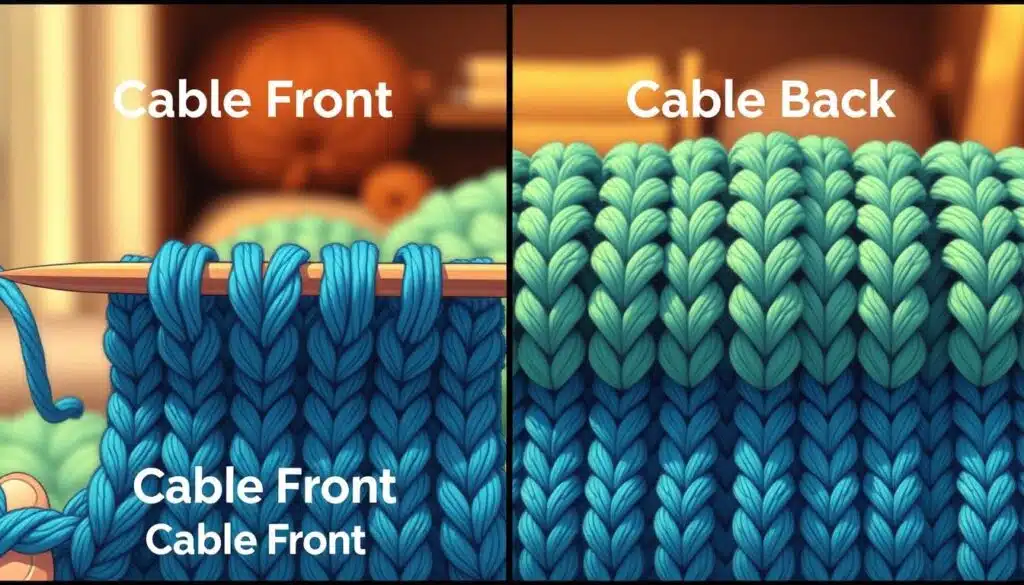
When you put stitches on a cable needle, you change the cable’s direction. If you hold it in front, the stitches are before you. This makes a left leaning cable, like a mirrored tuck. If you hold it in back, the stitches are behind. This makes a right leaning cable with a clean top stitch crossing.
Visual differences are key when planning motifs. Designers use left and right leaning cables to create braids and rope effects. Knowing how to use cable front vs back helps you follow patterns and achieve symmetry.
Want to try it out? Practice with a small swatch. Work a cf4 on one side and a cb4 on the other. Slip two stitches, hold to the front for cf4 and to the back for cb4, then knit. After blocking, compare the slant and decide which suits your design.
Here are three quick drills to build muscle memory and control.
- cf4 then cb4: Knit both on the same row so you can see the difference instantly.
- cf6 vs cb6: Use three-stitch groups to feel the extra bulk and how it alters the lean.
- Mirror repeat: Place a left leaning cable next to a right leaning cable to practice symmetry for panels and borders.
Need a concise how-to or extra tips on transfers and counts? Check out a clear tutorial and pattern notes. For example, stitch and story and Crochet Craze offer practical guidance. They show step counts that make the cable front vs back distinction obvious and simple to practice.
After a few repeats, your hands will instinctively know whether to hold the cable needle forward or back. This instinct turns a fiddly technique into a dependable tool for shaping and style.
Practice Swatch: A Simple Cable Swatch Pattern to Build Skills
Want to sharpen your skills with a simple exercise? This cable swatch is perfect for focused practice. It lets you test your tension and see how cables look against other stitches. Plus, it’s a great way to check out a worsted weight swatch before starting a sweater or hat.
You’ll need some basic materials: worsted weight yarn, matching needles, a cable needle, a yarn needle, and scissors. Choose a smooth, plied yarn for clear twists and a defined swatch.
Cast on 26 stitches. Add 4-stitch garter borders for neat edges. Knit four rows of garter to set the border, then start the pattern. This setup gives your cable room and stable edges for measuring gauge.
Follow simple row-by-row instructions. Row 1 (RS): K4, P5, K8, P5, K4. Row 2 (WS): K9, P8, K9. Repeat rows 2–5. On Row 6, make an 8-st left-leaning rope: K4, P5, slip 4 sts to a cable needle and hold to front, K4, knit 4 from cable needle, P5, K4. Continue with rows 7–10, then repeat the 10-row sequence for the stitch pattern.
Keep repeating the pattern until your swatch is 6–8 repeats tall. End with four garter rows to mirror the start, then bind off loosely. Blocking will even out the stitches and show the cable’s true shape.
After your swatch, check out easy knit shawl patterns for inspiration. Regular practice on a worsted weight cable swatch helps you keep tension even, avoid laddering, and learn about turning rows.
Troubleshooting Common Cable Problems and Fixes
You want cables that pop, not gaps that stare back at you. This guide will help you fix common cable knitting problems. You can try these fixes right now.
Handling little holes that appear in cable twists
Small holes often show when stitches are shifted during a twist. These gaps usually settle after a few rows and blocking. If they bother you, try tightening the stitch before you cross it by pulling the working yarn gently while the cable needle is held.
Swatching helps you see how often holes appear and whether blocking will hide them. If a hole persists, use the short-wrap trick to tidy the nearby purl: wrap the purl stitch under the working yarn so it sits smaller. On the next row work that stitch through the back loop to untwist it. For more detailed troubleshooting steps see a practical write-up at cable troubleshooting.
Dealing with loose or tight cable stitches and cable tension tips
Inconsistent tension causes uneven cables. Keep a steady grip on the cable needle and move the yarn into the correct position before slipping stitches. Bent or U-shaped cable needles help stop stitches from slipping off when you carry them.
Adjust needle size or your hand tension if swatches show tight or loose columns. Try smaller needles for the cable columns and larger needles for the background if your pattern allows. After repairs, block the piece to even out stitches and check whether your adjustments improved the look.
How to fix dropped stitches in a cable without unraveling the whole row
A dropped stitch in a cable need not ruin your row. Use a crochet hook or a smaller needle to pick it up. Recreate the crossing sequence by slipping the picked-up stitch over the appropriate neighboring stitches until it sits in the correct spot.
If the drop spans multiple rows, ladder the stitch up row by row, following the purl and knit bars so the stitch lands back in the twisted column. Work the rescued stitch into the next row as the pattern requires. This dropped stitch cable fix saves time and keeps your work intact.
| Problem | Quick Fix | When to Swatch |
|---|---|---|
| Little hole at twist | Tighten before crossing; short-wrap purl; block | When hole repeats on a swatch |
| Stitches slipping off cable needle | Use U-shaped or bent needle; hold stitches securely | Before starting a large project |
| Loose or tight cable columns | Adjust needle size; steady tension; alternate needle sizes for background and cable | Always, to tune cable tension tips |
| Dropped stitch in cable | Pick up with crochet hook; ladder up rows; recreate crossing | When you fear long runs of cables |
Knitting Cables in the Round: Tips for Circular Projects
Knitting cables in the round is like a magic trick. The steps are the same as flat knitting. The way you hold stitches determines if a cable leans left or right. But, you need to plan differently because circular knitting can change fit and rhythm.
Why cables behave differently on circular needles and how to plan for it
When you cross stitches on a circular needle, the fabric can pull in. This makes your piece tighter. Choose a needle that’s at least two inches longer than your finished measurement. This gives the twists room to lie flat.
If stitches are too close during a twist, you might need to stop mid-round. This can be frustrating.
Adjusting circumference and when to switch to magic loop or DPNs
If your needle makes rounds too tight, switch tools early. Magic loop cables are great for long circulars with small diameters. Double-pointed needles are best for small circumferences like hat crowns or mitten wrists.
Test a swatch before starting your project. If cables bunch and make it hard to knit the next stitch, change your method. Switching early saves time and keeps your work neat.
Converting flat cable instructions to in-the-round work (right side vs. wrong side guidance)
To convert flat patterns, treat every round as a right-side row. Follow the right-side cable directions exactly. For wrong-side rows in flat patterns, swap knits for purls and vice versa to keep the texture right.
Practice on a swatch to see how crossings sit. This helps avoid surprises when converting flat to round cables in a larger piece like a sweater or cowl.
Finishing Touches: Blocking, Swatching, and Choosing Yarn for Best Results
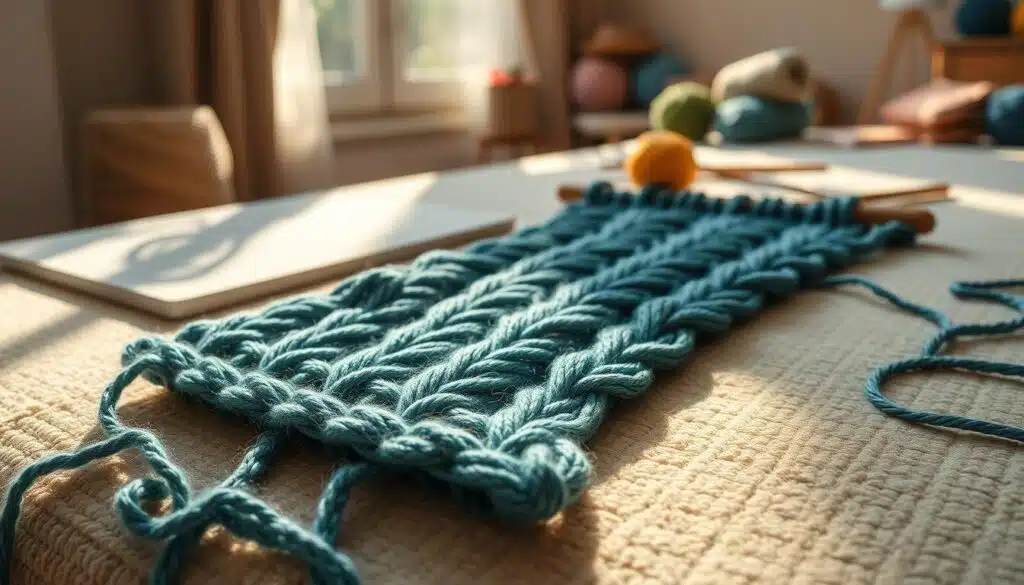
How your cables look depends on a few steps. A quick wet or steam block can make them sharp. It smooths stitches and opens twists, showing the stitch definition.
Blocking helps you see how turning rows affect spacing. It also shows how repeats look on the fabric.
Quick blocking how-to: Soak your swatch, then gently squeeze out water. Pin it to measurements and let it dry. For steam, hover an iron without pressing the fabric flat. This enhances cable ribs and keeps stitches neat.
Choosing the right yarn for cables is key. Wool gives cables natural elasticity and memory. This means twists spring back and hold their shape. Animal fibers like merino or Shetland define cable edges well without flattening the texture.
Avoid cotton for first-time cable projects. It lacks stretch and can make cables stiff.
Test with several swatches before starting a sweater. Make different sizes and try various needle sizes. This helps you find the perfect cable swatch gauge.
Swatches show how tight or loose your cables will be. They also tell you if you need to change needles or yarn.
Use swatches to check repeat placement and turning-row frequency. Mark rows and measure after blocking. This confirms the final dimensions. Resources like “400 Knitting Stitches” and video tutorials help compare yarns and see how they affect cable clarity.
Do a final check: if your swatched cables look neat after blocking and measuring, you’re ready to start the full project with confidence.
Conclusion
Now you know the knit cable technique in simple steps. It starts with a slip, hold, knit, replace, then knit. This one move can create a basic rope, a complex braided panel, or a textured cushion.
Using a bent or U-shaped cable needle makes it easy. Even a double-pointed needle works the same way. This makes learning it a breeze.
This summary shows how important it is to read abbreviations and practice swatches. It helps you quickly add new projects to your list. Paying attention to background stitches and turning rows is key. They frame the cable and keep your fabric balanced.
Using smooth, plied wool and a good blocking finish sharpens the twists. This makes your work look amazing.
For a final push, try video demos, classic stitch dictionaries, and short practice swatches. They help build muscle memory. Soon, you’ll confidently add cable texture to sweaters, hats, scarves, and home decor.
Keep knitting, experiment often, and enjoy the transformation. A small cross of stitches can turn into big style.
FAQ
What exactly is a cable in knitting?
A cable is when you move stitches out of order to twist them. You put half the stitches on a cable needle, then knit the same number from the left needle. After that, you knit the stitches on the needle. This creates the twisted look in sweaters and scarves.
Why do cables add so much visual impact to garments and home items?
Cables make fabric look textured and sculpted. They catch light and shadow, making them stand out. This contrast makes cables look professional on any item.
Aren’t cables too hard for beginners?
No, they’re not. The basic action is simple: slip, knit, replace, knit. This works for all kinds of cables. With a little practice, you’ll get the hang of it.
What projects are best to show off cables?
Hats, mug cozies, and scarves are great for beginners. Sweaters and blankets are good once you’re more confident. Try a simple beanie or mug cozy to see results fast.
What types of cable needles exist and which should I use?
There are straight, bent, and U-shaped cable needles. Bent or U-shaped ones keep stitches in place better. Choose what feels right in your hands.
Can I cable without a cable needle?
Yes, you can. Use double-pointed needles or a spare needle as a substitute. A cable needle makes it easier, though.
What yarns show cables best?
Use smooth, plied yarns like wool for clear cables. Avoid loose or textured yarns for best results.
How do background stitches affect cable appearance?
Background stitches contrast with cables, making them pop. The choice of stitches affects the overall look. Swatch to see how they work together.
Do I cable on every row?
No, you only cable on turning rows. Follow with plain rows to keep the fabric balanced.
What’s the exact step-by-step for a basic cable?
First, slip stitches onto a cable needle. Then, hold them back or front, knit the next stitches, and knit the held ones. This is the basic cable sequence.
How does a cb4 or cf4 instruction translate into actions?
The number in the instruction is the total stitches in the cable. For cb4 or cf4, split it in half. Slip 2 stitches onto the cable needle, hold them back or front, knit the next 2, then knit the 2 from the cable needle. For cb6/cf6, slip 3 and follow the same logic.
How can I stop stitches slipping off the cable needle?
Use a bent or U-shaped cable needle for security. Keep the needle close to your work and maintain steady tension. A hooked cable needle helps prevent slippage.
How do I know how many stitches to slip onto the cable needle?
Split the number in the cable instruction in half. If it says C8F/C8B, slip 4 stitches. Always check the pattern’s abbreviation key for full instructions.
What’s the difference between holding stitches to the front or back?
Holding stitches to the front (cf) makes the cable twist left. Holding them to the back (cb) makes it twist right. Designers use both for different looks.
Any exercises to feel the difference between left- and right-leaning cables?
Yes, work a small swatch with cf4 on one side and cb4 on the other. Compare after a few repeats and after blocking. This practice shows the visual difference.
Can you give a simple cable swatch pattern to practice?
Try a 26-stitch worsted swatch. Cast on 26 with knit 4-st garter borders. Setup rows knit 4 rows. Row 5 (RS): K4, P5, K8, P5, K4. Row 6 (WS): K9, P8, K9. On a cable row (Row 11 example): K4, P5, slip 4 to cable needle and hold front, K4, knit 4 from cable needle, P5, K4. Repeat rows 6–15 for the pattern, finish with 4 garter rows, and bind off. Use worsted-weight yarn and the needle size suggested on the yarn band.
Why should I swatch before a cable project?
Swatching tests gauge, tension, and cable spacing. It shows if your cable looks neat or if you need to adjust. It also helps you practice the crossings for a smooth main project.
I see small holes at cable crossings—what causes them and how do I fix them?
Small gaps come from stretched stitches during crossing. They usually blend in after a few rows and with blocking. To minimize them, keep even tension, use the right cable needle, and swatch to find the right needle size.
What if my cables are too loose or too tight?
Adjust tension or needle size. If stitches look loose, try a smaller needle or pull a touch firmer when crossing. If too tight, go up a needle size. Swatching helps you find the right size before starting a full project.
How do I fix a dropped stitch within a cable without ripping out the row?
Use a crochet hook or a small needle to pick up the dropped stitch. Then, recreate the crossing sequence if needed. Often, you can work the stitch back into place without unraveling the entire row. For safety, stop and fix promptly to avoid laddering.
How do cables behave when knitting in the round?
Cables can tighten the circumference because crossings pull fabric in. Plan your circular needle length at least two inches larger than the finished circumference. If the round gets too tight when crossing, switch to magic loop or DPNs to redistribute stitches.
How do I convert flat cable instructions for in-the-round knitting?
Treat every round as a right-side row. Follow RS instructions as written. For rows that would be WS in flat knitting, substitute the opposite stitch (knit ↔ purl) to maintain the pattern. Test the conversion on a swatch to confirm results.
Will blocking help my cables?
Yes. Wet or steam blocking evens tension, smooths background stitches, and defines the cable twists. Pin your swatch or finished piece to shape while blocking to get the clearest, most polished cable definition.
What resources help you learn cables faster?
Video tutorials, stitch dictionaries like PotterCraft’s “400 Knitting Stitches,” and pattern stitch books speed learning. Short how-to videos and step-by-step photos are great for both right- and left-handed knitters.
Any final tips before I start cabling?
Practice the basic sequence on small swatches, choose smooth plied yarn and a cable needle you like, and block your swatches to see the final look. Once you master the simple crossings, you’ll be able to use cables across hats, sweaters, scarves, and home decor with confidence.