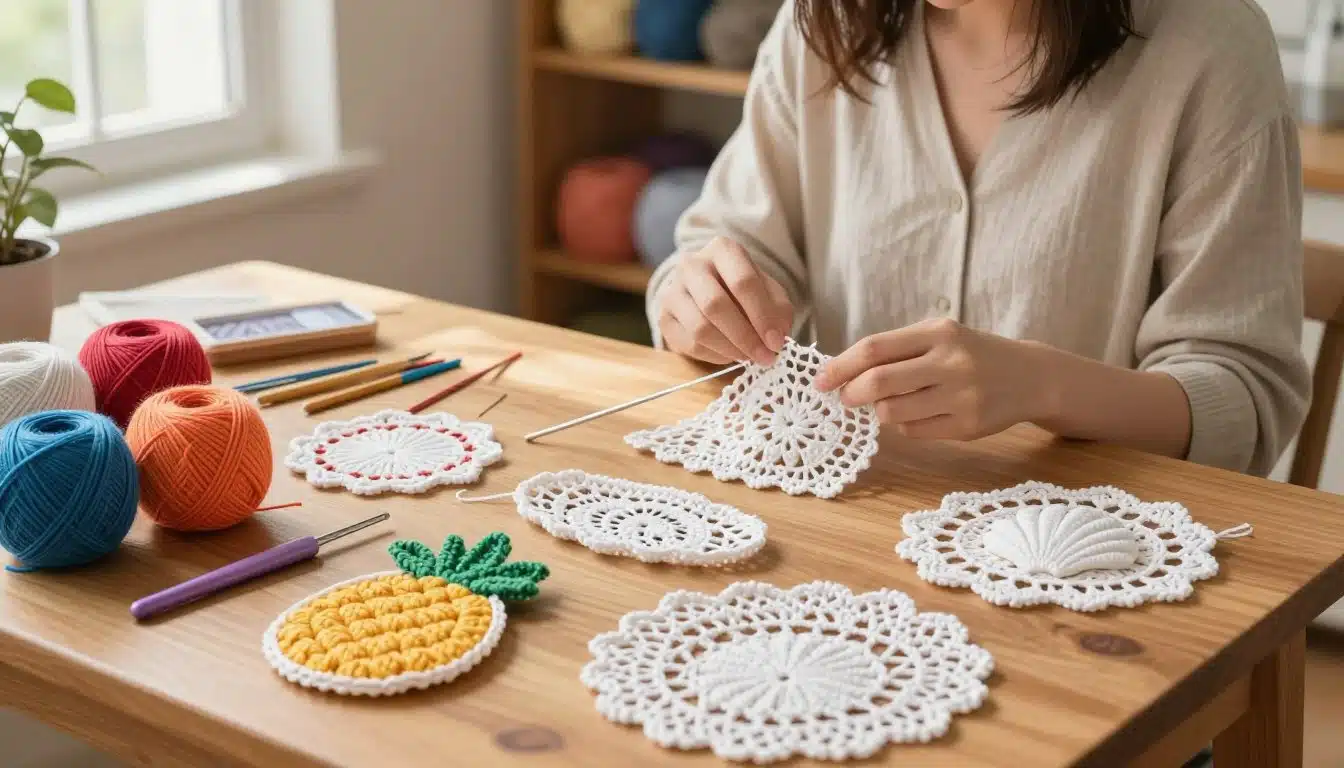
Welcome! You’re on your way to making beautiful shawls and airy tops. If you know how to chain and double crochet, you’re off to a great start. Lace crochet uses simple stitches in clever ways, making them look amazing with a bit of practice.
For my swatches, I used Knit Picks Stroll fingering yarn and an F (3.75mm) hook. This combo gives clear stitch definition and a nice drape. You can start with foundation single crochet (Fsc) or a chain plus a row of single crochet. Both methods lead to beautiful mesh.
Blocking is key to making your swatches look their best. It turns a scrunched sample into crisp lace. Try short practice pieces before diving into a full pattern.
The article includes step-by-step guides for beginner crochet lace swatches. You’ll learn shells, V shells, twisted stitches, and pineapple lace. Once you’ve mastered a swatch, you can move on to free patterns and tutorials or even design your own.
Summer projects are perfect for lightweight yarns and open stitches. Lace types like broomstick, Bruges, filet, hairpin, Irish, and Tunisian lace are great for beginners. For a quick visual guide, check out a crochet stitch guide like this one: crochet stitch guide.
Key Takeaways
- You only need basic stitches — chains, single and double crochet — to start with beginner crochet lace.
- Knit Picks Stroll (fingering) and an F (3.75mm) hook are a reliable combo for swatches and scarves.
- Use foundation single crochet or a chain-plus-row start; both work for lace beginnings.
- Blocking is essential: it opens motifs and improves drape for lace crochet techniques.
- Practice short swatches (shells, V-stitch, twisted, pineapple) before tackling full patterns.
- Explore free tutorials and stitch libraries to expand your lace crochet tutorial toolkit.
Why Crochet Lace Is Perfect for Beginners
Lace might seem fancy, but it’s actually welcoming. Simple patterns can create beautiful scarves and wraps. This makes crochet lace a great choice for beginners who start with small projects and practice regularly.
Debunking the intimidation factor
Intimidation often comes from seeing fancy photos. But most lace patterns are simple, with repeating rows that are easy to remember. Start with a small project like a scarf to build your confidence.
Use beginner tips like marking repeats and counting stitches out loud. This helps you stay focused and improve your skills.
Essential basic stitches you already know: chains, single and double crochet
Lace patterns often use basic stitches like chains, single and double crochet. These are likely familiar from other projects. The key is to focus on rhythm and simple repeats, not complex designs.
Begin with foundation single crochet or a chain start. Then, try working shells, V-stitch, or mesh. Short swatches show how these basic stitches create beautiful, airy patterns.
How lightweight yarns and simple hooks make lace easy in summer
Summer is the perfect time for crochet lace, thanks to lightweight yarns. Fingering or sport weight yarns create airy fabrics that keep you cool. Use small hooks and simple patterns to make projects quick and easy to carry.
Beginners can use solid colors to see stitch definition and block gently to enhance the pattern. Free tutorials and stitch libraries make it easy to go from swatch to finished piece.
Tools, Materials, and Prep for Lace Projects
Choosing the right tools makes lace projects fun, not frustrating. Start with yarn that drapes well and shows off stitches. Fingering and sport yarns are great for shawls and trim. I used Knit Picks Stroll for swatches and loved its softness, color range, and price.
Get hooks that match your yarn. Lace often uses single, double, and treble crochet. A set of small steel and standard hooks works for most. I found an F (3.75mm) hook worked well for swatches.
Special tools can speed up lace techniques. For broomstick lace, a large needle or broom handle works. The Clover Hairpin Lace Tool is perfect for hairpin lace, keeping strips even and joins neat.
Swatching is key to avoiding mistakes. Make small squares to check gauge and pattern. Follow recommended hook sizes and yarn weights, then adjust for your tension. Use fingering yarn for delicate swatches and sport for more substance.
Blocking is essential for lace. Learn how to block early. Use pins, mats, and a gentle spray or steam to open motifs and set edges. Blocking can make a swatch look professional.
Below is a compact comparison to help you prep quickly.
| Item | Why it matters | Recommended example |
|---|---|---|
| Yarn weight | Determines drape and stitch clarity | Fingering for airy shawls, sport for sturdier trims |
| Specific yarn | Color choices and hand affect blocking and wear | Knit Picks Stroll for soft, affordable fingering yarn lace |
| Hook sizes | Controls openness; smaller hooks tighten, larger hooks open | F (3.75mm) for many fingering swatches |
| Specialty tools | Make specific techniques repeatable and neat | hairpin lace tool like Clover; broomstick lace tools such as large needles |
| Blocking supplies | Sets shape and refines motifs | Pins, blocking mats, spray bottle or steam iron |
| Swatch plan | Confirms gauge and pattern look before you commit | 3–4 small panels in chosen yarn and hook, then block |
crochet lace techniques
Ready to explore openwork crochet? This section guides you through easy crochet lace techniques. You’ll learn about mesh and motif work, chart reading, and classic patterns like pineapples and shells.
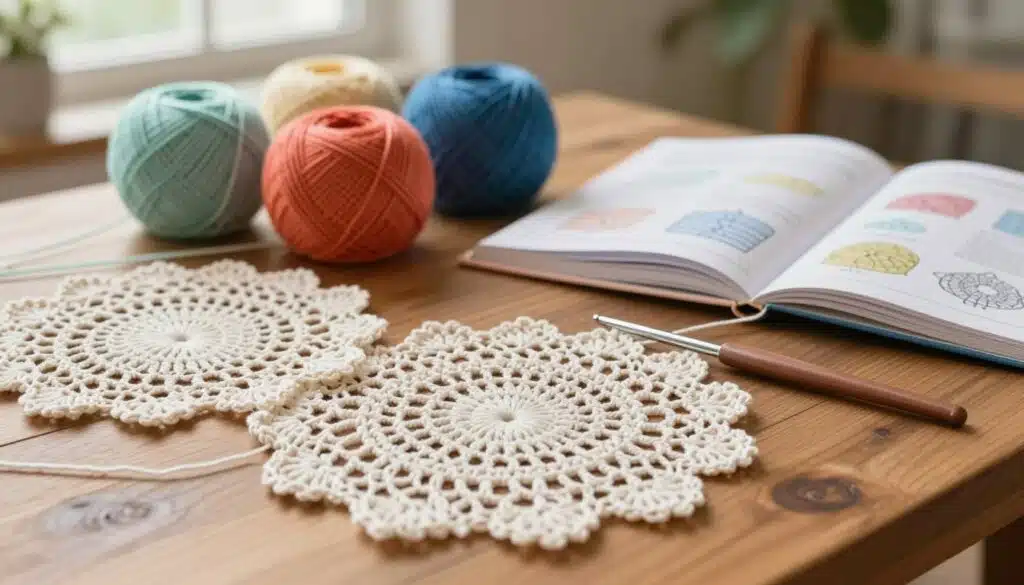
Filet crochet is a great starting point for beginners. It uses double crochet and chain to create windows. Reading charts helps keep your work tidy as motifs grow.
Filet crochet: mesh basics and chart reading
Begin with a gauge swatch of even doubles and chain spaces. Each filled square is a block of double crochets, and each open square is a chain space. A chart guides you, making pattern reading easier and reducing mistakes.
Pineapple stitch lace: classic motifs and variations
Pineapple stitch lace is known for its vintage charm. It grows from clusters and chains into a unique motif. A step-by-step tutorial helps keep the motif balanced.
Try a full pineapple scarf pattern at Pineapple Scarf to see how repeats shape a shawl. Many free patterns and classes teach this motif as a key openwork skill.
Shells, V-stitches, and fan motifs: building blocks for openwork
Shell stitch lace uses fans of double crochets for scallops and texture. Shells work well in short repeats and fit grid layouts. V-stitch lace combines double crochets and chains into a V for airy fabric.
Mix shells, V-stitch lace, and small fans for borders or panels. A swatch helps learn foundation multiples and chain-start equivalents. Swatches preserve stitch rhythm and teach expanding motifs without losing edge shape.
| Technique | Stitches Used | Typical Repeat | Best First Project |
|---|---|---|---|
| Filet mesh | Double crochet, chains | 1–4 row repeats | Simple mesh scarf |
| Pineapple motif | Clusters, double crochet, chains | 8-row motif with repeats | Shawl or panel |
| Shell stitch lace | Groups of double crochets | 2–4 row repeats | Edging and trims |
| V-stitch lace | Double crochet, chain | 2-row repeat | Lightweight scarves |
| Fan motifs | Shells, picots (optional) | 1–3 row repeats | Decorative panels |
Broomstick Lace, Hairpin Lace, and Other Unique Methods
Get ready to learn about three crochet methods that are quite different. Broomstick lace uses a big rod or needle to create big loops. These loops look like “eyes” and are perfect for showing off special yarns.
For a step-by-step guide, try a broomstick lace tutorial. It will teach you how to make loops, the single crochet crown, and how to add beads or fabric strips.
Hairpin lace is like a magic ribbon maker. You use a special tool to make long loops on both sides. Then, you connect them with a crocheted spine. The Clover hairpin lace tool is great for making these strips fast.
Once you have strips, learn how to join them. You can crochet, lace, or use Russian grafting to hide seams and make the fabric continuous.
Introduction to broomstick lace and getting started with a tutorial
Begin with a large dowel or a size 35–50 knitting needle and a hook that fits your yarn. Make loops, pile them on the rod, and then crochet single crochets across the tops. This forms the crown. You can use a free pattern or a lesson to learn how to space loops and move rows.
For practical photos and comparisons, check a guide that covers broomstick and hairpin basics.
Hairpin lace: tools, joining strips, and project ideas
Choose a hairpin fork that matches your design. Narrow forks make delicate strips, while wider forks create bold ribbon effects. After making strips, try joining them in different ways. You can use simple slip-stitch seams for a rustic look or invisible joins for a sleek shawl.
Start with small projects like scarves, trim, and modular bags to practice joining.
Bruges and Irish-inspired techniques: motif creation and joining
Bruges lace crochet uses narrow tapes and decorative connections, inspired by Belgian tape lace. You can braid or join tape-like pieces to frame motifs, then fill with delicate bars or picots. Irish crochet motifs focus on small, sculpted pieces like flowers, leaves, and medallions. These are stitched separately and assembled on a mesh background.
Learning to join lace motifs helps you move from making swatches to garments.
Resources are key. Ellen Gormley’s Bruges lessons and Kathryn White’s Irish motif collections offer clear patterns and joining techniques. A tutorial that combines broomstick and hairpin methods is great for experimenting with different stitches.
| Technique | Primary Tool | Best Yarn Types | Common Joins | Quick Project |
|---|---|---|---|---|
| Broomstick lace | Large dowel or knitting needle | Ribbon yarn, art yarn, sport to worsted | Crochet crowns, woven strips | Shawl or lacy scarf |
| Hairpin lace | Hairpin fork (try hairpin lace tool Clover) | Ribbon yarn, fingering to DK | Crochet seams, lacing, Russian graft | Striped scarf, bag panels |
| Bruges lace crochet | Small hook, tape shapes | Fingering, cotton | Braided tapes, picot joins | Edged cuffs, decorative panels |
| Irish crochet motifs | Fine hooks, motif templates | Thread, lace-weight yarn | Sewn or crocheted onto mesh | Doilies, motif blankets |
Try mixing techniques. Pair broomstick panels with Irish crochet motifs or add hairpin lace strips to Bruges-style frames. For step-by-step photos, follow a guide that shows both techniques.
broomstick and hairpin lace guide
For stitch references and pattern notes, check a stitch library. It will help you understand repeats and gauge. Use swatches to practice joining lace motifs before starting a full garment.
Step-by-Step Beginner Swatches to Practice Lace Stitches
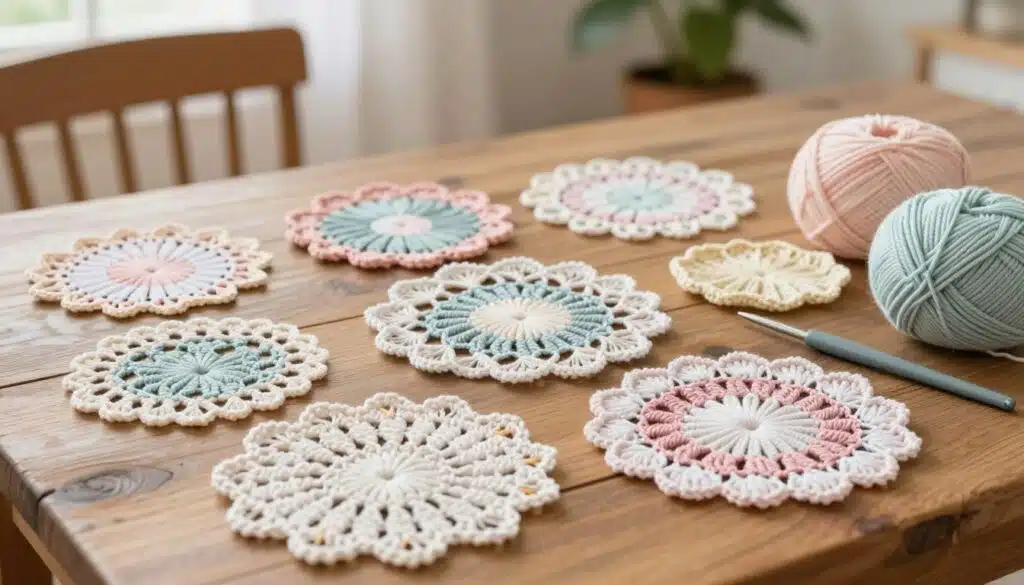
Begin with simple swatches. They help you get the hang of rhythm, gauge, and how to block. Use fingering or sport yarn and a hook that’s one or two sizes bigger than usual. This lets your lace breathe.
Make sure your swatches are square or long enough to see the pattern repeat.
Basic shells swatch: foundation single crochet or chain start
Cast on a number of stitches that’s a multiple of 3, plus one extra chain. Or start with a foundation single crochet in that number. Row 1: Start with a Ch3 (which counts as a dc), then dc in the next stitch. Skip two, then 3 dc in the next stitch. Finish with dc in the last two stitches.
Row 2: Start with a Ch3, then dc in the next stitch, and skip one. In the next ch-space, put 3 dc, then repeat Row 2 until you have about nine rows.
Pay attention to the edge tension and count the clusters. If the loops seem too tight, try a bigger hook size and see if it works better.
V shells (v-stitch) swatch: pattern repeat and tips
Start with a chain that’s a multiple of 3 plus one, or a foundation single crochet in the same number. Row 1: Ch3, then dc, and skip two. In the next stitch, make (2 dc, ch1, 2 dc). Row 2: Ch3, then dc, and in each ch-space from the row before, make (2 dc, ch1, 2 dc). Repeat Row 2 for nine rows.
The v-stitch swatch shows how mesh and fan shapes work together. Make sure your ch-1 spaces are even so the pattern looks crisp. This pattern is great for making scarves and trims.
Twisted stitches swatch: rhythm, technique, and short tutorial
Start with a foundation chain that’s a multiple of 2 plus one. Row 1: Ch4, then tr in the next fsc. Skip the next fsc, then tr in it, working behind the tr just made, tr in the skipped stitch. Repeat across and repeat Row 1 for five or six rows to learn the stitch rhythm.
Take your time with each twisted stitch. Place the hook behind the prior post. This small step gives the stitch its corkscrew look. This twisted stitch tutorial is perfect for adding texture with moderate openness.
Pineapple lace swatch: row-by-row breakdown and blocking tips
Start with a foundation chain of 14 or a fsc of 13, and add a sc row for a base. Rows build from clusters into ch-4 loops and larger ch spaces. Early rows form 9-dc clusters with ch-1 spaces. Mid rows expand ch-4 loops, then return to 9-dc shells in those loops. Repeat the sequence through about 14 rows to see a full pineapple motif.
Block the pineapple lace swatch gently. Pin each curve and steam with a hand iron or use wet blocking so the arches open and the motif reads. This pineapple lace swatch rewards careful blocking more than most patterns.
For more stitch options, free photo and video guides are handy. Try the collection at easy lace crochet stitches to expand your practice and access printable patterns.
| Swatch | Foundation | Rows to Practice | Hook Tip |
|---|---|---|---|
| Basic Shells | Chain multiple of 3 +1 or fsc multiple of 3 | 9 rows | Go up one size if shells collapse |
| V-stitch | Chain multiple of 3 +1 or fsc multiple of 3 | 9 rows | Keep ch-1 spaces even for neat Vs |
| Twisted Stitches | Chain multiple of 2 +1 or fsc multiple of 2 | 6 rows | Work behind the post to form twist |
| Pineapple Lace | Chain 14 or fsc 13 + sc row | Repeat rows 2–8, repeat motif ~14 rows | Block gently to open motifs |
Common Lace Stitch Patterns You Should Learn
Start with a few easy patterns to build your confidence quickly. Begin with simple designs and move to more complex ones. This guide will show you the best patterns for your practice time.
The eyelet mesh stitch is perfect for light tops and summer shawls. It uses chains and double crochet to create small windows. Practice it in 1–4 row repeats to get the hang of it.
The classic shell & grid is versatile and works well with other patterns. Try braided shell for a rope-like texture. Remember to keep track of your stitches with a marker.
For trims and borders, try lacy mini fan stitches. They blend well with bigger motifs and keep hems neat. Small repeats are great for beginners.
The crown stitch is a stately scallop that frames garments beautifully. It creates a layered look with stacked shells.
Bunny ears stitch is fun for baby blankets and whimsical scarves. It makes paired loops that look like ears. Use worsted or sport yarn to see the shape well.
Balance your practice with openwork and textured stitches. Try eyelet mesh, braided shell, and crown stitch. Finish with a bunny ears stitch border to practice joining and edging.
Keep a notebook of your stitch counts, hook sizes, and yarn types. This habit turns trial and error into reliable patterns for shawls, trims, and garments.
Design Tips, Modifying Patterns, and Troubleshooting
Make your lace look smooth, not messy. First, learn to read lace charts. This helps you spot repeats and count stitches. Jennifer Hansen and Kim Guzman offer classes and tutorials to help.
Test a motif with small swatches. Use foundation single crochet or a chain-and-row start to find repeat length. This makes it easy to adapt lace patterns into different items.
If your swatch looks wrong, try adjusting the gauge. Change the hook size in half steps to tighten or loosen the fabric. Adjusting repeat counts changes width, and selective increases or decreases shape the ends.
Common mistakes include uneven edges and holes. Uneven edges come from missed stitch counts. Holes mean a skipped stitch or tension slip. To fix, recount the last repeat, use a lifeline row, or rip back and rework slowly.
Fix tension issues by swapping hooks and measuring gauge again. A smaller hook makes lace firmer, while a larger one makes it drapier. Always re-check stitch counts after any change.
Blocking can fix many problems. Wet or steam block to open motifs and flatten edges. This makes stitches look neat and motifs match.
Here’s a quick checklist for edits:
| Problem | Quick Fix | Preventive Tip |
|---|---|---|
| Uneven edges | Check stitch counts in each repeat; use foundation single crochet for stable starts | Mark repeat boundaries with stitch markers and count at row ends |
| Unexpected holes | Unpick to the error, correct stitch sequence, tighten tension if needed | Practice pattern repeat in a swatch and read lace charts before starting |
| Fabric too loose or dense | Adjust hook one size up or down for lace gauge adjustment | Measure gauge with a swatch after changing yarn or hook |
| Motifs not matching across panels | Block pieces together using the same pin spacing and tension | Make identical swatches and use the same blocking routine |
| Stitches skipped or misread pattern | Watch a step-by-step video, count stitches as you go, place a lifeline | Read lace charts and written instructions side by side before starting |
When adapting lace patterns, plan changes on paper. Note repeat counts, edge treatments, and how motifs join. This keeps your design unique while maintaining style and structure.
Learning Resources, Patterns, and Next Steps
Looking for places to learn and grow your crochet skills? Start with free patterns and step-by-step tutorials. These will guide you through basic stitches and more complex ones like pineapple lace. Check out Desert Blossom Crafts for a collection of 13 lace stitch patterns and email support.
Start with simple swatches and gradually move to more complex ones. Use Knit Picks Stroll patterns to test different yarns. Save patterns on Pinterest and watch video tutorials to improve your skills.
For structured learning, look for crochet classes from trusted teachers. Donna Wolfe teaches broomstick lace, and Ellen Gormley covers Bruges lace. Craftsy courses like Jennifer Hansen’s Classic Crochet Openwork can also help deepen your skills.
Joining a membership like Nordic Hook Club can give you access to a large stitch library. It offers charts, ad-free tutorials, and new stitches to try. Use these resources to experiment with different patterns and designs.
Here’s a practice plan: (1) Swatch Basic Shells, (2) Move to V Shells, (3) Try Twisted Stitches, (4) Tackle Pineapple Lace. Block each piece and keep notes on materials and methods. When ready, start designing your own lace motifs.
Get feedback and inspiration from the crochet community on Instagram and Pinterest. Save patterns, tag photos, and join forums to share and learn. For more structure and ideas, consider Nordic Hook Club and specialty classes.
Need help? Email rachel@desertblossomcrafts.com for guidance and project notes. Your next steps are clear: stitch a swatch, follow a class, and collect patterns to design with confidence.
Conclusion
Learning crochet lace is easy if you know basic stitches. Start with small swatches and use a fingering yarn like Knit Picks Stroll. Practice blocking to see big improvements right away.
Short practice sessions help build muscle memory and confidence. This is better than trying many patterns at once.
Choose one technique to focus on, like broomstick lace or Bruges. Follow clear tutorials or guides with photos and videos. For stitch references, check the Crochet Stitch Guide.
With a few tools, helpful books, and free patterns, you can start making lace today. You can make scarves, shawls, trims, and more. Keep projects light for summer and don’t worry about mistakes. Soon, you’ll be ready to design your own patterns.
FAQ
Why is crochet lace a good project for beginners?
Crochet lace is easier than it seems. If you know how to make chains, single crochet, and double crochet, you’re off to a great start. Many lace patterns repeat in 1–4 rows, so once you learn the pattern, you can keep going.
Start with small swatches like shells, V-stitches, or simple eyelet mesh. This will help you get the hang of it and build confidence.
Aren’t lace patterns advanced and fiddly?
Not necessarily. The fear often comes from how it looks, not the actual stitches. Most lace patterns use basic stitches and follow a predictable pattern.
Practice with swatches and use foundation single crochet (Fsc) starts or a chain + single crochet row for a stable edge. The right yarn and blocking can make your lace look professional.
What stitches should I know before trying lace?
Learn chains, single crochet (sc), double crochet (dc), and a few trebles (tr) or half-dc for some motifs. Shells, V-stitches, fans, and simple clusters are built from these basics.
Twisted stitches and some clustered stitches add texture. Most tutorials explain these step-by-step if you need them.
Which yarns and brands work best for lace?
Lightweight yarns like fingering (sock) and sport are perfect for lace. Knit Picks Stroll (fingering/sock) is a great, affordable choice that blocks beautifully and comes in many colors.
Choose a yarn that shows stitch definition and blooms with blocking.
What hook sizes should I use for lace?
For fingering and sport lace, small hooks like an F (3.75mm) are common for swatches. Adjust up or down to get the drape and openness you want.
Specialty techniques like broomstick and hairpin lace may use larger rods, big knitting needles, or a hairpin lace loom alongside your crochet hook.
What extra tools might I need for specific lace types?
Some lace methods need special tools. Broomstick lace uses a large knitting needle or broomstick handle. Hairpin lace requires a hairpin lace loom—Clover makes a popular tool.
Tunisian lace benefits from Tunisian hooks with stoppers. Pins, mats, and a spray bottle or steamer are essential for blocking.
How important is blocking, and how do I do it?
Blocking is very important. It opens stitches, evens edges, and reveals lace patterns. Pin your piece to shape on blocking mats, spray lightly or use steam, then let dry.
For lightweight yarns like Knit Picks Stroll, wet or steam blocking makes a big difference in stitch definition.
What’s the difference between filet crochet and pineapple lace?
Filet crochet creates a grid-like mesh of dc and chain spaces and is often worked from charts. Pineapple lace is a classic openwork motif built from clusters, chains, and arches; it grows row by row into the fan-like pineapple shape.
Both are beginner-accessible once you learn chart reading (for filet) or the row-by-row sequence (for pineapple).
How do I start broomstick lace or hairpin lace?
Follow a step-by-step tutorial. For broomstick, wrap loops over a large needle or broomstick, then crochet groups of stitches through those loops. For hairpin lace, work long loops around the loom’s prongs and join strips together with crochet or a joining technique.
Free patterns and books—Donna Wolfe’s Broomstick Lace Crochet and video tutorials—are great starting points.
Can I turn swatches into finished projects?
Absolutely. Repeat your swatch rows to make scarves, borders, or panels. Shell and V-stitch swatches scale well into scarves and shawls.
Join motifs or strips—hairpin, Bruges, or Irish crocheted motifs—into larger pieces once you’re comfortable with the repeats.
How do I fix uneven edges or holes in my lace?
Check your stitch counts and repeat multiples first. Use foundation single crochet for a firm, tidy edge or add a single crochet border. Adjust hook size to fix tension issues.
Many tutorials show common fixes; blocking will also even edges and close unwanted gaps.
Where can I find reliable tutorials and patterns?
There are many free photo and video tutorials online, plus books and classes. Recommended resources include Craftsy classes, Donna Wolfe’s and Ellen Gormley’s books, Jennifer Hansen’s openwork classes, and curated stitch collections that list repeats and tutorials.
Stitch libraries like Nordic Hook Club and pattern-rich sites such as AllFreeCrochet and Underground Crafter offer excellent references.
What are some must-learn lace stitch patterns?
Start with shells, V-stitches, eyelet mesh, little windows, braided shell, lacy mini fan, crown stitch, bunny ears, and aligned arches. These build the vocabulary for more complex motifs like pineapple, Bruges strips, or Irish motifs.
Are there curated collections of lace stitch tutorials?
Yes. Curated lists with 30+ stitch tutorials exist that cover mini fans, eyelet mesh, picot trellis, braided shells, stacked squares, crown stitch, and many more. They often include photo/video guides and charts, making them perfect for systematic practice.
How do I read and adapt lace charts and written patterns?
Learn common chart symbols and read row or round direction. Identify the stitch repeat multiple, practice the repeat on a swatch, and adjust hook or yarn to match the desired openness.
Once you understand repeats, you can lengthen, shorten, or combine patterns for scarves, shawls, or trims.
What resources are available if I need help or inspiration?
Join Instagram and Pinterest communities to save patterns, get feedback, and find inspiration. Follow designers and hashtag threads for projects. Stitch libraries, online classes, and books by known authors provide structured learning.
For direct support, authors and bloggers often offer contact options and community links.
Any quick swatch recipes to get started?
Yes—try these: Basic shells (Fsc multiple of 3 or ch multiple of 3 +1; repeat shell rows), V-stitch (Fsc multiple of 3; repeat V rows), twisted stitches (Fsc multiple of 2; work tr pairs twisted behind), and a pineapple sample (Fsc 13 or ch14 + sc row; follow an 8-row sequence and repeat).
Use an F (3.75mm) hook with fingering yarn to practice and block for best results.
Where can I learn more about joining motifs or designing my own lace?
Tutorials on joining hairpin strips, crocheting and joining Irish motifs, and Bruges strip assembly are widely available. Start by practicing swatches and small motif joins, then experiment with layout and borders.
Books and online classes that focus on motif construction and joining are helpful for moving from swatches to original designs.