
This easy crochet cardigan is like a warm hug. It looks great in photos, too. It’s perfect for those who want a cozy cardigan without complicated stitches.
The pattern is simple, using T-shaped panels and straight rows. This lets you focus on the details like tension and color. It also looks great when it’s finished.
The pattern comes with a printable PDF and kit options. You’ll need Lion Brand LB Collection Chainette yarn, a Size I (5.5mm) hook, and some basic tools. Sizes range from XS to 3XL, and the finished size is 4″ after blocking.
This cardigan is great for beginners or anyone who loves cozy projects. It’s made with fluffy yarn and simple construction. You’ll get a cardigan that’s both stylish and comfortable to wear all season.
Key Takeaways
- Pattern is beginner-friendly with T-shaped panels and straight rows.
- Recommended yarn: Lion Brand LB Collection Chainette; kit options available.
- Hooks and notions: Size I (5.5mm), tapestry needle, measuring tape, scissors.
- Sizes cover XS–3XL with a gauge of 14 sts x 16 rows = 4″ after blocking.
- Design yields a fluffy cardigan that’s cozy yet stylish for everyday wear.
Why You’ll Love an Easy Crochet Cardigan
You want something that looks chic and feels like a hug. An easy crochet cardigan offers that comfort without the fuss. It’s made with fluffy yarn and has a lacy shoulder for style and breathability.
Comfort meets fashion
The design uses soft fibers like baby alpaca and wool blends. These materials feel gentle against your skin. The cardigan’s boxy shape is modern and allows for layering.
Beginner-friendly construction
You don’t need to know complex stitches. The design uses simple panels and straight rows. This makes it easy for beginners to follow and enjoy the process.
Versatile styling for all seasons and occasions
Change the yarn and color to match the season. For fall, try warm tones, and for summer, go for pastels. This cardigan works over dresses, tees, or blouses, and you can adjust the length to fit your style.
Choosing the Best Yarn for a Cozy Cardigan
Choosing the right yarn is key to making your cardigan cozy. You need yarn that’s warm, has good drape, and fits well. Think about the yarn’s weight, what it’s made of, and how it will look and feel after you wear and wash it.
Why chainette and fluffy yarns feel dreamy
Chainette yarn is light but warm. It has a woven look that keeps its shape and breathes. This makes it perfect for a soft, airy cardigan without being too heavy.
Fluffy yarns like brushed alpaca are super soft and warm. They look great in photos, hide small mistakes, and feel luxurious. This makes them great for a cardigan you’ll want to wear all the time.
Wool, alpaca blends, and durability considerations
Alpaca blend yarns are warm and soft. Adding polyamide or nylon makes them last longer, which is good for areas that get a lot of wear. Lion Brand Chainette is a great example, mixing baby alpaca, virgin wool, and a bit of polyamide for both softness and durability.
For a structured cardigan, use worsted or medium weight yarn. Changing yarn weight changes how the cardigan looks and fits. So, make sure to follow the gauge or be ready to adjust the size.
Color choices that flatter and shop recommendations
Choose colors that you love and that go with your clothes. Neutrals like cream, warm mustard, olive, and soft pink are great. They look good with many outfits. Lion Brand Chainette has colors that are perfect for layering with jeans or dresses.
If you like mixing colors, plan how many skeins you’ll need. For more tips on yarn, check out this guide at yarn basics for beginners.
| Yarn Type | Why it works | Weight / Hook | Recommended Colors |
|---|---|---|---|
| Chainette (alpaca blend) | Lightweight warmth, lofty drape, woven look | 3/Light — 4.5–5.5mm | Pink, Cream, Mustard, Olive |
| Worsted / Medium (rectangle styles) | Structure for boxy cardigans, reliable stitch definition | 4/Worsted — 5.0mm | Ecru, Honey, Adobe, Pomegranate |
| Alpaca blend yarn (with polyamide) | Soft loft with added durability for cuffs and bands | 3–4 depending on blend | Mahogany, Olive, Cream |
Essential Tools and Materials
Before starting, make sure you have the basics for a smooth cozy cardigan project. A well-stocked kit helps avoid frustration and boosts creativity. Think of it as your preflight checklist for crochet.
Choose a reliable crochet hook that matches your yarn. Many patterns suggest a Size I / hook size 5.5mm for worsted weight and some chainette blends. You might need a smaller or larger hook to get the right tension.
Don’t forget essential crochet notions like a tapestry needle for seaming and a measuring tape. Also, have sharp scissors and buttons for closures. Keep extra stitch markers on hand for tidy rows. These tools make assembly and finishing quicker and neater.
Reading yarn labels is a small skill that saves time and money. Use a clear yarn label guide to note weight category, yardage, fiber content, and recommended hook size. For example, Lion Brand Chainette might list 131 yds/50 g and suggest a different hook size than your pattern.
Always swatch to match gauge. The pattern gauge for this cardigan is 14 sts x 16 rows = 4″ in single crochet after blocking. Create a 4″ square, wash and block it, then measure. If your swatch doesn’t match, change the hook size until you get the right gauge.
Below is a quick comparison to help you choose the right tools for common yarn choices.
| Yarn Type | Typical Weight | Suggested Hook | Key Tools | Swatch Target |
|---|---|---|---|---|
| Lion Brand Chainette | Light to Worsted (varies) | Size I / 5.5mm (pattern) | Tapestry needle, measuring tape, scissors, buttons | 14 sts x 16 rows = 4″ (after blocking) |
| Worsted Weight (4) | Worsted | 5.0–5.5mm depending on tension | Tapestry needle, stitch markers, extra skein for ribbing | Adjust to pattern gauge; test after blocking |
| Alpaca/Wool Blend | Light to Worsted | Check yarn label guide; start with 5.5mm | Gentle wash tools for blocking, measuring tape | Match gauge gently; fibers may bloom |
Easy crochet cardigan
This easy crochet cardigan pattern is perfect for beginners. It uses simple shapes and straight rows. You can make it while watching TV, at a knitting group, or with your morning coffee.
The design is straightforward. It has one large back panel and two matching front panels. These pieces create clean, wearable lines. Working in T-shaped panels makes shaping easy and lets you focus on texture.
What makes this pattern easy
The pattern focuses on T-shaped panels. This avoids complicated decreases and short rows. You work long straight rows for the body, then add the sleeve and shoulder parts easily. This makes a polished cardigan fast to finish.
Three-piece construction overview
You’ll crochet a three-piece cardigan. This includes a back panel and two front panels that mirror each other. After blocking, you seam the panels with mattress stitch. The result is tailored and clean, yet easy for beginners.
Size range and inclusive sizing
The pattern offers inclusive sizing crochet for XS–3XL. Each size has stitch counts and row targets. This lets you choose a fit that flatters your measurements and adjust the length easily.
By using this layout, you can change yarn weight and length. This allows you to make cropped, classic, or oversized cardigans. The modular approach makes changes simple and predictable.
Step-by-step Pattern Roadmap
Start with a clear plan so your cardigan builds evenly and fits like it should. The roadmap below walks you from the chain foundation to the finished panels. Keep gauge in mind, check after a few rows, and adjust hook size if needed.
Back panel kickoff: Begin the back panel crochet with a straight foundation chain. For the Cozy Cardigan example start Ch 53 (61, 65, 75, 81, 89, 95) then single crochet across the row. Work body rows to Row 58 to reach the measurement across the shoulders and torso.
Maintain stitch counts and repeats listed for your size. Use a stitch marker at row ends to track repeats. These cardigan pattern steps prevent surprises when you join panels later.
Lace sleeve transition: Without breaking yarn, extend with chains to begin the lace section. Example: Ch 57 (size-dependent) then continue with the pattern’s extended single crochet rows. Repeat lace motif to the counts given, usually until Row 17–25 depending on size.
Watch tension during the lace sleeve transition. A looser gauge here keeps the sleeves comfortable. If lace rows pull in, try a larger hook for just the lace section to match drape.
Right front panel crochet: Create the right front starting with Ch 25 (29, 31, 37, 39, 43, 47). Work the same body rows to Row 58 so the front mirrors the back in length and stitch placement.
Follow the pattern’s specific lace counts for the right front. This ensures button-band alignment and a neat neckline when you seam the pieces together. Finish off and weave ends after completing the panel.
Left front panel crochet: Mirror the right front with its starting chain and body rows. Some lace row counts differ slightly to shape the neckline. Use the pattern’s explicit stitch counts and repeats so both sides match at assembly.
| Panel | Starter Chain Example | Body Rows | Lace/Sleeve Rows |
|---|---|---|---|
| Back panel | Ch 53–95 (size dependent) | Work to Row 58 | Continue without breaking yarn; lace repeats to Row 17–25 |
| Right front | Ch 25–47 (size dependent) | Work to Row 58 to match back | Follow pattern lace counts; finish off |
| Left front | Ch 25–47 (size dependent) | Work to Row 58, mirror right front | Adjust lace row counts for neckline shaping |
| Panel assembly note | Use mattress stitch or invisible seam; check alignment before seaming and weave in all ends | ||
Seaming and Assembly Tips for a Professional Finish
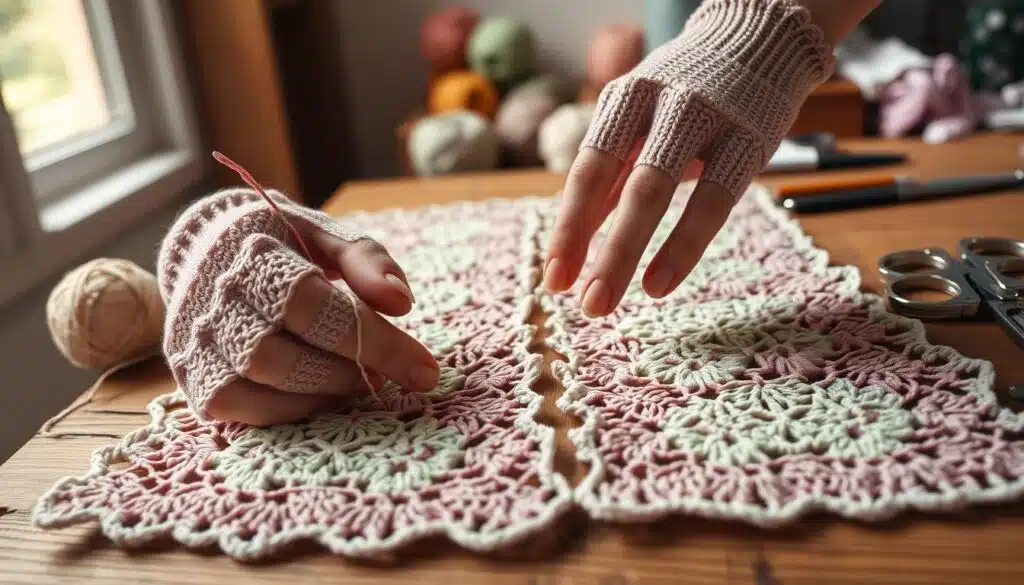
Before sewing, lay your pieces flat and align them with right sides together. Work on a stable surface. Use stitch markers or safety pins to keep edges in place.
Blocking first makes rows even and helps match stitch counts. This ensures seams lie flat.
Lining up panels and working with right sides together
Be careful when matching edges, checking selvedge rows and stitch counts. Use a long yarn length, about three times the seam length. This allows for smooth movement without tightening one area too much.
Mattress stitch and other invisible seam techniques
Mattress stitch crochet makes a flat join that looks like hand-knitting. It’s perfect for invisible seams. Work into horizontal bars on each selvedge, keeping the yarn snug but not tight.
For small or decorative joins, try a flat braid or slip-stitch join. These add subtle texture.
How to avoid common seaming pitfalls (stretch, puckering)
To avoid puckering, keep tension even and don’t pull too hard. If a seam feels tight, loosen and re-seam. Using the same yarn and hook throughout prevents drape mismatch that can warp seams.
When joining shoulders or side seams, check fit as you go. Use a form or a folded towel to mirror body shape. This prevents seams from pulling at curves. Sew a scrap swatch first for a quick technique test.
Batch similar tasks for finishing workflow. Weave in ends as you go or use a weave-as-you-go approach to reduce bulk later. Trim stray fibers and smooth edges before final pressing.
For more on stress-free finishing and join options, see this guide at stress-free finishing. For curling fixes, check a practical resource at crochet curling solutions.
| Task | Technique | Why it helps |
|---|---|---|
| Side seams | Mattress stitch crochet | Creates a flat, nearly invisible join that aligns rows and prevents bulk |
| Shoulder joins | Mattress stitch or whipstitch | Tethers lace edges without changing drape; easy to adjust tension |
| Decorative edges | Flat braid join | Adds a neat border while keeping seams low-profile |
| Ribbing attachment | Crochet join around hem | Prevents rolling and offers a smooth transition for collars and cuffs |
| Small motifs | Slip-stitch join or mattress stitch | Keeps motifs flush and helps you join seams invisible on visible panels |
| General finishing | Weave-as-you-go and batch processing | Reduces loose ends, maintains consistent tension, and speeds final assembly |
Collar, Ribbing, and Button Band Finishing
Before adding the final touches, lay the cardigan flat. A neat collar, tidy wrist edges, and well-placed buttons make a big difference. Here are practical steps to finish like a pro, following crochet collar instructions and cardigan finishing tricks.
Collar basics: Start by joining yarn at the front corner along the hemline of the left panel. Ch 1, then single crochet evenly along the selvedge of the front panel. Continue into each of the three skipped stitches on the back panel, and along the selvedge of the other front panel.
Work evenly; if fabric ruffles, you’re working too many stitches. If it pulls, you’re working too few. For most cardigans, repeat Row 2 (Ch 1, sc across) until you have about 8 rows or roughly 2″ total, then finish and weave in ends.
Troubleshooting: Count stitches across small test sections if the collar changes shape. If one side looks fuller, remove a few stitches and rework that edge. For a softer roll, use a larger hook for the collar than the body. These small adjustments follow straightforward crochet collar instructions and avoid puckering at the neckline.
Wrist and bottom ribbing: Attach yarn to the sleeve opening, Ch 1, then work sc2tog around to form a snug cuff. To make a classic ribbed strip, chain 11 as a foundation, sc into the 2nd ch, then work short rows in single crochet in the back loop only (BLO). Anchor the strip with slip stitches as you go, then sew the ribbing to the cuff with mattress stitch or whipstitch for even tension.
If you prefer a simpler finish, work single crochet rounds in BLO around the sleeve until the cuff sits snug. Use the same approach at the hem to create a cohesive look. When you follow the guidance for a crochet ribbing wrist cuff, your sleeves will stay put and look tidy after washing.
Button band and buttonholes: Single crochet along the front opening to form the band. On the next row, add buttonholes by creating chain spaces sized for your buttons. For 19mm buttons, a ch 2 often works well; for thicker buttons, use ch 3. On the following row, work single crochet over the chain spaces to define the hole edges.
Place buttons by measuring from the top down and marking positions with scrap yarn or pins. Test each button with its hole before sewing. Fasten buttons securely with a needle and matching thread; a small shank made from a few extra turns of thread lets the button sit comfortably through the crochet buttonholes.
| Area | Method | Tips |
|---|---|---|
| Collar | Join at front corner, sc evenly along selvedge, repeat rows to 2″ | Work evenly to avoid ruffle or pull; use larger hook for softer roll |
| Wrist Ribbing | sc2tog around for snug cuff or attach rib strip (Ch 11, sc BLO) | Sew ribbing with slip stitches; test fit before fastening |
| Bottom Ribbing | Same as wrist: rib strip or BLO sc rounds | Match tension to sleeve cuffs for uniform look |
| Button Band | sc along front opening, add ch spaces for buttonholes | Use ch 2 for 19mm buttons; secure buttons with a small shank |
Gauge, Sizing Notes, and Fit Adjustments
You want a cardigan that fits like it was made for you. Start by understanding gauge and how it behaves after blocking. Get comfortable with simple tweaks so you can adjust cardigan size without fear.
Swatch, block, and measure. A typical Cozy Cardigan swatch reads 14 sts x 16 rows = 4″ in single crochet after blocking. Record your swatch so you can compare panel or square measurements from patterns such as Grateful + Thankful or ELOISE. That step tells you whether to change hook size or yarn to hit a true-to-size result and helps you decide how to choose crochet size for your body.
Use panel or square measurements to test tension. Measure the finished swatch in the same orientation the pattern lists. If your gauge is tighter, try a larger hook. If it’s looser, drop down a hook. These moves let you customize crochet fit before you waste yarn on a full cardi.
Want to adjust cardigan size? Here are three simple moves you can make without rewriting the pattern.
- Add or remove body rows to lengthen or shorten the torso. Count rows as you go, following ELOISE’s advice to watch row counts closely.
- Increase the foundation chain or add stitches evenly across panels to expand the bust. Work evenly so shaping and stitch patterns stay balanced.
- Alter sleeve length by adding or subtracting lace or sleeve rows. Check armhole depth after blocking and tweak before seaming.
Patterns with square or panel dimensions make it easy to eyeball fit. The Grateful + Thankful Cardi lists boxy, slightly oversized measurements, so you may want to size down for a trimmer fit. Cozy Cardigan finished measurements run bust 30–54″, length 21–24″, armhole 6.5–9.5″, sleeve length 16–17.5″. The model is 5’5″ wearing size Medium, which helps you place your own measurements on the chart.
Circle or highlight numbers in the pattern that match your measurements. That simple habit cuts mistakes and speeds decisions when selecting between multiple sizes. It’s the fastest way to how to choose crochet size without overthinking.
| Adjustment Goal | Quick Action | Check After Blocking |
|---|---|---|
| Lengthen torso | Add body rows evenly across panels | Front hem sits where you want it, stitch pattern remains balanced |
| Wider bust | Increase foundation chain or add stitches to panels | Chest measurement matches your relaxed bust measurement |
| Tighter sleeve | Subtract lace or sleeve rows, or reduce stitch repeats | Armhole depth feels comfortable, sleeve movement is free |
| Less oversize | Choose one size down from boxy pattern notes | Overall silhouette fits closer to the body without pulling |
Always swatch and block before committing. If your swatch matches the crochet gauge after blocking, you can move forward with confidence. If not, retest with a different hook or yarn until you hit the numbers that let you customize crochet fit and reliably adjust cardigan size.
Pattern Variations and Style Ideas
Make a cardigan that’s uniquely yours by experimenting with different yarns. Try changing yarn weights and textures to alter the look and feel. For example, a soft mohair can give a haloed effect, while a worsted yarn will show off every stitch.
Want a cardigan that’s shorter or longer? The basic T-panel or seamed-panel design makes it easy to adjust length and sleeves. Shorten the rows for a cropped look or add more panels for a longer cardigan. You can also add pockets as patch panels or integrate them from the start for a clean finish.
Colorwork opens up a world of possibilities. Try different patterns like striping, color blocks, or a granny square cardigan. These methods let you mix and match colors and textures, creating unique and playful cardigans.
For seamless construction, consider top-down or yoke methods. These methods eliminate bulky seams and allow for easy customization. You can switch yarn weights to change the cardigan’s feel without losing its shape.
To add your personal touch, choose contrasting ribbing colors, add wooden or metal buttons, or work a button band with vertical slip stitches. You can study construction options to see how different methods work with different yarns.
Modular makes are great for quick personalization. Use granny squares for pockets, add a panel of ribbing at the hem, or mix stitch textures for visual interest. These simple changes let you customize your cardigan while keeping the core pattern intact.
Think about fit and function when customizing your cardigan. If using heavy yarns, reinforce front edges or skip deep pockets to avoid sagging. For a polished look, leave long tails for seaming, block pieces before assembly, and test small adjustments on a swatch to ensure your cardigan looks and feels right.
Care Instructions and Longevity
Take care of your cardigan like a treasured book. Handle it gently and store it wisely. For soft blends like baby alpaca and virgin wool, avoid hot water and harsh soap. Instead, use cool or lukewarm water and a mild, pH-neutral detergent.
Washing and blocking delicate yarns
Hand washing is best for most handmade items. Use cool water and a small amount of baby shampoo or wool wash. Gently submerge your cardigan and avoid scrubbing or wringing.
If the yarn label says it’s okay for the machine, use a mesh bag. This is good for light agitation on medium-weight blends. Rinse until the water is clear, then blot out moisture with towels.
Let it dry flat and block while damp. This sets the pattern and fit right. Blocking is key for crochet cardigans before seaming.
Storing to keep shape and loft
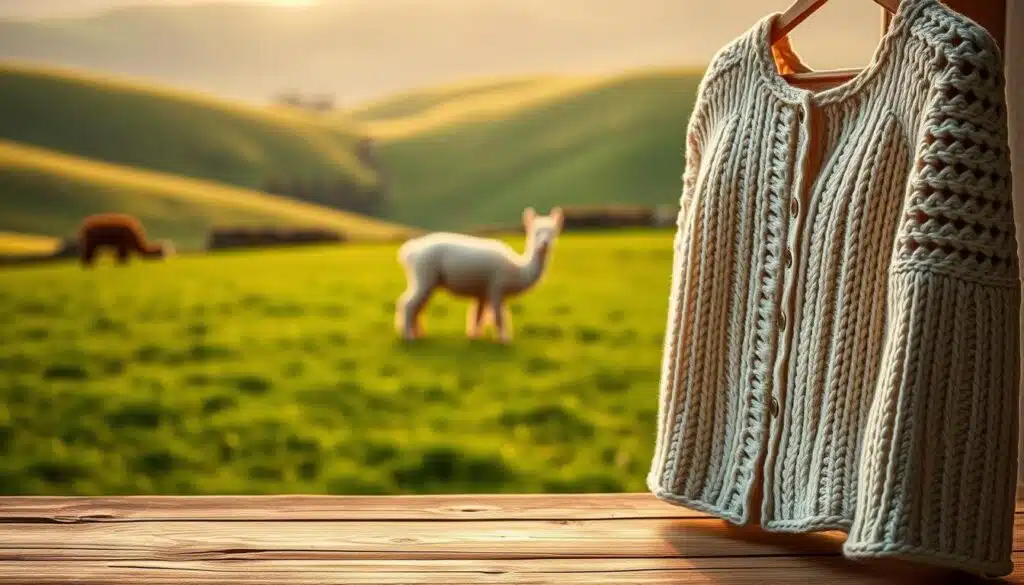
Don’t hang heavy handmade cardigans. Hanging can stretch shoulders and ruin the drape. Fold them and store in a breathable bag or drawer.
Keep cedar blocks or lavender sachets nearby to deter moths. For long-term storage, use acid-free tissue to prevent creases. Check items seasonally and refold to avoid permanent lines. A quick steam or water spritz can revive the fabric.
Repair tips for common wear spots
Small snags and loose loops can be fixed. Use a fine crochet hook to guide a snagged loop back into place. Avoid cutting.
For worn elbows or seams, use duplicate stitch or a sewn patch. Keep an extra skein for color-matched repairs. Pilling can be managed with a fabric shaver or sweater comb. For visible mending, try tonal embroidery or a small patch.
For more tips on washing chainette yarn and caring for alpaca blends, see yarn-care tips. The Crochetcraze guide offers broader fiber care strategies: yarn care tips.
Conclusion
In this easy crochet cardigan summary, you get a clear road map. Choose the construction that fits your mood. You can go for T-panels for a classic look, granny squares for fun, or simple rectangles for speed.
The Cozy Cardigan shows how a fluffy Chainette option gives lightweight warmth. The Grateful + Thankful Cardi and ELOISE patterns remind you that many paths lead to success. Make sure to follow the pattern’s gauge, materials list, and size range (XS–3XL) to avoid surprises.
For practical crochet cardigan takeaways, focus on three things. Match yarn and hook to the gauge. Use mattress stitch and careful seaming for clean joins. And finish collars and ribbing evenly.
Those small moves can turn a beginner-friendly cardigan into something you wear every week. Adjust the length or sleeve fit as needed. This way, the piece will fit your wardrobe and lifestyle perfectly.
This beginner crochet cardigan recap is simple. Choose the style you love, check stitch counts, and follow finishing tips. With straightforward panels, clear sizing, and a few smart finishing touches, you’ll make a cozy, stylish cardigan that feels like it was made for you.
Now pick your yarn and get crocheting. Your next favorite layering piece is within reach.
FAQ
What makes the Cozy Cardigan an “easy” crochet garment?
The Cozy Cardigan is simple because it uses T-shaped panels worked in straight rows. It mostly uses single crochet, avoiding complex shapes or stitches. You make one big back panel and two front panels that mirror each other. Then, you sew them together.
If you can chain, single crochet, and follow row counts, you can make this cardigan.
Which yarns work best for a soft, wearable cardigan?
Fluffy yarns like Lion Brand LB Collection Chainette are great for a soft cardigan. They are made of 70% baby alpaca, 18% virgin wool, and 12% polyamide. They give a light, airy feel.
Worsted or Medium (4) yarns offer more definition and a sturdy drape. Blends with polyamide/nylon are durable, while alpaca/wool blends are warm and soft. Choose based on the look you want.
What hook and notions do I need?
You’ll need a Size I (5.5mm) crochet hook, a tapestry or darning needle, a measuring tape, and scissors. For granny-style or Worsted-weight designs, a 5.0mm hook is often used. You might also need buttons for the button bands.
Always have a spare skein for repairs.
How do I match the yarn to the pattern gauge?
Check the yarn label for weight and yardage. For example, Chainette is 131 yds/50 g and is Light/3. Make a swatch, block it, and measure.
The Cozy Cardigan gauge after blocking is 14 sts x 16 rows = 4″. Adjust your hook size or yarn weight as needed to match the pattern gauge.
What sizes does the pattern include and how inclusive is the sizing?
The Cozy Cardigan pattern includes sizes XS–3XL. The finished bust measurements are roughly 30″–54″, and the length options are around 21″–24″.
Other similar patterns offer XS–4XL. The pattern follows standard CYC sizing, and you’re told to circle the numbers for your size to avoid confusion.
How do I start the back panel and work the body?
Start with the foundation chain listed for your size. For example, Ch 53–95 depending on size. Then, work straight single-crochet rows until you reach the specified body row.
The Cozy Cardigan notes working to Row 58 for the main body before moving into lace details. Monitor your stitch counts as you go.
How do I transition into the lace or shoulder detail?
After the body rows, the pattern shifts into a lace shoulder section. It uses extended chains and specific repeat rows. Follow the lace row counts for your size; keep consistent tension and block the panels before seaming to open up the lace evenly.
How are the front panels made to mirror the back?
Each front panel begins with a shorter foundation chain. For example, Ch 25–47. It repeats the body row sequence to the same row count as the back, then follows the lace instructions with mirror-specific row totals.
The pattern lists exact stitch counts for each size so the fronts align with the back when seamed.
What seaming method gives the best finish?
Mattress stitch is recommended for a flat, invisible seam. It’s used across these patterns. Work seams with the right sides together, use yarn three times the seam length for comfortable tension, and block pieces beforehand when possible.
How do I avoid seams that pucker or stretch?
Match stitch counts along join edges and don’t pull the mattress stitch too tight. Use the same yarn held single (or a slightly thinner yarn) if seams seem bulky. Block pieces before seaming and check alignment frequently; a gentle, even tension keeps seams flat.
What’s the easiest way to add a collar or button band?
For a flat collar, join yarn at the front hem corner and single crochet evenly along the selvedge, across any skipped stitches, and along the opposite front selvedge. Work about 8 rows (roughly 2″) or until you get the look you want.
For a button band, sc along the front opening, add buttonholes by chaining to the size of your buttons on one row, then sc over those chain spaces on the next row.
How do wrist and bottom ribbings work on these cardigans?
Ribbing can be made by working in the back loops only, creating short rib strips, or by crocheting a trim and sewing it on. For snug cuffs, sc2tog around the sleeve opening for one row, then add a rib strip (Ch foundation, sc back loops) and sew it to the cuff for a neat finish. Bottom ribbing follows the same principle.
How can I alter length, bust, or sleeve depth for a custom fit?
To change length, add or subtract body rows. To increase bust, start with a longer foundation chain or add width via extra repeats; for sleeves, increase or decrease row counts in the sleeve section. Always swatch, measure, and block before making big changes—adjust gradually and re-measure against finished measurements provided in the pattern.
Can I swap yarn weights or switch to granny-square construction?
Yes. Swapping yarn weight or texture will change drape and silhouette—Worsted (4) yarn yields more structure; Chainette (3) gives airy loft. You can adapt the look by choosing modular granny squares (as in the Grateful + Thankful Cardi) or rectangles (like ELOISE) to create boxy, cropped, or long silhouettes. Expect to re-swatch and recalculate skein counts.
How many squares or panels do modular versions require?
In granny-panel designs you typically assemble many squares—one pattern cites 27 body panel squares plus 8 sleeve squares per size. Rectangle or T-panel designs use three main pieces. Always follow the pattern’s panel count and square size guidance for your chosen size.
How should I wash and store a cardigan made with Chainette or alpaca blends?
For fluffy alpaca/wool blends like Chainette, hand wash or use the machine’s delicate cycle if the yarn label allows. Use cool water and mild detergent, avoid agitation, and lay flat to dry. Store folded in a breathable container to preserve loft; avoid hanging heavy handmade cardigans to prevent shoulder stretch.
What repair and maintenance tips should I follow?
Keep an extra skein for color-matched repairs. Reinforce high-stress areas with duplicate stitch or carefully sewn patches. Use a fabric shaver gently on pills, and darn worn elbows before holes grow. For loose seams, re-sew using mattress stitch for a neat repair.
How do I read yarn labels to ensure compatibility with the pattern?
Check three things: weight category (Light/3 vs Worsted/4), yardage per skein (e.g., 131 yds/50 g for Chainette), and fiber content (alpaca/wool/polyamide affects warmth, loft, and care). Match the recommended hook size and make a swatch to confirm gauge after blocking.
Any tips for first-time garment makers?
Circle the numbers for your size in the pattern and make a gauge swatch. Choose a forgiving yarn like Chainette for a soft drape or a worsted blend for clearer stitch definition. Work clean, even seams with mattress stitch, block your pieces, and try on as you go to tweak fit. Keep your sense of humor—crochet is supposed to be relaxing, not stressful.