
Just when you think you’re done, the edge starts to curl. But don’t worry, it’s not a sign of a bad habit. Issues like granny squares or scarves curling up can be fixed easily. The main causes are tight stitches, a too-tight foundation chain, the wrong hook size, or certain stitch patterns.
This guide is your quick fix for crochet curling and fixing edges. You’ll learn how to change hook sizes, test your tension, and pick the right border techniques. For Tunisian crochet, the solutions are similar: use bigger hooks, balance your stitches, and add strong borders.
You’ll also discover quick fixes and finishing tricks. These include blocking, swapping stitches, and simple borders. These methods are proven to work and will boost your confidence in no time.
Key Takeaways
- Crochet curling often stems from tension, wrong hook size, or stitch choice; adjust these first to prevent curls.
- Swatch small and test foundation chains to avoid tight starts that lead to rolled edges.
- Use larger hooks or balanced Tunisian stitches to tame Tunisian curl before adding borders.
- Blocking and lay-flat borders are reliable finishing steps to fix crochet edges and achieve flat results.
- Simple crochet tips—tension practice, stitch swaps, and targeted borders—save time and preserve your work.
Why Your Crochet Projects Curl and What That Really Means
You picked up a pattern, followed every stitch, and your project curled up. Knowing what crochet curling is can help you fix it easily.
Defining crochet curling
Crochet curling occurs when parts of your fabric don’t lie flat. This can show as edges curling under, panels curving, or rounds puffing out. The way you stitch and the tension you use can cause these issues.
Common visual signs: edges rolling, dish-shaped centers, inward vs. outward curl
Look out for signs of curling to know how to fix it. Edges curling under often mean tight starting chains or dense stitches. Dish-shaped centers, seen in amigurumi or circular squares, show up as domes.
Inward curl is common in granny squares and blankets. Outward curl is seen in circular work and some amigurumi. Spotting these signs early helps you choose the right fix.
How pattern type, stitch height, and tension create the curl effect
Your stitch choices are key. Dense stitches like single crochet can pull edges inward. Taller stitches, like double or treble, may push edges out. This is why changing stitches can fix the problem.
Pattern mechanics also play a role. Uneven increases, skipped turns, or Tunisian work can create bias. This bias often leads to curling, which needs special fixes.
Think of curl as something you can control. By checking your pattern, balancing stitch heights, and adjusting tension, you can make your project lie flat or have its own unique shape.
Mastering Tension to Prevent Curl
Getting tension right is key to avoiding curl. You want your fabric to lie flat, not curl up like a cinnamon bun. Too tight makes stitches stiff and edges pull in. Too loose makes them floppy and uneven.
How tight vs. loose tension affects fabric behavior
Tight tension makes stitches shorter and edges pull in. Loose tension stretches stitches, causing gaps and a wavy edge. Check your stitches at the edge to know if to tighten or loosen.
Practical tension exercises and swatch tests
Start with a small square as a test area. Crochet a swatch that includes the foundation chain and the first row. If it bows or cups, adjust your hook size or hand position. Keep testing until it lies flat without stiffness.
Try these quick exercises:
- Work five short rows with a relaxed grip, then five with a firmer grip to feel the difference.
- Swap to a hook one size up and one size down and compare the same swatch pattern.
- Repeat a simple project three times to retrain consistent tension.
Tools and habits to stabilize your tension
Make small changes for big results. Relaxing your grip helps avoid yarn choke. Yarn holders and tension rings help with steady feed and reduce hand strain. Ergonomic hooks from Clover or Boye help many keep even tension.
Use tension tools and steady habits: keep a consistent hand posture, take short practice sessions, and always start with a swatch. These steps train muscle memory and lower curling chances in finished pieces.
Hook Size and Yarn Choices That Fight Curling
Choosing the right hook and yarn is key to avoiding curl. A small hook tightens stitches, causing curl. A large hook makes fabric loose and flat. For foundation chains, use a hook slightly bigger than the main rows to prevent edges from pulling in.
Fiber choice is as important as gauge. Cotton makes firm fabric that doesn’t stretch much but may need blocking to flatten. Wool has spring and recovers well after wet-blocking. Acrylic and polyester can be heat-sensitive when steam-blocking, so test them first.
Mid-weight blends are best for predictable results. They offer balanced fabric, manageable drape, and fewer edge surprises. Lace and fingering yarns curl with tight stitches. Bulky yarns make stiff, heavy borders that distort edges.
For Tunisian or dense patterns, choose yarns with good drape. A yarn with moderate elasticity softens curling. For structure, go for firmer cotton or wool blends. For softness and flow, opt for milder wool or blends with drape.
When reducing curl, choose balanced yarns. Switch to a medium-weight blend if your sample curls. Pair a lacy stitch with a slightly heavier yarn for open fabric and flat edges.
Test your hook and yarn with small swatches. Work the foundation, a few rows, and block them. This quick test shows if your choices will lie flat or need a change before starting the full project.
Foundation Chains and Starting Techniques That Save You Time
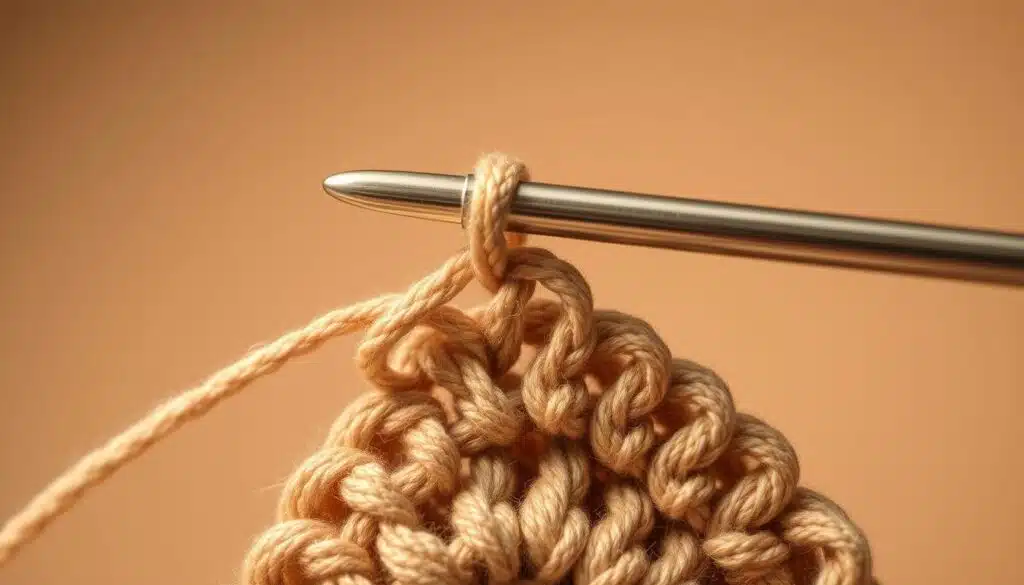
Start smart and your blanket will thank you. A tight beginning creates a cinch that pulls edges inward. This starts foundation chain curling early, before row five.
You can spot this early: the base row looks narrower than the rest. The edge begins to roll toward the wrong side.
Why a tight foundation chain causes edge curling
Tension that’s firmer on the foundation than on the body makes the first row act like a waistband. The pulled chains sit smaller, so taller stitches tug them up and toward the center. This mismatch drives uneven tension across the fabric and leads to curling along the selvage.
Using a larger hook for the foundation chain and chainless foundation options
A simple fix is to switch foundation hook size for the starting row. Try one or two sizes larger than your pattern calls for to loosen the base. If you prefer no-starting-edge headaches, consider a chainless foundation.
This method builds the chain and first stitch together and removes that tight edge entirely. For an in-depth how-to on no-count foundation methods, see a practical guide at no-count foundation.
Swatching foundation + first row to avoid surprises
Don’t skip a swatch foundation test. Work the foundation plus the first row and let it relax. If the edge cups, tweak the foundation hook size or try a chainless foundation.
Making small adjustments while the swatch is tiny saves hours of ripping later.
Need pattern-specific advice? For troubleshooting common start-up problems and quick fixes, check a practical troubleshooting roundup at crochet troubleshooting. A brief test now prevents long-term curling and keeps your blanket edges neat and flat.
Stitch Patterns That Encourage or Halt Curl
You love your yarn, but your edges might not love you back. The right stitch pattern can change how fabric behaves. Some stitches pull inward, some push outward, and a few sit quietly flat. Use this quick guide to spot common troublemakers and the cures you can use right away.
Which stitches tend to curl
Dense stitches like single crochet often create an inward tension that leads to rolling. Taller stitches such as double or treble can flare the edges or make the center dish. Tunisian simple stitch curl is a familiar complaint among makers because the forward-and-return rhythm builds a stiff strip that wants to roll.
Balanced stitch choices for flatter fabric
Choose patterns that spread tension evenly. The moss stitch flat result comes from alternating single crochet and chain, which balances row height and prevents warping. Alternating row heights or mixing in lacy motifs gives the fabric room to breathe and reduces edge distortion.
Edge techniques that stabilize your work
Anchor your edges with purposeful stitches. Rows of slip stitch, reverse single crochet, or deliberate anchor rows act like ribs, holding the perimeter steady. Those edge stabilizing stitches help finished pieces keep their shape while you wear or wash them.
Fixes for Tunisian curl
If Tunisian simple stitch curl plagues your project, switch a few starting rows to Tunisian purl, Tunisian reverse, or seed-style variants. Extended or double Tunisian stitches alter drape and break the rolling tendency without changing the whole design.
Practical tips you can try now
- Swatch with single, double, and moss stitch to see which lies flat for your yarn.
- Add a narrow slip-stitch border early, then continue the main pattern.
- For Tunisian pieces, test a purl row or ribbed border before committing to a large project.
Tunisian Crochet: Why It Curls and How to Tame It
You love the dense, fabric-like feel of Tunisian crochet. But, the edges curl and the center domes up. This curl comes from the technique itself. The forward pass picks up loops on one side, while the return pass works them off.
This creates an imbalance in tension and stitch orientation. Understanding this imbalance helps you take simple steps to tame the curl in Tunisian projects.
Start by choosing stitches that change how the fabric behaves. Try swapping some Tunisian Simple Stitch rows for Tunisian Purl or Tunisian Reverse Stitch. This even outs the surface.
Adding seed-stitch or Tunisian Double Stitch rows also helps. They break the monotony and make the piece lie flatter. A good rule is to alternate one stabilizing row for every four dense rows.
Adjust your tools and size next. Using a larger Tunisian hook relaxes the forward pass loops. This reduces pull at the edges. For worsted yarn, try stepping from a 4–5mm equivalent to a 6.5mm Tunisian hook for immediate relief.
Small tool changes can make a big difference. They help tame the curl Tunisian tends to create.
Borders and ribbing act like a built-in bracing system. Add Tunisian ribbing made from Tunisian Knit Stitch combined with Tunisian Purl. Or work a secure single-crochet or crab-stitch edge. A well-placed border anchors the fabric and often prevents curl from forming.
Tunisian blocking finishes what stitch work starts. Use wet-blocking on wool and steam or gentle heat for blends and acrylics when safe. Proper Tunisian blocking can flatten stubborn edges and smooth the center. It turns a curled sample into a wearable piece.
If you want a guided path, follow a short practice module. It mixes TPS, TRS, and extended stitches in small swatches. Bite-sized exercises teach you how Tunisian purl reduce curl in real projects.
Project-based drills from courses like Tame the Curl Tunisian give a clear roadmap. They lead to consistent, flat results.
Blocking Techniques to Flatten and Finish Like a Pro
Blocking makes your crochet pieces look neat and polished. It relaxes the fibers and sets the shape. Choose the right method based on your yarn type. Natural fibers like wool do well with a wet block, while acrylics prefer steam.
Wet-block wool for a soft drape and lasting shape. Soak the piece, then lay it flat on a foam mat or board. Pin it to the right size and let it dry completely. For quick fixes, try spray-blocking.
Wet-blocking, spray-blocking, and steam-blocking—what works for each fiber
Wool and cotton love wet blocking. They relax and keep their shape. For acrylic, steam gently to avoid melting. Tunisian acrylic projects benefit from careful steam to remove curl.
Step-by-step blocking process: pinning, shaping, drying
Start by laying your work on a grid-marked board or mat. Use pins to hold it in place. Shape it gently, matching edges and corners. Apply moisture or steam, then let it dry completely before removing pins.
Safety notes for acrylic and heat-sensitive yarns
Acrylic yarns melt under high heat. Steam from a distance and let it cool while pinned. Test a swatch before treating the whole project. For blends, try both spray and steam on a swatch to find the safest method.
For visual guides, check out this helpful guide: blocking crochet projects. It covers wet, spray, and steam techniques and shows the tools pros use.
| Fiber Type | Best Method | Speed | Risk Level |
|---|---|---|---|
| Merino Wool | Wet-block wool | Moderate (dry time varies) | Low |
| Cotton | Spray or wet block | Moderate | Low |
| Acrylic | Steam block acrylic (light) | Fast | Medium (heat sensitive) |
| Blends | Test swatch; spray or light steam | Variable | Variable |
Learning to block crochet properly makes your finished items look great. Small steps like testing a swatch and using the right pins make a big difference.
Reworking and Repairing Completed Projects
You spotted the curl and felt your chest tighten. Relax. Small fixes can save hours of work and your sanity. Start by figuring out the cause: a tight foundation, uneven increases, or stubborn rows near the start.
If the problem is a too-tight foundation chain, it’s often best to frog crochet back only as far as necessary. Then, rework the foundation chain with a larger hook.
When to frog and when to add a border
If the curl is severe across the whole piece, frog crochet and redo the offending rows. This way, you won’t be guessing at tension mistakes after that. If the curl is minor or confined to edges, adding a stabilizing border is faster and less stressful.
Pick a border that adds weight and structure, such as reverse single crochet or ribbing. This approach can fix curling edges while giving the piece a polished look.
How to rework foundation chains and stubborn edge rows
Unravel only as far as needed. Stop, inspect, and retest with a swatch before you commit. When you rework the foundation, switch to a slightly larger hook for the first row. This change loosens the start and helps the fabric lie flat.
For Tunisian projects, try adding a few Tunisian-specific rows like TPS or TRS near the beginning to counteract curl instead of frogging miles of work. After any rework, block the piece to reset the fibers; steam blocking can relax fibers and help repair crochet edges.
Using stitch markers and careful counting to avoid repeats
Mark your pattern repeats and rate-limiting rows with stitch markers. Count methodically each time you rejoin, and use temporary lifelines when the work is fragile. These tiny habits reduce the chance you’ll recreate the same problem.
Take breaks during frogging so your tension and patience remain steady. If you want a detailed troubleshooting flow, check this practical guide from Secret Yarnery for step-by-step fixes and tools to help you rework foundation chain or add the right edge treatment: fix curling edges and blocking tips.
- Quick tool picks: tension rings for steady loops, blocking boards with grid lines for layout, and a gentle fabric steamer for final shaping.
- Practical step: frog crochet only to the last row that looks even, then redo with a larger hook and swatch two rows to confirm.
- Edge-first rule: when in doubt, try a stabilizing border before committing to a full redo to repair crochet edges efficiently.
Edges, Borders, and Decorative Solutions That Also Stabilize
Turn a curling issue into a design feature with smart border choices. A stabilizing crochet border tames loose edges. It gives your piece a neat, finished look without heavy blocking. Choose a technique that fits the fabric and your style goals.
Start with simple anchors. A row of single crochet smooths the edge and adds a firm frame. For more bite at the rim, try a crab stitch edge. It gives a raised, rope-like finish that resists rolling.
Decorative borders stop curling while adding flair. Shells and picots bring visual interest and extra weight at the perimeter. Ribbing works well on stretchy or Tunisian fabrics. It counters the forward-and-return imbalance.
Design the border to match the body stitch. Choose a shell border weight that complements the yarn and stitch height. Lighter shells keep the piece airy, heavier shells add drape and pull the edge flat.
Use a contrast in stitch height or a couple of anchoring rows to make borders function, not merely decorate. This way, the border solves a curling problem and becomes a deliberate style choice.
| Border Type | Primary Benefit | Best For | How It Helps Curling |
|---|---|---|---|
| Single Crochet | Clean, firm edge | Most flat projects; beginners | Provides stabilizing crochet border to anchor stitches |
| Crab Stitch Edge | Raised, decorative finish | Scarves, blankets, edges that need tension | Reverse single creates a tight rim that stops roll |
| Shells | Decorative, weighted look | Shawls, cardigans, blankets | Shell border weight pulls edges down to reduce curl |
| Picot | Delicate, lacy edge | Light garments, baby items | Adds tiny anchor points to prevent minor curling |
| Ribbing / Tunisian Rib | Elastic, structured trim | Tunisian pieces, cuffs, hems | Opposes forward/return imbalance to flatten edges |
Try a small swatch with your chosen border before committing. This quick test shows how shell border weight or a crab stitch edge will change drape and tension. You’ll save time and keep your project stylish and flat.
Pattern Selection and Gauge: Choose Wisely to Avoid Curl
You want your finished piece to lie flat, not curl at the edges. The right pattern and gauge are key to avoid warped shapes. Start by planning: aim for the pattern’s gauge, test stitches, and adjust as needed.
How gauge impacts drape and edge behavior
Gauge affects stitch density. If your gauge is tighter than the pattern, edges curl. A looser gauge can lead to a floppy, uneven edge. Measure over a 4″ square to see the real effect.
Picking patterns that naturally lie flat
Choose stitches known for balance. Moss stitch works well with many yarns, creating a stable fabric. Granny patterns that keep row height consistent also resist curling. But, be careful with ripple or wave patterns unless your increases and tension are precise.
Swatching in the pattern stitch and blocking the swatch
Swatch and block, then measure. Swatching in the actual pattern stitch shows true behavior better than a plain single-crochet square. Block the sample and note changes in stitch count and drape. If needed, change hook size or yarn before committing.
Quick checklist for reliable results
- Swatch and block in the chosen stitch to verify gauge and curl tendencies.
- Target the pattern gauge; adjust hook size if your swatch is off.
- Favor moss stitch flat or balanced granny layouts when you need a non-curling edge.
- Test small projects—coaster or scarf—to confirm pattern selection flat crochet works in real life.
Community Tips, Tools, and Myths Busted
When your crochet edges curl, the community has quick fixes. A few tweaks to tools and technique can fix the problem. Here’s maker-tested advice and quick solutions.
Top recommended gear from makers
Forums and workshops recommend blocking boards with grid lines and rust-proof pins. They help shape your work precisely. Fabric steamers are great for setting wool and blends gently.
For Tunisian crochet, longer hooks from brands like Clover and WeCrochet reduce curl. Simple tools like stitch markers and tension rings are also helpful.
Busting common beliefs about curl
Some think curling is just part of crochet and can’t be fixed. But this is a myth. Curl usually comes from tension, stitch choice, yarn, or a tight foundation chain. You can fix these problems with the right methods.
Quick fixes makers swear by
Try using a larger hook for the whole piece or just the foundation row. Adding Tunisian purl or reverse-stitch rows can help. Swapping to lacy stitches in a few rows can also loosen the edge.
If you’re short on time, a sturdy border can stabilize the work right away. Options include single crochet, crab stitch, or ribbing.
How to eliminate Tunisian curl
To get rid of Tunisian curl, swap tools and techniques. Use a longer hook and a tension ring while practicing Tunisian purl. Wet-block or steam-block after finishing to set the fabric.
If curl remains, add a weighted border or rework the first few rows with a larger hook.
Resources and learning for steady improvement
For guided practice, take classes focused on curl issues and stitch balance. A clear tutorial can help you improve faster. For a useful guide, see Mastering Your Crochet. It covers common mistakes and fixes.
- Tools to try: blocking board, rust-proof pins, fabric steamer, longer Tunisian hooks, tension rings.
- Technique swaps: larger hooks, Tunisian purl, reverse stitch, lacy rows, sturdy borders.
- Mindset change: don’t accept curling as inevitable—use community crochet tips and methodical fixes.
Conclusion
Crochet curling has clear causes like tension, stitch choice, and yarn. By controlling tension and matching hook size to yarn, you can fix curling edges. This makes your crochet pieces flat and ready to finish.
Tunisian crochet needs extra care because of its unique structure. Use a bigger Tunisian hook and try different stitches. Adding ribbing or lace can also help. Remember to steam-block acrylics and wet-block wool to stop curl.
Learn by doing: practice techniques and choose stitches that don’t curl. Pair yarn with the right stitch height. Always use borders and block your work. Use community resources and tools like blocking boards to improve faster.
In short, curl is something you can control in crochet. Follow these tips to stop curl and finish your projects professionally.
FAQ
What is crochet curling and how does it show up in my projects?
Crochet curling happens when parts of your work roll or flare instead of staying flat. You might see edges curling inward on granny squares or dense single-crochet panels. On the other hand, amigurumi rounds or continuous rounds might flare outward.
Domed centers in circular motifs are another sign. Look for edges rolling inward or a domed middle to spot curling. It can come from tight tension, stitch choice, foundation chain issues, or the yarn itself.
Why does tight or loose tension make my work curl?
Tight tension makes fabric stiff and edges curl inward. Loose tension makes it floppy and can cause uneven edges. To avoid curling, keep your tension even and consistent.
Swatching and small tension exercises are key before starting a big project. This helps ensure your stitches are even and fabric lies flat.
How can I practice tension so my pieces stop curling?
Start with small, quick swatches in your chosen stitch. Include the foundation and the first row. Aim for a flat square without stiffness.
Try relaxing your grip and using yarn holders or tension rings. Do short drills of five or ten minutes until your stitches stabilize. If needed, adjust your hook size and retest.
How does hook size and yarn choice affect curl?
A small hook tightens stitches and can cause curl. A larger hook loosens the fabric and improves drape. Yarn weight and fiber also play a role.
Lightweight yarns like fingering or lace may lack structure and curl. Bulky yarns can be stiff. Cotton is stable but might need blocking. Wool responds well to wet-blocking, and acrylic is best with gentle steam.
Match your hook size to the yarn weight and desired drape to reduce curling.
My foundation chain always pulls—what should I do?
A tight foundation chain causes curled edges. Use a larger hook for the chain or try a chainless foundation. Loosen your first chains intentionally.
Always swatch the foundation plus at least one working row. This catches problems early and avoids frogging later.
Which stitches are most likely to curl and which lie flat?
Dense stitches like single crochet and Tunisian Simple Stitch (TSS) tend to curl inward. Tall stitches (treble) can flare or create opposite edge behavior. Stitches that usually lie flat include moss (linen) stitch, balanced granny patterns, and patterns that alternate row heights or add lace.
Edge or anchor rows—slip stitch, reverse single crochet—also stabilize borders.
I’m doing Tunisian crochet—why does it curl more than regular crochet?
Tunisian crochet often curls because it’s worked on one side. It doesn’t get the balancing effect of turning rows. The fabric’s structure from forward/return passes leads to curl unless you address it with stitch substitutions, larger hooks, or finishing methods.
What specific Tunisian techniques help stop curling?
Swap some TSS rows for Tunisian Purl Stitch (TPS), Tunisian Reverse Stitch (TRS), seed stitch combos, Tunisian Double or Extended Stitches, or ribbing. Use a larger Tunisian hook to loosen the fabric. Strong borders—Tunisian ribbing or a few TPS/TKS rounds—also anchor edges.
Blocking (wet for wool, gentle steam for acrylic) completes the cure.
How do I block safely to flatten my crochet without damaging the yarn?
Choose the right method for the fiber: wet-block wool and cotton, steam lightly for acrylic (test a scrap first), and use spray-blocking for delicate blends. Pin the piece flat on a blocking board or foam mats with rust-proof pins, shape the edges and corners, apply water or steam, and let it dry fully before removing pins. Never press an iron directly onto heat-sensitive yarns.
When should I frog and rework versus adding a border to fix curl?
If the curl stems from a tight foundation chain or widespread tension, frogging back and redoing with a larger hook or chainless foundation is the best fix. For minor or localized curl, a stabilizing border or a few corrective rows (in Tunisian work) is faster and effective. Diagnose the cause—tension, stitch, or yarn—then choose rework or border.
How do I rework a tight foundation chain without panicking?
Unravel only as far as necessary, switch to a larger hook for the foundation, and re-crochet the first few rows. Use stitch markers and careful counting so you don’t repeat the error, and take breaks to avoid frustration. Re-swatch the corrected foundation plus a couple of rows to confirm the edge now lies flat.
Which borders stabilize edges best and look good?
Simple anchor borders like single crochet and reverse single crochet (crab stitch) provide firm stabilization. Decorative borders—shells, picot, and ribbing—add weight and visual interest while countering curl. For Tunisian pieces, Tunisian ribbing or a few Tunisian purl/reverse rows as an edge work brilliantly.
Design borders to match the fabric’s drape and color palette for a polished finish.
How important is gauge and swatching for preventing curl?
Very important. Gauge determines stitch density and drape; mismatched gauge causes edge curling and poor fit. Swatch in the actual pattern stitch, block the swatch, and measure stitches and rows over a 4″ square. Adjust hook size or yarn until the blocked swatch behaves like the finished fabric you want.
What community tools and tips do makers swear by to beat curl?
Makers recommend blocking boards with grid lines, rust-proof pins, fabric steamers, longer Tunisian hooks (brands like Clover, WeCrochet, and Furls are popular), and tension aids such as rings. Quick fixes shared in communities include switching to larger hooks, adding a few Tunisian purl or reverse-stitch rows, using lacy stitches to balance density, steam or wet-blocking, and taking targeted courses that teach no-curl stitch strategies.
Are there myths about curling I should ignore?
Yes—don’t accept “it just happens.” Curl has identifiable causes: tension, stitch choice, foundation, hook size, and yarn. It’s predictable and solvable with swatching, stitch swaps, blocking, borders, or reworking. With the right combo of technique and finishing, you can get flat, professional-looking crochet every time.