
You’re here because your project has a surprise in the stitch pattern. You want help that calms you down. Knitting troubleshooting is about spotting mistakes, deciding how to fix them, and then moving forward with skill.
Mistakes are like practice with consequences that build confidence. Common issues like dropped stitches and uneven tension are normal. You can fix these with simple tricks like picking up a dropped stitch or adjusting your tension.
This guide is practical and reassuring. First, you’ll learn how to diagnose the issue. Then, you’ll choose a strategy based on how far along you are. Lastly, you’ll pick up habits to prevent mistakes next time.
Key Takeaways
- Mistakes are learning tools; each fix boosts your confidence.
- Diagnose the problem before you act: that guides whether to fix, spot-fix, or frog.
- Common issues — dropped stitch repair, twisted stitches, and gauge troubles — are usually solvable.
- Use stitch markers, counting, and swatching to avoid bigger problems later.
- Keep tools nearby and adopt habits that reduce beginner knitting problems.
Quick Diagnostic Guide for Your Knitting Project
Start by spotting the problem before you cut your work. Look for ladders, holes, twisted legs, or uneven tension. Check a few rows and stitches to see if they match the pattern.
If the issue is near your needles and the work is live, you can usually fix it. But if it’s far away or already bound off, you’ll need a spot-fix.
How to identify what kind of mistake you’re looking at
Look for visual clues. A vertical ladder or a missing stitch means you need to fix a dropped stitch right away. Holes or an extra loop usually point to an accidental yarnover or added stitch.
Tight edges suggest a cast-on or bind-off problem. Twisted stitches show by a tilted V on a single loop or a whole row that looks flat and narrow.
When to fix, when to spot-fix, and when to frog
Decide based on location and damage. Fix immediately with a crochet hook for knitting if the work is live and the error is local. Spot-fix on the wrong side when the piece is bound off; weave in or sew closed for small holes.
Choose when to frog by asking whether the mistake changes shaping or repeats across rows. If it alters garment size or repeats through pattern repeats, it’s time to frog.
Essential tools to have within arm’s reach (crochet hook, stitch markers, tapestry needle)
Set up a compact knitting toolkit so you don’t hunt for tools mid-project. Keep several crochet hook sizes, removable stitch markers, tapestry needles, stitch stoppers, and a small pair of scissors together. A crochet hook for knitting will save a dropped stitch and make raveling up simple.
Use a removable marker to isolate a problem before you undo rows. Practice calm inspection under good light, and consult tutorials when a fix feels tricky. If you want a concise skills refresher, check this guide for common errors and fixes at skill-builder mistakes.
Common Dropped Stitches and How to Rescue Them
You’ve spotted a gap and felt that small panic. A dropped stitch can quickly ruin a neat row, making it look like a ladder. Stay calm. A quick eye and the right move can save your work and your mood.
How dropped stitches form and the ladder effect
A dropped stitch occurs when a live stitch slips off the needle. If it runs down, it creates a vertical column, or ladder. Loose yarn, pausing mid-row, or smooth yarn increase the risk of a run.
Knitting above the fall tightens the row above, making it hard to ravel up without undoing more. Spotting the ladder early keeps your options open.
Fix-it-now: raveling up with a crochet hook while the work is live
If the stitch is live, act fast. Slip a removable stitch marker under the run to steady adjacent stitches. Use a proper-size crochet hook to ladder the stitch back up, catching each rung and pulling through to recreate the original loops.
Many knitters find the fix dropped stitch crochet hook method fast and clean. Match hook size to yarn weight so loops sit naturally on the needle again. When done, place the rescued stitch back on the needle and continue knitting.
Spot-fix after bind-off and securing rescued stitches on the wrong side
Sometimes the stitch has closed or you’ve already bound off. In that case, ravel up knitting to the last intact row. Catch the live stitch on a length of yarn, pull it through to the wrong side, and weave the tail to secure it neatly.
If you plan to wear or gift the piece, hide the repair on the wrong side and weave in ends well. This keeps the fabric stable and prevents the rescued stitch from re-opening in the wash or wear.
- Stabilize: mark nearby stitches before working the ladder.
- Prevent: push stitches down when pausing and use stitch stoppers in bags.
- Practice: short ravel-up knitting drills with different yarns builds confidence.
Twisted and Misoriented Stitches: Tiny Goofs, Big Looks
Spotting a twisted stitch early keeps your fabric neat and saves time. A twisted stitch can happen when a stitch is on the needle wrong or when you knit into the wrong leg. Good lighting and regular checks help catch these problems before they spread.
What a twisted stitch is and why it happens
A twisted stitch often comes from wrong needle placement or a small mistake. If you knit into the left leg instead of the right, the stitch looks tighter. Sometimes, a stitch just rotates on the needle and ends up wrong.
When a single twisted stitch is fine and when it’s worth undoing
If the twisted stitch is alone and in a textured pattern, you can leave it. It adds a bit of character without affecting the fit. But if twisted stitches keep happening across a row or on a visible seam, you should fix them. This keeps the fabric smooth and the pattern clear.
How to drop and pick up a stitch to correct orientation
To fix a twisted stitch, drop it down a row or two until it’s right, then work it back up. Slip the stitch off, put your needle in the right spot, and pick it up. Using a crochet hook makes this process quicker and neater.
Stopping mistakes early means slowing down and checking each stitch. This practice reduces errors. Small, consistent habits help keep your work looking great and make knitting faster over time.
Split Yarn and Snagged Plies: Preventing Terrifying Little Loops
That tiny snag that looks like a pill but feels worse? It’s called a split stitch. It happens when a needle tip parts a yarn’s plies, leaving loose threads. These can catch and run. If not fixed, a split yarn can pull apart, ruining your work.
How split stitches look and why they’re risky
Split stitches look like a fuzzy blob or a little loop on the surface. They can look like extra stitches, making you think your count is wrong. A snagged ply weakens the strand. If it breaks, you might have to unravel many rows to fix it.
Dropping the stitch and re-picking it up to repair split plies
The best way to fix a split yarn is simple. Drop the affected stitch and use a crochet hook to tease the separated plies back together. Work from the live end, pick the stitch up cleanly, then slide it back onto the needle. This method will repair split ply while keeping fabric intact.
Tips to avoid splitting yarn (needle tips, yarn choice, attention)
To avoid splitting yarn, match needle tips to your fiber. Blunter tips suit loosely plied yarns. Sharper tips work well with tight, smooth yarns like Malabrigo or Cascade 220. Test a small swatch if you suspect splitting-prone yarn.
Keep a crochet hook at hand and good lighting so you can spot tiny issues before they become holes. Inspect each stitch before you work it when using novelty or multi-ply yarns known to let yarn plies snag. If a yarn brand splits repeatedly, try a different brand that offers more stable plies.
| Problem | Immediate Fix | Preventive Step |
|---|---|---|
| Split loop on surface | Drop stitch, use a crochet hook to re-twist plies and pick up | Use blunt needles with loosely plied yarn |
| Yarn plies snagged mid-row | Secure with a temporary clip, repair with hook from live end | Choose brands with stable plies like Berroco or Rowan |
| Appearance of extra stitches due to split | Inspect before knitting, fix split then recount | Work in good light and slow down on tricky yarns |
| Broken ply after snag | Weave broken end into wrong side; repair nearby stitches if needed | Avoid cutting pills; always check for split yarn before trimming |
Too Many Stitches and Accidental Yarnovers
Did you notice a hole or bulge at the end of a row? It might be because of a small mistake. This could be yarn catching on a needle tip or a muddled make-one. Or maybe the yarn split, making a stitch look like two.
Causes and quick clues
Accidental yarnovers can happen when the working yarn slips around the needle. Or when turning a row and creating a double stitch at the edge. Yarn splitting can also look like an extra loop.
If you see an unexpected hole or your stitch count grows, check the row ends. Look for a stray strand in the stitch legs.
Simple fixes you can use now
If only a few rows are above the mistake, the quickest fix is to remove an extra stitch k2tog. This keeps your count right without ripping back.
If a yarn over left a visible hole, sew it closed on the wrong side with a short matching tail. Use a tapestry needle to draw the fabric together. This way, the mend will be hidden under light wear.
When to rip back and when to spot-fix
If the error spans many rows or the hole distorts a motif, rip back to the safe point. Then redo those rows. Spot fixes are best for minor blemishes where the pattern hides a k2tog.
Preventing repeat offenses
Keep the yarn position consistent—behind for knits, in front for purls. Pass the yarn under needle tips when working ribbing to avoid accidental YO. Use a center-pull cake or a progress keeper to prevent snags that cause stray loops.
Troubleshooting checklist
- Scan row ends each turn for doubled stitches.
- Spot accidental YOs early and decide: sew, k2tog, or rip.
- Use short yarn tails to invisibly close holes on the wrong side.
- Choose k2tog to remove extra stitch k2tog discreetly where pattern allows.
Gauge Problems: Tight, Loose, and Inconsistent Tension
Gauge problems in knitting can be a surprise in a calm pattern. Before you worry, here are a few quick signs. They help you understand what’s happening and how it will affect your project’s size.
Signs your gauge is off and how it affects finished size
Too-tight stitches are hard to insert the needle into. This makes your fabric smaller and stiffer. Loose stitches make your fabric grow and sag.
Inconsistent gauge means some rows are tight, others loose. This causes wavy edges and uneven measurements. A quick swatch will show if the pattern fits or if you need to adjust it.
Techniques to loosen up or tighten your tension without panic
To fix tight knitting, relax your grip and breathe between stitches. Try using a slightly larger needle. Wooden or bamboo needles are draggy; metal needles are faster and can loosen tension.
To loosen knitting tension, let the yarn flow more freely. Use a yarn bowl or change how the yarn moves around your fingers. For tighter rows, hold the yarn firmer or use a smaller needle. Practice swatches help you find what works for you.
Why swatching and blocking save you heartbreak later
Swatching is very important. Always knit a swatch in the stitch pattern, wash and block it like the final item, and measure. Adjust needle size until the swatch matches the pattern gauge.
Blocking knitwear fixes minor issues and improves drape. Blocked swatches show the true size and behavior of fabric. If your gauge is close but not exact, blocking can save your project without ripping it back.
If you need help with yarn and tension issues, check out crochet troubleshooting. It has tips for all fiber crafts.
Stitch Count Errors and Keeping Track Without Losing Your Mind
You see a wobble in your fabric and feel a bit panicked. A quick check of the stitch count clears up the confusion. It shows if the error changed the total or just twisted a stitch. This tells you if you need to unpick rows or fix it locally.
How to notice stitch count discrepancies quickly
Count at the end of a repeat, not in the middle. Compare each needle or section to the pattern to spot errors fast. If the numbers don’t match, mark the row with a removable marker. Then, decide if the error is recent or buried deep.
Using stitch markers and progress keepers to prevent counting slips
Put stitch markers knitting in every repeat to make counting easier. Use a progress keeper or stitch counter when you pause. This way, you won’t lose your place. For more tips, check out this guide: fix knitting mistakes.
Fixing wrong counts by unpicking versus strategic decreases
If many rows are wrong, unpicking is the best choice. It gives you a clean fabric. But, if the error is recent, a targeted decrease like k2tog might work. This hides one extra stitch.
When you must remove a stitch, work a yarn-over plus a decrease. This keeps the pattern balanced. Decide fast: unpick for perfection or use a decrease for speed. Keep your routine simple: check stitch count often, use stitch markers, and you’ll stay on track.
Edges and Seams: Casting On or Binding Off Too Tight
Your sweater might look perfect, but a tight cuff or neck can ruin it. A tight cast-on or bind-off can make your sweater stiff and uncomfortable. You want your edges to stretch with your fabric, not fight it.
How tight edges ruin fit and drape
Tight edges pull your sweater inward, changing its shape. A tight cast-on can make the hem ripple. A tight bind-off can shorten the neckline, making it hard to slide on.
Stiff edges also show when you block, because they resist the same shaping. In short, tight edges turn soft knits into awkward shapes.
When you must redo cast-on or bind-off and how to choose a better method
Sometimes, you need to undo and redo. If your cast-on stitches are too tight, you need a new approach. If your bind-off is too tight, unpick it and use a stretchier option.
Choose the right method for your project. For cuffs and necklines, use a stretchy bind-off like tubular or picot. For hems and pieces you’ll graft or pick up later, a provisional cast on is best. Try a swatch first to see what works best.
For a quick guide on why cast-ons get tight and how to fix them, check out this guide from A Bee in the Bonnet: what to do when your knitting cast on is too.
Simple hacks: larger needles for edges, stretchy bind-offs, and provisional cast-ons
Use a larger needle for the edge rows only. Work the cast-on or first couple of rows on a needle one size up, then switch to your working needles. This is an easy fix that keeps your gauge in the body while giving a looser edge.
Learn at least two bind-offs. An elastic option keeps cuffs wearable. If you need a neat, flexible start for grafting or ladders, a provisional cast on lets you try the fit and adjust before committing.
Retrain your tension over time. Practice relaxing your hands and watching the tug after each loop. Small, mindful changes deliver long-term improvement in loose edge knitting and overall fabric evenness.
- Quick fix: redo the bind-off with a stretchy bind off when only the finishing edge is tight.
- Edge-only change: cast on with a larger needle then transfer to working needles.
- Future-proof: use a provisional cast on when you plan to graft, pick up, or test fit.
Knitting in the Wrong Direction and Crossed Stitches
You see a weird flap or extra rows where the fabric looks like it hiccupped. This usually means you started knitting the wrong way or turned the work incorrectly. The fastest way to fix this is to unpick to the last correct row, make sure the working yarn is on the right-hand needle, then reorient and reknit the stitches in the right direction.
How the error shows up
Knitting the wrong direction creates two extra rows in a patch and tiny holes where you turned. Crossed stitches look like small Xs or twisted bars where the loop was pulled through incorrectly or knit into the row below. Good lighting and frequent checks stop many of these surprises before they grow into time-consuming repairs.
Unpick and reset without drama
To unpick a knitting mistake, slip the last correct row onto a needle or use a lifeline. Work back only as far as needed. Place an opening stitch marker in the last worked stitch so you don’t knit it twice when you resume.
Picking up crossed stitches cleanly
When stitches have crossed, knit across to the crossover, slip the offending stitch off and carefully unravel the crossover one loop at a time. Use a crochet hook to pick up dropped loops and realign them on the needle. This approach gives a tidy crossed stitch correction without stretching the surrounding fabric.
When stitches are too short or tangled
If a loop is too short to pull through while you reorient knitting work, use the needle-as-peg trick: park the short strand and lift the stitch over it, or peg-knit the stitch then continue. This keeps tension even and prevents new holes.
Quick habits that save time
- Check which side the working yarn sits on before you pick up mid-row.
- Mark the last correct stitch to avoid doubling it on the next pass.
- When a miscross is deep, consider a structural fix or try an optical I-cord if speed matters.
For a detailed structural method to fix miscrossed cable arms and ladder down only the problem column, see this clear guide on fixing miscrosed cables for step-by-step photos and techniques: fixing miscrossed cables. Use the method that matches your patience level and the yarn’s value: unpick and reknit for a permanent mend, or an I-cord for a fast visual repair.
knitting troubleshooting: Tools, Mindset, and Prevention Strategies
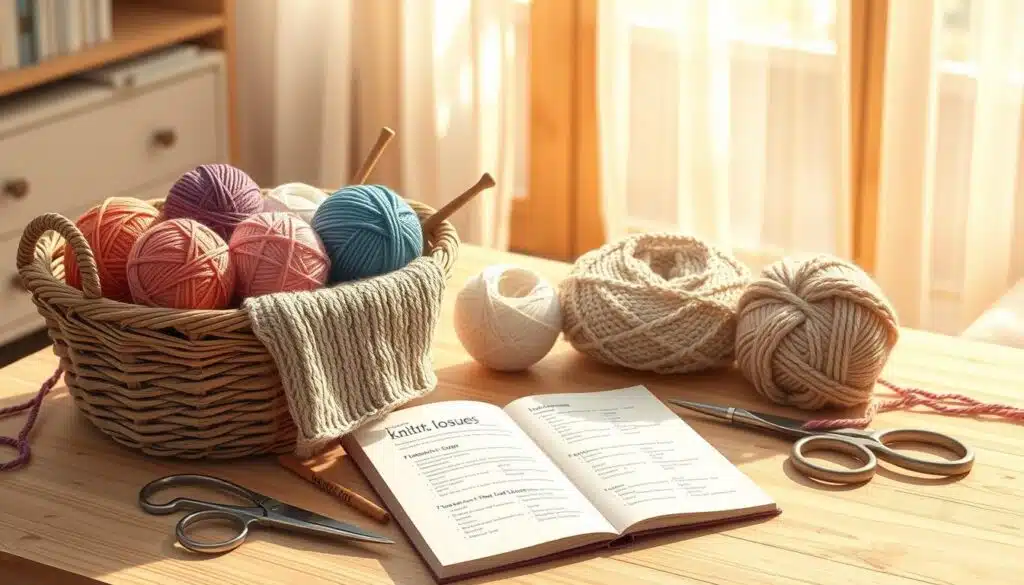
Want fewer mid-project headaches and more smooth rows? Build a reliable knitting toolkit to keep small problems small. A set of crochet hooks in various sizes quickly fixes dropped stitches. Removable stitch markers and progress keepers track pattern repeats without guesswork.
Tapestry needles finish ends cleanly. Stitch stoppers protect live stitches when you pause. A yarn bowl or center-pull ball keeps tension steady and tangles rare.
Building your toolkit
Keep these essentials in your project bag: a range of crochet hooks, removable stitch markers, tapestry needles, stitch stoppers, a yarn bowl, small scissors, and a needle gauge. A compact set from Clover or ChiaoGoo covers most needs. Carrying this kit reduces panic and speeds repairs.
Adopting a learning-friendly mindset
See mistakes as lessons with a troubleshooting mindset. Treat errors as confidence builders, not failures. Knowing the issue—dropped stitch, split ply, or twisted loop—helps you fix it right.
Watch a short video or follow a quick how-to article like fix crochet mistakes to learn repair steps in minutes.
Prevention habits that save time
Small habits prevent big redo sessions. Swatch before starting a project to avoid gauge surprises. Use good lighting and take breaks to reduce mistakes caused by fatigue.
Relax your grip to avoid tight tension. Choose yarns suited to your skill level and try different needle materials for comfort.
Regularly using stitch markers and progress keepers makes stitch count errors rare. Stitch stoppers and a yarn bowl stop live stitches from escaping. These simple steps prevent knitting mistakes before they start.
When stuck, seek knitting community help. Ravelry groups, Instagram makers, and local guilds offer fast feedback, clear photos, and moral support. Patience and steady practice make repairs fast and less scary.
Conclusion
You’ve learned that mistakes like dropped stitches and tight edges are normal. Seeing each mistake as a chance to learn helps. Use tools like a small crochet hook and stitch markers to fix issues calmly.
Preventing mistakes is better than fixing them. Swatching and using stitch markers can save time. Joining Ravelry groups or watching tutorials can also help.
Don’t worry if you make mistakes, even experienced knitters do. Keep a small kit handy and check your work often. With patience and practice, fixing mistakes becomes easier, and your projects will improve.
FAQ
What exactly is “knitting troubleshooting” and how will this guide help you?
Knitting troubleshooting is finding and fixing mistakes in your knitting. This guide will teach you how to quickly spot and fix errors. You’ll learn simple fixes and how to prevent mistakes in the future.
How do you identify what kind of mistake you’re looking at?
First, compare your work to the pattern. Look for signs like ladders, holes, and twisted stitches. Good lighting and a quick stitch count will help you identify the mistake.
When should you fix a mistake immediately, spot-fix it later, or frog the project?
Fix it now if it’s close and your work is live. Spot-fix if it’s isolated and not critical. Frog when the error affects many rows or shaping.
Which tools should you keep within arm’s reach for fast fixes?
Keep a small kit with crochet hooks, stitch markers, tapestry needles, and a yarn needle. A yarn bowl and good lighting are also essential.
How do dropped stitches form and what’s the ladder effect?
Dropped stitches happen when a stitch slips off the needle. This creates a ladder of horizontal bars. If you keep knitting, it can close the row above, making rescue harder.
How do you ravel up a dropped stitch while the work is yet live?
Stabilize stitches with markers, snag the errant loop with a crochet hook, and ladder it up. Place it back on the needle and continue. Work gently to avoid new twists or splits.
What if the dropped stitch has closed or the piece is bound off?
Ravel back to the narrowing point, pull the live loop through with a scrap yarn, and weave or sew it down. For small holes, sew them closed on the wrong side with matching yarn.
What causes twisted stitches and how do they affect the look?
Twists come from knitting into the wrong leg or wrong needle orientation. A single twisted stitch is often invisible after blocking. But a whole row or pattern of twisted stitches changes texture and may need unpicking.
When is a single twisted stitch worth leaving alone, and when should you fix it?
Leave it if it’s isolated or hidden. Fix it when it’s visible, repeated, or disrupts pattern repeats. Unpick and rework a section with many twisted stitches for a clean finish.
How do you drop and pick up a stitch to correct orientation?
Slip the stitch off, drop it down the row(s) needed, then ladder it back up with a crochet hook or needle. Make sure the leg orientation is correct before rehanging it on the needle.
What does a split stitch look like and why is it risky?
Split stitches show loose plies or a small pill where the needle has gone between strands. They snag, fray, and can break, leading to larger runs. They’re subtle but worth catching early to avoid bigger damage.
How do you repair split plies without making matters worse?
Drop the stitch and pick it back up to re-twist the plies. Use a crochet hook to coax the strands back together. Don’t cut the loop—first try reworking it into a normal stitch. Adjust needle tips if splitting is recurrent.
How can you avoid splitting yarn in the first place?
Choose yarns with stable plies, use blunter or smoother needle tips, and pay attention to each stitch. Test combinations on a swatch. Good lighting and a crochet hook on standby help you spot splits early.
Why do accidental yarnovers and extra stitches happen?
Yarnovers can occur when yarn catches around needles, cords, or your fingers, or during muddled increases. Double stitches at row ends or yarn splitting that looks like two stitches also add unwanted stitches. Turning rows and ribbing can be trouble spots.
What are quick fixes for extra stitches or accidental yarnovers?
If it’s minor, work a k2tog to remove an extra stitch discreetly. For holes from accidental YOs, either drop and rework or sew the hole closed on the wrong side with a short matching tail. Rip back when multiple rows or shaping are affected.
How do you spot and prevent accidental yarnovers during ribbing and turning rows?
Keep yarn position consistent, pass yarn under needle tips as needed, and use progress keepers at turning points. Check the fabric edge after each turn. Short attention checks and stitch markers help avoid surprises.
How do you know if your gauge is off and why does it matter?
Signs include difficulty inserting needles (too tight), floppy fabric (too loose), and inconsistent row/stitch density. Gauge affects finished size and drape, so mismatches can ruin fit even if the pattern is flawless.
What techniques help you loosen or tighten tension without panicking?
Relax your grip, try a different needle material, change needle size, and practice consistent hand position on swatches. These techniques help even out your tension.
How do swatching and blocking prevent heartbreak later?
A swatch in the pattern and finished blocking show true stitch and row gauge. They show how the fabric behaves and whether your chosen yarn/needle combo will give the desired drape. Blocking can also even out minor tension issues before you commit to a whole garment.
How do you notice stitch count errors quickly?
Count stitches on each needle after pattern repeats, check for ladders and holes, and compare your counts to the pattern frequently. If something feels off, stop and recount before continuing—you’ll save time unpicking later.
How do stitch markers and progress keepers prevent counting slips?
Place markers at pattern repeats or key shaping points so you only count segments instead of whole rows. Progress keepers mark your last worked stitch when pausing; removable markers let you secure live stitches mid-row without losing your place.
When should you unpick versus use strategic decreases to fix a wrong stitch count?
Unpick when the error affects shaping, multiple repeats, or will show at the finished edge. Use strategic decreases (k2tog) when only a few rows are involved and the change won’t distort the pattern or silhouette. Choose the cleaner route for visible areas.
How do tight cast-on edges or bind-offs ruin a project?
Tight edges pull fabric in, distort drape, and make garments hard to wear. A too-tight cast-on can permanently narrow the opening; a tight bind-off can choke a neckline or cuff after days of perfect knitting.
When must you redo a cast-on or bind-off, and how do you pick a better method?
Redo a cast-on if the edge is visibly narrower than the body—no amount of fiddling will fix a tight foundation. For bind-offs, consider redoing with a stretchier method if fit is impacted. Try provisional cast-ons, tubular or elastic bind-offs, or simply a larger needle for the edge.
What simple hacks make edges stretchier and neater?
Use a larger needle for the first cast-on row, practice stretchy bind-offs like Jeny’s Surprisingly Stretchy Bind-Off, or use a provisional cast-on to test and adjust before committing. These small choices rescue fit without wrecking your work.
What happens when you knit in the wrong direction and how does it show up?
Knitting the wrong way adds extra rows in parts of the piece and can leave holes where you turned. This creates visible mismatches and shaping errors. It’s usually obvious where the fabric’s rhythm breaks.
How do you fix knitting the wrong way or crossed stitches?
Unpick back to the last correct row, reorient the work so the working yarn is on the right needle, and reknit. For crossed stitches, unravel the crossing carefully, slip the stitch off, and pick it up cleanly with a crochet hook to avoid further tangles.
What should be in your troubleshooting toolkit?
A set of crochet hooks, removable stitch markers, tapestry needles, stitch stoppers, a yarn bowl or center-pull ball, small scissors, needle gauge, and good light. Add extra needles and a small tape measure for swatching and shaping checks.
How should you approach mistakes so they actually help your knitting?
Adopt a learning-friendly mindset: treat mistakes as small lessons that build confidence. Pause, diagnose the issue, choose the right fix, and practice prevention. Share progress with a community like Ravelry or a local group—support and tutorials speed learning.
What prevention habits will make mistakes less frequent?
Swatch and block before large projects, use stitch markers and progress keepers, count stitches regularly, choose yarns and needles that suit your hands, use good lighting, relax your grip, take breaks, and keep a crochet hook handy. These habits reduce errors and keep knitting fun.
Any final practical tips for rescuing and preventing common knitting errors?
Check stitch count often, inspect for ladders and holes, decide quickly whether to fix immediately or spot-fix later, and keep your kit nearby. Swatch, block, and join a community for tutorials and encouragement—your mistakes are just practice runs toward better, faster knitting.