
Starting a crochet project can be exciting, but what if the yarn is out of stock? Finding a substitute yarn is like solving a small puzzle. Just check the yardage, fiber, and make a swatch to ensure the new yarn works well.
This article will guide you through the steps to swap yarns confidently. You’ll learn about yards-per-gram math, WPI, and using tools like YarnSub.com. This way, your yarn swap won’t be a guess.
Let’s look at examples like Cascade 220 Superwash and K+C Element. They show how close you can get with a +/-20% rule. You’ll also see why two yarns of the same weight can differ and why buying an extra skein is wise.
Key Takeaways
- Prioritize yardage and fiber when choosing a substitute yarn.
- Use a +/-20% yardage range to find safe yarn alternatives.
- Convert pattern yardage into skein counts and round up before buying.
- Swatch and measure WPI to confirm stitch definition and drape.
- Tools like YarnSub.com and simple yards-per-gram math make yarn replacement reliable.
Why yarn substitution matters for your crochet projects
Ever felt frustrated when a pattern calls for a specific yarn, but it’s not available? Learning to substitute yarn can save you time, money, and disappointment. This section will explain why swapping yarns is important and what to check before making a change.
Common reasons you’ll need to substitute yarn
Yarn availability is a big reason for substitution. Popular yarns often sell out quickly at stores like Michaels and WEBS. Sometimes, a favorite yarn line gets discontinued, leaving you to find a replacement.
Allergies can also force you to switch yarns. If wool makes you itch, you might choose cotton or synthetic blends. Many people also swap yarns to use up their stash or for easier care.
Being short on time is another reason. Using yarn from your stash or finding a machine-washable alternative can make projects more practical for daily wear.
How substitution affects size, drape, and appearance
Swapping yarns can change the size and drape of your project. Even if two yarns are labeled as “worsted,” they might have different stitches per inch. This means you need to swatch to get the right fit.
The drape of a yarn affects how a garment hangs. A dense yarn will be boxy, while a drapey yarn will flow. Choose a substitute that matches the drape you want.
Texture and spin also impact how a yarn looks and feels. For example, a single-ply mohair will blur stitches, while a tightly plied merino will make them stand out.
Why yarn personality beats label weight alone
Label weight is just the beginning. The personality of a yarn, including its loft, twist, fiber blend, and finish, determines its behavior. Two yarns in the same category can have very different results.
For a structured sweater, look for yarns with higher twist and less halo. For drape and sheen, choose plant fibers or silk blends. Always trust your swatch over the label.
For a deeper look at how different fibers and textures affect your projects, check out this guide on yarn types unraveled. This article highlights the importance of choosing the right yarn, whether it’s due to pattern requirements, yarn availability, or personal preferences like allergies.
Understanding yarn weight, yards per gram, and what it really means
Ever felt confused when two Super Bulky yarns act so differently? Labels and categories help, but they’re not always right. The Craft Yarn Council chart gives a rough idea, not a sure thing.
How the Craft Yarn Council weight categories are a starting point, not a guarantee
The Craft Yarn Council made weight symbols to make shopping easier. They help narrow down choices, but there’s more to explore. These symbols group yarns by thickness and hook size, but brands can interpret them differently.
Comparing brands like Cascade 220 Superwash and Katia Cotton shows symbols can hide real differences. Think of categories as a guide, not a final answer.
The yards-per-gram equation explained and why it’s your secret weapon
Yards per gram is just math: yards divided by grams. This figure lets you compare yarns’ density. A higher number means a thinner yarn, and a lower number means thicker.
Yards per gram helps you compare yarns better than labels alone. It shows actual density. Aim for a difference of 0.10–0.15 yards per gram for similar results. A bigger difference means you might need to swatch.
Practical examples showing how two “same weight” yarns can behave differently
Bernat Softee Chunky has about 108 yards per 100 grams, or 1.08 yards per gram. Wool-Ease Thick & Quick has 106 yards in 170 grams, or 0.62 yards per gram. Both are Super Bulky but feel and stitch differently.
For substituting yarns, check yardage and fibre first. A +/-20% yardage rule works for many projects. You can compare skeins or use resources like this guide to convert labels.
Estimating an unlabeled skein? Try wraps per inch and cross-check with yards per gram. Tools and databases help, but swatching and adjusting hook size is your best bet.
Match fiber content first (when you want predictable results)
When fit and drape are key, start with matching fiber content. The type of fiber affects stretch, memory, and how a garment looks after wear or washing. Swapping merino for a plant-based yarn will change how a sweater hangs.
How wool, cotton, acrylic, and blends change stretch, drape, and care
Wool offers elasticity and bounce, helping garments keep their shape. Cotton is heavy with little stretch and a crisp drape. Acrylic is stable with less natural stretch and is easy to wash in a machine.
Fiber blends mix different traits. A wool-acrylic mix combines warmth with easy care. Cotton-alpaca blends add softness and shine.
Knowing the differences between wool, cotton, and acrylic helps predict fabric feel and durability. Swapping Cascade 220 Superwash for a cotton-acrylic blend will change the fabric’s bounce and fit.
When it’s OK to change fiber and what to expect
You can safely swap fibers for non-fitted items like hats, cowls, and bags. Expect changes in drape, stitch definition, and wearability.
For fitted or lace items, avoid big fiber changes unless you plan to swatch and adjust gauge. Use a texture-twin approach: choose a substitute with similar drape and ply to keep the look.
Care and blocking differences that affect finished garments
Yarn care is important. Wool needs gentle handling and wet blocking to set its shape. Cotton may need heavy blocking to flatten stitches. Acrylic rarely blocks the same way and may relax differently after washing.
Blocking differences can affect size and drape more than changing hooks. Always check care icons and follow washing guidelines for each garment. For extra confidence, order a swatch or sample of the substitute and treat it like the finished piece.
For more on fiber behavior, substitution tips, and examples, visit this guide. It compares fiber blends, discusses yarn care, and shows texture-matching strategies before you start.
Gauge: the final truth teller — swatching and adjusting hooks
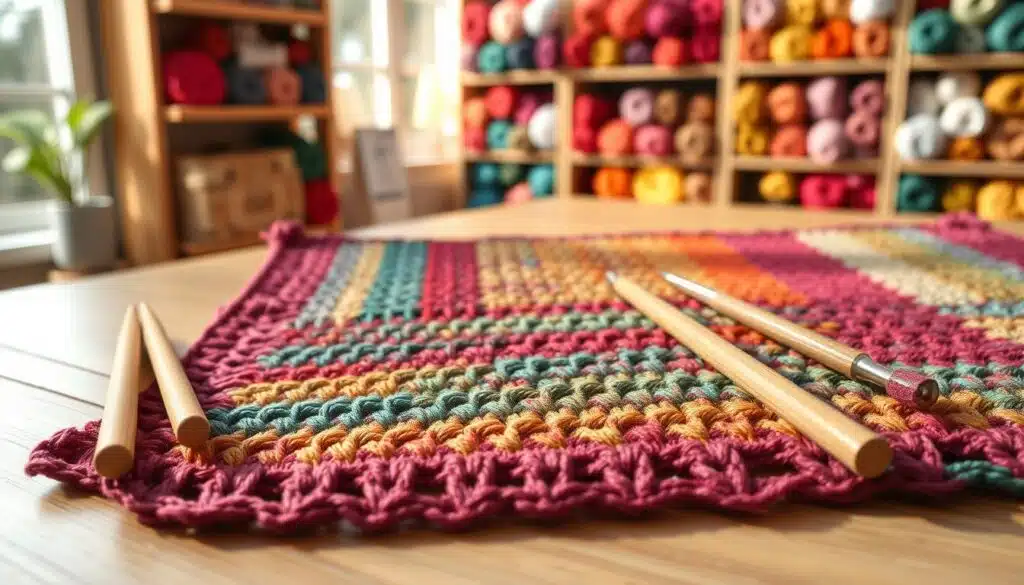
Checking yarn weight and fiber is just the start. The real test is how your stitches look. A good gauge swatch shows how yarn, hands, and stitch pattern work together.
How to make a gauge swatch that really represents your project
Swatch in the actual stitch pattern of your project. Make a square at least 6 inches across. This prevents edge distortion.
If your project has special sections like ribbing or lace, swatch those too. This ensures accurate results.
Block the swatch like you will the finished garment. Measure the center for stitches and rows. Note down yarn, hook, and needle details for later use.
Adjusting hook size to reach the pattern gauge without sacrificing fabric feel
If stitches are too tight, increase the hook size. For loose stitches, decrease it. Make small changes and re-swatch until gauge is right.
Remember, the fabric should feel good too. It shouldn’t be stiff or floppy, even if gauge is correct.
What to do if you can’t match gauge comfortably
If adjusting hook size doesn’t work, try a different yarn. A better match in fiber or ply will keep the fabric’s drape and feel right. Use these tips: swatch more, test critical pieces, and compare blocked swatches.
| Step | Action | Why it matters |
|---|---|---|
| 1 | Make a project-sized stitch pattern swatch | Shows real fabric behavior beyond simple gauge numbers |
| 2 | Block the swatch as you will the finished piece | Blocks reveal true stitch spacing and drape |
| 3 | Measure center stitches and rows | Avoids edge distortion and gives accurate counts |
| 4 | If needed, adjust hook size one step and re-swatch | Helps you match gauge while keeping fabric feel |
| 5 | Test ribbing, cables, or lace separately | Critical sections can behave very differently |
| 6 | Choose a different substitute if fabric feels wrong | Numbers alone don’t guarantee wearable results |
Texture, ply, and spin — details that change stitch definition
Changing yarns can keep your project looking the same if you focus on texture, spin, and ply. Small changes in these areas can make a big difference in how patterns look. A quick swatch can show if your yarn makes cables crisp or lace soft.
First, compare single-ply and multi-ply yarns. Single-ply yarns tend to lie flat and soften stitch definition. This can make detailed patterns less clear. On the other hand, multi-ply yarns with tight twists sharpen stitch lines, making them perfect for detailed patterns.
Next, consider loft and halo. Yarns with a lot of loft and halo, like brushed mohair, add warmth and glow. But they can hide small details. Chainette and tightly spun yarns, without halo, offer clearer texture and stitch definition, ideal for motifs that need contrast.
Yarn texture also affects the look of a piece. Thick-thin or boucle yarns give a rustic, painterly look that downplays stitch patterns. Worsted-spun yarns or those with a smooth, tight spin are better for garments that need structure.
When swapping yarns, match the fiber and spin to the pattern’s needs. Lace and cables do well with smooth, multi-ply yarns with good twist. But for chunky bobbles, seed stitch, and garter-like textures, fuzzier or single-ply yarns work better, softening edges and adding bounce.
| Characteristic | Effect on Stitch Definition | Best Uses |
|---|---|---|
| Single-ply | Softens stitches, can blur fine details | Shawls, drapey garments, rustic scarves |
| Multi-ply (tight twist) | Sharp, clear stitch lines and strong definition | Cables, lace, textured sweaters |
| Lofty / Halo yarns | Obscures small motifs, creates soft edges | Cozy wraps, lightweight warm layers, accents |
| Chainette / smooth spun | Maintains stitch clarity with light drape | Fitted garments, detailed stitchwork |
| Thick-thin / boucle | Masks pattern repeat, enhances surface interest | Statement accessories, textured outerwear |
Practical substitution method you can use right now
First, check the yarn label for yardage and fiber content. For example, Cascade 220 Superwash is 220 yards per 100 grams and made of 100% superwash merino. If the pattern only mentions skeins, convert them to yards before you start.
Step 1 — find original yardage and fiber content
Write down the yards per skein and the fiber type. If a pattern calls for 4 skeins of Cascade 220, multiply 4 by 220 yards to get 880 yards. If you can’t find the label, a quick web search usually gives you the accurate yardage and composition.
Step 2 — search substitutes within a +/-20% yardage range and why that works
Look for substitutes with yards per 100 grams within +/-20% of the original. This range keeps the yardage similar, ensuring drape and fit are predictable. For instance, K+C Element at 204 yards per 100 grams is a good candidate because it’s within 20% of 220 yards.
Focus on yardage first, then fiber if you want similar results. Matching fibers like merino to merino preserves hand, stretch, and care. Use resources like yarn substitution guides for quick comparisons across fiber, ply, and skein size.
Step 3 — calculate how many skeins of the substitute yarn you’ll need
Calculate the total pattern yardage and divide by the substitute’s yards per skein. Using the earlier example: 880 yards needed ÷ 102 yards per 50 gram skein ≈ 8.63 skeins. Round up to 9 skeins, then buy one extra skein for safety. This small cushion solves dye lot or gauge surprises.
If you hold yarns double, adjust your math. Two identical 400 yards/100 gram strands held together behave like 200 yards/100 gram, effectively changing weight and yardage. Use this conversion to see if double-holding reaches the target gauge without swapping brands.
Want a faster way to estimate? Use a yarn skein calculator or an online tool to automate these steps. Treat the calculator as a helper, not a replacement for a swatch. Always swatch and compare gauge; the substitution method is only as good as the sample you test.
| Original | Yards per 100 g | Substitute | Yards per 100 g | Within +/-20%? |
|---|---|---|---|---|
| Cascade 220 Superwash | 220 | K+C Element | 204 | Yes |
| Example A (400 y/100 g) | 400 held single | Held double | 200 equivalent | Shows weight change |
| Pattern need | 880 y total | Substitute skein | 102 y per skein | 9 skeins (buy 10) |
Follow this outline and use a yarn skein calculator when you want speed. Keep the +/-20% yardage rule in mind, swatch to confirm gauge, and buy an extra skein so your project finishes without drama.
Tools and resources to make substitution fast and reliable
Need a quick swap? A few digital and hands-on tools can save you hours. They help you check fabric behavior, yardage, and get real-world advice before starting a project.
Using YarnSub.com to find excellent and good matches
YarnSub is a database of over 10,000 yarns. It rates matches as excellent or good and shows comparisons. You can see yards-per-skein, fiber content, and hook sizes easily. It helps narrow down options when choosing a substitute.
Wraps per inch (WPI) — test mystery skeins from your stash
Use wraps per inch to guess weight if a label is missing. Wrap the yarn around a dowel without stretching and count the wraps per inch. Match that number to typical ranges for different yarn types. A simple WPI tool or ruler gives you a reliable baseline for patterns.
Online calculators, virtual swatches, and community input
Yarn calculators save time for yardage and skein counts. Virtual swatch tools show how a yarn will look in different patterns. Use these tools with community feedback from Facebook groups, Ravelry forums, and YouTube demos. This helps you learn how a yarn performs in real garments and regional availability issues.
- Quick checklist: check YarnSub for matches, measure wraps per inch if unlabeled, run numbers through yarn calculators, then test a virtual swatch before committing.
- When in doubt: ask your favorite Ravelry group or YouTube maker for recent substitution notes; users often report shrinkage, dye lot quirks, and blocking tips you won’t find in specs.
Special cases: holding yarns double, novelty yarns, and discontinued yarns
When a pattern meets reality, you need clear, practical moves. This section guides you on how to hold yarns together, tame textured skeins, and replace a discontinued favorite without ruining your project.
How to calculate equivalent weight when holding strands together
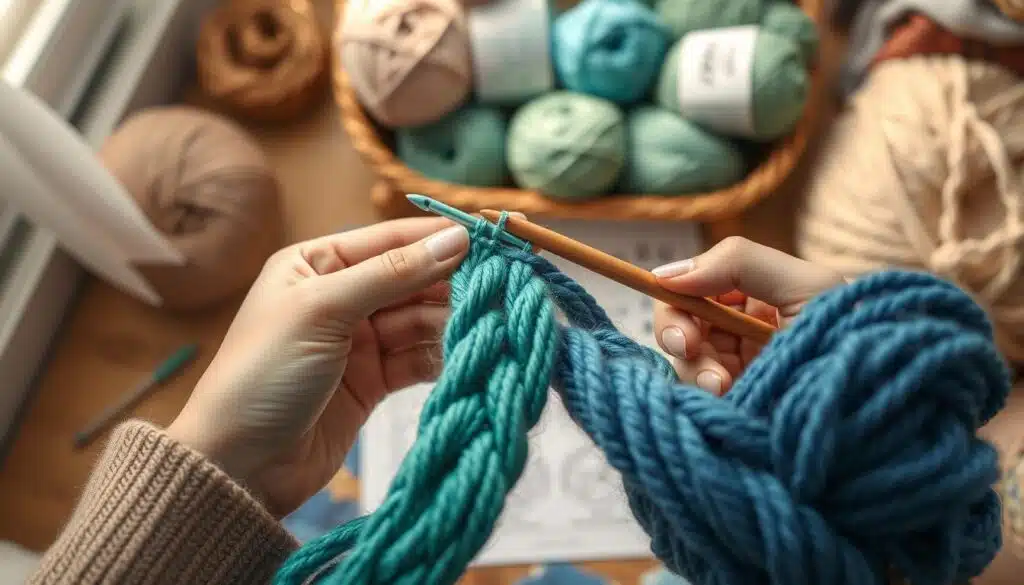
If you choose to hold yarns double, treat the pair as a new single yarn. Divide the yards-per-100g of one strand by the number of strands to estimate the new yardage. For example, a 400 y/100 g fingering held double becomes about 200 y/100 g, which sits near worsted. Use that number to pick hook size and recalc skein counts.
Working with thick-thin, boucle, mohair and other tricky fibers
Thick-thin yarns and boucle hide stitch detail. Mohair and halo yarns blur edges. Swatch the stitch pattern you care about, not a generic square. If lace or cables disappear, reserve novelty yarn substitution for plain panels, edgings, or accents where texture helps instead of harms.
Strategies when the original yarn is discontinued or hard to find
Start by matching yards-per-gram and fiber content. Use community input from Ravelry groups or local yarn shops to find close matches. If you must mix lots, buy extra skeins to cover dye-lot drift. Test critical areas like ribbing and collars first, then adjust pattern tension or hook size as needed.
When working from stash, wraps-per-inch and a quick weight-to-yardage check will save you guesswork. If you plan to hold yarns together to mimic a discontinued texture, swatch the combined yarns to confirm gauge and look before committing to the whole piece.
crochet yarn substitution
When you write project notes or post about a swap, using “crochet yarn substitution” helps others find your tips. Use it in pattern notes, Ravelry comments, and blog posts. This way, readers searching for replacements get straight to your advice.
Why the phrase matters: searchers type plain, practical terms. SEO for yarn substitution rewards clear wording that matches user intent. Keep descriptions short and factual. Link to a trusted guide like yarn fiber guides when you explain fiber behavior.
Why the exact phrase matters for search and how to use it naturally in your project notes
Start project notes with a one-line substitution summary using “crochet yarn substitution”. Add a sentence that names the original yarn and your replacement. This small move improves discoverability and helps fellow crocheters replicate your result.
Real-world example: substituting Cascade 220 Superwash with a stash yarn
Pattern calls for Cascade 220 Superwash (100% superwash merino, 220 yd/100 g). You find K+C Element at 204 yd/100 g. Yardage sits within a typical +/-20% range for a clean swap. List the math in your notes so readers can follow your logic.
Example calculation: pattern needs 4 skeins of Cascade 220 (220 yd × 4 = 880 yd). If your substitute is 102 yd/50 g, divide 880 by 102 to get about 8.62 skeins. Round up to 9 and buy 10 to be safe. Label this entry “Cascade 220 substitute” in your materials list.
Checklist to verify a substitution before you commit
Use a short substitution checklist every time. This keeps projects predictable and cuts wasted time and yarn.
- Confirm total yardage and fiber content match project needs.
- Compute yards-per-gram and ensure it lies within ~±20% of the original.
- Assess spin, ply, and texture for stitch definition and drape.
- Swatch in the actual pattern, wash, and block before finalizing.
- Adjust hook size to meet gauge without changing fabric feel.
- Test ribbing and cuffs first when working garments.
- Check YarnSub.com and community feedback for real-world reports.
- Buy at least one extra skein to cover dye lot or shortage issues.
Keeping a concise substitution checklist in your pattern notes helps others replicate success and improves search relevance. Use the phrase “crochet yarn substitution” and tag any Cascade 220 substitute you try. This makes your project a reliable reference.
Conclusion
You’ve learned a clear path to substitute yarn. First, note the original yardage and fiber. Then, look for substitutes within a +/-20% yardage range. Calculate skein needs, swatch, and adjust hook size as needed.
Use tools like virtual swatches, online calculators, and YarnSub.com to narrow options. This summary turns guesswork into a repeatable routine you can trust.
Match fiber for predictable drape and care. But don’t ignore yards-per-gram, ply, and texture. They often decide how a fabric will behave.
Keep a small swatch and a few extra skeins on hand to avoid mid-project surprises. These final tips for yarn substitution will save you time and keep your finished pieces looking professional.
Substitution is a craft you sharpen with practice and the right references. Start with the weight symbol, use yards-per-gram as your secret weapon, and always test before committing. This substitute yarn conclusion should leave you ready to confidently swap from stash to shop and make smart choices across projects in the United States and beyond.
FAQ
What is the simplest rule for a safe crochet yarn substitution?
First, focus on total yardage and fiber content. Look for substitutes that are within ±20% of the original yarn’s yards-per-skein. Then, match the fiber type if fit and drape are important.
Calculate the pattern yardage or convert skeins to yards. Divide by the substitute’s yards per skein to get the skein count. Always round up and buy at least one extra skein.
Why isn’t the Craft Yarn Council weight symbol enough?
Weight symbols are just a starting point. They group yarns broadly but don’t account for spin, ply, loft, and yards-per-gram variations. Two “Super Bulky” yarns can have different gauges and drapes.
Use yards-per-gram and swatch to confirm the substitute’s suitability.
What is yards-per-gram and how do I use it?
Yards-per-gram is a precise metric to compare thickness. It equals (yards ÷ grams) per 100 g. Aim for substitutes within about 0.10–0.15 yards-per-gram of the original for minimal change.
Use this along with fiber and texture checks.
How do I convert skeins to total pattern yardage?
Multiply the number of skeins by the yards listed on the original yarn label. For example, 4 skeins × 220 y = 880 yards. Then divide that total by the substitute’s yards per skein to estimate skein count.
Can I hold two yarns together to reach the required weight?
Yes. Calculate the resulting yardage by dividing the yards-per-100 g by the number of strands. For example, fingering at 400 y/100 g held double becomes 200 y/100 g (worsted).
Swatch to confirm gauge and fabric hand when holding strands together.
How important is fiber content in substitution?
Very important for garments and fitted pieces. Wool adds elasticity and bounce; cotton has little stretch and feels heavier; acrylic can be less elastic and behaves differently when blocking.
Match fiber when you need predictable fit and drape. For accessories and non-fitted items, fiber swaps are more forgiving.
What about texture, ply, and spin — how do they affect the outcome?
Texture and ply change stitch definition and visual effect. Single-ply or fuzzy yarns blur cables and lace. Tightly plied, multi-ply yarns give crisp stitch definition.
Loft and halo soften details. Always swatch in the project stitch to see how pattern elements render before committing.
How big should my swatch be and how should I prepare it?
Make a swatch large enough to measure center stitches—typically 4–6 inches square after blocking. Use the same stitch pattern and edge treatments, block it the same way you’ll block the finished piece, and measure gauge from the center.
Adjust hook size until gauge and fabric feel are right.
What if I can’t match gauge without the fabric feeling wrong?
If achieving gauge forces a fabric that’s too stiff or too floppy, the substitute isn’t suitable. Try a different substitute with closer yards-per-gram or matching fiber, or accept design changes (resize, different stitch pattern) instead of compromising fabric hand.
How do I estimate a substitute when the original yarn is discontinued or hard to find?
Use yards-per-gram and fiber as your primary clues. Check YarnSub.com for rated matches and user notes, consult Ravelry or Facebook groups for real-world reports, and swatch the best candidates.
Buy extra skeins from the same lot when possible to avoid dye-batch variation.
Can I use stash yarn even if the label is missing?
Yes—use WPI (wraps per inch) to estimate weight, measure a known-length sample to estimate yards per weight if possible, and swatch. Online WPI charts tied to the Craft Yarn Council ranges help identify likely weight categories for stash skeins.
How many extra skeins should I buy when substituting?
Buy at least one extra skein beyond the rounded-up estimate. If sourcing skeins from different lots or multiple shops, buy enough from the same dye lot to avoid visible color shifts.
For large garments or colorwork, consider two extra skeins for safety.
What online tools speed up substitution decisions?
YarnSub.com for side-by-side matches and ratings, WPI guides and videos, yards-per-gram calculators, virtual swatch tools, and stitch/gauge calculators make substitution faster. Community forums on Ravelry, YouTube tutorials, and Facebook groups give real-world feedback for region-specific availability.
How do novelty fibers like mohair, boucle, or chainette change substitution strategy?
Novelty fibers often obscure stitch detail and change drape dramatically. Use them only where texture won’t hide design features, or pair them with a smooth yarn held together for structure.
Always swatch and assess whether lace, cables, or textured stitches survive the substitution.
Is the ±20% yardage rule absolute?
It’s a practical guideline, not a law. ±20% yardage prioritizes keeping finished dimensions similar. Combine it with yards-per-gram checks, fiber matching, and swatching.
For delicate projects, tighten tolerances; for bulky accessories, you can be more flexible.
How do I calculate skein counts when labels use different weights (e.g., 50 g vs 100 g)?
Convert everything to yards per skein. If a substitute lists yards per 50 g, double that to get yards per 100 g, or divide total pattern yards by the substitute’s yards-per-skein directly. Always round up and add an extra skein for safety.
What are practical first steps for a confident substitution?
Find the original yarn’s yardage and fiber, compute yards-per-gram, search substitutes within ±20% yardage or close yards-per-gram, compare fiber and texture, swatch in the pattern and block, adjust hook size for gauge, consult YarnSub.com and community feedback, then buy extra skeins.
Will a substitute change care instructions for my finished item?
Often yes. Swapping fiber types can alter washability and blocking behavior—superwash wool can be machine-washable while a cotton/acrylic blend may not block the same way. Check care labels and choose substitutes that meet your care needs when longevity and maintenance matter.
Where can I learn more and practice substitution skills?
Explore virtual swatches, stitch/gauge calculators, YarnSub.com, WPI tutorials, and community forums on Ravelry and Facebook. Practice by swatching different substitutes and noting how yards-per-gram, ply, and fiber affect fit, drape, and appearance—substitution is a skill you hone over time.