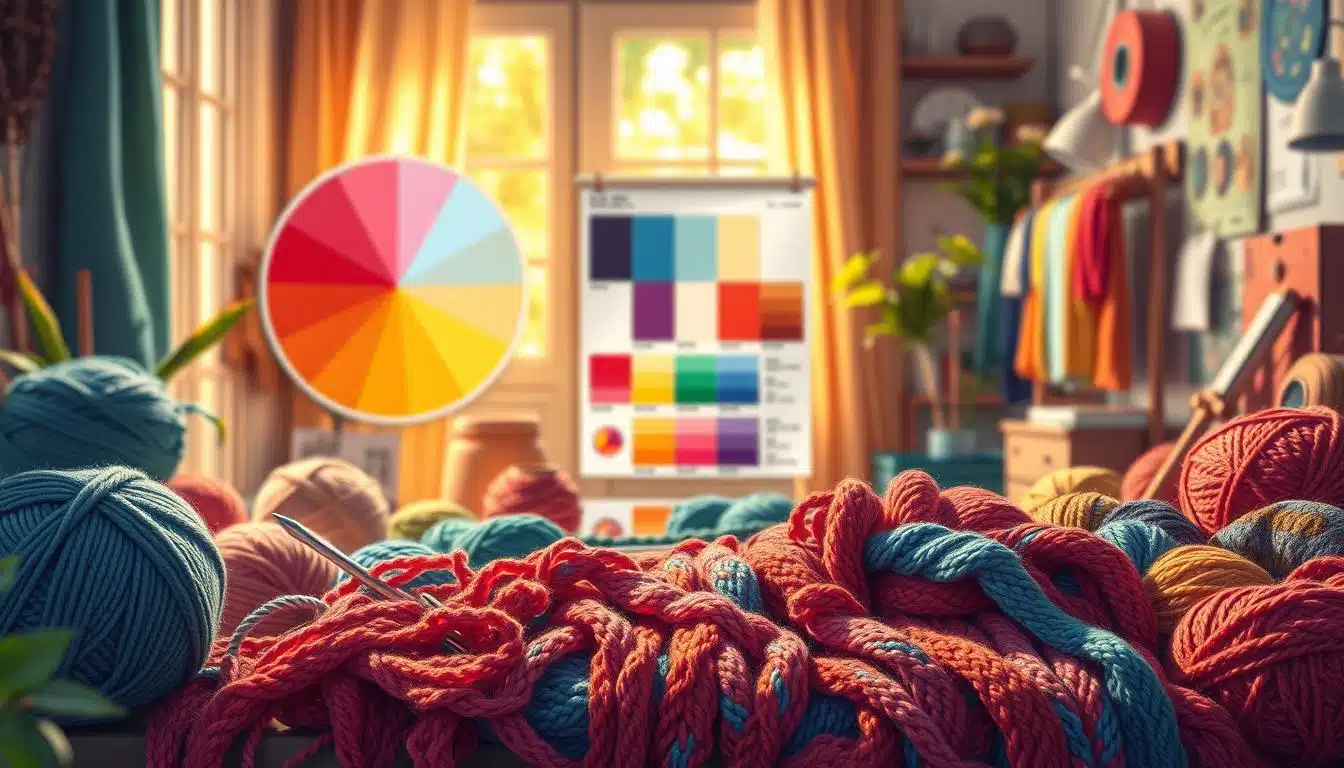
Color is a powerful tool for makers. The right colors can make a simple stitch shine like a sunset or a blanket feel calm. This guide will help you choose colors with purpose.
Many knitters struggle with choosing colors. You might wonder between neutrals, bold contrasts, or mixing scraps. But, knitting color theory is simple once you learn a few rules and try some experiments.
Keep reading for tips on yarn colors and planning palettes. You’ll learn how to make your stitches stand out, improve wearability, and work with variegated yarns. We’ll cover color wheel basics, harmony schemes, and maker-tested techniques to make your next project shine.
Key Takeaways
- You’ll learn simple color theory for knitters that applies to any project.
- Clear palette planning for knitters makes yarn shopping faster and more confident.
- Yarn color tips will help you choose neutrals, accents, and contrasts intentionally.
- Color wheel knitting concepts unlock harmony schemes you can use immediately.
- Practical tests like swatching and small samples improve final results.
Why color matters in knitting and crochet
Color affects how people feel when they see your work. Warm colors like red, orange, and yellow make things feel energetic and cozy. Cool colors, such as blue, green, and purple, calm and soothe. Neutrals like cream, taupe, and gray keep things steady and versatile.
Thinking about color’s emotional impact helps you choose the right mood for your project. This way, you can pick a color that matches the feeling you want to create.
Emotional impact of color
Changing yarn colors can make the same shawl look bold or gentle. A fiery red can be eye-catching at a party. On the other hand, a sea-glass blue can be a quiet friend on a rainy day.
Match your mood with your pattern by choosing the right yarn. Try swatching in different shades to see how they change under natural light.
Color and stitch visibility
Solids and lace look best with solid yarns. Variegated yarns add movement but might hide details. Choose yarn that lets your stitches shine if you want clear cables or lace.
Gradient yarns are great for wraps because they guide the eye without overwhelming the pattern.
Wearability and versatility
Your color choices affect how often someone will wear your project. Neutral colors are great for mixing and matching. A bold color like red can make an accessory go from casual to dressy.
Consider the person’s wardrobe before choosing bold colors. Practical makers test their color choices with swatches. For more on yarn and texture, check out this guide: yarn types unraveled.
color theory for knitters
You don’t need art school to pick great colors. Start with a simple map that explains color relationships. The color wheel basics show twelve hues, including primaries, secondaries, and tertiaries. Keep this wheel handy when pairing skeins from Madelinetosh, Cascade, or Berroco.
The color wheel basics
The wheel shows pure hues like red and blue, and mixes like orange and green. It helps spot opposites and neighbors fast. A quick look tells you which yarns will work well together and which won’t.
Common harmony schemes
Choose a scheme to set your project’s mood. Complementary blends, like blue and orange, add contrast. Analogous choices, like blue, blue-green, and green, calm the eye. Triadic sets, like red, yellow, and blue, balance energy.
Start with one main color and apply these schemes. You’ll learn to create drama or subtlety easily. Many knitters use digital wheels or Pantone guides to test yarns before knitting.
Hue, tint, tone, and shade
Learn four words that change everything. Hue is the pure color you start with. Tint adds white for lighter versions. Tone mixes gray for softer looks. Shade adds black for depth.
Work with these ideas to tweak contrast and readability in textured patterns. Swatching a hue at different tints, tones, and shades helps you see how patterns read at each value.
| Concept | What it means | Knitting use |
|---|---|---|
| Hue | Pure color, like red or blue | Main color choice for garments and focal points |
| Tint | Hue mixed with white | Light accents, baby items, soft gradients |
| Tone | Hue mixed with gray | Muted palettes, wearable sweaters, vintage looks |
| Shade | Hue mixed with black | Deep contrasts, edging, and shadow in cables |
| Complementary | Opposite on wheel (e.g., blue + orange) | High contrast, bold accessories |
| Analogous | Neighbors on wheel (e.g., blue → green) | Calming sets, seamless fades |
| Triadic | Three evenly spaced hues (red, yellow, blue) | Vibrant balance for colorwork and stripes |
How to pick a dominant color and build a palette
Choosing a dominant color sets the mood for your project. Start with a color you love or one that fits the project’s purpose. This color will be the main focus and guide your other choices as you build your yarn palette.
Choose your dominant color
Choose a dominant color that matches the garment’s purpose. For calm, pick a cool blue. For energy, choose a warm red or coral. Trust your instincts. Place a large skein next to the pattern to see how it looks at scale.
Add secondary and accent colors
After picking your dominant color, add one or two secondary shades for balance. Use analogous colors for smooth transitions or a complementary hue for crisp contrast.
Decide on the hierarchy early. Save one small skein as the accent color for edges, cuffs, or a single stripe. Accent colors knitting work best when used sparingly to draw the eye.
Include neutrals strategically
Neutrals in knitting palettes provide visual breathing space. Cream, gray, beige, or black can calm bold choices and make the garment more wearable.
When mixing three or more bright shades, add a neutral between them. This prevents color fatigue and keeps the look elegant.
Practical plan: pick the dominant color first, then add 1–2 secondary colors and one accent. Map small skeins or mini-winds onto a color wheel or a digital palette to test proportions before buying large amounts.
| Step | Action | Why it helps |
|---|---|---|
| 1 | Choose dominant color | Sets mood and covers most surface area for cohesion |
| 2 | Add secondary colors | Provides harmony and supports the main hue without competing |
| 3 | Select an accent | Creates focal points and visual interest with minimal yarn |
| 4 | Insert neutrals | Balances bold shades and increases wearability |
| 5 | Test with small swatches | Reveals real-world color interaction before large purchases |
Practical tools and techniques for testing yarn color combinations
Before you buy a lot of yarn, test small amounts first. Swatching color helps avoid surprises like color pooling or dullness. Wind a little yarn onto cards or clothespins and knit short pieces in your planned stitch pattern.
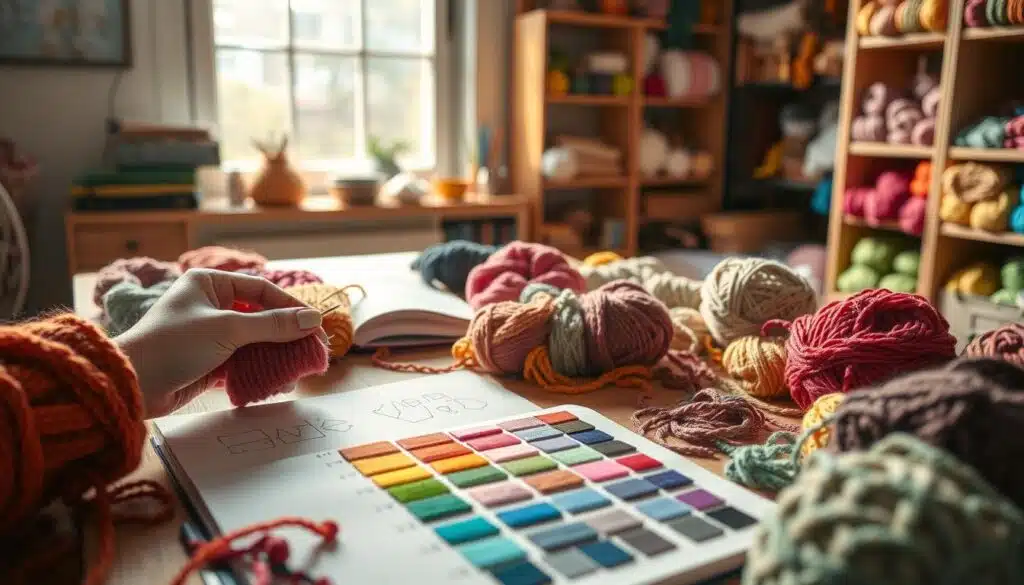
Use yarn pegs or cards to mix skeins side by side. This lets you see how colors work together without a big commitment. Test variegated yarns on the exact stitches you plan to use to check for pooling. Keep notes on needle size, tension, and lighting for future reference.
Digital tools save time and sharpen decisions.
Try digital palette tools like Coolors, Colormind, or Procreate. They help pull palettes from photos and adjust them. Upload a photo of a sunset or leaves to get color swatches that match your mood. Use Canva for yarn palettes to arrange swatches and check scale and balance before buying.
When matching digital colors to yarn brands like Malabrigo, Cascade, or Rowan, check dye lot numbers and fiber blends. Remember, digital colors are just guides. Use them to narrow your choices, then test with physical swatches to confirm.
Nature and art fuel better palettes.
Find color inspiration in nature and art. A walk on the beach or a museum visit can spark harmony. Photograph these scenes and use digital tools to extract palettes.
Try this: Photograph a leaf cluster, pick four colors, and knit tiny swatches for each. Then, knit one combined swatch. This connects nature’s colors to your knitting, making your projects cohesive and wearable.
- Wind yarn onto cards for quick swaps.
- Test variegated yarns in the pattern you’ll use.
- Compare swatches in multiple lighting conditions.
- Use Canva for yarn palettes to visualize layout and scale.
Matching yarn types and textures to color choices
When you’re making something, you want it to look just right. Think about whether to use solids or variegated yarn. Solids are great for lace and cables because they show off the stitches well. But variegated yarns add a fun twist with their color changes.
Solids, variegated, and speckled
Choose solids for complex patterns. They make the stitches pop. Variegated yarns are perfect for simple designs or stripes. They bring out the color shifts.
Gradients are awesome for shawls and wraps. They create smooth color transitions without messing up the stitches.
Texture’s effect on perceived color
Fuzzy yarns like mohair or brushed alpaca soften colors. Smooth yarns make colors stand out. This can change how bright a color looks.
Speckles can make colors seem textured. Always test them before you start your project.
Gauge and drape considerations
Gauge and drape affect how colors look. Thicker yarns make colors deeper. Laceweight yarns let light through, softening colors.
Think about both gauge and drape when planning your colors. This will help your colors look right.
Knit a swatch to see how colors work. Use neutral colors to balance bold ones. Build your color palette around your main color. For more help, check out this color theory guide or this article on yarn choices from CrochetCraze: Yarn Types Unraveled.
| Yarn Type | Best Uses | Color Behavior |
|---|---|---|
| Solid, smooth plied | Lace, cables, textured garments | Vibrant, crisp edges; shows stitch definition |
| Variegated / Gradient | Simple repeats, shawls, wraps | Movement and flow; can obscure complex patterns |
| Speckled / Tweed | Hats, mitts, rustic garments | Reads as texture; shifts visual weight of color |
| Haloed fibers (mohair, brushed alpaca) | Delicate scarves, layered pieces | Softens contrast; mutes color intensity |
| Laceweight / Open gauge | Light, airy shawls | Colors appear lighter; values shift with light |
| Bulky / Dense gauge | Cozy blankets, warm sweaters | Colors read deeper; stripes look bolder |
Swatches are key to making sure your project turns out right. Match yarn type to pattern complexity, consider texture and gauge, and check color before starting. A quick test saves time and ensures your project looks as you imagined.
Beginner-friendly palettes and sample project ideas
Looking for easy color combos? Start here. These palettes are perfect for beginners. They help you plan colors and finish projects that look great.
Try small swatches before making a big project. This way, you can check how light and dark look together.
Coastal calm
The Coastal Calm palette combines seafoam green, sandy beige, and driftwood gray. It’s soft and wearable. Use it for shawls, blankets, or sweaters.
For contrast, pick a darker driftwood gray, a medium seafoam, and a pale sandy beige. Try a small motif or the Velvet Wake Wrap to see how it looks. For more tips, check this color guide for knitters.
Harvest glow
Harvest Glow knitting uses pumpkin orange, mustard gold, and deep brown. It’s perfect for bold, autumnal accessories. Use deep brown or beige to ground the palette.
Sample yarns in four value categories: light, medium-light, medium-dark, and dark. A coaster or a Firelight Facets Shawl square will show if the colors work together.
Classic chic
Classic Chic focuses on black and cream with a pop of red. It’s timeless for cardigans, shawls, and accessories. Use black or cream as the main color and red for accents.
Start with small projects like Luca’s Compass Coasters. This helps you test proportions before starting a big project. Swap red for deep burgundy for a different look.
- Quick tests: coasters, small cowl strips, or a swatch panel of three values.
- Project jumps: Velvet Wake Wrap for solids or gradients, Firelight Facets Shawl for mixing palettes, Monomania sweater kit for kit-style decisions.
- Pre-cast-on rule: confirm contrast with squinting, a value finder, or a grayscale photo before you commit.
Common color mistakes and how to avoid them
Choosing colors can be exciting, but it can also lead to chaos in your finished piece. To avoid color mistakes in knitting, plan your colors carefully, test swatches, and pick the right stitch for each yarn. A few simple checks can save you hours of frustration and regret.
Too many bold colors without neutrals
Using too many bright colors at once can be overwhelming. To avoid this, stick to two to four main colors. Add a neutral like gray, cream, or navy to give your eyes a break.
Use solid colors as your base. If you want to add drama, place bright colors as accents. This way, you can avoid color mistakes and keep your project exciting.
Ignoring lighting and yarn bleed
Yarn colors can change under different lighting. Always check your swatches in various lights to catch any surprises early. Skipping this step can lead to color mistakes that ruin your project.
Hand-dyed yarns might bleed when washed. Test a small swatch before washing it with the rest. This shows how colors might change and helps you avoid surprises.
Using complex yarns with busy stitch patterns
Variegated or speckled yarns can hide the details of lace and cable work. Pairing them with complex stitches can make your design look messy. Instead, use simple stitches with these yarns.
Save solid colors for textured sections. Or, use complex yarns for borders or accents. This keeps your design clear and intentional.
Do a few simple checks to avoid mistakes. Always knit a test swatch in the final stitch pattern. Check if colors bleed and if yarns pool at your gauge. These steps help you avoid color mistakes and surprises.
| Common Issue | How to Spot It | Quick Fix |
|---|---|---|
| Too many bold colors | Competing hues, no visual anchor | Limit to 2–4 colors; add a neutral anchor |
| Lighting shifts | Swatch looks different in daylight vs. artificial light | View swatches under multiple lights before committing |
| Yarn bleed | Color runs during a test wash | Pre-wash swatch; use color catchers when possible |
| Busy yarn with complex stitch | Texture disappears; pattern looks muddy | Pair busy yarns with simple stitches or reserve solids for texture |
| Pooling and striping surprises | Uneven color distribution across swatch | Adjust needle size or stitch pattern; re-evaluate dye lot |
Advanced color play: contrast, balance, and intentional accents
To make a design stand out, focus on contrast, balance, and accents. Start with a main color and decide where you want the eye to go. High contrast makes motifs pop, while low contrast gives a soft, modern vibe.

Using complementary accents
Choose a main color and add complementary accents yarn to create highlights. A mustard stripe against navy looks intentional, not chaotic, when mustard is used sparingly. Try it out with a grayscale photo before you start knitting.
Playing with triadic and tetradic schemes
Triadic schemes use three colors for a lively balance. Pick one color to lead and use the others in smaller areas. Tetradic schemes are richer but need careful planning. Use a main color, a secondary for big areas, and the rest as accents.
Knitter’s Color Wheel tools and mood boards help plan your colors before buying yarn.
Gradient and fade techniques
Gradient techniques blend colors smoothly for a natural look. Try alternating skeins or short-row fades for shawls. Swatch a fade to see where contrast peaks, then adjust your design.
- Control emphasis through proportion: more surface area equals more visual weight.
- Use neutrals to soften busy sets and to anchor variegated yarns.
- Swatch fades to confirm how your complementary accents yarn and triadic schemes knitting behave across texture and stitch.
Tools and resources for continued learning and inspiration
Stay sharp with digital tools, real-world tests, and sharing. Try bold combos, test tiny samples, and get ideas from fellow color lovers.
Online palette generators and apps
Coolors.co offers instant palettes, while Paletton lets you play with schemes. Colormind uses AI for suggestions. Canva and Procreate help you turn photos into swatch plans.
Yarn shops and swatch services
Local yarn shops have mini skeins and sample packs. Big retailers and indie dyers offer swatch cards and skein samples. Use yarn pegs or clothespins for temporary palettes.
Communities and inspiration sources
Ravelry and Instagram hashtags show how others mix colors. Read blogs like The Knit Edit and follow yarn brands for ideas. Join local knit groups or online forums for feedback.
Study color in art and nature, then make tiny projects. Follow designers and dyers you admire for constant inspiration.
Conclusion
Color theory is all about tools, not rules. It helps you pick yarns that show your mood, highlight stitch details, and make your projects more wearable. The main idea is to learn about color wheel relationships like complementary, analogous, and triadic. Then, use these to create color palettes that feel thoughtful, not random.
Some key takeaways from color theory include swatching before you start, matching yarn to stitch complexity, and balancing bold colors with neutrals. Use soft browns or natural whites instead of black and white. Try twisting yarns, wrapping them on a card, or making quick swatches to test colors fast.
To get started, pick a color you love and add harmonies or nature-inspired palettes. Test your choices with swatches and digital tools. For a guide on Fair Isle colors, check out this article from TKGA: Color Theory for Fair Isle.
Keep exploring, visit local yarn shops, and join knitting groups to grow your color confidence. Don’t be afraid to try new things. When a color scheme makes you happy, go with it. That’s the secret to creating stunning projects.
FAQ
What is the emotional impact of color and how should it guide my yarn choices?
Color sets mood. Warm hues like red, orange, and yellow feel energetic and cozy. Cool hues like blue, green, and purple read calm and fresh. Neutrals—cream, gray, taupe, black—ground a design and increase wearability.
Pick a dominant color that matches the mood you want. Then, add accents or neutrals to fine-tune energy and formality.
How does color affect stitch visibility and pattern choice?
Solids reveal stitch definition, so use them for lace, cables, and textured patterns. Variegated and speckled yarns add movement but can obscure fine details. Gradient yarns show smooth transitions and work beautifully for shawls and wraps.
When a pattern has complex stitches, favor a solid or subtle tonal for the main fabric.
How do color choices influence wearability and versatility?
Color determines whether a piece reads seasonal, timeless, or trendy. Neutral bases let you mix-and-match across outfits; bold accents change perceived formality. Choose neutrals strategically to balance multiple bold shades and make garments more wearable in varied settings.
What are the basics of the color wheel every maker should know?
The standard wheel shows twelve hues: primary (red, blue, yellow), secondary (orange, green, purple), and tertiary mixes. It maps chromatic relationships you’ll use again and again to build harmony and contrast in palettes.
Which harmony schemes should I use for knitting palettes?
Try complementary (opposites like blue + orange) for drama, analogous (neighbors like blue, blue-green, green) for soothing harmony, and triadic (three even-spaced hues like red, yellow, blue) for balanced vibrancy. Tetradic or double-complementary palettes are lively but need clear hierarchy—pick one dominant color and use the others as accents.
What’s the difference between hue, tint, tone, and shade?
Hue is the pure color (red, blue). A tint adds white (lighter), a tone adds gray (muted), and a shade adds black (darker). Knowing these helps you adjust intensity and contrast without changing the base hue.
How do I choose a dominant color for a project?
Start with a color you love or that suits your intended mood. Let it occupy most surface area and set the tone. If the piece needs to be versatile, pick a neutral dominant; if it’s a statement, choose a bold hue and plan supporting colors around it.
How many secondary and accent colors should I add?
A simple, reliable plan is one dominant, one or two secondary colors, and one accent. Use analogous secondaries for harmony or a complementary accent for high contrast. Map skeins or mini-winds onto a wheel or digital palette to test proportions before buying large quantities.
When and how should I include neutrals?
Use neutrals as breathing space to balance bold colors, increase wearability, and prevent visual chaos. Place neutrals in large areas or between bold stripes. A single neutral can calm a palette containing multiple brights.
What’s the best way to swatch for color interaction?
Wind small amounts onto cards or clothespins and knit small swatches in the stitch pattern you’ll use. View swatches in different lighting and from a distance. Pre-wash a swatch to check for dye bleed and see how colors settle and pool in the chosen stitch.
Which digital tools help generate and test palettes?
Use Coolors.co, Paletton, Colormind, Canva, or Procreate to generate palettes, extract colors from photos, and visualize proportions. Upload a photo—sunset, leaves, fabric—to generate a palette, then match those colors to yarn brands you know.
Where can I find real-world inspiration for palettes?
Look to nature (sunsets, shells, autumn leaves), fine art, and textile design. Use photos you love to extract palettes with online tools, and visit Ravelry project pages, Instagram feeds, and yarn brand blogs for tested pairings and real-project examples.
When should I choose solids versus variegated or speckled yarns?
Choose solids for intricately patterned projects; pick variegated and speckled yarns to add energy to simple repeats. Gradients excel in shawls and wraps where smooth shade transitions are desired. Always swatch complex yarns in the pattern to check pooling.
How does fiber texture change perceived color?
Fuzzy fibers like mohair and brushed alpaca mute colors and soften contrast, while smooth plied yarns show vibrancy and crisp boundaries. Speckles can read as texture and alter a color’s visual weight. Match fiber to your desired color effect.
What gauge and drape factors change how color reads?
Heavier yarns and dense stitches deepen perceived color; laceweight and open stitches let light through and can lighten value. Drape affects whether color bands read bold or subtle. Knit a gauge swatch in the final stitch to evaluate color behavior at scale.
Can you give beginner-friendly palette examples?
Coastal Calm—seafoam green, sandy beige, driftwood gray—reads serene and wearable for shawls and baby blankets. Harvest Glow—pumpkin orange, mustard gold, deep brown—feels warm and rustic for scarves and cowls. Classic Chic—black, cream, pop of red—timeless with a decisive accent for cardigans or wraps.
What common color mistakes do makers make and how do I avoid them?
Mistake: too many bold colors without neutrals—fix by adding a neutral or reducing main colors to 2–4. Mistake: ignoring lighting and dye bleed—fix by viewing swatches in multiple lights and pre-washing a swatch. Mistake: pairing busy yarns with complex stitches—fix by using simple patterns with variegated yarns or reserving solids for textured sections.
How do I keep improving my eye for color over time?
Practice with small projects, study color in art and nature, follow designers and dyers you admire, and use palette generators to experiment. Swatch often and collect mini palettes—experience sharpens your instincts faster than rules alone.