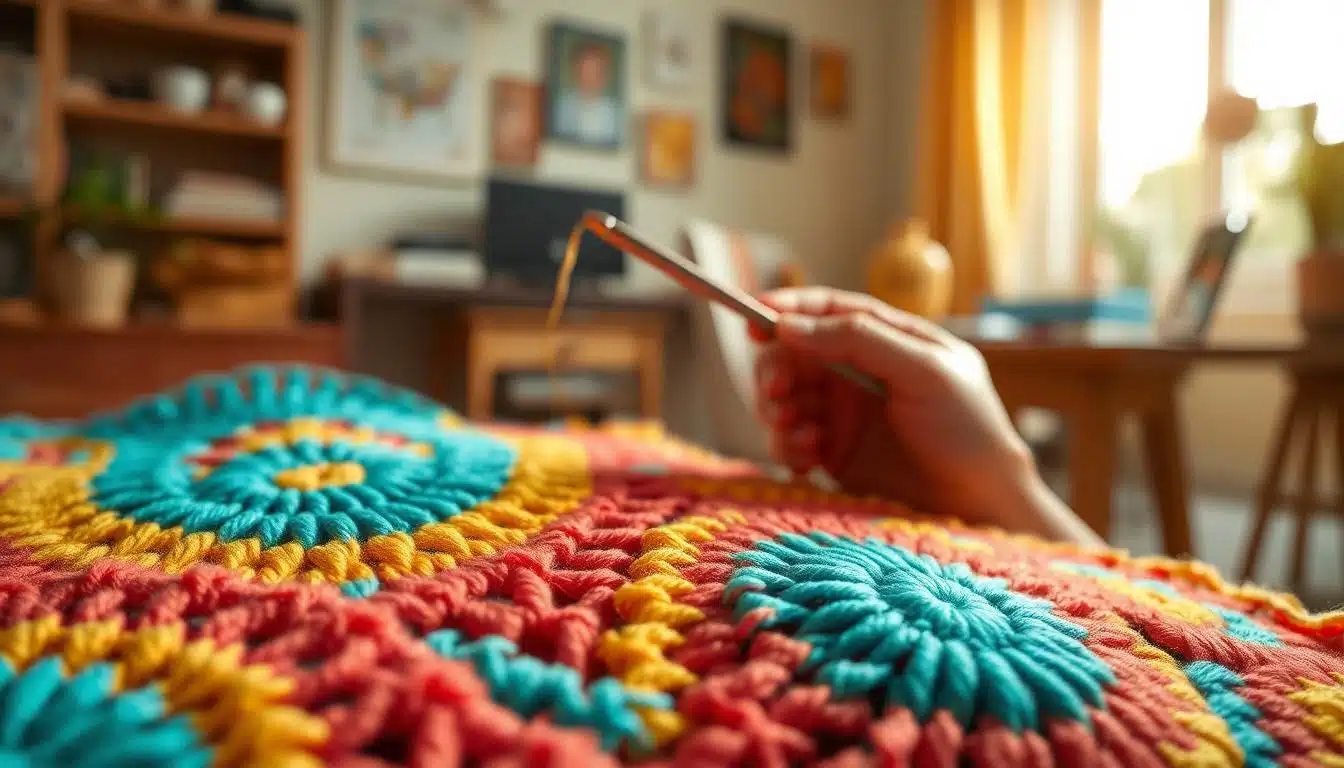
You’re about to learn how to create vibrant crochet colorwork. This guide will show you how to mix motifs, texture, and 3D shapes. Your next project will be a story of bold colors, crisp shapes, and satisfying finishes.

The MoonlightMagicCAL is a great example. It was a Halloween crochet mystery CAL that brought makers together. They worked on a whimsical wreath with bobbles, spikes, and tiny charms. This shows how mystery CALs and themed drops excite people.
Meet real designers like Amigurumi Adventures’ Ilaria and Irina. They’ve been creating clever sculptural pieces together for years. Their work proves that vibrant crochet is not just about looks. It’s about texture and engineering.
This guide will cover the basics of colorwork crochet. You’ll learn about yarn and color choices, tension swatches, and how to reinforce your work. You’ll also get tips on designing motifs, planning CALs, solving problems, and taking photos or selling your work.
For a deeper dive into intarsia and tapestry methods, check out this primer from Crove Vida: colorwork crochet techniques.
Key Takeaways
- Colorwork crochet combines motif, texture, and shape for bold, wearable or decorative pieces.
- MoonlightMagicCAL shows how a Halloween crochet mystery CAL builds community and creative momentum.
- Ilaria and Irina at Amigurumi Adventures model how shaping and stitch play elevate colorwork.
- This guide covers yarn choice, tension swatches, reinforcement, motif design, and troubleshooting.
- Start small: a coaster or simple motif will teach you more than one complex pattern ever will.
Why Crochet Colorwork Is Having a Moment
Crochet is more than just single-color scarves and granny squares. Colorwork brings a new level of creativity. It combines colors, contrasts, and float management to create pieces that look like tiny paintings or fun sculptures.
What makes colorwork different from basic crochet
Basic crochet teaches you to crochet in a rhythm. Colorwork, on the other hand, requires thinking in layers. You work with multiple yarns, manage floats, and switch colors to create clear shapes.
Amigurumi Adventures introduced shaping beyond the basics. Adding curves and 3D shapes turns flat panels into sculptural pieces. This technique makes your creations unique and special.
Trends driving interest: maximalist palettes, Halloween CALs, and community-along projects
Today, crochet trends focus on bold colors. Maximalist crochet celebrates clashing brights and layered textures. Designers like Katie Jones use vibrant palettes to grab attention on social media.
Mystery CALs like #MoonlightMagicCAL and seasonal events like Baby Boo with Hobbii create excitement. The CAL community turns pattern releases into celebrations. You learn new techniques, try new things, and feel supported by others.
Join a themed link, try a project from a designer-led event, or follow a discussion thread on a crochet chronicle to see how these movements shape what makers pick up next.
Creative benefits: storytelling through color, texture, and 3D shaping
Color tells a story. A witchy palette sets a moodier tone. Nature-inspired tones suggest seasons and settings. You use color to set the mood before you even start crocheting.
Texture and three-dimensional shaping add depth to your story. Raised stitches, bobbles, and sculpted amigurumi elements highlight parts of your tale. A smiling moon, a mossy mushroom, or a spiky pumpkin can all carry your story.
| Feature | What it adds | How you use it |
|---|---|---|
| Color contrast | Visual focus and readability | Pick high-contrast pairs for motifs, test small swatches |
| Float management | Cleaner backs and smoother drape | Catch floats at intervals, use bobbins for tidy tension |
| 3D shaping | Sculptural detail and storytelling | Combine increases, decreases, and surface stitches for form |
| Community-alongs | Motivation and shared learning | Join a CAL community, follow progress tags, swap tips |
| Maximalist crochet | Bold identity and social standout | Layer palettes, mix textures, embrace playful clashes |
Choosing the Right Yarn and Palette for Bold Colorwork
Starting with a plan and swatches is key when picking yarn for colorwork. You want the fibers to blend well, not clash. MoonlightMagicCAL kits offer compatible yarns, but understanding why they work is essential for your projects.

Yarn weight and fiber choices for vibrant results
Ensure a consistent gauge when mixing skeins. Jamieson & Smith jumper weight is known for its stickiness and clear stitch definition. This is great for holding complex patterns.
Wool blends offer crisp color contrast, while cotton is clean but might gape. Acrylics shine with bright, fade-resistant colors, perfect for bold motifs.
Test yarn combinations with small swatches. If using two strands for thickness, practice with the right hook size and even tension.
How to mix sheen, matte, and novelty yarns without muddying colors
Swatch often. Use novelty yarns as accents to avoid overwhelming charts. Alternate sheen and matte stripes for clarity. Katie Jones suggests using a bridging color for bright hue transitions.
Ensure fiber hand and gauge match when mixing yarn types. Place novelty textures on the surface for interest, not in dense colorwork areas.
Palette inspiration from spooky, seasonal, and nature-driven themes
For spooky palettes, contrast and mood are key. Shiny black and sparkly blues anchor, while moody grays and pastel lilacs add depth. Use vibrant yellows sparingly for impact.
Nature and seasonal themes inspire palettes. Mushroom caps and autumn leaves suggest layered neutrals with pops of color. Katie Jones’s Halloween Baby Boo collection shows how a few hues can be maximalist.
Knit or crochet motif tests in your colors before committing. Small samples show if your palette works in real light and with your hook. This saves time and ensures your work stays vivid and balanced.
Essential Techniques to Master Before You Start
Before you start with bold colors and fun designs, learn some basic skills. These skills will make complex colorwork seem easy and fun.
Basic color-change methods and managing floats
Start with simple color changes. Switch colors at the end of a stitch or through a pull-through for neat edges. For small designs, like amigurumi, you’ll have many short color changes.
Carry yarn where you can, catch floats into the fabric, or use a chain spacer for longer gaps. This keeps your fabric flat and stitches even.
Practice managing floats so your fabric lies flat and your stitches stay even. When floats are long, weave them on the wrong side or tie temporary slip knots to prevent snagging during wear.
Tension swatches: why they matter and how to make one
Make a small tension swatch crochet before starting a big project. Use the same hook and yarns you plan to use. Measure gauge, test how different hook sizes change drape, and note how color combos affect stitch definition.
A swatch helps predict shaping, sizing, and how patterns sit. Label yours with hook size and yarn pairings so you can repeat the result when you start the main piece.
Reinforcement tricks adapted from knitting (crocheted steek concept) and why planning matters
Adopt the steek mindset for planned openings or attaching 3D pieces. Work a narrow reinforced column with slip-stitch crochet on a slightly smaller hook. Use a non-superwash yarn like Jamieson & Smith 2-ply for visibility and stability.
Alternate colors to keep the cutline obvious. Work reinforcement from the right side up one edge and back down the other. After sturdy stitching, remove the center and finish edges. This approach reduces surprises during finishing and makes bold construction choices practical.
Designing Playful Colorwork Motifs and Shapes
Think of your project as a small stage. You want elements that pop, curves that invite touch, and pauses that let the eye rest. Use simple tests to see how color and form work together before committing to a full piece.

From flat panels to 3D amigurumi elements — shaping techniques that bend and curve fabric
To make flat crochet panels behave like sculptures, practice increases, decreases, and short rows. These moves shape edges and create natural curves. Try a small swatch, add strategic stuffing, and note how stuffing density affects the final silhouette.
Amigurumi shaping relies on balanced tension. If your rounds pull tight, the curve shrinks. If they sit loose, the shape flops. Tweak stitch count and stuffing until the piece keeps its intended bend without bulging seams.
Incorporating iconic and whimsical symbols (witchy motifs, mushrooms, nature-inspired details)
When you add icons like witch hats or a mushroom crochet motif, size matters. Design motifs at several scales so tiny details read cleanly on textured backgrounds. A small cap or leaf can sit next to a bold panel without competition.
Use crochet motifs as story beats. A row of bats can lead to a textured moon, while a clustered mushroom motif anchors a woodland vignette. Keep motif repeats predictable so the eye can follow the pattern without effort.
Balancing busy patterns with breathing space for visual impact
Maximal palettes need resting points. Alternate dense motif rows with solid color bands or rows of simple texture. These pauses make your whimsical crochet designs legible and calm the overall composition.
Katie Jones advises starting small and staying true to your idea. If a section feels noisy, trim a color or widen a plain strip. Negative space acts like punctuation; it clarifies rhythm and lets bold elements read as intentional.
| Design Goal | Techniques | When to Use |
|---|---|---|
| Gentle curve for a doll face | Short rows, small increases, targeted stuffing | Facial shaping, soft contours in amigurumi shaping |
| Bold standalone motif | High-contrast colors, defined border rows | Feature panels, focal points on wearable pieces |
| Repeating small details | Multiple-scale crochet motifs, simplified stitches | Background texture, pattern fills that don’t overwhelm |
| Clean maximal look | Alternating dense rows with solid bands, negative space | Maximal palettes and whimsical crochet designs where clarity is needed |
| Woodland vignette | Varied scales, clustered mushroom crochet motif, layered applique | Small wall hangings, seasonal decor, themed amigurumi pieces |
Step-by-Step Project Planning for Mystery CALs and Kits
Starting a mystery crochet-along is like opening a present every week. You’ll get hints, color clues, and parts released slowly. The MoonlightMagicCAL kit sends parts via email, so keep your notifications on and your hooks ready.
What to expect in a mystery crochet-along and how to prep
First, read the designer’s notes and timeline. Patterns are released over several weeks. If you’re an intermediate crocheter, you’ll do great with patience and practice.
Make a quick tension swatch with the yarn provided. Sort your yarn and colors as the pattern suggests. When the pattern is released, you’ll work faster if everything is ready.
How kits simplify color and material choices (what’s typically included)
CAL kits make choosing colors and materials easy. They include the right amount of yarn, color pulls, and sometimes extra yarn. A MoonlightMagicCAL kit has all the yarn you need, clear color guides, and instructions.
Designers often list the hook sizes and tools you might need. For a hassle-free version, check if the pattern is available as an ebook or paperback. The project page and FAQs have sign-up and kit purchase details. Visit the Mosaic Flower Garden CAL page for more information.
Managing pace and avoiding burnout during multi-part releases
Set achievable weekly goals instead of rushing. Break each part into manageable sessions. This keeps your hands and mind fresh.
Use community groups for help if you’re stuck. Ask questions, watch tutorials, and share your work. Katie Jones suggests working in short sessions that fit your life.
If you’re feeling overwhelmed, take a break for a day or two. Coming back with fresh eyes helps avoid mistakes. These tips help you stay excited and avoid burnout.
| Prep Task | Why it Matters | Quick Tip |
|---|---|---|
| Read timeline and notes | Keeps you synced with release dates and difficulty | Mark Fridays and Tuesdays on your calendar |
| Make a tension swatch | Ensures consistent gauge across sections | Use the kit yarn and labeled hook |
| Organize yarn and labels | Saves time when sections call for color changes | Wind small bobbins or use clips for color A–F |
| Join the community | Offers help, encouragement, and troubleshooting | Look for Facebook groups and YouTube playlists |
| Set a weekly goal | Prevents rushing and helps you avoid CAL burnout | Aim for one repeat or chart block per session |
| Buy a CAL kit if available | Simplifies yarn selection and ensures color accuracy | Choose an official kit like the MoonlightMagicCAL kit when offered |
Troubleshooting Common Colorwork Challenges
Colorwork can surprise you with quirks. Approach issues like a detective: gather a small swatch, note where the fabric puckers or loosens, then decide whether to tweak or frog. For minor trouble, change hook size or block the piece. When many rows show inconsistent gauge, rip back and rework; patience wins more often than patching hurried stitches.
Fixing tension issues and when to frog versus tweak
To fix tension crochet, start with a targeted swatch. If one band is tighter, try a slightly larger hook for that section. If the entire panel is uneven, frog back to the last reliable row and re-crochet with steadier tension. Take breaks when frustration builds; your hands remember patterns better when rested.
Dealing with floats, snagging, and hidden stitches
Long floats invite snags. Keep floats short or catch them into the fabric every few stitches. If a float has already snagged, weave it into a seam or anchor it with a row of slip-stitch reinforcement. Use a bright basting thread on the wrong side to map hidden stitches before cutting or finishing. This trick borrows from steek practice and prevents surprises.
When to use reinforcement techniques and adapting sewing ideas to crochet tools
When you need reinforcing crochet, use slip-stitch reinforcement to mimic a sewn edge. Pick a sticky, non-superwash yarn and a hook one size smaller than your working hook. Work tidy rows where you plan openings or weak points. A stockinette-style slip-stitch band makes picking up stitches for bands much easier and secures floats.
You can learn practical approaches and see demonstrations, including uses of longer cords and reinforcement tips, at les laines biscotte. The Sólbein Cardigan demo shows slip-stitch reinforcement producing tidy, cuttable edges that help when you must adapt sewing-machine ideas to crochet tools.
Inspiring Makers and Real-Life Colorwork Stories
Find inspiration in the honesty and creativity of makers. They share their process and playful color choices. These stories highlight how small changes can greatly impact a project’s mood and a designer’s voice.
Profiles that spark creativity: Amigurumi Adventures and the designers behind MoonlightMagicCAL
Amigurumi Adventures started with Ilaria (@airali_gray) and Irina (@irenestrange). They mix sculptural shapes with woodland and witchy themes. Their MoonlightMagicCAL showcases their skill in turning simple items into stories you can wear or display.
How motherhood, life changes, and the maker community shape designer voices
Katie Jones crochet is a true example of creative growth. In Skein and Tell episodes, she talks about how infertility and loss changed her. She now focuses on smaller, joyful projects that protect her creative happiness.
Examples of standout projects: whimsical Halloween wreaths, spooky mini-collections, and bold wearable pieces
The MoonlightMagicCAL wreath is a great example of bold colors and textures. Katie Jones’s Baby Boo collection shows how a few items can form a cohesive set. Amigurumi Adventures and community projects prove that themed CALs can teach and share colorwork and 3D shaping.
Take these ideas for your next project: choose a strong motif, keep shapes simple, and let feedback guide your color choices. These real-life examples help you design with passion and sell with confidence.
Practical Tips to Share, Photograph, and Sell Your Colorwork
Start by treating your finished pieces like mini exhibits. For wreaths and amigurumi, pad and shape parts before you photograph crochet projects so curves read clearly on camera. Steam-block flat panels where fiber allows, secure floats, and add slip-stitch reinforcement at stress points to keep three-dimensional forms tidy and durable.
When you stage shots, use plain backgrounds and a single accent prop to show scale. Natural light near a north-facing window gives soft, even tones that help colors pop. Take multiple angles: one close-up to show stitch detail, one mid-shot for texture, and one full view for shape. If you plan to sell crochet patterns, include a clear finished-size photo alongside a swatch image and needle or hook for reference.
Social sharing should feel like conversation, not an ad. Tag CAL hosts and designers such as Amigurumi Adventures and Katie Jones when you post progress photos, and add community tags like #MoonlightMagicCAL to join the thread. Use process shots, short tip captions, and reply to comments to boost visibility. Brand tags from yarn makers like Hobbii amplify reach when you credit materials.
Packaging matters when you choose to sell crochet patterns or kits. Provide step-by-step instructions, suggested yarn and hook sizes, tension swatch guidance, and links to support resources. Include a small printed swatch chart in kits and a brief reinforcement tutorial showing slip-stitch techniques to build buyer confidence.
Price kits to cover material costs, your time, and hosting or platform fees. Offer tiered options: digital-only pattern, small kit with yarn, and premium kit with extras like buttons or themed charms. For an example of selling ideas and packing inspiration, see easy crochet crafts to make and.
Use crochet packaging tips that keep items safe and presentable. Wrap soft pieces in tissue, include care instructions, and seal printed patterns in clear sleeves. Label kits with yarn weight, dye lot, and finished measurements so buyers know what to expect. Clear packaging increases perceived value and reduces returns.
| Focus | Quick Action | Why It Works |
|---|---|---|
| Blocking & finishing | Steam-block flats, pad 3D parts, secure floats | Improves silhouette and stitch clarity for photos |
| Photography shots | Close-up, mid-shot, full view; natural light | Shows detail, texture, and scale for buyers |
| Community tags | Use #MoonlightMagicCAL, #skeinandtell, tag designers | Joins conversations and raises profile in CALs |
| Pattern contents | Include swatch guide, hook sizes, FAQ, tutorials | Reduces buyer uncertainty and support requests |
| Kit tiers | Digital, basic kit, premium kit | Caters to different budgets and increases sales |
| Packaging | Tissue wrap, clear sleeve, labeled materials | Protects product and boosts perceived brand value |
Conclusion
Modern crochet colorwork mixes bold colors, stories, and shapes to create eye-catching pieces. Before starting, make a tension swatch and test color palettes from projects like MoonlightMagicCAL and Amigurumi Adventures. These steps help avoid mistakes and keep your work neat.
Practice slip-stitch reinforcement for openings and learn diagonal color-change tricks to avoid jagged lines. Use a mini swatch to try the Clean C2C Color Change. For tidy edges, add a single crochet or crab stitch. For fixing jagged diagonals, check this resource.
Think about using kits and joining crochet CALs to keep your creativity safe. These offer pacing, feedback, and help avoid color regrets. Use stitch markers for slanted transitions. For better colorwork, explore visual stitch guides.
See each piece as a chance to play and learn. Start small, test new things, and enjoy the journey. This is the essence of crochet colorwork: begin with small steps, be bold, and have fun as you grow.
FAQ
What is the central promise of this guide to crochet colorwork?
This guide teaches you to create vibrant crochet colorwork. You’ll learn about yarn and color selection, tension swatches, and reinforcement techniques. It also covers motif design, CAL planning, troubleshooting, and tips for showing off your work.
What makes colorwork different from basic crochet?
Colorwork adds hue, contrast, and float management to basic stitches. It requires managing color interactions and texture across a surface. Amigurumi Adventures focus on shaping, using curves and stuffing to create 3D motifs.
Why are mystery CALs and themed community events so popular right now?
Mystery CALs like #MoonlightMagicCAL and designer-led events create excitement. They offer teasers and staggered releases, encouraging experimentation and community support. This approach lowers the fear of mistakes and builds momentum.
How should I choose yarn weight and fibers for vibrant colorwork?
Follow kit guidance for yarn selection. Choose compatible gauge and hand when mixing yarns. Use fibers with a bit of “stick” for reinforcement. Always swatch when holding yarns together for thickness.
Can I mix sheen, matte, and novelty yarns without muddy colors?
Yes, but test combinations first. Alternate sheen and matte for clarity. Use novelty yarns sparingly as accents. Katie Jones suggests using bridge colors to transition strong hues cleanly.
Where should I look for palette inspiration?
Draw from MoonlightMagicCAL’s palette and nature. Consider seasonal themes like Katie Jones’s Baby Boo collection. Make small swatches to confirm contrast and harmony before starting a project.
What basic color-change and float techniques should I master?
Practice neat float management and consistent color changes. For amigurumi and wreaths, manage joins and short color runs. Keep floats short to avoid snagging.
How important are tension swatches, and how do I make one effectively?
Tension swatches are key. Make one with kit yarns and any held-together strands. Verify hook size, gauge, and yarn behavior. Swatches help plan shaping and dimensions.
What is the crocheted steek idea and when should I use it?
The crocheted steek reinforces a planned cutline. Use slip-stitch reinforcement with a sticky yarn. Work reinforcement rows from both sides, then cut the center. This prevents last-minute headaches.
How do I shape flat crochet into 3D amigurumi or wreath elements?
Use increases, decreases, short rows, and strategic stuffing for shaping. Amigurumi Adventures show how small shaping choices transform flat panels into 3D pieces. Practice on small swatches before starting a large motif.
Which motifs work best for Halloween or nature-themed colorwork?
Classic Halloween icons and nature motifs work well at various scales. Use tiny details as accents. Mix symbols for a whimsical narrative, as MoonlightMagicCAL did with its wreath.
How do I balance a busy, maximalist pattern so it doesn’t look chaotic?
Alternate dense motif rows with solid color bands or textured stitch rows. Start small and use negative space for clarity. Simple textured rows or narrow solid stripes give the eye a rest.
What should I expect when joining a mystery crochet-along like MoonlightMagicCAL?
Expect staggered releases, teasers, and color hints. Prepare by making swatches and setting realistic goals. This helps avoid last-minute panic.
What do kits usually include and how should I prepare?
Kits include all required yarns and sometimes extras. Make a tension swatch with kit yarns and practice holding yarns together. Follow kit instructions to ensure readiness.
How can I manage pace and avoid burnout during a multi-part release?
Take parts slowly and set small goals. Step away when needed and use community groups for support. Katie Jones advises protecting creative joy and working in short bursts.
How do I fix tension problems when I discover them mid-project?
Diagnose with swatches. Adjust hook size or block small sections. If widespread, consider frogging and reworking. Walk away and return with fresh eyes if frustrated.
What are practical fixes for floats that snag or are too long?
Shorten floats, catch them into the fabric, or weave them into seams. Reinforce snagged floats with stitching. Use a bright basting thread to mark centers for easy locating.
When should I use reinforcement techniques and how can I adapt sewing-machine methods to crochet?
Use reinforcement for openings, weak points, or cuttable edges. Adapt sewing-machine methods with slip-stitch reinforcement. Alternate colors for visibility and plan a stockinette-style reinforcement.
Who are Amigurumi Adventures and what projects have they led?
Amigurumi Adventures are Ilaria (@airali_gray) and Irina (@irenestrange), designing together. They focus on shaping, unusual stitches, and collaborative projects. Their work emphasizes playful textures and nature motifs.
How have life changes influenced designers like Katie Jones?
Katie Jones has talked about how life changes, like infertility and motherhood, have shaped her. She now focuses on smaller, protective creative bursts. This approach has influenced her maximalist colorplay and seasonal minis.
What are standout projects that show this approach to colorwork?
Standout projects include the MoonlightMagicCAL wreath, Katie Jones’s Baby Boo collection, and Amigurumi Advents. These projects blend bold palettes, 3D shaping, and narrative motifs.
How should I block and finish three-dimensional elements for the best photos?
Shape and pad pieces before assembly. Steam-block flat pieces and secure floats with slip-stitch reinforcement. Use pins, padding, and steaming for final shaping.
What hashtags and sharing tips will help me join the community?
Use CAL-specific tags like #MoonlightMagicCAL and #skeinandtell. Tag designers and host accounts for visibility. Share progress photos and ask for feedback.
How can I package patterns or kits to sell successfully?
Provide clear instructions and suggested yarn and hook sizes. Include tension swatch guidelines and reinforcement tutorials. Offer pattern support and align CAL schedule with realistic pacing.
What are the main actions I should take after reading this guide?
Make a tension swatch and test palettes inspired by MoonlightMagicCAL. Practice slip-stitch reinforcement and consider joining a CAL. These steps protect your creative joy and prepare you for colorwork.