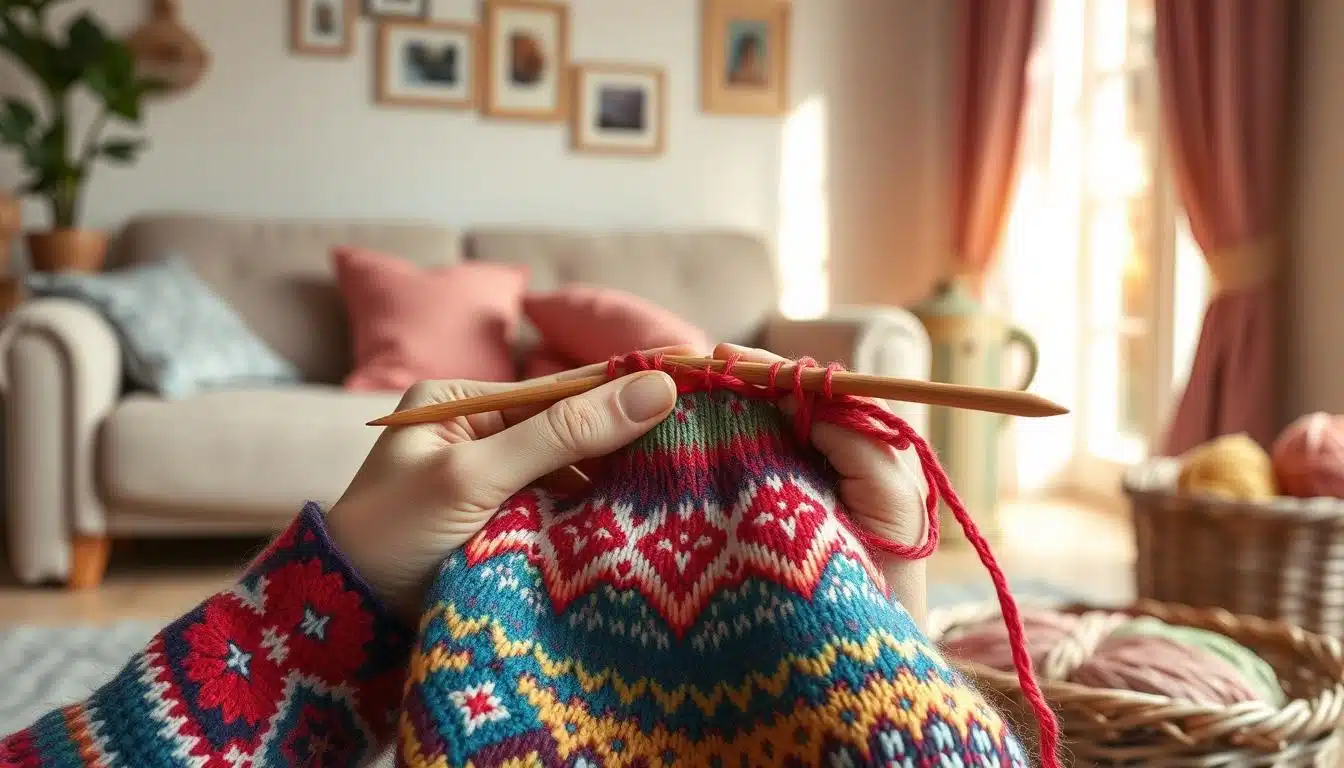
Ready to make your stranded colorwork knitting stand out? This guide will help you get started. You’ll learn key colorwork techniques, how to apply Fair Isle to today’s projects, and tricks for seamless circular knitting.
Instagram is full of visual tutorials and swatch ideas. It shows how to do jogless colorwork and fix tension issues. Patty’s column at Material Culture offers detailed methods for removing jogs. You can find her advice and examples here: Patty’s jogless stranded colorwork advice.
This article will teach you a quick, effective stranded knitting tutorial. You’ll learn when to start a new round, how to rewrite charts, and Patty’s last-stitch method. You’ll also get tips on yarn weight, blocking, and finishing touches.
Remember, practice makes perfect with jogless colorwork. But the results are worth it. Try these techniques on a cowl or tam using leftover yarn.
Key Takeaways
- Stranded colorwork knitting blends Fair Isle motifs with modern colorwork techniques for striking results.
- Instagram offers quick visual demos; Patty’s column gives step-by-step jogless strategies.
- The common work-into-row-below trick reduces jogs but can thicken lines in heavier yarns.
- Patty’s last-stitch trick hides jogs while preserving round-start increases and decreases.
- Fingering-weight yarn and good blocking make jogless results easier to achieve.
Why You’ll Love Stranded Colorwork Knitting
Stranded colorwork is all about patience and bold results. It creates a dense, warm fabric with striking patterns. Visual learners on Instagram show how contrast and placement make simple shapes pop.
What makes stranded colorwork different from other color techniques
Stranded work uses carried yarn across the wrong side, making it firmer. This is different from intarsia, which uses separate bobbins for each color. Stranded pieces feel warmer and charts repeat more naturally in the round.
Style payoff: why motifs and color contrast turn heads
Strong contrast and neat repeats make motifs stand out. You can nest motifs and layer shapes for clear light and dark. The Rhinebeck Cowl shows that good technique is key for crisp patterns.
Who benefits most: skill levels and project types
Stranded knitting is great for knitters wanting warm, graphic garments. It’s perfect for hats, cowls, mittens, and tam-style caps. Intermediate knitters will find it most rewarding, but beginners can start with small projects.
Essential Tools and Yarn Choices for Colorwork Success
Start with a clear plan: pick tools that make stranded knitting pleasant, not painful. The right gear helps you focus on motifs and color contrast, not on wrestling stitches. Below you’ll find practical advice on needles, yarn, and palettes so your projects read crisp and even.
Needles and stitch markers that make stranded work easier
Choose circular needles from brands like Addi or ChiaoGoo for smooth joins and consistent glide. For small circumferences, keep a set of spare needles or a pack of Clover bamboo DPNs on hand. Good stitch markers save you from counting every round; use metal split-ring markers for durability.
Needle material changes how yarn behaves. Slick metal needles help slippery yarn flow, while bamboo gives more control on woolly wool. Test what feels right on a quick swatch to balance speed and grip. Think about needle size tension when selecting needles: a half-size up or down can tame tight or loose tension without changing pattern gauge drastically.
Yarn weight, fiber and how they affect tension and visibility
Fingering weight hides minor thickened rows better than worsted weight, so choose fingering if you want forgiving results while you learn jog fixes. Patty’s column notes that heavier yarns amplify variations, making work-into-row-below repairs stand out as elongated stitches on worsted yarns.
Wool and wool blends have stitch memory and block well, which helps even out tension and sharpen motifs. Non-superwash options like Jamieson & Smith 2ply Jumper Weight and Rauma Finullgarn offer “grippiness” that locks floats and keeps patterns crisp. If you prefer ease of care, add a wool-nylon blend for durability, but expect slightly different blocking behavior.
Color selection tips: contrast, value, and palette pairing
Prioritize value contrast: choose a light and a dark yarn so motifs pop at a glance. Use a neutral base—cream, gray, or black—with one or two accent colors to keep motifs readable. Try converting yarn photos to grayscale to test separation before committing to a full project.
For palette inspiration and practical examples, check resources that show real swatches and pairings; a curated guide can spark combinations you might not try on your own. Leftover yarns are perfect for small practice pieces; Patty used leftover Rhinebeck Cowl yarn to make a tam and learn color relationships.
| Choice | Pros | Cons |
|---|---|---|
| Fingering weight wool | Hides thickened rows, great stitch definition, blocks well | Requires smaller needles and finer tension control |
| Worsted weight wool | Faster to work, durable fabric, warm | Magnifies tension differences, jog fixes can show |
| Wool blends (wool/nylon) | Durable, good for accessories, stable stitch memory | Less “grippiness,” may slip on slick needles |
| Non-superwash traditional yarns | Natural grip, crisp motifs, forgiving floats | Require gentle care; may felt if mishandled |
Practice with small swatches and a simple stranded motif like a tiny cup cozy to test needle size tension, yarn for stranded knitting, and color contrast tips. Use stitch markers to mark repeats and a tapestry needle for tidying floats. When you pair your choices with deliberate swatching, the finished fabric will reward you with clean colorwork and predictable results.
For deeper guidance on yarn behavior, color ideas, and texture, visit this detailed guide at Yarn Color and Texture: Your Guide to Colorwork, which includes palette examples and brand-specific notes you can try on your next swatch.
Foundational Skills to Master Before You Start
Before starting a stranded project, focus on three key skills. These are accurate gauge, chart literacy, and managing floats. Mastering these basics ensures your project turns out right and looks great.
Gauge, tension control, and why they matter
Gauge is key for fit and drape. Check gauge for colorwork by testing in the round with both colors. Use the needle size you plan to use. Uneven tension can cause stitches to stretch and rows to thicken, making blocking less effective.
Practice tension control Fair Isle by knitting long swatches. Change needle sizes until the fabric feels right. If you see puckering, try a larger needle or a different yarn like Swedish wool or merino for better definition.
Reading charts and working from motifs
Stranded patterns use charts. To read charts, know the start-of-round marker and how columns relate to stitches. Also, understand where motifs are in relation to decreases and pickups. Small changes in chart placement can make a big difference.
Watch short Instagram clips to see chart moves and how motifs look on a tube versus a flat swatch. For a project that helps with chart skills, check out a colorwork sock design course at Domestika.
Managing floats and preventing puckering
Managing floats keeps your work’s back neat and prevents snags. Catch floats when they’re longer than four or five stitches. When carrying strands, give them some slack to let the fabric breathe.
Place stranded sections away from heavy increases or decreases. If puckering happens, wet blocking can help. But the best fix is consistent tension and careful float management.
Techniques to Hide the Jog and Get Perfect Rounds
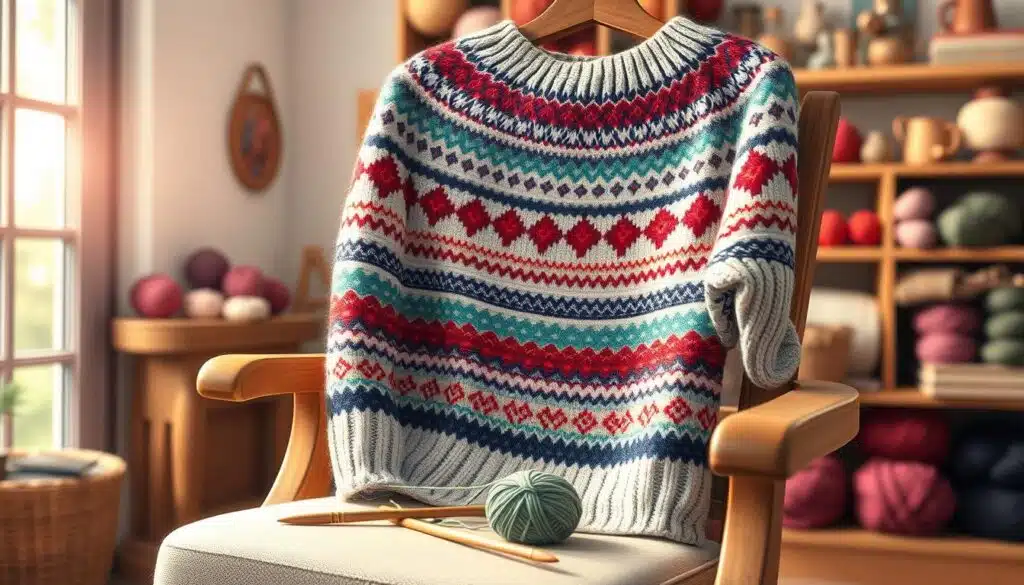
If you knit stranded colorwork in the round, you know the jog shows up like an uninvited guest. The jog is the tiny shift where a motif meets the end-of-round marker. This shift makes a vertical seam or a misaligned motif that ruins a clean Fair Isle look. You can fix this with a few practiced moves that keep your charts crisp and your edges neat.
The problem of the jog at the round transition
The round transition splits the first and last stitch of a chart repeat. When the two halves don’t line up, your motif steps up or down. This is most visible on symmetrical motifs, like those in many Fair Isle designs. A shifted motif catches the eye and breaks the pattern flow.
Work-into-row-below trick: benefits and drawbacks
The simplest fix is to work into the row below for the first stitch of the new round. This classic trick blends rounds at a glance. You likely learned it as a stripe trick; it works for stranded colorwork too.
The downside appears when you use it every round. That stitch can thicken and pull longer, creating a raised line across your fabric. The effect is subtle in fingering weight, but obvious in worsted. If you try this, test on a swatch first and weigh the trade-offs for your project.
Patty’s last-stitch trick for jogless stranded colorwork
Patty’s method fixes alignment without thickening one stitch every round. It treats the last stitch of the round as the key stitch to shift. Follow these clear steps and practice the rhythm to get consistent results.
- Work the first round exactly as written so your motif starts clean.
- At the end of that round, move the last stitch from the right needle back to the left needle. Leave the end-of-round marker in place.
- Knit that last stitch again using the color that begins the next round. If both colors match, pass the working yarn under the inactive yarn to close the gap.
- On the following round, knit until one stitch before the marker. Lift the stitch from the round below (the original last stitch) and place it on the left needle.
- Work the final stitch by knitting into the row below, which lets the motif align smoothly.
- Repeat these moves across your chart so the end-of-round stitch always ties into the next round’s first color.
This Patty jogless trick keeps increases and decreases that start rounds intact. It reduces the thickened-line problem you’d get if you worked into the row below every single round. You will need practice to maintain even tension, but the payoff in alignment is worth the effort.
Adjusting for yarn weight: why fingering hides imperfections more than worsted
Yarn weight changes how visible any fix becomes. Fingering weight yarn compresses and hides tiny inconsistencies. Worst ed or aran weights make jog fixes pop up as ridges or elongated stitches. Choose a lighter yarn when you practice these jogless methods, then scale up once your tension is steady.
Blocking and a gentle tug with a tapestry needle can refine the look after you knit. If you want a quick reference for common fixes and swatching tips, check this helpful guide on fixing knitting mistakes at fix knitting mistakes.
| Technique | How it works | Pros | Cons |
|---|---|---|---|
| Work into row below | Knits first stitch of new round into the stitch below to drop the round visually | Easy, quick to learn, blends rounds immediately | Can thicken/elongate a stitch line; more visible in worsted |
| Patty jogless trick | Transfer last stitch back, reknit it in next round’s color, then work into row below at end of next round | Aligns motifs without a permanent thickened line; preserves round-start shaping | Learning curve; needs even tension and practice |
| Ignore and block | Continue knitting and rely on blocking and finishing to reduce visibility | Fastest; no special technique required | Often insufficient for clear motifs; not ideal for bold colorwork like jogless Fair Isle |
Carrying and Tensioning Multiple Colors
You’ll learn how to do neat stranded work. This includes when to catch floats and drills to build muscle memory. Quick visual clips on Instagram show how to hold your hands and catch floats, which helps when you try these techniques yourself.
When to catch floats versus carrying loosely across the back
Catching floats every 4–5 stitches stops long strands from snagging. On edges, cuffs, and in tight-gauge sections, catching the yarn adds stability. It prevents hems from stretching out.
If you work a loose fabric or use bulky yarn, leave extra slack. This prevents the floats from pulling the fabric flat.
To keep elasticity, carry floats loosely across the back. Avoid trapping the yarn too tightly. This keeps ribbing lively and avoids puckering around increases and decreases.
Keeping even tension with two-color and multi-color strands
Tensioning multiple yarns is more important than which hand holds what. Make sure both strands feed at a similar feel. This prevents one color from stretching out and creating elongated stitches.
Try wrapping methods or feed the nonworking yarn under a finger. This moderates pull. Yarn weight affects how much slack you need. Fingering weight tolerates closer carries. Bulky yarns need noticeably more ease to keep rows from thickening.
When colors shift frequently, consistent tension prevents uneven gauge across rounds.
Practical exercises to train your nonworking hand
Start with simple swatches that alternate color dominance every two rows. Knit one 20-stitch repeat carrying floats every four stitches. Then switch to deliberate tension drills: feed the nonworking yarn with one finger, release on the next stitch, repeat for ten minutes.
Do training nonworking hand knitting exercises by timing short rounds. Focus on identical wraps per stitch. Block your swatches to see tension differences vanish or persist. Repeat the drills until your nonworking hand feeds yarn with the same rhythm as your working hand.
- Practice swatch: 40 sts, two-color stranded, catch floats every 4 sts, 8 rows. Note any puckers.
- Tension drill: 5-minute cycles of stitch-by-stitch feeds, alternating which color is dominant.
- Float-length drill: fixed 3-stitch floats vs. fixed 6-stitch floats to compare elasticity and snag risk.
These concrete rules and short exercises make carrying floats and tensioning multiple yarns feel routine. With steady practice, your hands learn the tempo. Your fabric will reward you with even colorwork and crisp motifs.
Designing and Adapting Charts for Better Results
Small edits and smart placement can make a busy colorwork chart shine. Decide if you should adapt the charts or use in-stitch tricks. Some projects benefit from a quick rewrite, while others need stitch-based solutions to keep the pattern intact.
Consider shifting motifs around the end-of-round marker to hide jogs. Move the motif start a few stitches to nest pattern repeats. Knitters on Instagram show how a small shift can keep symmetry.
How to rewrite a chart to eliminate jogs or improve symmetry
For permanent fixes, rewrite the chart to place the round marker between motif repeats. Slide the divided section up or down by a row to align motifs. This method takes time but offers cleaner results in the long run.
Using repeats and negative space to simplify complicated patterns
Use repeat blocks and negative space to simplify patterns. Break complex panels into repeatable tiles. Let the background color help. Repeating motif blocks makes knitting easier and reduces jog-prone transitions.
Choose your approach based on the garment and timeline. For quick hats, shifting motifs and using Patty’s last-stitch trick might be enough. For a sweater to last years, adapt the charts fully and rewrite for a neat solution.
- Test edits on a swatch before altering a full pattern.
- Keep a copy of the original chart and note each change for future reference.
- Use repeat units and negative space to make reading the chart easier on long rounds.
Troubleshooting Common Stranded Colorwork Problems
Stranded colorwork seems easy until you see a raised line or puckering. You’ll learn how to spot and fix these problems quickly.
Thickened rows and elongated stitches: causes and fixes
Thick rows often come from working into the same stitch each round. Patty says this is the main cause. Heavy yarns make the ridge stand out more.
To fix thick stitches, try Patty’s last-stitch trick. It’s better than the first-stitch method. Use even tension and try a lighter yarn to hide the line.
Puckering, uneven floats, and how blocking helps
Puckering occurs when floats are too tight or tension varies. Start by carrying floats looser. Try a larger needle to relax the fabric.
Block your work to smooth out stitches after finishing. Use a tapestry needle to ease tight floats before blocking. Photos on Instagram show big improvements after blocking.
Managing increases and decreases in colorwork rounds
Shaping can mess up a chart if not planned well. Patty’s trick helps keep increases and decreases balanced. It changes the last stitch, not the first.
Place increases and decreases where they make sense. Adjust your chart for balanced motifs. Test small swatches to check for tension before starting a big project.
Project Ideas and Patterns to Level Up Your Skills
You want projects that teach without wasting time or yarn. Start small and focused. Choose pieces that force you to practice jogless transitions and keep a steady tension. Instagram feeds full of finished hats and cowls are great for inspiration.
Hats and cowls that teach jogless transitions
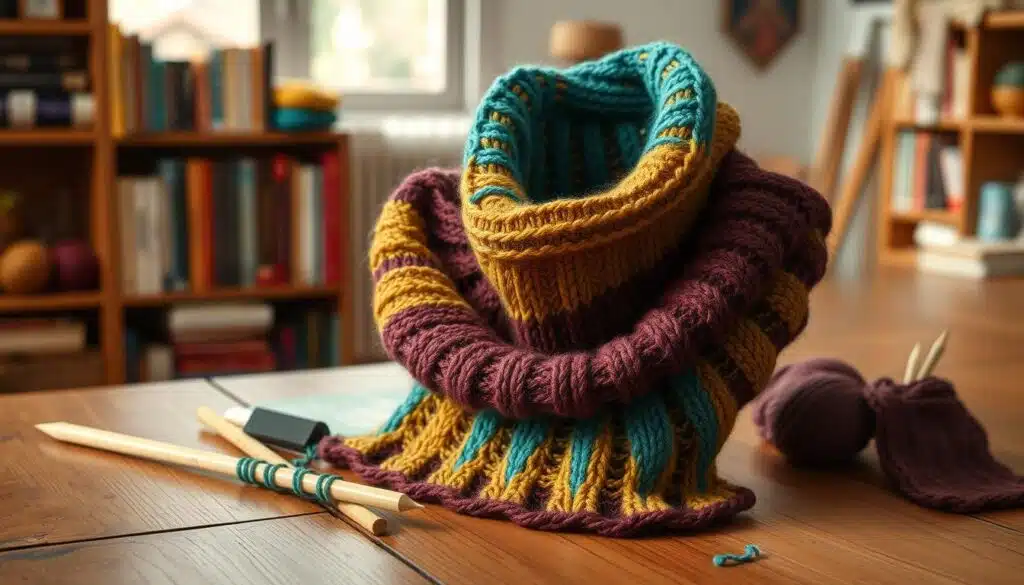
Look for a pattern with simple repeats. This lets you focus on the round join. Try vetted jogless hat patterns or adapt a basic beanie to include a two-color band.
Patty’s Rhinebeck Cowl shows how a visible jog can teach you what to fix. Her tam using the last-stitch jogless trick proves the method works across accessories.
Small projects for practicing tension control
Work a pair of wrist warmers or mitts to build even tension. These small projects help you feel the yarn and calibrate your nonworking hand. Repeat the same motif in different yarn weights to see how they respond.
How leftover yarn projects can be teaching tools
Use leftover skeins for trial runs. A tam, cowl, or hat made from scraps lets you test contrast and stranded colorwork patterns. You’ll learn adjustments that transfer to larger pieces and save money on mistakes.
Try an ordered approach: 1) choose a short pattern, 2) knit a tension swatch in pattern, 3) make the small project and note where floats tighten or the jog appears. These practice knitting projects build confidence fast and keep your progress visible.
Videos, Community, and Further Learning Resources
If you learn best by watching, you’re in the right place. Short clips and timestamped lessons make tricky moves clearer than any written step. Use visual platforms to compare swatches, study tension, and replay the same moment until your hands remember what your eyes saw.
Where to find jogless demonstrations and timestamped tutorials
Search YouTube for focused clips such as “Patty last stitch jogless” and “row below jogless” to reach the exact moments you need. Look for creators who list timestamps in the video notes. Material Culture, MDK, and independent teacher channels often provide clear timestamps for the last-stitch trick and the work-into-row-below method. These same channels will include a Fair Isle video tutorial when a full pattern walkthrough is needed.
Instagram and YouTube for visual help and pattern inspiration
Instagram serves up quick reels and swatches that show jogless technique in real time. Tap hashtags like #strandedcolorwork and #jogless to find short, repeatable demos. Complement those with longer lessons on YouTube knitting channels when you need slow motion or close-ups of tension. Use Instagram to gather visual ideas; use YouTube for step-by-step practice.
Joining local or online knitting groups for feedback and stitch clinics
Ravelry groups, local guilds, and neighborhood yarn shops host stitch clinics where you can try a technique with an instructor at your side. Reach out to column authors or teachers who list contact info in their write-ups to ask for clarification or a time-stamped clip. Post a short video of your work in progress to knitting community Instagram threads for targeted feedback.
Mix short-form and long-form learning. Replay a reel to fix a wrist position, then follow a full tutorial to lock in the motion. That blend will speed up your progress and make jogless tutorial knitting feel routine.
Conclusion
Learning stranded colorwork is easier with small projects and clear techniques. Start with simple, in-the-round patterns. This lets you focus on tension and floats without feeling overwhelmed.
Use fingering-weight yarn for practice to hide mistakes. But remember, good technique is key, no matter the yarn weight. Patty’s last-stitch trick is a great example.
Practice jogless knitting by making hats, cowls, or tams with leftover yarn. Watch short demos on Instagram or YouTube for tips. For quick help on basics or fixing mistakes, check out this guide: stranded colorwork basics.
To get better at colorwork, practice and get feedback from others. Share your work on Instagram, ask questions in stitch groups, and compare notes. If you make a mistake, there are how-tos to help you fix it. A useful guide for fixing mistakes can be found here: fix knitting mistakes.
Stay playful and keep your projects small. Ask questions and you’ll see your skills improve quickly. Short projects and good references, along with a curious knitting community, will help you get better fast.
FAQ
What exactly is stranded colorwork and how does it differ from intarsia?
Stranded colorwork, also known as Fair Isle, uses unused colors as floats. This creates a dense, warm fabric with crisp motifs. Intarsia, on the other hand, uses separate bobbins for color blocks and has no floats. It lies flatter and is better for large color fields.
Stranded is ideal for graphic repeats like hats, cowls, mitts, and tams. It produces characteristic color interplay and warmth.
Who should try stranded colorwork and what projects are best for learning?
Adventurous beginners and intermediate knitters should try stranded colorwork. Start with small projects like hats, cowls, wrist warmers, and tams. These projects let you practice tension, color changes, and jogless tricks without wasting time or expensive yarn.
Which needles, markers, and tools make stranded work easier?
Use comfortable circular needles that match your gauge and circumference. Add stitch markers to mark end-of-round and repeats. Tapestry needles help with tension and blocking adjustments.
For small circumferences, have DPNs or a short circular handy. Smooth tips help when switching yarns quickly. A spare needle can help when transferring stitches for jogless tricks.
How does yarn weight and fiber affect jog fixes and overall results?
Yarn weight hugely affects visibility. Fingering weight masks jog-fix thickening far better than worsted. Working into the row below every round creates a raised line that shows up in worsted but blends in fingering.
Fiber matters too: wool and wool blends block well and relax stitches. Slippery fibers may need more attention to tension. Choose yarn weight and fiber to match your tolerance for visible fixes while you learn.
How should I pick colors so motifs read clearly?
Prioritize contrast in value—light versus dark—so motifs pop. Choose palettes where a main color reads cleanly against contrast colors. High-contrast pairings reveal motifs best; subtler contrasts can be beautiful but demand careful gauge and blocking.
Use Instagram and community swatches to preview how your chosen fibers and colors behave in real projects.
What are the basic skills I need before attempting stranded colorwork?
Nail a steady gauge, even tension across colors, and chart reading. Know how round-start markers relate to chart columns and practice catching floats when they get long. Managing floats, avoiding puckering, and keeping both yarns feeding evenly are foundational.
Practice with swatches and small repeats before committing to a big project.
How do I manage floats so they don’t snag or pucker the fabric?
Catch floats every 4–5 stitches (or sooner near edges), but carry them loosely so the fabric keeps elasticity. Tight floats cause puckering. If floats are long, catch them; if you must carry across many stitches, add a loose twist to anchor them.
Blocking can relax minor tension issues, but good float practice prevents most problems.
What causes puckering and how do I fix it?
Puckering comes from tight floats or uneven tension between colors. Fixes include carrying floats more loosely, switching to a slightly larger needle, practicing even tension, and blocking to relax stitches. A tapestry needle can gently tug and even stitches before or after blocking for a smoother finish.
What is the “jog” problem in circular colorwork?
The jog appears where the round starts and ends: the portion of a motif split by the end-of-round marker can shift up or down, making a visible seam or misaligned motif. This is most obvious when there’s no spacer stitch and the pattern continues across the marker.
What is the common work-into-the-row-below trick and its downside?
The row-below fix removes the marker, inserts the needle into the row below the first stitch of the round, lifts a loop, and knits it—making the first stitch of the new round also look like the last stitch of the previous round. It’s simple and familiar from stripe work, but if you do it every round it can create a thick, elongated line—very noticeable in worsted-weight yarns.
What is Patty’s last-stitch jogless method and why is it better?
Patty’s method targets the last stitch of the round instead of the first. You transfer the last stitch from the right needle back to the left (leave the end-of-round marker), then knit that stitch again with the color of the next round—crossing yarns under if needed. On the next round, work until one stitch before the marker, lift the stitch from the row below (the original last stitch) onto the left needle, and knit into that row-below stitch to finish. Repeat across the chart. This preserves increases/decreases that begin rounds and reduces the raised-line effect compared with working into the row below every round.
Is Patty’s last-stitch trick hard to learn? Any tips?
It takes practice to get tension right. Work a sample swatch and experiment with fingering-weight yarn first—imperfections hide better. Pay attention to crossing yarns under when colors match to avoid gaps. Finish with blocking and use a tapestry needle to ease tension if needed. Patty’s examples (like the Rhinebeck Cowl and the tam) show it cleans up nicely when practiced.
When should I rewrite or shift a chart instead of using in-stitch tricks?
If your motif has a clear spacer (a main-color stitch between repeats), shifting the round start backward or forward to nest motifs (Meg Swansen’s nesting) or editing the chart so the split falls in a less visible place can eliminate jogs. When patterns are continuous with no spacer stitch, rewriting is trickier—Patty’s last-stitch trick avoids recharting and keeps shaping intact. Choose chart edits when you want a permanent, symmetrical fix; use in-stitch tricks when you prefer less chart work.
How do increases and decreases interact with jogless methods?
Patty’s last-stitch approach is designed to preserve increases and decreases that begin a round because it operates on the last stitch instead of the first. If increases or decreases fall elsewhere, plan float catches and symmetry in your chart. When recharting, keep shaping in mind so motifs remain balanced across rounds.
What practical exercises help me keep even tension with two colors?
Knit swatches alternating color dominance, practice fixed-float-length strips, and do stitch-by-stitch tension drills—feed and release each yarn with your nonworking hand in a consistent rhythm. Work small projects with leftover yarns to train your hands without wasting expensive skeins. Watch Instagram reels or YouTube timestamped clips for hand-position demos to mimic in real time.
Which yarn weights should I practice on first?
Start with fingering weight to hide minor jog fixes and tension issues. Once comfortable, move to sport or worsted if your chosen pattern calls for it. Keep in mind that heavier yarns magnify issues like the raised line from row-below fixes, so Patty’s last-stitch trick or careful chart edits are useful in worsted.
How can I find reliable video demos and community examples?
Search YouTube for “jogless stranded colorwork,” “Patty last stitch jogless,” and “row below jogless.” Look for timestamped how-to sections in video notes. Use Instagram hashtags like #strandedcolorwork, #jogless, and #fairisle to find reels, swatches, and community posts demonstrating tension, needles, and palette choices. Ravelry groups and local guilds also host stitch clinics and pattern discussions.
What should I do if I notice a raised line or thickened stitches after using the row-below trick?
Consider switching to Patty’s last-stitch method to avoid creating a repeated thickened line. If you already used the row-below trick, block the piece to relax the stitches, and use a tapestry needle to gently ease and even the line. For future projects, test on a swatch and use fingering weight when trying the row-below approach.
Can I practice jogless techniques using leftover yarns?
Absolutely. Leftovers are perfect for tams, cowls, and small accessories that teach tension control, color switching, and the last-stitch trick without wasting premium yarn. Patty’s own tam made from Rhinebeck Cowl leftovers is a great low-stakes example to copy or adapt.
How much does blocking help with jogless colorwork?
Blocking helps even out minor tension differences, relax floats, and smooth stitches, and it can significantly reduce the appearance of small jogs. It won’t fix deeply distorted tension or a consistently tightened float, so combine blocking with good tension practice and the appropriate jogless technique for best results.
Where can I get feedback while I’m learning?
Post progress photos or short clips on Instagram with hashtags like #jogless and #strandedcolorwork, join Ravelry groups, or attend local guild stitch clinics. YouTube comments and Material Culture/knitting-column threads often include helpful commentary. Many knitters also reach out directly to pattern authors or tutors for targeted troubleshooting.