
Tunisian crochet is a mix of knitting and crochet. It creates fabric that’s warm, structured, and has a special texture. If you’re new to Tunisian crochet, this guide will help you start with the basics and move on to more complex stitches.
First, you need to know how to hold a hook and the basics of single crochet. There are many resources, like video tutorials and an ebook, to help you. They cover everything from materials to free patterns.
For those who prefer visuals, there’s a big community on Instagram. They share photos and videos of their projects. If you’re worried about curling, there’s a guide that explains how to prevent it and block your work properly.
By the end of this guide, you’ll know how to use the Tunisian stitch. You’ll also learn which hooks and yarns work best. You’ll be ready to start your first project and make it look professional and feel cozy.
Key Takeaways
- Tunisian stitch blends knitting-like fabric with crochet ease, making it ideal for structured projects.
- Start with basic crochet skills before tackling Tunisian crochet for smoother progress.
- Follow a Tunisian crochet guide that includes video tutorials and step-by-step patterns.
- Use curated pattern libraries like I Like Crochet Gold Club for polished, tested instructions.
- Community photos and short videos on social platforms speed up learning and spark project ideas.
- Blocking and edge techniques fix curl and give professional-looking finished pieces.
What is Tunisian Crochet and Why You’ll Love the Tunisian Stitch
Tunisian crochet is a special craft that blends two worlds. Its origins are a topic of debate, but its appeal is clear. It creates a dense, warm fabric that feels like a cozy hug.
Those interested in Tunisian stitch history can find stories online and in old pattern books. Each story adds a piece to the puzzle.
Origins and the name debate
Some say it comes from Tunisia, while others believe it has European or Middle Eastern roots. This debate sparks interesting conversations online and in yarn shops. For a detailed comparison, check out this guide.
Why it feels like knitting but is crochet
The secret lies in the tools and the way you work. You use a long hook for a forward pass that picks up loops. Then, a return pass releases them.
This method creates a fabric that feels like knit. It brings up the old debate of crochet vs knitting when you show a Tunisian swatch.
Controlling tension is key here. Loops stay on the hook until the return pass. Once you get the hang of it, the technique becomes easy and quick to learn.
What makes Tunisian stitch unique: texture, warmth, and structure
The Tunisian texture is unique. It has close-packed stitches, a woven look, and excellent stitch definition. This makes pieces warm and stable, perfect for bags, blankets, and garments.
Tunisian crochet is less stretchy than standard crochet. This makes it great for patterns that need structure. The fabric shows colorwork well and holds shaping, making your projects look polished.
Essential Materials for Tunisian Crochet
Get ready to start Tunisian crochet. You need yarn and a special hook. The right tools make the craft smoother and the fabric neater. Choose tools that fit your project and your patience.
Tunisian crochet hooks: straight, double-ended, and corded options
There are three main hook types. Straight hooks are made of metal, wood, or bamboo. They feel familiar if you like traditional crochet.
A double-ended hook lets you work rounds without switching tools. It’s great for hats and tubular pieces. A corded hook with interchangeable tips is the most flexible for large blankets or tall panels.
Choose a corded Tunisian hook set for projects that grow. The Clover Tunisian Crochet Hook sets are popular. They include many sizes and cords, preventing cord length issues.
Yarn choices that work best for Tunisian techniques
Your yarn choice affects drape and stitch definition. Worsted weight is reliable and easy to see for scarves and beginner patterns. Bulky yarn is good for warm hats and cozy blankets.
Lighter yarns like fingering or sport weight give a delicate look. But they need more stitches and patience. Think about fiber too. Wool and wool blends block nicely and tame curl. Cotton shows stitch texture sharply, but it may lack stretch.
Match the best yarn for Tunisian to the pattern’s advice and your end goal.
Notions and extras: stitch markers, tapestry needles, blocking tools
Complete your kit with smart notions. Stitch markers hold pattern repeats and short rows. Tapestry needles make seaming and weaving in ends easy. Blocking tools—pins, mats, and a spray bottle or steam iron—help flatten panels and reduce curl.
Social channels like Instagram show which notions creators prefer. Look there for trending tools that might speed your workflow or solve a nagging problem.
Practical takeaway: favor an interchangeable corded Tunisian hook for adaptability. Carry a double-ended Tunisian hook if you plan to work rounds. Choose the yarn weight the pattern requests. Keep stitch markers, tapestry needles, and blocking tools handy for tidy results.
Understanding Forward Pass and Reverse Pass Mechanics
Learning the forward pass Tunisian and the reverse pass Tunisian is key. On the forward pass, you pick up loops across the row. Then, on the reverse pass, you work back to release them. Mastering these two steps makes the rest of the stitches easier.
How the forward pass “picks up” stitches
During the forward pass, you insert the hook and draw up a loop for each stitch. It’s important to target the correct vertical bar or loop for a clean fabric. If you miss a loop, you’ll see a gap later.
For cable-style moves, treat each cable leg separately. Work into the second leg first, then place those loops on a cable needle. Next, work the first leg. This lets you twist the legs and continue without losing your place. A video tutorial can show you the hand motion and timing.
How the reverse pass releases stitches and forms fabric
On the reverse pass, you work back across the row, pulling the loops off the hook. This forms the fabric. Keep your yarn tension consistent so the loops sit evenly. If you pull too tight or too loose, the edges will look wrong.
When cables or special stitches are involved, the reverse pass may feel tighter. A slightly larger hook or a gentle rework of the row can help if tension gets away from you.
Common mistakes on each pass and how to fix them
Common forward-pass Tunisian mistakes include missed loops and picking up the wrong vertical bar. To fix this, slide back one or two loops to redo the pick-up, or rip to a clear marker and rework the forward pass. Use stitch markers to prevent repeats of the same Tunisian mistakes.
Reverse-pass Tunisian slipups often come from inconsistent tension when releasing loops. Practice holding the yarn the same way each pass. If the edge looks uneven, try a practice row on scrap yarn and adjust hook size or tension. Watching step-by-step videos and following pattern notes from trusted sources like I Like Crochet can speed your recovery.
| Issue | When It Happens | Quick Fix |
|---|---|---|
| Missed loop | Forward pass Tunisian | Slide back one loop, pick up correct bar, or rip to marker |
| Wrong vertical bar picked | Forward pass Tunisian | Undo last few loops and rework with a marker on correct bar |
| Tight reverse edge | Reverse pass Tunisian | Use a slightly larger hook or loosen yarn tension on return |
| Loose, gappy fabric | Reverse pass Tunisian | Practice consistent tension; rework row if needed |
| Confused cable legs | Forward pass with cables | Work legs separately onto cable needles and follow twist order |
Practice the forward pass Tunisian and reverse pass Tunisian on scrap yarn until you get the rhythm. For a visual guide to the forward-pass cable concept, check a focused video tutorial at Tunisian crochet cables video tutorial. Small, steady practice eliminates most Tunisian mistakes and builds confidence with the Tunisian stitch technique.
Basic Tunisian Stitches to Start With
Start simple and build confidence. Your first practice swatch should focus on the foundational stitch that shows up in nearly every pattern. Learn the rhythm on a few rows before you try color changes or combos.
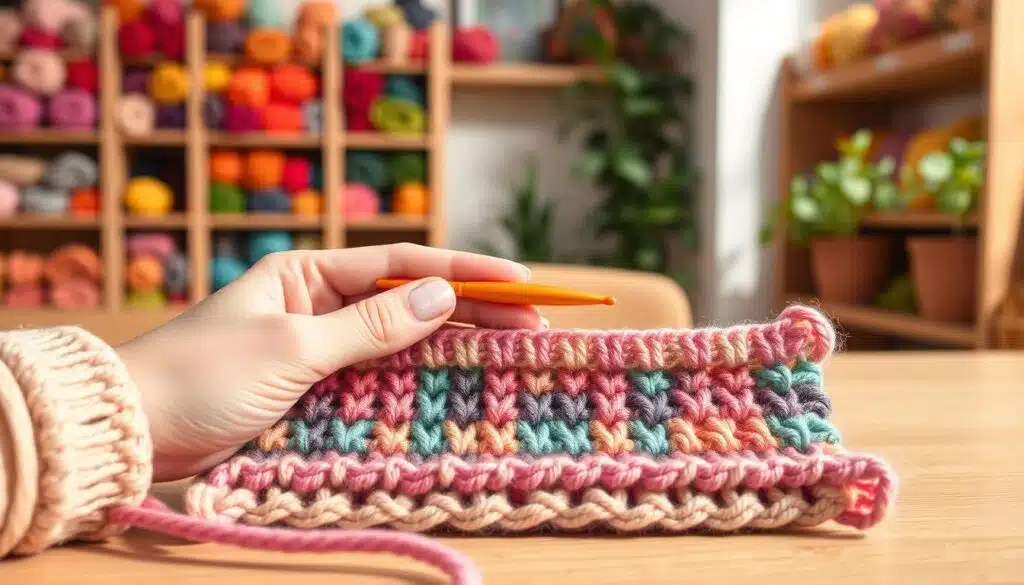
The Tunisian Simple Stitch is the gateway stitch for most makers. The TSS symbol in charts is shown as an “I”, which makes reading patterns easier once you know the key. TSS gives a tidy, dense fabric and helps you master the forward pass and reverse pass.
Next, try the Tunisian Knit Stitch TKS for a knit-like surface. When you work TKS the fabric lies flatter and looks more like stockinette. Designers use Tunisian Knit Stitch TKS in scarves and garments to mimic knitting while keeping crochet speed.
After you can do TSS and TKS, add the Tunisian Purl TPS to your toolkit. The Tunisian Purl TPS uses the reverse handling of loops to create a bumped texture. Pairing Tunisian Purl TPS with Tunisian Knit Stitch TKS produces ribbing and simple textures that read as intentional patterning.
Work small projects to practice transitions. A tri-color scarf or a narrow sample strip helps you switch between TSS, Tunisian Knit Stitch TKS, and Tunisian Purl TPS without committing to a large piece. Video guides and photo tutorials make it easier to match your loop appearance on the forward pass.
| Stitch | Chart Symbol | Look | Best for |
|---|---|---|---|
| Tunisian Simple Stitch | I | Flat, grid-like texture | Beginner Tunisian stitches, panels, dense fabric |
| Tunisian Knit Stitch | O | Knit-like, smooth surface | Garments, scarves, when you want a knitted look |
| Tunisian Purl Stitch | – | Bumpy, reversed texture | Ribs, texture combos with TKS |
Keep practice focused and brief. Five to ten minutes of deliberate stitch work each day beats one long, tired session. Start with the Tunisian Simple Stitch, then add Tunisian Knit Stitch TKS and Tunisian Purl TPS when you feel steady.
Tunisian stitch
You’ve seen that look: dense, plush fabric that’s between knitting and crochet. This guide explains the Tunisian stitch and how to use it on project pages. It helps readers find your work.
Defining the term and SEO context for your project
The Tunisian stitch is like a family name for a group of techniques. It creates rows with a forward and reverse pass. Use the Tunisian stitch definition in headings and meta snippets. This helps searchers find pages with basics, tools, and stitch notes.
How it appears in patterns and charts
Designers show Tunisian stitch patterns as repeat blocks with simple symbols. Vertical bars are for basic picks, circles for chain edges, and crossed marks for slipped or twisted variations. When writing patterns, add clear Tunisian stitch charts and written directions. This way, makers who prefer visuals or text can follow along.
When to choose the stitch for garments, accessories, or home decor
Choose the Tunisian stitch for structure and warmth. It’s great for sturdy bags, plush scarves, and flat pillow panels. It’s perfect for pieces that need a knit-like look without needles and for dense, insulating fabric.
If you have a pattern collection, list each item’s stitch choice and link to sample swatches. This helps knitters and crocheters decide if your Tunisian stitch patterns match their needs.
Advanced Tunisian Techniques and Textures
Ready to go beyond the basics? You can learn textured, sculpted patterns for unique garments and home decor. These advanced Tunisian techniques create dense fabrics and bold textures with practice.
Tunisian Full Stitch (TFS): texture and tips
The Tunisian Full Stitch makes a dense fabric perfect for hats and bags. Start with a firm gauge and use a hook one size up if it’s too stiff. Work in short rows to see the crossed-over look form, keeping tension even for deep texture.
Tunisian Smock (Honeycomb) stitch: uses and shaping
Tunisian Smock stitch, also known as Tunisian honeycomb, creates sculpted, reversible panels. It’s great for blankets, pillows, and pouches. Use stitch markers for shaping and practice increases and decreases in a scrap before adding them to a project.
Tunisian cables and how to approach them step-by-step
Tunisian cables add dramatic texture and are easier when broken into small steps. Follow cable-friendly charts, place lifelines every few repeats, and use stitch markers for crossing points. Work cable crossings on the forward pass, then maintain the cable path during reverse passes for neat definition.
If you prefer learning visually, check out video tutorials and Instagram clips. They show crossings and smock shaping in motion. Pattern collections from I Like Crochet and tutorials by CrochetKim offer many examples, from in-the-round Tunisian Full Stitch hats to textured pillows and scarves.
Quick practice plan: spend a session on Tunisian Full Stitch for dense texture, another on Tunisian Smock stitch for sculpted panels, then tackle Tunisian cables using charts and lifelines. This sequence keeps progress steady and builds confidence for creative projects.
Managing Curl and Blocking for Professional Results
A neat Tunisian panel can turn into a bad haircut if the edges curl. This happens because you work on one side, like knitting. This uneven tension makes the fabric curl inwards. To fix this, plan carefully while working and block the fabric afterwards.
Why panels curl and what that mirrors
Curling is common in stockinette-like Tunisian fabric. The forward pass creates loops on one side, while the reverse completes them on the other. This makes the fabric lean towards one side. Knitters face the same issue with knit stockinette, making the analogy useful for edge treatments.
Practical techniques to reduce curl while you work
Give your edges a fighting chance. Add a border of single crochet or a slip-stitch edge as you go. These stitches help keep the edges from curling. You can also prevent curling by alternating stitch patterns.
Make short swatches to test edge combos. For a neater look, use smaller needles or a tighter gauge for the first and last five stitches. This helps keep the border flat.
Blocking tips for flat, finished pieces
Blocking Tunisian crochet makes it flat and professional. Wet-block natural fibers by soaking, squeezing, and pinning to shape. Steam-block acrylic blends carefully to avoid melting. Use blocking wires for long edges and stainless pins for corners.
If needed, add a light interfacing or lining for items like pouches and bags. This keeps the shape without altering the drape too much.
Swatch, block, and repeat. This routine helps predict drape and avoid surprises. Many patterns and video tutorials show edge and blocking methods, making it easy to adapt these tips.
| Issue | Quick Fix While Working | Blocking Solution |
|---|---|---|
| Rolled long sides | Single crochet border or slip-stitch edge every 6–10 rows | Wet-block with wires pinned straight; dry fully |
| Curling short edges | Use reverse stitches or tighter gauge for first/last 5 sts | Steam-block gently; use small pins to hold corners |
| Lightweight drape but unstable shape | Alternate TSS and TFS near edges; add a firm border | Wet-block then apply light interfacing when dry |
| Persistent curl after blocking | Reinforce edges with slip-stitch or sewn hem | Repeat blocking; consider lining for structure |
Easy Tunisian Projects to Practice Your Skills
Ready to learn while you create? Start with small projects that teach one or two new skills. These projects help you get better at switching stitches, changing colors, shaping, and finishing neatly. Choose yarn and tools you like, set a timer, and see each swatch as a step towards a beautiful accessory or gift.
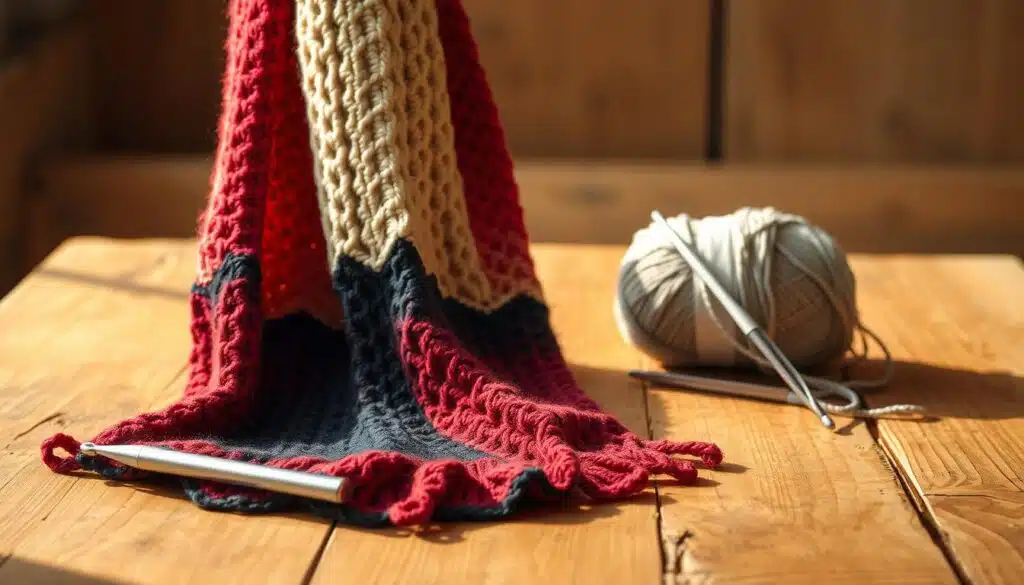
Tri-Color Scarf: mix simple, knit, and purl
The Tri-Color Tunisian Scarf is a great next step. It starts with the Tunisian simple stitch, then mixes Tunisian knit and purl rows. This creates a textured scarf with clean color joins.
This scarf is not just a skill-builder; it’s also something you can wear. For a quick guide to tools and a basic swatch, check out TLYC Blog.
Block scarf: full stitch and color-change tips
The Tunisian Block Scarf uses the Tunisian Full Stitch for dense fabric. It has wide color bands to practice joining yarn without gaps.
This project teaches you how to change yarn smoothly and how tension affects the fabric. You can try different hook sizes and yarn weights to get the perfect drape.
Pouch, cable square, and seasonal makes
Try a Tunisian pouch to practice shaping and adding a zipper. It’s a quick way to learn seaming and make a useful item.
Next, make a cable square for twisting and crossing stitches. It’s perfect for learning placement and blocking before making larger items.
Seasonal projects keep things fun. A Tunisian pumpkin is a quick project that teaches finishing skills. It’s a great way to practice while being creative with colors.
- Practice roadmap: Tri-Color Tunisian Scarf → Tunisian Block Scarf → Tunisian pouch or cable square.
- Skill goals: color changes, TFS practice, shaping, zipper insertion, and neat seaming.
- Extras: video demos on Instagram and tutorial pages help with tricky finishes; many pattern collections at I Like Crochet include color-change notes and yarn lists.
| Project | Main Stitches | Key Skill |
|---|---|---|
| Tri-Color Tunisian Scarf | TSS, TKS, TPS | Color joins and stitch switching |
| Tunisian Block Scarf | TSS, Tunisian Full Stitch | Even fabric and long color bands |
| Tunisian pouch | Smock and simple stitches | Lining, zipper, and seaming |
| Tunisian cable square | Cables, cross techniques | Shaping and blocking for motifs |
| Tunisian pumpkin | TKS/TPS rectangle | Seaming and finishing for decor |
For another quick pattern, try the one-day scarf at Crochet Craze. Focus on one technique per project and watch your skills improve with each piece.
Where to Find Patterns, Tutorials, and Membership Resources
Start with a plan to learn Tunisian crochet. Use free materials to learn the basics. Then, add paid resources for more depth and polish.
Make sure to mix short videos, long lessons, and guides. This keeps your practice fun and varied.
Free pattern sources and creator-designed tutorials with videos
Look for free Tunisian tutorials with photos and videos. Many designers offer step-by-step guides. These guides often come with a Tunisian eBook or printable chart.
One great resource is The Ultimate Beginner Guide. It includes video tutorials and an ad-free eBook. You’ll also get links to more free patterns. Sign up for newsletters to stay updated on new tutorials.
Collections and paid libraries for curated patterns
For a deep archive, join I Like Crochet Gold Club. It offers curated Tunisian patterns for all skill levels. Members get access to hundreds of patterns, full-color images, and tech-edited instructions.
There are also on-demand video tutorials. The Gold Club offers downloadable magazines and streaming series. These help you move from beginner to advanced projects.
Video tutorials, photo guides, and eBook options for step-by-step learning
YouTube and Instagram are great for short technique demos. Use video tutorials for tricky stitches. Then, follow a Tunisian eBook for a structured lesson plan.
For a mix of videos and downloadable chapters, check out a curated resource at crochet video tutorials. It combines clips, photo guides, and patterns in one place.
| Resource Type | What You Get | Best For |
|---|---|---|
| Free creator tutorials | Step-by-step patterns, short videos, community comments | Learning basics and trying quick projects |
| Tutorial bundles with eBook | Structured lessons, ad-free Tunisian eBook, printable patterns | Self-paced study and reference |
| I Like Crochet Gold Club | 700+ patterns, curated Tunisian collections, Tunisian video tutorials | Deep archives and polished, tech-edited designs |
| Instagram & YouTube creators | Short clips, project photos, real-time tips | Visual inspiration and quick troubleshooting |
Use a mix of free tutorials, video tutorials, and paid collections like I Like Crochet Gold Club. Combine visual demos with a Tunisian eBook for reference. You’ll learn faster than you think.
Conclusion
You’ve learned how the Tunisian stitch combines crochet and knitting. Start with a special hook like Clover and some basic supplies. Practice the forward and reverse passes until they become second nature.
These basics will help you move from simple swatches to real clothes. Begin with basic stitches like TSS, TKS, and TPS. Then, try more complex patterns like TFS, smock, and cable for richer textures.
Use smart edge stitches and blocking to control curl. Start with small projects like scarves, pouches, and squares. This will help you get used to different stitch combinations.
For more advanced steps, use free tutorials, videos, and curated libraries. They will help you improve your skills quickly. Join communities on Instagram and subscribe to creators for photo and video lessons and printable ebooks.
Memberships like I Like Crochet Gold Club offer edited patterns and a deep archive. With regular practice and the right tools, mastering the Tunisian stitch is easy. You’ll be able to make your clothes and home decor look amazing.
FAQ
What exactly is Tunisian crochet and why should you try the Tunisian stitch?
Tunisian crochet is a mix of knitting and crochet. It uses crochet tools and a two-pass method. You pick up loops in one pass and work them off in the other, creating dense fabric.
It’s great for making bags, hats, blankets, and sweaters. You get a knit-like drape without using knitting needles.
Is Tunisian crochet actually from Tunisia?
The origin is debated. But, the technique is loved worldwide. Social platforms like Instagram keep the conversation going.
They show how designers from all over adapt and evolve the stitch.
Why does Tunisian feel like knitting even though it’s crochet?
The long hook lets you hold multiple loops. The forward and reverse pass rhythm builds fabric like knitted stockinette.
The visual similarity comes from held loops and vertical bars that look like knit stitches.
What materials do I need to start Tunisian crochet?
Start with a Tunisian hook. Corded/interchangeable hooks are the most versatile. Choose yarn weight for your project.
Keep stitch markers, tapestry needles, blocking mats/pins or wires, and good scissors on hand.
Which types of Tunisian hooks should you consider?
Use straight Tunisian hooks, double-ended hooks for working in the round, or corded/interchangeable hooks. Corded sets are best for flexibility.
They avoid running out of cord length when a project widens.
How do the forward pass and reverse pass work?
On the forward pass, you pick up stitches across the row. On the reverse pass, you work back, pulling yarn through loops.
Mastering the rhythm of these two passes is key to Tunisian crochet.
What common mistakes happen on the forward pass and how do you fix them?
You might skip a vertical bar or pick up the wrong loop. Fix it by spotting the skipped loop, pulling back one or two loops to redo that section, or ripping back to a marked spot.
Use stitch markers or a contrasting yarn to mark the first and last stitch as a safeguard.
What common mistakes happen on the reverse pass and how do you fix them?
Uneven tension when releasing loops can create tight or loose edges. Practice keeping consistent tension, adjust your hook size if necessary, and rework the row if the edge looks off.
Watching a video tutorial of the reverse pass helps correct hand placement and yarn path.
Which beginner Tunisian stitches should you learn first?
Start with the Tunisian Simple Stitch (TSS), symbolized as “I.” Next learn the Tunisian Knit Stitch (TKS), symbolized as “O,” for a knit-like surface, and the Tunisian Purl Stitch (TPS), symbolized as “-,” which pairs with TKS to create texture.
How should you practice those stitches?
Make small swatches of TSS to learn rhythm. Then try a project like a Tri-Color Tunisian Scarf to practice switching between TKS and TPS, color changes, and maintaining tension across longer rows.
What does the term “Tunisian stitch” cover and how is it used in patterns?
“Tunisian stitch” broadly refers to the family of stitches and their variations. Patterns use chart symbols (I, O, -, crossed-out O) and written notes to explain stitch sequences.
When writing or following patterns, look for both symbol charts and step-by-step notes to clarify how each stitch behaves.
When should you choose Tunisian stitch for a project?
Pick Tunisian when you want dense warmth and structure—bags, mats, outerwear—and when you want a knit-like appearance without knitting needles.
It’s also great for reversible textures and sculptural stitches like smock or honeycomb.
What are the useful advanced Tunisian stitches to learn next?
After basics, move to Tunisian Full Stitch (TFS) for dense texture, Tunisian Smock (Honeycomb) for sculpted, reversible panels, and Tunisian cables for textural interest.
Tutorials and step-by-step cable charts make those transitions manageable.
How do you approach Tunisian cables and smock stitches?
Break them into small steps, use lifelines or stitch markers to track crossings, and watch video demos to see the hand moves.
Practicing on small squares (like a 10×10 cable square) builds confidence before you commit to a full blanket or garment.
Why do Tunisian panels curl and how is that similar to knitting?
Tunisian is usually worked on one side only, so edges tend to curl like knitted stockinette. The curl is a structural trait of the fabric.
But you can manage it with the right techniques.
What techniques reduce curl while working?
Add non-curling edge treatments such as a border of single crochet, slip-stitch edges, or alternating stitch rows. Using reverse stitches or combining stitch types at edges also stabilizes panels as you work.
What are the best blocking methods for Tunisian pieces?
Wet-block or steam-block finished panels, pin them to shape on a flat surface, and let them dry fully. Use blocking mats, wires, and pins.
For pieces needing extra structure—pouches or bags—consider light interfacing or lining after blocking.
What easy Tunisian projects should you try as practice?
Start with the Tri-Color Tunisian Scarf to practice TSS/TKS/TPS and color changes. Then try the Tunisian Block Scarf to practice TFS and colorwork.
Move on to smaller finished items like a Smock Pouch (with zipper and lining), a Cable Square for an afghan, or seasonal projects like a Tunisian Pumpkin.
Where can you find step-by-step tutorials, free patterns, and more advanced collections?
Free creator tutorials and video-led guides are great for basics. For curated, tech-edited patterns and a large searchable library, consider paid options like I Like Crochet Gold Club.
It offers full-color images, downloadable issues, videos, and hundreds of patterns. Instagram and YouTube are excellent for short demos and visual inspiration.
Should beginners learn standard crochet before Tunisian?
Yes. Brand-new crocheters will benefit from learning standard crochet basics first. Understanding tension, basic crochet terminology, and how to hold yarn and a hook will make learning the two-pass Tunisian technique much smoother.
How do you choose yarn weight for Tunisian projects?
Match yarn weight to the pattern. Worsted weight is common for scarves and practice projects. Bulky yarn works well for warm hats and blankets.
Always swatch and block to check drape and curl before committing to a large project.
What tools help with finishing and assembly in Tunisian projects?
Keep tapestry needles for seaming, stitch markers for tracking repeats, blocking tools for shaping, and sewing supplies if your project needs a zipper or lining.
These small notions make a big difference in polished results.
Where can you watch demonstrations of forward/reverse passes and tricky stitches?
Video tutorials on YouTube and short-form demos on Instagram are invaluable. They let you see yarn path, hand position, and tension in real time.
Perfect for correcting common mistakes and learning cable crossings or smock shaping.
What printable or ebook resources are recommended for a structured learning path?
Ultimate beginner guides that include step-by-step lessons, video tutorials, and an ad-free, printer-friendly ebook are ideal. These guides usually progress from materials to advanced stitches and include practice patterns and downloadable swatches.
How should you progress from swatches to finished projects?
Start with focused swatches to master one stitch at a time. Move to a small practical project like the Tri-Color Scarf, then to multi-stitch pieces such as a Block Scarf or smock pouch.
Tackle cables and complex textures last, using charts, lifelines, and video help as needed.
Are there curated Tunisian pattern collections worth joining?
Yes. Membership libraries like I Like Crochet Gold Club offer curated Tunisian collections, professional tech editing, full-color photos, and video support.
These are useful if you want a deep, searchable archive and polished, tested patterns.
How can social media help your Tunisian crochet journey?
Instagram and Facebook groups provide visual inspiration, community feedback, and quick technique clips. You can see what hooks and yarns makers use, find pattern tags, and join conversations about stitch origin, finishing tips, and design variations.