
You’re at the yarn counter, looking at two skeins and wanting to start colorwork. You face a choice: mosaic knitting or Fair Isle. Mosaic uses slip-stitch and one strand at a time. Fair Isle involves juggling multiple colors and carrying floats.
This comparison will help you decide based on ease, look, and project type. Each method has its own strengths.
Fair Isle brings the rich colors of the Shetland Islands and a layered look. Mosaic, made famous by Barbara Walker, offers clear geometric patterns with less effort. It’s like choosing between a neat, boxy design and a textured, classic one.
This article combines practical tips from knitters with a look at technique history. You’ll learn about the differences in tension, drape, and finishing. You’ll also get advice on when to use each method for your next project.
Key Takeaways
- Mosaic knitting is beginner-friendly and uses slipped stitches with one strand at a time.
- Fair Isle is stranded colorwork with multiple colors per row and rich motif possibilities.
- Mosaic vs Fair Isle differ in tension, drape, and typical construction methods like steeking.
- Choose mosaic for flat pieces and fewer tension worries; choose Fair Isle for complex palettes and traditional garments.
- Swatching and gauge planning are essential for both techniques to get the fit and fabric you want.
Quick snapshot: mosaic knitting vs fair isle at a glance
Looking for a quick comparison of mosaic and Fair Isle knitting? Below, you’ll find a summary of their visual differences. You’ll also get a brief on slipped-stitch and stranded colorwork. This will help you choose your next knitting project with confidence.
Visual differences you’ll notice
Mosaic knitting is known for its bold, boxy shapes and graphic patterns. Slipped stitches create a two-row pattern that looks like tiles. Fair Isle, on the other hand, offers a flowing look with bands of repeating motifs.
Mosaic knitting is sharp and modern. Fair Isle knitting is rich and traditional.
Technique summary: slipped-stitch vs stranded colorwork
Mosaic knitting uses one yarn at a time. It slips stitches to create contrast over two rows. This makes it easy to manage and great for beginners.
Fair Isle knitting involves carrying two or more yarns across each row. This creates floats on the wrong side and builds motifs stitch by stitch. Mastering float control is key to even tension and tidy fabric.
Which projects suit each method
The best projects for mosaic knitting are graphic cowls, scarves, hats, and flat shawls. These showcase geometric repeats well. They’re also easy to shape and less prone to tangling.
For traditional sweaters, yokes, warm hats, and mittens, Fair Isle is the way to go. It’s perfect for subtle shading and complex motifs. Use it for projects that need curved shaping or multi-color bands.
For a deeper dive, check out a detailed guide at this colorwork techniques primer. It has examples, charts, and tips from real knitters.
What is Fair Isle and where it came from
Fair Isle knitting is known for its small, colorful bands. It started as a practical craft on the island. Now, it’s a language of knitwear with its own rules and motifs.
Historical origins on Fair Isle and Shetland
The style is named after the small island between Orkney and Shetlands. Local knitters used short yarn scraps for markets and ships. The arrival of bright dyes in the 1800s changed the patterns to bold.
Knitting was a daily part of life. It shows thriftiness in every stitch. Small motifs and tight repeats came from using leftover yarn.
Traditional rules: limited colors per row, in-the-round work, and floats
Knitting rules evolved over time. Classic rules limit colors in a row to two, even with more shades overall. This keeps the fabric even and prevents snagging.
Knitting in the round was common for its warmth and seamlessness. Managing long floats was key to avoiding snags. Rules about consecutive stitches help keep the fabric neat.
Why Fair Isle became a fashion staple
Royal fashion choices helped spread Fair Isle’s popularity. Prince Edward’s patterned pullovers in the 1920s showcased it worldwide. Fashion houses like Chanel and Ralph Lauren later adopted these motifs, making it a global trend.
Steeking played a big role in its success. It allowed for complex color work and then cutting for openings. This made finishing faster and more reliable for mass production.
What is mosaic knitting and how Barbara Walker popularized it
Have you seen those neat, geometric color patterns that look impressive but are easy to make? Mosaic knitting, popularized by Barbara Walker in the 1970s, makes this possible without juggling multiple yarns. Walker turned complex slip-stitch ideas into simple, repeatable patterns that anyone can follow.
Slip-stitch fundamentals and the two-row logic
Slip-stitch mosaic is based on one simple move: slipping a stitch while the yarn stays in place. On right-side rows, keep the yarn in back. On wrong-side rows, it goes in front. This simple rule creates a pattern of color as you knit.
The method uses pairs of rows. You work the same color for two rows or two rounds. This means each square on a chart equals a two-row action. This makes patterns easy to follow and stitch.
Why it’s beginner-friendly: one strand at a time
Working with just one yarn at a time means fewer tangles and less tension. If you know how to knit, purl, and slip one stitch, you’re ready for many mosaic projects. You can use written instructions instead of charts if they seem too hard.
Beginners love that they don’t have to manage multiple threads. This ease is why many start with mosaic knitting for simple projects like dishcloths and pillows.
Typical geometric look and chart reading for mosaic
Mosaic knitting often uses boxy, geometric patterns and two colors per design. Charts are read from the bottom up. Right-side rows move right-to-left, and wrong-side rows go left-to-right. A square on a right-side row tells you whether to slip or knit with that color, not which yarn to hold.
Learning to read mosaic charts quickly improves your knitting and lets you create simple variations. For a detailed guide, check out this guide that covers examples and history you can follow along with.
| Feature | Mosaic | Why it helps you |
|---|---|---|
| Yarn handling | One strand at a time | Fewer tangles, easier tension control |
| Techniques needed | Knit, purl, slip (Sl 1) | Quick to learn for newcomers |
| Chart style | Action-based (slip or not) | Simplifies mosaic chart reading |
| Visual result | Geometric, pixel-like motifs | Professional look with little fuss |
| Best for | Flat pieces, pillows, shawls, socks | Easy shaping and scalable projects |
If you’re starting with colorwork, try a mosaic knitting swatch. You’ll get the hang of it, see how slipped stitches create patterns, and understand why mosaic knitting is a favorite among knitters.
How the fabric behaves: tension, drape, and thickness
Understanding how different techniques affect your knitting is key. This guide explores common issues with tension, how stitches look on fabric, and warmth. Making small swatches and blocking them can help you figure out how your yarn and needles will work together.
Fair Isle tension issues often show up as floats that are too tight or too loose. When yarn runs across the wrong side, it can pucker or create lumps. To avoid this, limit long floats and catch them regularly. Always check your tension row by row, where many color changes happen.
Some knitters fix Fair Isle tension by slipping stitches or changing needle sizes for colorwork. Swatching flat and in the round helps you see if floats are too tight or too loose. Blocking can help, but it won’t fix persistent tight floats.
Mosaic stitch elongation is a big issue with slipped stitches carried over rows. These stitches can look taller than others, which is more noticeable in two-row mosaic patterns worked flat. Knitting mosaic in the round makes this effect less noticeable, but single-row transitions can show some elongation.
To reduce mosaic stitch elongation, use a smaller needle for slipped-stitch rows or tighten the first stitch after a long float. Blocking can also help by opening up slipped-stitch patterns and making elongation blend in.
Before starting a big project, compare the warmth and body of different techniques. Fair Isle tends to be warmer because of its dense, double-layered interior. Mosaic, on the other hand, has a lighter, more open surface that gives garments more drape and less bulk.
Practical steps: swatch each method with your chosen yarn, measure blocked gauge, and note the colorwork drape. Use these notes to decide between the cozy, dense feel of stranded work and the lighter silhouette of mosaic. Blocking can even out tension for both techniques and shows the difference in fabric thickness.
Tools, materials, and gauge considerations for each technique
Choosing the right tools and yarn is key for success in Fair Isle or mosaic knitting. Your yarn, needles, and swatching affect how clear your patterns are, how well they fit, and how much finishing you need. Here’s advice to help you pick yarn, needles, and do colorwork gauge swatching before starting.
Yarns and color choices that work best for complex colorwork
For traditional Fair Isle, use Shetland-style wool that’s springy and has firm stitch definition. These fibers are great for steeks and keeping the structure. Choose colors that contrast in value, not just different hues.
If you plan to steek, pick yarns that can handle cutting, like Jamieson & Smith or Jamieson & Smith 2-ply jumper weight. They’re good for heavy wear. Learn more about yarn textures at yarn types unraveled.
Yarn and needle preferences for slipped-stitch projects
Mosaic knitting looks best with yarns that show clear stitch definition. Use plied wool or a smooth wool blend to keep slipped stitches neat. You don’t need fancy fibers, just yarn that contrasts well between colors.
For mosaic, choose needles that give you the right pattern gauge after swatching. Slipped-stitch fabric can change, so try different needle sizes to find the best fit and clarity.
Gauge planning and swatching tips for accurate fit
Always swatch in the technique you’ll use. For Fair Isle, swatch in the round if your project will be knit that way. Work several inches of the actual motif, block the swatch, then measure. This shows how the fabric will stretch and float.
For mosaic, swatch the two-row repeat and test both flat and circular approaches if you might convert the pattern later. Keep notes on needle size, yarn pairings, and blocked measurements. This helps you reproduce the result for the garment body.
| Need | Fair Isle approach | Mosaic approach |
|---|---|---|
| Yarn type | Springy Shetland-style wools; barbed yarns for steeking | Clear-definition plied wool or wool blends |
| Color strategy | Limit two colors per row; prioritize value contrast | Two-color combos with strong contrast for slipped motifs |
| Needles | Size for stranded gauge; circulars for in-the-round work | Needles that match slipped-stitch gauge; try adjacent sizes |
| Swatching | In-the-round swatch, block, measure after blocking | Two-row repeat swatch, test flat vs circular, block and measure |
| Tools | Bobbins, yarn holders, steeking thread, darning needles | Charts, stitch markers, standard circulars or straights |
| Practical tip | Manage floats carefully; twist yarns to avoid long floats | One-strand rhythm reduces tangles and speeds progress |
Start with colorwork gauge swatching early. Treat swatches as experiments to avoid costly reshaping later. Keep a small notebook with yarn brand, needle size, stitch count, blocked dimensions, and a photo. This record helps with adjustments when scaling up from swatch to sweater.
Steeking and finishing need the right tools and confidence. If you plan to cut knitted fabric, follow steeking yarn recommendations and practice on scrap pieces. The right yarn and a careful swatch save time and make your project wearable for years.
Construction styles: flat knitting, in-the-round, and steeking
How you build a colorwork piece changes its look and feel. You can choose between flat knitting and circular methods. Each choice impacts shaping, managing floats, and finishing touches. Here are some tips to help you decide and switch between them.
Why knitters often choose circular work
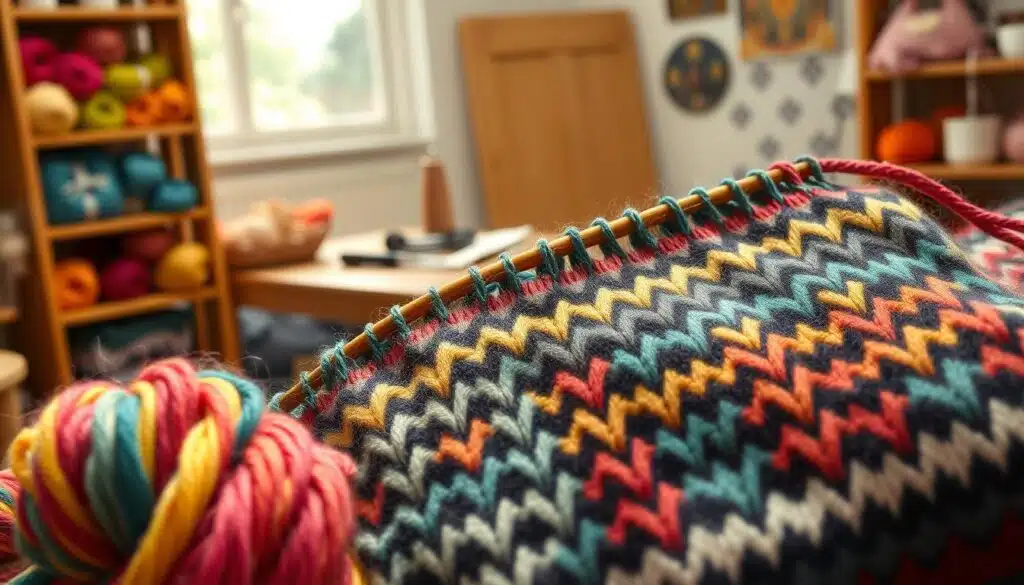
Knitting in the round keeps the pattern smooth, without purl rows to mess with floats. This makes motifs look neat and reduces the need to fuss with the wrong side. To make openings, like cardigan sleeves, knitters use steeking. They add extra stitches, reinforce them, and then cut to create strong openings.
What steeking asks of your materials and skills
Steeking requires wool that stretches well and binds well, plus good finishing skills. It’s great for those who want clean joins and minimal seams. But, if you’re nervous about cutting live fabric, flat methods are safer.
Mosaic’s natural home: flat work and easier shaping
Mosaic flat knitting works well because patterns are built by slipping stitches and using one color at a time. This makes shaping easier when working back and forth. Many choose mosaic for its simplicity in managing floats and shaping.
How to adapt mosaic to round knitting
To turn mosaic into round knitting, pair rows into rounds. Knit two rounds of the same color and follow the slip-stitch pattern around the circle. Swatching is key to adjust for gauge and motif alignment before starting a full garment.
Converting between Fair Isle and mosaic
You can sometimes change stranded motifs into mosaic patterns if they’re geometric and have short floats. But, other times, it might not work because of the color gradations and long floats in Fair Isle. Always plan for differences in drape, gauge, and motif size when adapting or converting.
Quick practical checklist
- Choose knit in the round Fair Isle for continuous colorwork and a steeked opening.
- Pick mosaic flat knitting for easier shaping and single-color-at-a-time comfort.
- Swatch before adapting mosaic to round or converting between techniques to check gauge and motif size.
- Use wool that blocks well if you plan to steek; reinforce steeks with stitching or crochet.
Design possibilities and limitations of each technique
You can explore colorwork in two unique ways. Fair Isle offers layered bands, subtle shading, and rich colors. Mosaic, on the other hand, provides clean, bold geometry and a simple two-color rhythm.
Fair Isle’s palette and motif complexity
Fair Isle is perfect for detailed pictures or soft color blends. You can use more than one color at a time. This lets you create gradients, curved shapes, and overlapping motifs.
Even though there are rules about colors in each row, they spark creativity. You can make detailed bands, layered repeats, and rich textures. These are common in island sweaters and boutique designs.
Mosaic’s strength in geometric repeats and two-color motifs
Mosaic is all about simplicity. You only need one color per row and use slip stitches for patterns. This makes the fabric look like crisp architecture.
It’s great for bold repeats and clear graphics. If you like blocky diamonds, staggered crosses, or repeating tiles, mosaic is easy to use. It also reduces tension headaches.
Where one technique can replicate the other and where it can’t
You can turn mosaic into Fair Isle by using stranded colorwork. This method removes mosaic’s limitations. It lets you add colors, smooth curves, or longer motifs.
But, you can’t always turn Fair Isle into mosaic. Shading, long floats, or organic shapes that need multiple colors in a row are hard for mosaic. This is because of its slipped-stitch rules.
| Feature | Fair Isle | Mosaic |
|---|---|---|
| Color per row | Multiple (traditionally up to two visible at a time) | One active, one slipped |
| Motif shapes | Organic curves and layered motifs, high Fair Isle motifs complexity | Geometric, tile-like repeats; limited fluid shapes |
| Ease for beginners | Requires managing strands and tension | Lower entry barrier; clear slipped-stitch logic |
| Adaptability | Can mimic mosaic; can also do far more detailed colorwork | Some stranded patterns can be made, but mosaic limitations restrict shading and long floats |
| Best use case | Traditional garments, pictorial detail, subtle blends | Graphic sweaters, quick two-color projects, bold repeats |
Designers choose mosaic for its simplicity and graphic impact. Fair Isle is better for detailed pictures, color blending, or that classic island sweater look. Knowing which method to use saves time and keeps your tension steady.
Workflow and ergonomics: how they feel to knit
When you start a project, you’ll feel it right away. Knitting Fair Isle focuses on hand coordination and managing yarn. You’ll learn to handle multiple strands and manage floats.
Mosaic knitting is simpler. You work with one strand for two rows, then switch. This makes it easier on your hands and less cluttered.
Managing multiple strands and avoid tangles stranded knitting
For Fair Isle, plan how to hold your yarns. Twist them often to avoid tangles. Use guides or bobbins to keep things tidy. Short sessions help improve your tension.
Single-strand rhythm of mosaic and why it’s relaxing
Mosaic keeps only one yarn active. This makes it less snags and calming. It’s great for unwinding after a busy day.
Which technique is faster for similar motifs
Speed depends on your style. Mosaic might be faster because you only work with one yarn. But, Fair Isle can be quick once you get the hang of it.
Consider what you value most. If you prefer simplicity, mosaic might be better. For a challenge and the Fair Isle look, Fair Isle is worth the effort.
When to choose mosaic knitting vs fair isle for your project
Looking for a clear guide to pick the right colorwork? Here are simple choices based on ease, fabric goals, and looks. Match each point to your project’s vibe.
Choosing mosaic for ease
Go for mosaic if you want easy yarn handling and less worry about tension. It uses one strand at a time, so tangles are rare. It’s perfect for flat pieces, geometric patterns, and quick knitting.
Choosing Fair Isle for complexity
Opt for Fair Isle for designs needing many colors, subtle blends, or organic shapes. It creates a denser, warmer fabric great for sweaters and projects needing steeking. Ideal for curves and traditional Shetland-style patterns.
Hybrid colorwork methods
Try hybrid methods when you want a mix of both techniques. Use mosaic bands in a stranded garment to cut down on floats. Add small stranded motifs where mosaic can’t blend colors. Swatch both to check gauge and texture before starting.
Practical decision factors
- Yarn: choose wool that steeks for stranded work and smoother yarns for slipped stitches.
- Finishing: think about steeking, blocking, and seam choices up front.
- Skill comfort: if you hate juggling yarn, pick mosaic; if you love color juggling, pick Fair Isle.
- Aesthetic: pick geometric clarity for mosaic, organic richness for Fair Isle.
| Project Need | Best Option | Why |
|---|---|---|
| Easy, fast knitting with minimal tangles | mosaic knitting | One strand at a time reduces tangling and speeds work |
| Complex motif or color blending | Fair Isle | Stranded colorwork supports multiple hues and smooth transitions |
| Flat pieces or simple shaping | mosaic knitting | Slip-stitch logic adapts well to flat construction |
| Round garments needing warmth and steeks | Fair Isle | Dense fabric and traditional steeking make finishing easier |
| Mix of geometric bands and textured panels | hybrid colorwork methods | Combine techniques to exploit strengths of each approach |
Common mistakes, troubleshooting, and finishing tips
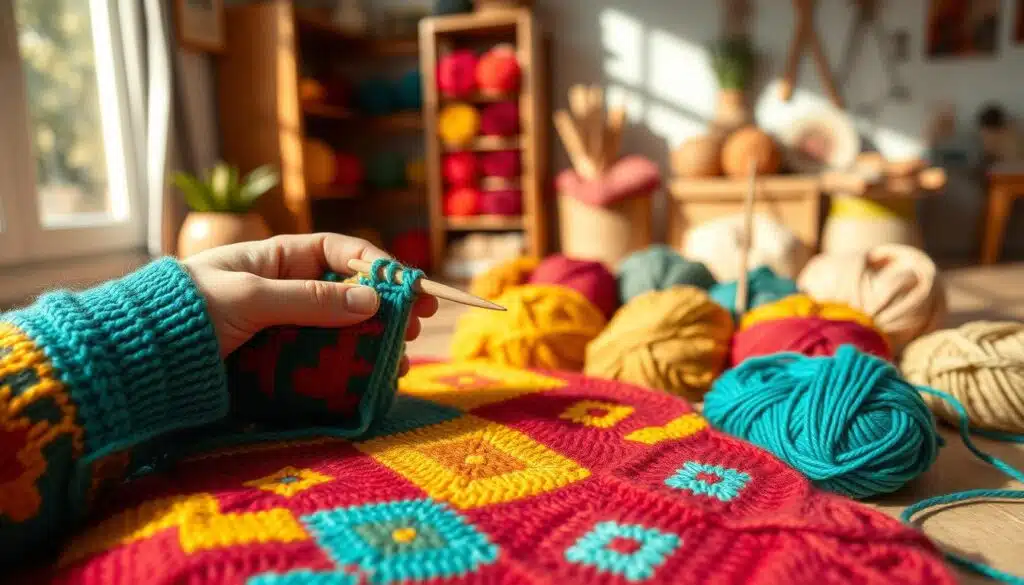
Small mistakes in colorwork can be fixed. Start by swatching in the same way you plan to knit. Take photos of both sides of the swatch to check floats and stitches. This helps you spot problems early and decide how to fix them.
Fix Fair Isle floats by checking their length as you go. Keep them short, about three to five stitches. Catch the yarn on the wrong side to avoid long tunnels. If a float feels too tight or loose, unpick and reknit with the right tension.
Use bobbins or yarn guides to manage multiple strands. The mosaic method works with one strand at a time, reducing tangles. Learn more about mosaic knitting basics at mosaic knitting basics.
For mosaic fixes, make sure you’re slipping stitches correctly. If stitches look too long, try different needles and block the swatch. Some elongation can be a design choice, or you can adjust the needles.
Blocking colorwork makes it even and opens up motifs. Use pins and steam or wet-block, depending on your yarn. Mosaic needs careful shaping for crisp stitches. Fair Isle can be stretched gently to smooth out floats.
Steeking tips are key for openings. Reinforce edges before cutting with strong thread or crochet. Woolly yarns like Shetland or Jamieson & Smith work well. Finish raw edges with mattress stitch or zigzag for stability.
For seams after steeking, use mattress stitch for a hidden join. If you can, knit in the round to avoid seams. When seaming, pin carefully and seam on the wrong side to keep the pattern right.
Keep a checklist for troubleshooting: swatch, photograph, use tools, test needles and blocking, and practice steeking. These steps help you fix Fair Isle floats, mosaic stitches, steeking, or blocking for a great finish.
Conclusion
When deciding between mosaic knitting and Fair Isle, think about what you like most. Mosaic is great for beginners who want bold colors without the hassle. It’s easy to use and perfect for flat pieces or those who prefer working with one strand at a time.
Fair Isle is ideal for those who love traditional island sweaters. It offers complex motifs and multi-color work in one row. This method creates denser, warmer fabric and allows for shaping in the round.
For a quick guide, swatch both techniques with your chosen yarn. Consider whether you prefer flat or in-the-round construction. Choose the method that suits your skill level, style, and finishing goals.
If you’re drawn to color but hate dealing with tangles, mosaic is for you. For traditional motifs and the challenge of steeking, Fair Isle is the way to go. You might find it incredibly rewarding to see your sweater come together.
FAQ
What’s the visual difference between mosaic knitting and Fair Isle?
Mosaic knitting gives you sharp, geometric patterns. It’s like creating strong graphic designs with slipped stitches. On the other hand, Fair Isle knitting offers more fluid patterns and richer colors. It’s perfect for creating organic shapes and subtle shading.
How does mosaic knitting actually work compared to stranded (Fair Isle) colorwork?
Mosaic knitting uses a slip-stitch system. You work with one color at a time for two rows. This creates contrast by slipping stitches with precise yarn placement. Fair Isle, on the other hand, carries two or more yarns across a row. This creates floats on the wrong side.
Which projects are better suited to mosaic and which to Fair Isle?
Mosaic is great for flat accessories and graphic designs. It’s also good for beginners. Fair Isle is better for traditional island jumpers and garments that need complex motifs.
Where did Fair Isle originate and why does that matter?
Fair Isle comes from the Shetland Islands. It grew in the 19th century with brighter dyes. The island’s economy and constraints shaped its classic motifs and limited palettes.
What traditional rules govern Fair Isle colorwork?
Traditional Fair Isle limits colors to two per row. It’s worked in the round to avoid purl rows. Floats are managed carefully to keep the fabric neat.
Why did Fair Isle become a fashion staple?
Royal attention and fashion houses like Chanel and Ralph Lauren made Fair Isle popular. Its colorful motifs fit well in high fashion and everyday wear.
How did mosaic knitting become popular?
Barbara Walker popularized mosaic knitting in the 1970s. She made complex patterns accessible with simple strategies.
What are the slip-stitch fundamentals and the two-row logic behind mosaic?
You slip stitches purlwise while working one color for two rows. Yarn placement is key. Each chart row equals two knitted rows, creating crisp patterns.
Is mosaic truly beginner-friendly?
Yes. It’s easy because you handle one strand at a time. You only need to know knit, purl, and slipping stitches.
How do you read a mosaic chart versus a Fair Isle chart?
Mosaic charts use two-row logic. Read them bottom-up. Fair Isle charts are also read bottom-up but worked in the round.
What tension problems should I expect with Fair Isle?
Stranded knitting can cause uneven tension. Manage floats carefully to avoid puckering. Swatching and blocking are key.
Do slipped stitches in mosaic look different or elongated?
Slipped stitches can look elongated. This depends on construction and yarn choice. Swatching and blocking can help.
Which technique makes a warmer, thicker fabric?
Fair Isle creates a denser fabric. It’s perfect for island sweaters. Mosaic is lighter but can be made warmer with the right yarn and blocking.
What yarns and colors work best for Fair Isle?
Use Shetland-style wools for traditional Fair Isle. Choose contrasting colors for clear motifs. Limit active colors per row.
What yarns and needles are best for mosaic?
Choose yarns with clear stitch definition. Use the needle size suggested by your gauge swatch. Swatching and blocking are important.
How should I swatch for accurate gauge in these techniques?
Swatch in the exact technique and construction. For Fair Isle, swatch in the round and block before measuring. For mosaic, swatch the two-row repeat.
Why is Fair Isle usually knit in the round and what’s steeking?
Knitting in the round avoids purl rows. Steeking is a method to create openings. It involves adding reinforcement stitches and cutting them.
Can mosaic be knit in the round or is it only for flat knitting?
Mosaic adapts well to flat knitting. You can convert it to circular knitting by working two identical rounds per chart row.
Can I convert a Fair Isle pattern to mosaic or vice versa?
Sometimes. Stranded knitting can replicate many mosaic looks. But mosaic can’t reproduce long floats or complex multi-color rows.
What design strengths does Fair Isle offer that mosaic cannot?
Fair Isle allows multiple motifs and richer color mixing. It’s ideal for layered bands and pictorial motifs.
Where does mosaic truly shine?
Mosaic excels at bold, graphic, two-color motifs. It’s perfect for stitch patterns that favor sharp contrast.
How do you manage yarns and avoid tangles in Fair Isle?
Use small bobbins and yarn guides. Twist yarns occasionally to avoid long tangles. Keep floats short and catch them regularly.
Why do knitters find mosaic more relaxing to work?
Mosaic is relaxing because you handle one strand at a time. It follows a predictable two-row rhythm. Fewer active yarns mean fewer tangles.
Which technique is faster for similar motifs?
It depends on your comfort. Mosaic can be faster because you avoid managing multiple strands. But experienced stranded knitters can be quick too.
When should I choose mosaic over Fair Isle for a project?
Choose mosaic for easier yarn management and geometric graphics. It’s ideal for flat pieces and beginners.
When is Fair Isle the better choice?
Choose Fair Isle for complex motifs and multiple colors. It’s perfect for traditional island sweaters and garments that need curved shaping.
Can you combine mosaic and Fair Isle in one garment?
Yes. Hybrid approaches are popular. Use mosaic bands in stranded garments or add small stranded motifs where mosaic can’t achieve the desired effect.
What are common mistakes and how do I troubleshoot them?
For Fair Isle, common issues are tight or loose floats. Fix by catching floats and adjusting tension. For mosaic, elongated stitches can be fixed by swatching and adjusting needle size.
How important is blocking and finishing for these techniques?
Very. Blocking evens tension and opens slipped-stitch patterns. Mosaic may need precise blocking to flatten stitches. For Fair Isle, blocking sets steeks and seams for clean finishing.
What about steeking and seaming best practices?
Reinforce steek edges before cutting. Use wooly yarns that bind when blocked. Secure edges and seam with mattress stitch or pick up stitches for clean joins.
What final advice helps you choose between mosaic and Fair Isle?
Swatch both techniques in your chosen yarn and construction. Consider the garment’s needs and your comfort with steeking or juggling strands. If you love color but hate tangles, start with mosaic. If you crave traditional motifs, color blending, and don’t mind managing yarns, dive into Fair Isle.