
Ever felt that sinking feeling when you drop a stitch? Frogging is a part of knitting, and it will happen to you. This guide will teach you how to undo stitches the right way. This way, your project stays intact, and you keep your sanity.
A stitch has two legs: left and right. For an untwisted stitch, the right leg should be in front. If it’s behind, the fabric tightens. Just pull the stitch off, rotate it, and put it back so the right leg is in front.
Before ripping your work, learn tinking. It’s like knit spelled backwards and helps undo rows safely. Tinking is great for fixing current rows and is easier on your work than frogging. Practice on swatches so you can use these lessons confidently.
I once had to unravel an entire sweater. But I learned to see mistakes as experiments. Frogging can be calming if you slow down and reuse the yarn. With these tutorials, you’ll learn to knit more efficiently.
Key Takeaways
- Frogging is common; use proper technique to protect stitches.
- Untwisted stitches show the right leg in front on the needle.
- Tinking undoes recent rows safely and should be in your toolkit.
- Practice on swatches to build confidence with knitting lessons.
- Reframe frogging as a restorative step and reuse yarn after unravelling.
Why You’ll Love Learning Knitting: confidence, creativity, and fewer frogging meltdowns
When you pick up needles, you get more than just a scarf. Knitting helps your hands stay steady and your mind calm. It’s a creative outlet that you can take anywhere.
Learning to fix small mistakes on swatches changes your mindset. You start to see errors as chances to learn, not as failures. Every small success adds up to big progress.
Making mistakes is part of knitting. You might drop a stitch or count rows wrong. But knowing how to fix these mistakes makes them less scary.
Learning to fix mistakes boosts your confidence. Every stitch you save teaches you something new. It shows you can handle even harder challenges.
Try MedKNITation when you make a mistake. It’s a way to focus on your breathing while you fix your work. This turns frustration into calm focus.
Being creative with knitting grows when you trust your repair skills. Once you can undo and redo, you start to play with different patterns and colors. Your projects become fun experiments, not stressful tasks.
Having a resilient mindset changes how you see knitting. Mistakes are no longer failures but chances to learn. This, along with practicing how to unravel, is a big benefit of knitting.
| Issue | Quick Fix | How it helps your knitting mindset |
|---|---|---|
| Twisted stitch | Drop to the stitch and reorient loop | Teaches calm, precise moves so you fear mistakes less |
| Single row error | Tink backwards stitch by stitch | Builds confidence building and muscle memory |
| Multiple bad rows | Ladder down to a lifeline or frog to the last marker | Encourages strategic problem solving and resilience |
| Frogging panic | Practice MedKNITation breathing while you unravel | Transforms stress into reflective creativity through knitting |
Understanding stitch anatomy and avoiding twisted stitches
Before you start fixing loops, learn the basics of a stitch. A stitch has two legs: the right and left. An untwisted stitch has the right leg in front. A twisted stitch has the left leg in front.
What a stitch actually looks like
Examine the loop and needle closely. You’ll see two legs. One leg faces you, the other away. This tells you if the stitch is right or twisted.
How twisted stitches affect tension and appearance
Twisted stitches can make your fabric tight and uneven. A single twisted stitch can cause a snag. Many twisted stitches can ruin the look of ribbing and cables.
Easy fixes for twisted stitches
To fix a twisted stitch, use the right needle to lift and re-place the loop. You can also knit it through the back loop. Always insert the needle correctly to avoid more twists.
| Problem | Quick fix | When to use |
|---|---|---|
| Single twisted stitch | Lift off with right needle, re-place with right leg front | Picking up after frogging or spotting a twist mid-row |
| Multiple tightened stitches | Knit through back loop or drop and re-pick ensuring leg orientation | When stitch tension changes are visible across fabric |
| Twists from tinking | Insert needle front-to-back, or use right needle to reposition | Undoing stitches one at a time or correcting rescued stitches |
| Rescued stitches after repeated frogging | Inspect each loop, correct stitch legs before resuming | Projects with lace, cables, or uneven gauge |
Knitting Stitch Tutorials
You’re ready to move from swatching to confident stitching. Start with the basics and build toward lace and garment work without the drama. Short practice sessions help you master stitch orientation so increases and decreases sit where they should.
Beginner stitches every knitter needs
Learn knit and purl first. A clear knit and purl tutorial speeds progress and keeps tension even. Practice on small swatches, then add a lifeline so you can experiment without fear. Video demos from teachers like VeryPink Knits make the moves visual and repeatable.
Once you can switch between knit and purl, try simple 2-row repeats: garter, stockinette, and 1×1 rib. Those patterns build the muscle memory you’ll use in more complex repeats. You can consult a curated list of patterns for practice at studioknitsf.
Essential increases and decreases
Master a small toolkit: kfb, make-one (M1), k2tog, and ssk. These four moves cover most shaping instructions. Work them slowly with bamboo needles to slow your hands if needed.
Practice each increase and decrease into a swatch, then undo and redo the last few rows. Tinking each basic stitch after you learn it helps you understand anatomy and fixes mistakes without starting over. That habit saves time once you tackle sleeves or waist shaping.
Working with yarn overs and lace basics
Yarn over is the heart of lace. Learn the yarn over placement and how paired decreases balance the holes. Start with a simple eyelet row so you see the effect immediately.
Lace knitting basics demand precise tension and good stitch placement. Use lifelines on lace swatches and follow step-by-step video demonstrations from trusted sources like Annie’s Crafts when you try more elaborate patterns. Early mastery of yarn overs and matching decreases prevents the need to frog large lace sections later.
- Tip: Keep a scrap needle handy to rescue live stitches when experimenting.
- Tip: Break complex rows into two passes: make yarn overs, then place decreases.
- Tip: Practice increases and decreases in mirrored pairs to maintain symmetry.
How to safely unravel: when to frog, ladder down, or tink
Every undo has a right time and a wrong time. Choosing between frogging, ladder down knitting, and tinking can save you hours and stress. Think of each method as a tool in your kit. Using the wrong tool can create more work.
Deciding which method to use
Ask three quick questions: how far is the mistake from your needle, does the pattern include lace or cables, and did you place a lifeline? If the error is in the current row or one row below, learn how to tink. Tinking preserves structure and is gentler on complex patterns.
If the mistake sits many rows back and the fabric is scrambled, you should consider when to frog. Frogging is best for big, irreparable pattern issues. It resets your work so you can restart cleanly.
Use ladder down knitting when a single column of stitches needs opening or when you want to return a defined run to live stitches. Laddering down gives you control over a narrow area without unpicking the whole piece.
Emotional survival tips for frogging
Unraveling hurts. Treat it like practice, not failure. Accept that frogging tips include small rituals: make tea, set a timer for short sessions, and wind the yarn as you pull. These moves keep anger low and your yarn tidy.
Try MedKNITation: breathe slowly while you frog. Count stitches as you go. That focus turns frustration into a steady, meditative rhythm. You will find the work less punishing and more purposeful.
Keep a mental file of frogging tips. Note what went wrong and what fixed it. When you need to ladder down knitting or to know when to frog next time, your notes will stop you from repeating the same sorrow.
Method for unravelling a few stitches (quick, surgical fixes)
When a small mistake stops your flow, you want a neat, fast way to fix it. The “stab, drop, pull” approach is perfect for a handful of stitches. It keeps stitch orientation intact, saves time, and avoids the drama of a full frog.
Step-by-step: stab, drop, pull
Insert the left needle into the stitch directly below the one you need to undo. This is the “stab” that targets the offending loop.
Let the stitch on the right needle fall free so it drops down onto the left needle. That single drop unlocks the row you want to correct.
Pull the working yarn gently to release one stitch at a time. The motion should be controlled so you can pick up dropped stitch loops in order and preserve tension. This is one of the best quick knitting fixes for small errors.
When to choose this method
Use this technique when the problem is localized to a few stitches and the rest of your row is sound. It beats frogging when you want to stay calm and keep progress.
If the mistake is only one stitch deep, consider tinking instead to undo stitch-by-stitch while the working yarn stays engaged. Practice on swatches to build confidence with both tactics and to learn when surgical unravelling is the faster route.
Common but clumsy method for unravelling rows and how to rescue stitches
You know the scene: you yank the needle out, shout “rip it rip it,” and hope for the best. That frogging technique looks heroic when deadlines loom, but loose loops and tangled legs wait on the other side. Use this method with caution and a plan.
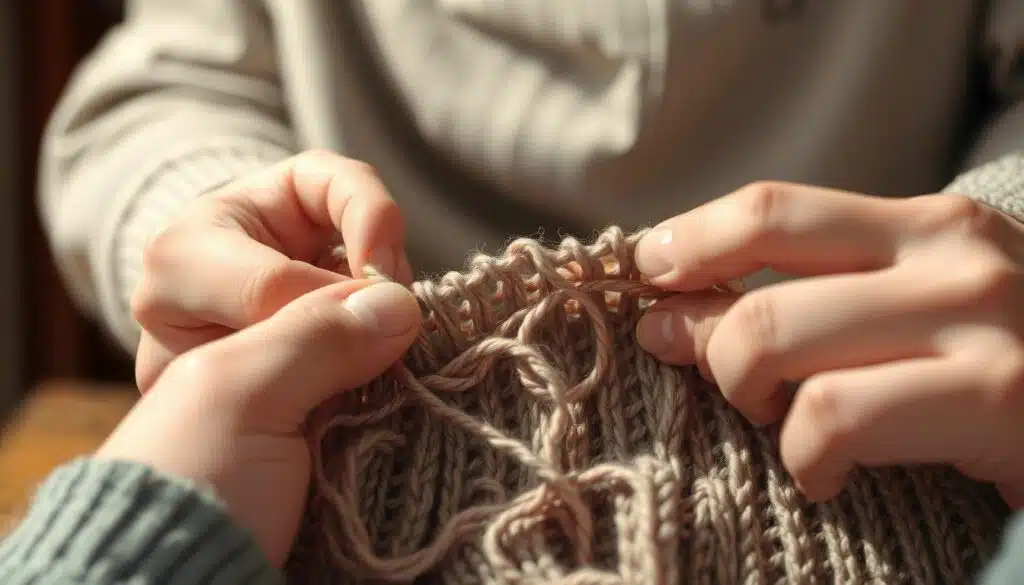
After a frantic rip, your job shifts from speed to care. Loose stitches must be gathered onto a rescue needle so they don’t tumble down the piece. As you corral stitches, expect mixed orientations and odd twists.
The “yank the needle and rip” technique explained
The basic move is simple: remove the working needle and pull the yarn to drop rows quickly. For some projects, it’s faster than painstaking laddering. For many projects, it creates work later.
Why it causes trouble: stitches land on the needle with their right or left leg forward at random. That creates tension and pattern mistakes once you resume knitting. If you rely on this frogging technique often, you’ll spend extra time untwisting and recounting.
How to corral and check rescued stitches
First, have rescue needles ready. Slip each loose loop onto a spare needle immediately to corral stitches. Work deliberately, one stitch at a time.
Next, transfer stitches to a second needle in sequence. As you move each stitch, check which leg faces front. If the wrong leg sits forward, use a point to untwist stitches so the right leg faces you before knitting.
- Count stitches as you go to catch any that dropped.
- Use a lifeline or scrap yarn later to avoid repeating the drama.
- Take breaks if your hands tense up; haste makes extra work.
Relying on a rip it rip it approach can save minutes now and cost hours later. When you do choose it, keep rescue needles close, corral stitches immediately, and untwist stitches after frogging before you start knitting again.
Preferred method for unravelling rows safely and precisely
Imagine a way to unravel rows that keeps stitches on needles. This method stops loose loops and prevents chasing after stitches. You can choose where to stop and keep the tension even, avoiding the stress of dropped stitches.
Why this method is faster and safer
This method is quick because you untwist stitch legs before moving them. Keeping stitches on needles lets you slice back rows in a controlled way. This makes precise frogging possible, stopping exactly at the problem row without redoing the whole piece.
Having stitches on needles gives you a clear visual cue. You can check stitch orientation as you work. This saves time and avoids the extra work of fixing twisted or missing loops.
Tools and visual aids to help
Use a lifeline knitting thread to mark the last good row. Lifeline knitting gives you a safety net that makes migration safer. Add stitch markers to map problem areas. If a stitch slips, a rescue needle method is the easiest way to hold and reinsert the loop.
Bright lighting and a contrasting background let you see stitch legs clearly. Watch video tutorials from creators like VeryPink Knits or JenACKNitwear for angle and hand placement tips. Record a short clip of your own process to spot small mistakes and refine your motion.
Plan your stopping point before you start. Lay out rescue needles and a lifeline in advance. This small prep turns a stressful rip-back into a tidy, precise operation that keeps your work intact.
| Step | Why it helps | Recommended tool |
|---|---|---|
| Insert lifeline one pattern repeat below error | Creates a fixed anchor so stitches cannot fall past a safe row | Lifeline knitting thread or thin tapestry needle |
| Move problem stitches onto spare needle | Keeps loops secure and visible while you work back | Rescue needle method using a short circular or double-pointed needle |
| Untwist stitch legs before unravelling | Prevents twisted stitches and maintains gauge | Good lighting and contrasting background |
| Unravel row-by-row while keeping stitches on needles | Gives you precise control and a clear stopping point | Spare needles plus stitch markers |
| Consult video tutorials for tricky sections | Shows hand positions and timing that photos miss | Short instructional clips from trusted channels |
Tinking: knitting backwards to undo stitches without losing structure
Tinking is a slow but satisfying way to fix knitting mistakes. It keeps the stitch orientation and saves time later. This section is a quick guide on when and how to tink knit and purl stitches, including cables and lace.
Use tinking when mistakes are recent and stitch orientation matters. It helps avoid big mistakes, keeps increases and decreases, and maintains pattern flow. If you don’t want to rip out rows, learn to tink instead.
When tinking is the best option
Choose tinking for recent mistakes where stitch anatomy is important. It’s best for twisted stitches, lace motifs, or cable crossings. This method requires patience and a steady hand.
How to tink knit and purl stitches
To tink, insert the left needle tip into the loop below the active stitch from front to back. Keep the working yarn tight to open the loop. Pull the needle back to undo one stitch at a time, then reknit or repurl correctly.
For knit stitches, insert front-to-back into the loop below, hold yarn taut, and pull. For purl stitches, bring the yarn to the front first, then insert front-to-back and yank gently. Videos by Knit Purl Hunter, VeryPink Knits, and JenACKNitwear show this clearly if you prefer visual practice.
Advanced tinking for cables and lace
Tinking cables is less scary than it looks. Drop all cable stitches from the right needle, unravel to the turn, and pick them up with the left needle at once. This keeps crossings intact and reduces rethreading fiddles.
Tinking lace or complex decreases takes planning. Use locking stitch markers to tag important yarn overs and lifelines where possible. Work on swatches so you learn each decrease type, then apply tinking to preserve the motif.
Tools and small habits that prevent mistakes
Keep your knitting kit simple and smart to avoid repairs. A few reliable tools can turn frantic moments into calm ones. These items act like first aid, saving your project, time, and helping you learn.
Essential kit that saves your work
Begin with a lifeline in your knitting. Run a scrap thread through live stitches before trying tricky parts. If you need to rip back, the lifeline keeps your row safe, preventing twisted stitches.
Use locking stitch markers and progress keepers to spot repeats and mistakes. Place markers at pattern breaks and use them as visual guides when tinkering. Rescue needles, like blunt tapestry needles or small cable needles, catch stray stitches quickly, preventing loose loops or dropped columns.
Small habit tweaks that cut errors
Slow down on complex patterns. This allows your eyes to catch any mistakes, like a missed yarn over or slipped stitch. Make it a habit to check your work every few inches to avoid big mistakes.
Choose needles that match your yarn and the moment. Bamboo and wooden needles are great for slippery yarns like silk and lace. Metal needles work well with wool. Swatching first helps you pick the right needle and avoid tension issues later.
Rituals and practical steps to avoid mistakes
When you must frogging, wind yarn neatly and keep your rescue needles ready. Use stitch markers to mark the stitch before you tink back. For tips on common mistakes and fixes, check out common knitting mistakes.
Work on more than one project at a time. Match the project’s complexity to your energy level to avoid distractions. Add a mindful pause—breathe, name the row, check markers—and you’ll avoid mistakes reliably.
Project rescue case studies and real knitter stories
Ever felt that sinking feeling when your sleeve doesn’t match or your lace unravels? This section shares short stories of how knitters turned setbacks into successes. You’ll pick up useful tips for the next time your project goes awry.
The Endless Summer sweater started as a cozy cotton pullover with a flattering pattern. But, after following the gauge and seaming carefully, the fit was off. Sleeves were wrong and the body pulled tight.
After repeated sweater frogging and patient rework, the knitter saw each undo as a lesson. They made changes to ease, swapped needles, and tried new seaming techniques. This fixed the fit issues without wasting yarn. This story shows how important perseverance and careful notes are.
The Endless Summer sweater and lessons learned
This example teaches us a few key lessons. Double-check measurements before cutting, try on as you go, and mark where ease will sit. When frogging, wind yarn into neat cakes to avoid tangles.
Adding lifelines on the second attempt saved time and nerves when another tweak became necessary. These small rituals can prevent big losses.
How a single tink saved a lace shawl
In a delicate lace project, a stitch slipped two rows back. Instead of ripping, the knitter tinking back stitch by stitch. This saved the project’s structure and fine pattern.
This tale shows how precise undoing can preserve cables and lace. From these stories, you learn small rituals that prevent big losses. Use lifelines for lace, slow down through tricky charts, and keep a rescue needle nearby.
When you treat mistakes as experiments, your knitting skills grow faster than your yarn stash.
Here are quick takeaways as a compact project case study checklist:
- Try on garments early to avoid repeated sweater frogging.
- Place a lifeline before complex sections to reduce panic.
- Tink when the error is recent to protect lace and cables.
- Wind yarn as you frog so tangles don’t waste time.
- Take notes; knitting lessons learned become future wins.
Conclusion
Unraveling is not a disaster; it’s a chance to learn. Use the right method to fix mistakes and keep your work neat. Tinking is key: practice it on swatches to undo any stitch easily.
Good habits reduce mistakes. Use lifelines, stitch markers, and slow down when tension changes. Also, check out knitlikegranny for helpful tips and tricks.
Being emotionally strong is as important as knowing how to knit. See frogging as a way to improve, not a setback. For extra help, watch videos from VeryPink Knits or Knit Purl Hunter. With the right mindset, you’ll get better at knitting and enjoy it more.
FAQ
What is a stitch and why does stitch anatomy matter?
A stitch is a loop with two legs — a right leg and a left leg. When knit normally, the right leg sits in front. This makes the stitch untwisted. After unraveling, legs can face any direction.
Knowing this helps you put stitches back on the needle correctly. It prevents twisted stitches that can tighten your gauge and look odd.
How can twisted stitches affect my project?
Twisted stitches can tighten tension and change how your fabric drapes. They can also create bumps in stockinette and lace. Plus, they make patterns repeat oddly.
If you spot them, fix them before you knit more. Leaving them in will make the problem worse across rows.
What’s the easiest way to fix a twisted stitch?
To fix a twisted stitch, slip it off the needle. Turn it so the right leg is in front. Then, put it back on the needle.
Or, you can knit the stitch through the back loop to untwist it. But turning and reseating it is the cleanest fix.
What are the main methods for unravelling knitting?
There are three main methods. Quick fixes for a few stitches, tinking for errors in the current or one-row-below, and frogging/ripping for larger problems.
Choose the method that preserves stitch orientation and minimizes extra work.
When should I choose tinking over frogging?
Use tinking when the mistake is in the current row or one row down. Or when you’re in lace/cable work without a lifeline.
Tinking preserves structure and is less risky than frogging long stretches. It’s also ideal for undoing a stitch or two without letting stitches go loose.
How do I tink knit and purl stitches correctly?
For knit stitches, insert the left needle tip front-to-back into the loop below the active stitch. Hold the working yarn taut and pull back to undo one stitch at a time.
For purl stitches, bring the yarn to the front and insert front-to-back into the loop below. Keep the yarn taut so the loop opens for needle insertion.
Can I tink complicated things like cables and lace?
Yes. For cables, you may drop cable stitches off the needle, unravel, and pick them up with the left needle at once. For lace and complex decreases, use lifelines and locking stitch markers where possible.
Practice on swatches to build confidence before tackling a project.
What’s the quick “stab, drop, pull” method for a few stitches?
For a small localized fix, stab the left needle into the stitch directly below the stitch to be undone. Drop the stitch from the right needle, then pull the working yarn to unravel one stitch.
This preserves stitch orientation and is faster than larger frogging.
When is the stab/drop/pull method the right choice?
Choose it for single-stitch errors or very small corrections in the current row. It’s fast, surgical, and less emotionally draining than ripping an entire section out.
What happens when you use the “yank the needle off and rip” method?
That method unravels rows quickly but leaves stitches loose and mixed-up. You’ll need rescue needles to corral stitches, then transfer them back carefully while untwisting each one.
It’s quick in the short term but creates more tedious work later if you don’t manage rescued stitches carefully.
How do I corral and check rescued stitches after ripping?
Use rescue needles to slide loose stitches onto. Transfer them one at a time to a working needle, inspecting each stitch so the right leg faces front.
Count stitches as you go and check twist and orientation under good light and on a contrasting background.
What is the preferred method for unravelling rows safely and why?
The preferred method keeps stitches on needles so they never hang loose. It’s safe because stitches remain secured, precise because you can decide exactly where to stop, and faster overall because you avoid untwisting a mess of rescued loops later.
What tools make unravelling easier and safer?
Lifelines, locking stitch markers, rescue needles, and good lighting make everything easier. A contrasting background and a short video of your hands can help you spot twisted legs.
Bamboo or grippier needles slow your hands for delicate sections.
How should I use lifelines and stitch markers when working lace or complex patterns?
Run a lifeline through a row you’re confident in before tackling lace or long repeats. Use locking stitch markers to mark repeats and to identify problem columns.
These tools let you rip back to a known-good row without losing structure and save you hours of rescue work.
What habits reduce mistakes and frogging meltdowns?
Slow down on tricky sections, pick the right needles (bamboo for control), avoid knitting when exhausted or distracted, and practice new stitches on swatches.
Keep multiple projects so you can match complexity to your current focus level.
Any emotional survival tips for when you must frog a big project?
Reframe frogging as learning. Try “MedKNITation”: breathe, wind the yarn as you frog, and use the process as a calming ritual.
Take breaks, name the lesson you’ll carry forward, and remember that pulled-apart yarn is reusable and often leads to a better outcome next time.
Are there quick visual resources to learn tinking and untwisting?
Yes. Video tutorials from VeryPink Knits, Knit Purl Hunter, Sheep and Stitch, and JenACKNitwear show step-by-step tinking and stitch-rescue techniques. Watch in good light, slow the playback, and practice the moves on swatches.
How did the Endless Summer sweater teach knitters about frogging?
The sweater’s repeated frogging showed that small misreads or fit issues can cascade into repeated undoing. The takeaways: use lifelines, slow down on critical sections, wind yarn while frogging, and treat mistakes as experience.
Can practicing on swatches really help me avoid big mistakes?
Absolutely. Swatches let you practice stitches and tinking so you can confidently undo them later. They accelerate learning, reduce panic when errors happen, and help you test needle and yarn choices before committing to a project.
What are some small rituals to make unravelling less painful?
Keep a tidy workspace, use a lifeline on tricky parts, wind yarn neatly as you frog, listen to calming music or a podcast, and treat the process as meditative.
These rituals reduce frustration and help you return to knitting with clearer focus.
Which keywords should I search to find tutorials and rescue techniques?
Search for tinking, frogging, laddering down, lifelines for lace, rescue needles, fixing twisted stitches, VeryPink Knits, Knit Purl Hunter, Sheep and Stitch, and JenACKNitwear for clear video demos and pattern-specific advice.