
Do you hate that bumpy ridge at the end of a round? It can ruin all your hard work. Invisible seam crochet offers a smooth alternative to the usual slip stitch join. It makes your projects look professional, from hats to amigurumi and seamless colorwork.
The basic invisible join is a “false” stitch that looks like the first stitch. To do it, cut the yarn and pull a short tail through the last stitch. Then, use a hook or yarn needle to draw the tail through the top loops of the first stitch and the horizontal loop behind the last stitch. When you match the tension, the seam will blend in and disappear.
Another way is to thread a 4″ (10 cm) tail under both top loops of the starting stitch with a yarn needle. Then, pass it through the eye of the final stitch to form the false stitch. Both methods give you a seamless join that looks like you never stopped stitching.
For a practical guide on joining squares or finishing edges, check out this helpful guide: joining crochet squares. With practice, invisible seam crochet will give you pro-level edges without bulky joins.
Key Takeaways
- Invisible join removes the bumpy seam at the end of a round for seamless rounds.
- It replaces the slip stitch with a false stitch formed with a hook or yarn needle.
- Cutting a short tail and threading it carefully helps the crochet invisible seam blend in.
- Proper stitch reading is essential to place the false stitch correctly.
- Invisible seam crochet is ideal for amigurumi, hats, and any piece where a clean edge matters.
Why you should care about seamless joins in crochet
You want your crochet to look like it’s from a high-end store, not a quick craft session. A neat finish makes colors stand out, edges look even, and the whole piece seems planned. But, if seams are visible, they draw attention away from your yarn and stitch work.
The visible seam problem: what it is and why it matters
The visible seam problem shows up as a bump or scar where rounds meet. This small issue can be very noticeable on striped beanies or tiny amigurumi. It ruins the smooth texture you worked hard for, and people notice it before they see your color work.
When seams ruin a project: hats, amigurumi, and small rounds
On hats and beanies, the seam is right where people look first. Amigurumi and small rounds have no place to hide. A seam can make eyes and noses look off-center, ruining a cute toy. At craft fairs, buyers choose the piece with the clean edge every time.
Benefits of a clean finish: professional look, easier color changes, and happier customers
A professional finish makes your crochet stand out. Clean joins mean smoother color changes and fewer tails to weave. Selling at craft fairs gets you better feedback and repeat buyers because your pieces look finished and polished. Use invisible join techniques to take your work from homemade to craft fair quality.
What invisible seam crochet actually is
Before you try this on your next hat or amigurumi, get a quick picture of the goal: a round that looks like it never had a join. You stop the visible bump that a slip-stitch leave behind. Then, you replace it with a neat finishing stitch that blends into the fabric.
Defining the technique: the “false” stitch vs slip stitch joins
The invisible join makes a false stitch that mimics a worked stitch instead of a slip-stitch knot. With false stitch crochet, you thread the tail through top loops and the eye of the last stitch. This recreates the shape of the first stitch.
Traditional slip-stitch joins add an extra set of loops at the end of the round. This often creates a raised ridge. The hidden slip stitch method hides a loop by working from the back. It gives faster results but has a slightly different finish.
How the invisible join replaces the first stitch or chain
At the end of the round, you cut the yarn and pull the tail through the first stitch. Then, you bring that tail back through the horizontal loop of the last stitch. This recreates the first stitch’s top and eye, so you don’t need the initial chain or a separate slip-stitch.
You can also follow a hook-based route. This pulls the tail through the first stitch and the back loop of the last stitch. This version skips a needle and creates a finished stitch shape without a visible seam.
Differences between invisible join, hidden slip stitch, and traditional slip stitch
Compare the three: invisible vs slip stitch makes a sewn-looking join that blends in completely when done right. The hidden slip stitch differences lie in approach and speed. The hidden slip stitch is crocheted from the back to hide the loop and works well when you need a quick, low-profile finish.
Traditional slip-stitch joins are the fastest to make, but they tend to leave a bump or gap at the join. If you want a truly seamless round and plan to cut the yarn, use the invisible join. If you prefer to keep working without cutting, try the hidden slip stitch.
For step-by-step visuals and stitch anatomy, you may find a good reference at a crochet stitch guide that walks through common finishes. It shows where the false stitch sits in the fabric.
Tools and materials you’ll need for a seamless finish
Want to make your joins disappear? Get the right tools and you’ll save time and stress. The right crochet tools for invisible join will make neat edges easy, whether you use a yarn needle or just a hook.
Essential tools: hook choices, yarn needles, and scissors
Your regular crochet hook is key. Choose a size that fits the yarn and your stitch pattern for even stitches. Sharp scissors are a must for cutting each round when needed. A yarn needle is vital for sewing false stitches, helping you thread through loops smoothly.
Yarn considerations: fiber, weight, and color changes
Think about the yarn’s fiber for the best finish. Cotton and linen show seams more than acrylic or wool. Test a swatch to see how it looks. Lighter yarns show joins easily, while thicker yarns hide them better. When changing colors, leave a 4″ (10 cm) tail for easier threading.
Optional helpers: stitch markers, magnifiers, and blocking tools
Stitch markers keep your work organized and help find the first and second stitches quickly. A magnifier or lamp is handy for small projects or tight stitches. Use blocking mats and pins to flatten seams for a neat finish. These tools aren’t necessary but make your work look professional.
- Crochet hook size: Match to yarn weight and your preferred gauge.
- Yarn needle: Use for threading tails and creating a sewn false stitch.
- Stitch markers: Mark round starts and tricky spots for easier joins.
- Yarn weight: Test how visible joins are with different weights.
Reading your stitches so the invisible join works
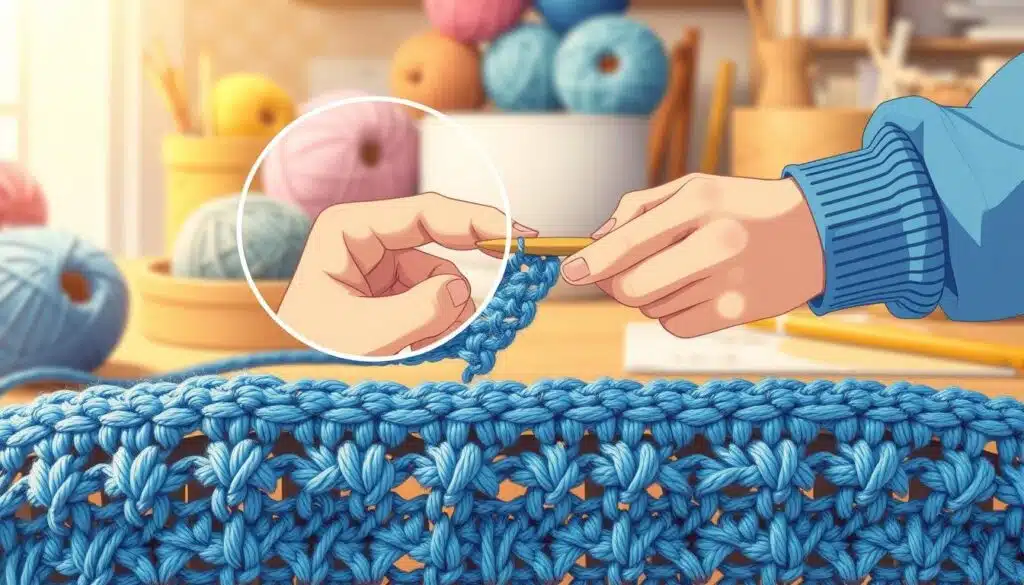
Learning to read stitches is like navigating a map. Knowing the anatomy of crochet stitches helps you spot top loops, the horizontal bar, and the stitch eye. This knowledge makes the invisible join seem like magic.
Stitch anatomy: identifying top loops, horizontal loops, and stitch eyes
Each stitch has two top loops and a horizontal loop behind them. The stitch eye is the small gap between these loops. Spotting the eye lets you pass a needle smoothly for a flat join.
How to find the first and second stitches in rounds
After finishing a round, count carefully. If you started with a chain, find the first stitch after it. If you began with a standing stitch, look for the second stitch. Inserting the tail into the wrong loop can lead to miscounting.
Practice with small swatches and mark the starting stitch with a contrasting scrap. For a visual guide, check the incredible invisible seam photo tutorial at Sweet Bee Crochet. It highlights the key landmarks you need to spot.
Troubleshooting common misreads that create extra stitches or gaps
One common mistake is inserting into the first single crochet when the pattern calls for the second. This error adds an extra stitch and messes up your round counts.
Another mistake is confusing front and back loops. The near piece may show the back loop as the front when the wrong side faces you. Always flip the piece to confirm you are using the true back loop before passing the needle through the stitch eye.
If you see bumps or gaps, gently tug both tails to even out the tension and realign the starting stitches. By checking your stitch anatomy and finding the stitch eye each time, you’ll avoid extra stitch errors and get a neat, invisible join.
Invisible join techniques for a starting chain
These techniques help you hide the chain’s tail for a clean edge. They avoid the bump that shows. You get a professional finish, perfect for hats and amigurumi heads.
Invisible join step-by-step
- Finish the round as usual, then cut the yarn leaving about 4″ (10 cm) tail. Pull that tail through the final stitch so no loose yarn remains on the hook.
- Thread the tail onto a yarn needle. Insert the needle under both top loops of the first stitch (the one after your starting chain). Pull the tail through gently; don’t tug it tight.
- Insert the needle down through the eye of the last stitch and through the horizontal loop behind it to form a false stitch that matches your worked stitches.
- Adjust tension so the newly formed stitch sits even with its neighbors. Weave the tails away neatly into the fabric to make the join blend.
Hook-based finish for the same goal
- Cut the yarn and pull the tail through the last stitch. Insert the hook through both loops of the first single crochet from the back, then pull the tail through to join the round invisibly.
- Insert the hook into the back loop only of the last stitch and pull the tail through to recreate the finishing stitch by hand. Ease the loops until the join looks seamless.
- Tie a small knot at the back if you need extra security, or simply weave in the ends for a cleaner interior.
How to secure and hide tails
- After forming the false stitch and evening tension, weave the tail into several underlying stitches. This reduces slippage in soft yarns like Lion Brand Wool-Ease or Bernat.
- If your piece will be stuffed, you may leave a short tail tucked in and skip extensive weaving. For flat projects, weave at least 2–3″ (5–8 cm) along the wrong side before trimming.
- For multiple small rounds, weigh the aesthetic gains of an invisible join against the extra cutting and standing-start work it requires.
Want a visual refresher on the mechanics? Check this clear guide that walks through the same principles at invisible join step-by-step. Use the invisible join starting chain method when you must finish round invisible join without a visible seam.
Invisible join using a standing stitch
When you start rounds with a standing stitch, your usual invisible join moves its target. The standing stitch takes the place of a chain. So, you need to use a false stitch that matches the first stitch worked. This keeps your stitch count right and your edge neat.
Why the placement shifts
With a standing double crochet, the join needs a false stitch to act as the standing stitch. You find the top of the second stitch in the round instead of the first. Then, insert the needle under both top loops of that stitch. This makes your recreated stitch follow the pattern’s geometry.
Step-by-step for a clean finish
- After finishing the round, cut yarn leaving about 4″ (10 cm) tail.
- Thread your needle and insert it under the two top loops of the stitch that functions as the first worked stitch in standing-stitch patterns (this is actually the second stitch overall).
- Pull the tail through moderately to form the false stitch standing start, then insert the needle into the top of the last stitch straight down into the eye and the horizontal loop behind it.
- Secure by pulling top-to-bottom through the horizontal loop behind the last stitch, which forms the seamless connection.
- Weave tails so the small floppy replacement stitch flattens and blends into the fabric.
Dealing with the floppy little stitch
You might see a tiny flappy stitch at first. This small floppy stitch is normal with an invisible join standing stitch. Once you weave the tails and press or block the work, that flap settles. The join then disappears into the surrounding stitches.
Hook-based alternative
If you prefer a hook method, you must insert through the correct top loops to avoid changing counts. A careful hook-based standing double crochet invisible join mirrors the needle steps. It gives the same tidy result when tension is even and tails are worked in neatly.
Fast crochet alternatives: hidden slip stitch and hidden slip vs invisible join
Looking for a quick way to crochet without a sloppy seam? This guide helps you pick and mix fast joins. You’ll learn about a speedy crochet option and compare it to the sewn invisible join. Choose the best method for your project and workflow.
Hidden slip stitch method:
The hidden slip stitch crochet starts by inserting the hook from the back of the first stitch. Then, pull the loop through behind the work. Finish the slip stitch so the front loop stays hidden. This method hides the bump of a regular slip stitch and lets you keep working without cutting yarn.
When to choose hidden slip vs invisible join:
Use the hidden slip stitch for ongoing rounds without cutting yarn. It’s faster and less fussy. For a neater finish at the end of a round, choose the invisible join. It’s perfect for cutting yarn or changing colors.
Combining techniques for smooth edges:
Pair the hidden slip stitch with an alternative turning chain for taller stitches like double crochet. Make the turning chain match the height of the stitches, then hide the joining loop at the back. This combination creates smooth edges that look almost invisible while saving time.
Try a hybrid approach: use the hidden slip stitch for most rounds to keep the momentum going. Then, finish key color changes or the final round with an invisible join for a polished look. This balance offers speed, practicality, and professional-looking seams every time.
Common mistakes and how to avoid them
First-time invisible join attempts often lead to small errors. This guide will highlight common mistakes and offer solutions. Your work will stay neat, and your projects will look professional.
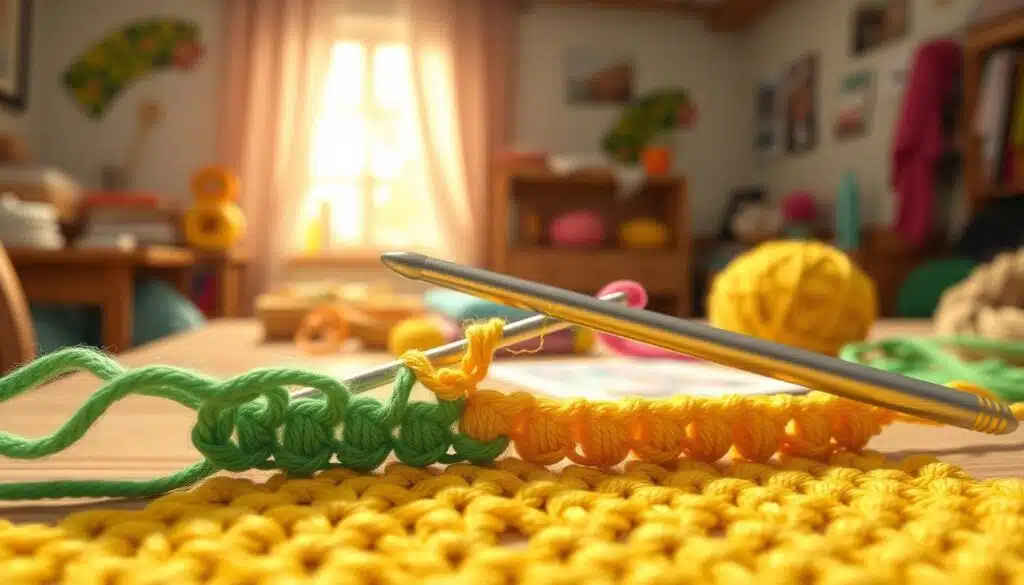
Accidentally adding or losing a stitch: causes and fixes
Most mistakes happen when you insert your hook in the wrong stitch. If you pick the first SC instead of the second, you get an extra stitch. It’s important to understand the stitch anatomy to avoid this.
Look for top loops and the horizontal bar to find the right spot. If you’ve already added a stitch, rip back one round or use a lifeline. This way, you can fix the count without undoing too much.
To prevent extra stitch errors, place a contrasting stitch marker in the first stitch before finishing the round.
Pulling the false stitch too tight or too loose: achieving the correct tension
The tension of the false stitch is critical. If it’s too tight, the join will pucker and distort nearby stitches. If it’s too loose, a gap will appear. Aim for the false stitch to match the size of the surrounding stitches.
Work slowly when creating the false stitch. Compare its size and height to the surrounding stitches as you go. If it looks off, adjust the tail slightly and check again. Small adjustments now can save a lot of time later.
Color-change pitfalls and how invisible joins help—or complicate—your workflow
Invisible joins make color changes seamless at the end of a round. They give you a crisp finish and a clean place to weave in tails. This is great for amigurumi and motifs. But, cutting yarn each round can slow you down when working with many colors.
If you plan to use many colors, consider a hidden slip stitch for speed. Use the needle-sewn invisible join for a sharp edge, but be prepared to weave in a few more tails.
| Problem | Cause | Quick Fix | Best Practice |
|---|---|---|---|
| Extra stitch | Inserting into first SC instead of second | Unpick one stitch or use lifeline, then redo join | Mark first stitch before finishing round |
| Missing stitch | Skipping the joining stitch or miscounting | Count stitches, add a stitch into correct spot | Count as you go and check rounds frequently |
| Puckered join | False stitch pulled too tight | Loosen tail and reform the false stitch | Match false stitch to neighboring stitch size |
| Visible gap | False stitch too loose | Tighten slightly and weave tail to stabilize | Adjust tension then weave tails carefully |
| Slow color work | Cutting yarn each round for invisible joins | Switch to hidden slip stitch for multi-round color | Reserve invisible join for final-round crisp edges |
Troubleshooting and finishing tips for pro-level seams
Here are quick, practical steps to help you fix visible flaws and finish seams that look like a shop-bought piece. Read each bite-sized tip, try it on a swatch, and keep the results crisp.
Fixes for visible gaps, bumps, or mismatched stitch size
If you spot a tiny hole where rounds meet, try this: after inserting your hook and pulling the loop, give the working yarn a gentle tug to snug that loop before completing the join. That single tug often will fix a small gap at the join without redoing the round.
For bumps or uneven stitch size, adjust the pulled stitches after you form the false stitch. Slide your hook through adjacent loops to redistribute tension and even out the row. If the seam looks lumpy, pass a tapestry needle once through the horizontal loop behind the false stitch to stabilize shape before weaving tails.
Weaving in ends vs leaving tails when stuffing amigurumi
When you stuff toys, decide early whether to weave tails or bury them. If you plan to fully stuff an amigurumi, you can tie the two yarn ends, pull the knot inside the body, and bury the tails instead of weaving every inch. This method reduces bulk and hides ends quickly.
If you prefer a flush finish, weave tails amigurumi-style: thread the tail on a tapestry needle, run it through several inner stitches, and trim close. Weaving flattens floppy false stitches and secures joins so stuffing won’t shift seams later. Many crafters find this technique in-depth at how to join crochet rounds.
When to use a hook-only method vs needle method (for hook loyalists)
If you hate sewing, try a hook-only invisible join. You pull the loop from the last stitch through the first stitch with your hook and snug it up. This method moves fast and suits practice swatches or quick gifts, yet it can need more fiddling to match tension perfectly.
Choose the needle method when you want the cleanest, most professional seam. A tapestry needle lets you form the false stitch precisely, match stitch height, and finish without puckers. If you have persistent trouble, run invisible join troubleshooting steps on a small swatch until the feel is consistent.
| Problem | Quick Fix | When to Use |
|---|---|---|
| Small gap at join | Tighten loop on hook before completing slip or pull tail snug | All projects, including hats and rounds with visible joins |
| Bumpy seam | Redistribute tension by sliding hook through adjacent loops; pass needle through horizontal loop behind false stitch | Delicate garments and amigurumi faces |
| Floppy false stitch | Weave tails amigurumi-style or anchor under horizontal loop before trimming | Stuffed toys and pieces with shape retention |
| Starter chain slant or travel seam | Use a standing stitch or place a stitch marker in the first stitch of each round | Any project needing straight seam lines |
| No-needle preference | Try hook-only invisible join; practice to refine tension | Speedy makes and testers who dislike sewing |
| Persistent miscounts | Mark the first stitch, recount before joining, correct with standing stitch if slant appears | Complex patterns and color changes |
Conclusion
You’ve learned how the invisible join makes scallops smooth and seamless. It also makes small rounds and amigurumi look like they belong in a gallery. This method requires a bit more effort, like cutting yarn or threading a needle.
But the result is worth it. You get a clean edge that matches your stitches perfectly. It also handles color changes without a hitch.
For quick work, use the hidden slip stitch during rounds. For a perfect finish, go for the needle-based invisible join. Using both methods means you get fast progress and a professional finish.
Remember, mastering the invisible join takes practice. Learn to read top loops and place the false stitch correctly. Soon, you’ll see your work without seams and get lots of compliments.
Your friends, family, or craft fair visitors will notice the difference. They’ll praise your work before you even talk about the technique.
FAQ
What is the invisible join and how does it differ from a slip stitch or hidden slip stitch?
The invisible join is a special stitch that replaces the slip-stitch join. It makes a smooth finish without visible bumps. Unlike a slip stitch, it blends in seamlessly.
The hidden slip stitch is a crochet method that hides the loop. It’s great for ongoing rounds without cutting yarn. The invisible join, on the other hand, is better for final rounds and color changes.
Why should you use the invisible join instead of the regular slip stitch?
The invisible join gives a professional, seamless edge. It’s perfect for small rounds, amigurumi, hats, and bags. It removes the bump left by slip stitches.
This makes your work look cleaner and more appealing. It’s ideal for tubular items and garments.
What tools and materials do you need to do an invisible join?
You’ll need a crochet hook and scissors. For the needle-sewn method, use a yarn needle and leave a 4″ tail. Optional tools include stitch markers and magnifiers.
Choose the right yarn fiber and weight. Lighter yarns show joins more clearly.
How does the invisible join work when your round starts with a chain (e.g., ch‑3 for dc)?
Finish the round and cut the yarn, leaving a 4″ tail. Thread the tail through the last stitch. Then, insert the needle under both top loops of the first stitch.
Pull the tail through but not too tight. Insert the needle into the top of the last stitch. This forms a false stitch. Adjust the tension so it matches the surrounding stitches.
How do you do the invisible join when you started the round with a standing stitch?
With a standing stitch, the false stitch replaces it. Locate the top of the second stitch. Cut the yarn and thread it on a needle.
Insert under both top loops of the first crocheted stitch. Pull through moderately. Then, insert into the top of the last stitch and through the horizontal loop behind it.
This recreates the finishing stitch. Expect a small floppy stitch at first. It will flatten and disappear after weaving in the tails.
Can you do the invisible join without cutting yarn or using a needle?
Yes, there are hook-only variations. They pull the loop from the last stitch through the first stitch. These are faster but can be fiddlier to tension.
For the cleanest seams, the needle-sewn method is preferred. It’s best for final rounds and color changes.
How do you identify the correct stitches to insert the needle or hook into?
You need to “read” stitch anatomy. Identify the top loops, the eye, and the horizontal loop behind the stitch. Use a stitch marker at the start of the round.
For chains vs standing stitches, remember the first working stitch differs. When starting with a chain, target the first stitch after the chain. With a standing stitch, target the second stitch.
What common mistakes make the invisible join look bad, and how do you fix them?
Common errors include inserting into the wrong stitch and pulling the false stitch too tight or too loose. Fix these by correctly identifying stitch anatomy and adjusting the pulled tail.
Secure the false stitch through the horizontal loop behind before weaving. If you accidentally added a stitch, undo the join and place the needle/hook into the proper stitch.
How much tail should you leave and how do you secure the join so it stays invisible?
Leave about a 4″ tail for threading and securing. After forming the false stitch, avoid pulling too tight. Secure by inserting the needle top-to-bottom through the horizontal loop behind the false stitch.
Pull through to stabilize, then weave tails into the fabric. For amigurumi, tie the two yarn ends at the back and bury them when stuffing.
Does the invisible join change how you handle color changes?
Yes. The invisible join is excellent for color changes at the end of a round. It avoids the extra loop created by traditional slip stitches.
This produces a tidy color transition. It encourages you to weave tails as you go. The downside is cutting yarn each round makes multi-color work more time-consuming.
When should you use hidden slip stitch instead of the invisible join?
Use hidden slip stitch when you want speed and don’t want to cut yarn every round. It’s a crocheted method worked from the back that hides the loop.
Use the invisible join when you need a final, needle-sewn, ultra-clean edge. This is best for small projects, final rounds, or visible color changes.
My false stitch looks floppy after a standing-stitch join. Is that normal?
Yes. With standing stitches, the replaced first stitch can appear slightly floppy or “flappy” at first. This is normal.
Once you weave the tails through the horizontal loop behind the stitch and flatten the area, the false stitch will settle and disappear into the fabric.
Are there tension tips for making the recreated stitch match surrounding stitches?
Do not pull the tail too tight or leave it too loose. Pull just enough so the false stitch sits the same height as neighboring stitches.
After forming it, visually compare and adjust the pulled tail before securing. If it looks uneven, unthread and try again. Stitch markers and practice reading stitch anatomy will speed consistency.
What do sellers and makers say about invisible joins and customer satisfaction?
Makers report that hidden seams dramatically improve perceived quality. On hats, bags, and amigurumi, a smooth join avoids embarrassing visible bumps.
Cleaner finishes often translate to higher customer satisfaction and repeat purchases at craft fairs and online shops.