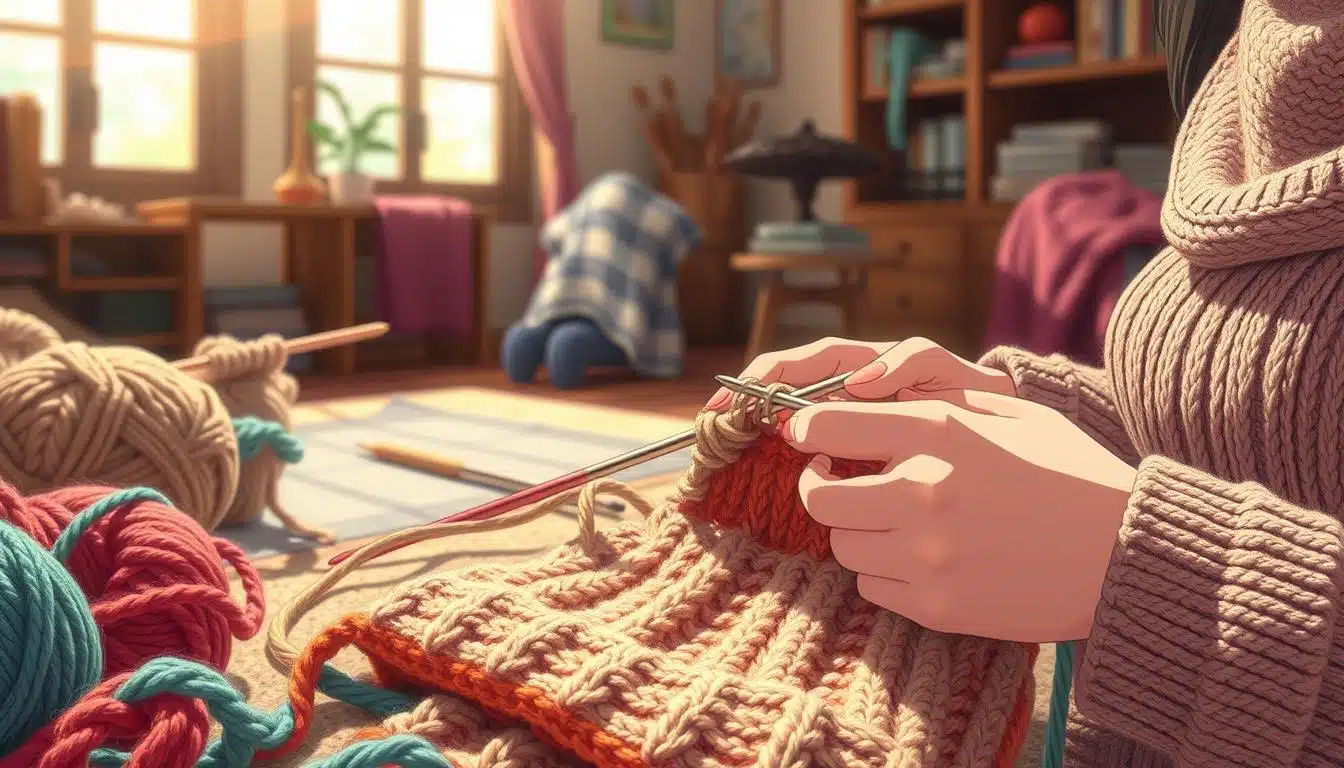
You’re about to learn the basics of knitting and make them into real, wearable items. This guide offers quick, easy tutorials for seven key knitting stitches. You’ll be able to start making useful projects right away.
You’ll use Pima cotton in light gray and aquamarine with US size 8 (5mm) straight beechwood needles for these lessons. This kit makes beginner knitting smooth, easy to see, and forgiving. It helps you practice both tension and speed.
The guide focuses on practical projects: scarves, blankets, beanies, snoods, and simple sweaters like the Lulling sweater and Brera cardigan. Each stitch tutorial has clear step-by-step instructions. It also includes fixes for common mistakes and project ideas like the Morse scarf, Babe snood, and Udon Blanket.
Along with written lessons, you’ll find links to video tutorials from trusted beginner resources. There’s also a simple practice plan to help you learn fast. Use scrap yarn for drills, follow the practice schedule, and share your progress with the knitting community. Use tags like #weareknitters to get feedback and motivation.
Key Takeaways
- This guide teaches seven easy knitting stitches to help you start projects quickly.
- Recommended beginner kit: Pima cotton (light gray, aquamarine) and US size 8 (5mm) beechwood needles.
- Lessons include step-by-step instructions, tension tips, and quick fixes for common errors.
- Projects include scarves, snoods, blankets, beanies, and simple sweaters to build skills fast.
- Supplement practice with video tutorials, scrap-yarn drills, and community tagging like #weareknitters.
Why Learn Easy Knitting Stitches Now
Grab your needles and yarn, and you start a journey that’s more than just a hobby. It’s a way to calm your mind and create something useful. Knitting helps you relax and focus, making it a great stress reliever.
Benefits for your sanity and schedule
Even a short time knitting can make a big difference. Just ten minutes can help you focus better and feel less stressed. The rhythm of knitting is like meditation, improving your mood and clarity.
Knitting isn’t just calming. It also teaches you patience, fine motor skills, and planning. Seeing your finished projects boosts your confidence and makes you want to keep knitting.
Quick wins: scarves, blankets, beanies, snoods, and simple sweaters
For quick results, start with simple projects. Scarves and small blankets are great for beginners. They’re fast to make and look good.
Beanies and snoods are also quick to make. They use rib stitch for a good fit. Simple sweaters become possible once you master basic stitches.
How mastering basic stitches unlocks endless project possibilities
Most patterns use just knit and purl stitches. Learning these basics lets you create many textures and patterns. You can mix and match to make something new every time.
Try different combinations to see how small changes can make a big difference. For a quick guide on essential stitches, check out this primer from We Are Knitters: 7 types of knitting stitches that every beginner needs to.
| Stitch | Best for | Why it’s helpful |
|---|---|---|
| Garter | Scarves, borders | Simple, no curling, fast confidence builder |
| Stockinette | Sweaters, smooth fabric | Sleek look, may curl at edges without borders |
| Rib | Hats, cuffs, snoods | Elastic, prevents rolling, snug fit |
| Seed | Blankets, textured scarves | Textured surface, clean edges, color play |
| Moss | Throws, cozy garments | Variation of seed, rich texture, stable edges |
| Waffle | Decorative blankets, accents | Bold texture, decorative surface with depth |
Getting Started: Tools, yarn, and casting on
Ready to start? Choose a starter kit to make learning easy. Pick beginner supplies like Pima cotton yarn and US size 8 needles. Wood needles, like straight beechwood, are warm, grippy, and make practice fun.
Recommended beginner materials
For your first projects, use Pima cotton yarn in neutral and bright colors. Light gray and aquamarine are good choices. They show mistakes well and look nice. Use US size 8 needles (5mm) in straight beechwood for clear stitches and easy tension control.
Why needle type and yarn weight matter
Yarn weight and needle choice affect your fabric’s look and feel. Medium-weight Pima cotton on US size 8 needles makes stitches easy to see. Beechwood needles help prevent slipping, so you can focus on your stitches.
Essential casting-on methods to get you knitting today
Start with three key casting on methods. Learn the long-tail cast-on for neat, stretchy edges. Try the knitted-on cast-on for flexible starts on small pieces. Use the single cast-on (beginner cast-on) for the simplest, fastest setup.
Practice these methods on scrap yarn before using your main yarn. Cast on a few extra stitches to test tension. This saves you from frustration and helps with garter borders or ribbing.
Garter Stitch: The must-know stitch that builds confidence
Garter stitch is perfect for a soft, even fabric. It’s great for beginners because it’s easy and forgiving. Once you get the hang of it, you’ll knit with ease and feel more confident.
To knit garter stitch, start by casting on the right number of stitches. Then, knit every stitch in every row. Turn your work and repeat. This creates a fabric that looks good on both sides and hides mistakes well.
Project ideas where garter stitch shines
- Morse scarf: wide, even ridges show off color and texture.
- Babe snood: soft, stretchy, and quick to make for last-minute gifts.
- Brera cardigan: a comfortable, casual jacket where garter keeps edges tidy.
Common beginner mistakes and how to fix them
- Dropped stitch: use a crochet hook or the left needle to ladder the stitch back up one rung at a time.
- Uneven tension: practice on scrap yarn and slow your motions. Tension evens out as your hands learn the rhythm.
- Accidental purl: spot purl bumps by sight. Slip back a stitch, re-knit the row, or tuck a fixing row into the pattern to hide the correction.
- Loose edges: slip the first stitch of each row or add a garter border to stabilize and prevent stretching.
Fixing knitting mistakes can be easy if you stay calm. Find the problem and choose the simplest fix. This garter stitch guide will help you knit every row with confidence. You’ll start easy projects and fix mistakes quickly, so you can enjoy knitting more.
Stockinette Stitch: Smooth finish and how to manage curling edges

Stockinette stitch makes your fabric smooth and sleek. To do it, knit on odd rows and purl on even rows. Keep going until it’s the length you want. You’ll get a nice, smooth right side and a textured wrong side.
How to knit stockinette
Start with any cast-on method you prefer. Then, knit one row and purl the next. Use a yarn that shows stitch definition well, like Pima cotton or a wool blend. If your rows are uneven, try using a bigger needle for knit rows or keep your tension even.
Why edges curl and easy border solutions
Stockinette edges curl because knit and purl rows are different. The fabric rolls towards the knit side at the top and bottom. But it rolls towards the purl side at the sides. This roll gets worse with light-blocking or stretching in one direction.
To stop the curl, add borders that stabilize. Use garter stitch at the start and end, or ribbing for stretch. You can also try foldover hems with extra stitches or an I-cord. For more ideas, see this guide on non-rolling edges.
Sample project: a stockinette sweater approach
When making a stockinette sweater, plan your borders and shaping early. The Lulling sweater shows how an all-stockinette body looks good with ribbed cuffs and a garter hem. Add purl-only rows before an I-cord or a foldover with extra stitches, then seam carefully.
Choose contrasting borders or texture panels to control curl. Small changes at the edges can make your sweater look professional. This is true whether you’re making a casual pullover or the cozy Lulling sweater.
Combining Rows: Lined stockinette and stitch variation for better edges
Want flatter edges without learning a dozen new techniques? Lined stockinette offers a simple trick to tame stockinette curl. It adds subtle texture while keeping the smooth face of stockinette. This results in a neater edge and better fabric behavior in scarves, hems, and blankets.
The four-row lined stockinette pattern starts with Row 1 knit all, Row 2 purl all, Row 3 knit all, and Row 4 knit all. Then, repeat. This extra knit row breaks the curl and adds a faint ridge. It gives a tidy border without the need for heavy ribbing.
Try stitch repeat combos to adapt the fabric. For a denser edge, use a 4-row repeat. For softer drape, move to a 6- or 8-row combo with five plain rows and a knit row on the sixth. Changing the gap between extra knit rows shifts elasticity and hand.
Pick spots to add extra knit rows based on use. Place them frequently along scarf edges and blanket borders to prevent curling. For garments, add them at hems and cuffs to preserve shape while keeping a smooth body. Small, well-placed changes beat ripping out whole panels.
Experiment with stitch variations to tune texture. Swap one of the extra knit rows for a slipped-stitch ridge, or mix in a 1×1 rib at the very edge. Each tiny alteration changes drape and bounce. A single extra knit row every 4–8 rows can change how your fabric stretches, lies, and wears.
Use these ideas to build stitch repeat combos that match your project. Test swatches in the same yarn and needles you’ll use. You’ll see how small changes affect curl, feel, and appearance before you commit to the full piece.
Rib Stitch: Elastic edges for hats and cuffs
Start with the basics for a neat, stretchy edge. This rib stitch tutorial will guide you. You’ll learn simple rules, quick tips, and when to pick a tighter or chunkier rib for your project.
How to do 1×1 rib with even and odd stitch counts
If your cast-on is even, work each row as K1, P1 to the end. For an odd stitch count, work odd rows as K1, P1 and even rows as P1, K1. Always knit the knit stitches and purl the purl stitches as they appear to keep those vertical ribs tidy.
Other rib combos and when to use them
Try a 1×2 rib for a subtle stripe of purl between knits, written as K1, P2. Use 2×2 rib for a chunkier, classic look, K2, P2. The 1×1 rib gives the most snug, fine elastic edge. The 2×2 rib reads bolder in texture and suits thick hat brims and cozy cuffs.
Why ribbing prevents rolling and adds stretch to garments
Alternating knit and purl columns pull the fabric vertically. Those columns trap little pockets of air and allow the fabric to stretch and spring back. This action keeps edges flat, so ribbing prevents rolling and makes a reliable finish for hat brims, sweater cuffs, and waistbands.
- Count stitches before you start; misplaced ribs look obvious.
- Place stitch markers at each repeat so you stay on pattern.
- Swatch your ribbing to test fit and elasticity before committing to a hat or cuff.
Seed and Moss Stitch: Texture that looks complicated but isn’t
These stitches add interest without extra effort. The seed stitch tutorial below offers clear, easy-to-follow instructions. You’ll get a pebbled, reversible fabric quickly.
For odd stitch counts, work every row as: k1, p1 across. This simple rule creates a neat, bumpy surface. It works well at edges and hides small tension shifts.
When your cast-on is even, follow this simple pair of rows: odd rows k1, p1, even rows p1, k1. Keep repeating until you reach your desired length. This method makes seed stitch forgiving and great for travel knitting.
Seed stitch patterns for odd and even stitch counts
Use the odd-count method for narrow pieces like scarves. Switch to the even-count pattern for borders or matched repeats. Both methods give the same pebbled look, but the even method is more uniform.
Moss stitch as a seed variation and its 4-row repeat
Moss stitch is a close cousin that feels denser and slightly ribbed. Cast on an even number of stitches. Rows 1–2: k1, p1 across. Rows 3–4: p1, k1 across. Repeat those four rows for a broken-rib effect.
Double moss gives a richer depth without adding bulk. It holds shape well, making it ideal for texture that looks crafted, not cluttered.
Best projects for textured stitches
These stitches are great for blankets, scarves, and accessories. The Udon Blanket pairs well with seed or moss. Texture masks tiny gauge differences and adds cozy insulation.
Try color changes in seed or moss for striking stripes or mosaic effects. For pattern inspiration and community tips, check this favorite stitch roundup at your favorite stitch pattern.
| Project | Recommended Stitch | Why it works |
|---|---|---|
| Udon Blanket | Moss stitch (4-row repeat) | Dense texture hides gauge changes and adds warmth without bulk |
| Striped Scarf | Seed stitch (odd or even) | Pebbled surface shows color shifts clearly and stays reversible |
| Textured Beanie | Double moss | Maintains shape at the brim and adds visual depth |
| Accessory Trim | Linen or rice stitch | Provides firm edge and pretty contrast to seed or moss panels |
Waffle Stitch: Decorative texture made easy
This stitch is fancy but easy for beginners. It creates a grid-like fabric that adds warmth and texture. It’s great for dishcloths, blankets, sweaters, and home decor.

To start, cast on a number that’s a multiple of 3 plus 1. This sets up the pattern’s four-row repeat. With the right number, the pattern is easy to follow and stitch quickly.
Cast-on requirements
- Cast on a multiple of 3 plus 1 stitch for the repeat to align.
- Use a medium yarn and US size 7–9 (4.5–5.5 mm) needles for clear texture.
Four-row repeat
- Row 1: *K1, P2* repeat to last stitch, then K1.
- Row 2: P1, *K2, P1* repeat to end.
- Row 3: Knit all stitches.
- Row 4: Purl all stitches.
Keep repeating these rows until your project is the length you want. This pattern creates the waffle stitch’s signature squares. Make sure your stitches are even to keep the texture right.
Tips for consistency
- Practice the four-row cycle on scrap yarn to build row memory.
- Use stitch markers to mark pattern blocks every multiple of 3 stitches.
- Watch the knit-and-purl transitions; steady hands give crisp edges.
Design ideas where waffle stitch pops
- Dishcloths that dry fast and scrub gently without looking basic.
- Baby blankets that feel plush and hold shape after washing.
- Textured sweaters and cardigans where panels of waffle stitch add depth.
- Pillows, placemats, and trims that use decorative knitting stitches to elevate home decor.
Mastering the waffle stitch takes practice. With the right cast on and repeat, you’ll have a versatile stitch for your projects.
easy knitting stitches
Short daily practice beats marathon sessions. Use a simple practice plan knitting routine that fits your schedule. Start with tiny swatches, build confidence, and keep your hands relaxed.
Quick practice plan to master the seven essential stitches in days
Day 1: cast on and work garter plus stockinette for five to ten minutes, two or three times a day. Day 2: practice 1×1 rib and 2×2 rib in short bursts. Day 3: try seed stitch and moss stitch with focused five-minute rounds. Day 4: work waffle stitch and combine lined stockinette into a small swatch project like a dishcloth or tiny scarf. Repeat and increase the swatch size as your confidence grows.
Tips for speed: small smooth motions, consider continental style
Keep movements compact. Use small wrist and finger motions and minimize hand travel to knit faster without extra effort. Press your left index finger against the needle to stretch stitches slightly; that makes insertion easier and reduces fumbling.
If you want to learn knitting fast, try continental knitting. Hold yarn in your left hand and pick the yarn with the needle for a quicker, smoother rhythm. Many knitters report steady gains after watching a short YouTube tutorial and practicing for a few sessions.
How to practice tension control and why to use scrap yarn for new techniques
Work every new stitch on scrap yarn practice first, specially inexpensive acrylic. Swatching protects pricier yarn and keeps mistakes low stakes. Test gauge, check rows, and take notes on needle size and tension.
Tension control comes from consistent hand position and cadence. If your stitches tighten or loosen mid-row, pause, re-center the yarn, then continue. Repeat short, focused drills to make steady gains.
For more stitch options and clear repeats, explore a handy pattern list at studioknitsf beginner stitches. Follow the practical mantra: swatch first, keep motions small, and use scrap yarn practice while you learn new techniques.
Conclusion
You’ve learned about seven easy knitting stitches. These include garter, stockinette, and rib. They’re great for making scarves, blankets, and more.
Start with Pima cotton and US size 8 (5mm) beechwood needles. Keep scrap yarn ready. Practice with short swatches to quickly make real projects.
For reliable results, use Pima cotton and US size 8 (5mm) beechwood needles when you start. Keep scrap yarn at hand and follow a short practice plan: swatch each stitch, try a garter scarf for instant satisfaction, and swatch ribbing to test fit. If you want speed, consider the continental style as one of your knitting next steps.
Manage curling with borders, experiment with row repeats to tune texture, and swatch lined stockinette to compare behavior. For community and resources, follow step-by-step tutorials and videos from trusted beginner sites and join knitting groups to share progress. This is the practical, encouraging easy knitting stitches conclusion you need to start knitting today and keep moving to knitting next steps.
FAQ
What are the seven essential stitches I’ll learn here?
You’ll learn garter, stockinette, and lined stockinette stitches. Also, 1×1 rib and its variations, seed stitch, moss stitch, and waffle stitch. These stitches cover texture, stretch, and structure for various projects.
What beginner kit do you recommend?
Start with Pima cotton in light gray and aquamarine. Use US size 8 (5mm) straight beechwood needles. Beechwood offers grip, and Pima cotton shows stitches well. This combo is great for learning.
How fast can I make something useful with these stitches?
You can make something quickly. Follow a quick practice plan. Finish a garter scarf in days, dishcloths in hours, and small items over a weekend. Many beginners see progress fast.
What casting-on methods should I master first?
Learn the long-tail cast-on for elasticity and the knitted-on for small projects. Also, practice the basic single/beginner cast-on. Use scrap yarn to practice for nice edges.
How do I work garter stitch and what is it good for?
Cast on, then knit every stitch on every row. Garter stitch is squishy and reversible. It’s great for beginner projects like scarves and beanies.
I keep dropping stitches—how do I fix them?
Use a crochet hook or the left needle to fix dropped stitches. For uneven tension, slow down and practice on scrap yarn. If you accidentally purl, spot the purl bumps and fix them.
How do I knit stockinette and why does it curl?
Knit one row, purl the next, and repeat. Stockinette curls because knit and purl rows are asymmetrical. This causes the fabric to roll.
How can I stop stockinette from curling?
Add garter stitch borders or ribbing to stop curling. Use lined stockinette repeats for a flat edge. Place extra knit rows at hems for garments.
What is lined stockinette and when should I use it?
Lined stockinette adds an extra knit row to reduce curl and add ridges. Try 4-, 6-, or 8-row combos for different edges.
How do I work 1×1 rib for hat brims and cuffs?
For even stitch counts, knit 1, purl 1 across each row. For odd counts, keep the pattern by knitting the knits and purling the purls. Ribbing adds elasticity.
When should I use 1×2 or 2×2 rib instead?
Use 1×1 for snug, fine elasticity. Use 1×2 or 2×2 for chunkier ribs and bolder texture on sweaters.
What’s the difference between seed stitch and moss stitch?
Seed stitch alternates K1, P1 every row. Moss stitch is a four-row seed variant for a denser, broken-rib effect.
Which projects suit seed and moss stitch?
These stitches hide gauge variation and add warmth. They’re perfect for textured projects like scarves and accessories.
How do I set up a waffle stitch repeat?
Cast on a multiple of 3 stitches plus 1. The four-row waffle repeat is Row 1: *K1, P2* to last stitch, K1; Row 2: P1, *K2, P1*; Row 3: Knit all; Row 4: Purl all. Repeat for a grid-like texture.
Any tips for keeping waffle stitch consistent?
Keep even tension and use stitch markers. Practice the repeat on scrap yarn. Small, steady motions help maintain consistency.
How should I practice to learn these seven stitches quickly?
Use a four-day quick practice plan. Day 1: garter and stockinette. Day 2: ribbing and seed stitch. Day 3: moss and waffle. Day 4: lined stockinette and a small swatch project. Short daily sessions help.
How can I speed up without losing quality?
Keep motions small and minimize hand travel. Press your left index finger to stretch stitches. Learning continental style can also help.
What about tension control and swatching?
Always swatch on scrap yarn before using prized yarn. Swatching shows your gauge and tension. Use scrap yarn to test cast-ons and stitches.
Where can I find video tutorials and community support?
Trusted beginner sites offer step-by-step lessons and videos. Join social sharing with tags like #weareknitters for feedback.
Any quick fixes for edge stitches and stretchy cast-on problems?
Slip the first stitch of each row or add a garter border to prevent edge stretching. For elastic cast-ons, long-tail gives good stretch. Practice it on scrap yarn.
How do small row-repeat changes affect my finished fabric?
Adding a single extra knit row every 4–8 rows alters curl, elasticity, and hand. More frequent knit rows flatten edges; fewer keep drape. Small adjustments tailor texture.
What quick projects should I try first with these stitches?
Start with a garter scarf, a seed-stitch dishcloth, or a ribbed beanie brim. Try a small waffle washcloth or a tiny swatch for a Lulling-style sweater. These projects teach basics quickly.