
You’re about to start a calm crafty journey. This article introduces simple, soothing knits that teach you skills. You’ll make something useful like a scarf, cowl, or cozy dishcloth without stress.
These projects are perfect for beginners or those returning to knitting. They fit into your busy days and quiet evenings.
This is your guide to beginner knitting and mindful knitting. You’ll learn basic stitches and choose yarn and tools that feel good. The aim is to knit for relaxation, enjoying a calming rhythm that quiets your mind.
We’ll keep things practical, witty, and focused on the United States. By the end, you’ll see how zen knitting can become a part of your life. Start with one simple project at a time, making sustainable choices along the way.
Key Takeaways
- Easy knitting projects help you learn while producing useful items quickly.
- Beginner knitting focuses on a few stitches and approachable patterns.
- Knitting for relaxation uses repetitive motion to calm the mind.
- Mindful knitting pairs simple projects with sustainable yarn choices.
- Start small: scarfs, cowls, and dishcloths offer fast wins and steady practice.
Why Knitting Brings You Calm and Focus
Knitting brings a quiet to the room, like a gentle hush. The loop, pull, slide motion is soothing. It’s the core of knitting mindfulness, keeping your mind steady without forcing it.
Imagine a soft chant or a simple breathing count. This internal rhythm helps you relax. It’s like Kiyosaki’s practice but much more calming, turning simple actions into meditation.
Working on a project with repetitive stitches frees your mind. You can watch TV, talk, or just think. It becomes a way to connect with others and find peace.
Materials like Quince & Co. Sparrow in linen are key. Knitting endless rounds creates a soft, natural fabric. This fabric is calming, with its smooth texture and gentle color changes.
Many knitters have a simple project ready for when they need to relax. These projects offer calm and focus, perfect for any time.
Practical tips
- Start with a small, repetitive project so you learn the cadence.
- Use natural-fiber yarns for pleasant texture and breathability.
- Adopt a short internal chant—count rows or breathe in sync with your hands.
| Project Type | Why It Calms | Key Feature |
|---|---|---|
| Endless stockinette rounds | Consistent motion soothes the nervous system | Stockinette meditation: smooth, rhythmic fabric |
| Simple linen cowl | Light texture that holds interest without effort | Quince & Co. Sparrow-like feel and drape |
| Garter stitch scarf | Row-to-row rhythm with tactile bounce | Repetitive stitches that build calm quickly |
Essential Tools and Materials for Relaxed Knitting
Choose tools that make knitting easy, not a chore. The right needles and yarn affect how relaxed you feel and how your project turns out. Good knitting notions help avoid frustration and keep you focused.
Needles: choosing the right size and type
Needles come in US numbers and millimeters. For a cozy blanket, start with US 10 / 6 mm. This is good for bulky projects.
Use straight needles for flat pieces like scarves. Circular needles are best for versatile projects.
Circular needles are great for small or big projects. They make long rounds easier and reduce wrist strain. They’re perfect for hats and seamless cowls.
Yarn basics: worsted, linen, cotton — feel, drape, and sustainability
Worsted yarn is cozy and fast to knit. Try Brava from Knit Picks in Dove Heather for blankets. It’s about 1700 yards for a throw.
Linen yarn, like Quince & Co. Sparrow, is crisp and smooth. It softens with wear and has great drape. Use small needles to show off the stitch.
Cotton yarn is cool and clean. But, it can use a lot of water and pesticides. Look for organic or local options to reduce impact.
Quince & Co. uses Belgian linen. Shipping can add to yarn miles. Try to find local mills to support makers and reduce environmental impact.
Must-have notions: tapestry needles, scissors, stitch markers
A blunt tapestry needle is key for weaving ends and grafting. Sharp scissors are needed for neat trims. Durable stitch markers help with increases and decreases.
Choose notions from trusted brands. Some links might be affiliate links. Pick tools that feel good in your hands and you’ll use often.
| Item | Why it matters | Suggested choice |
|---|---|---|
| Knitting needles | Control gauge and speed; comfort during long sessions | US 10 / 6 mm for blankets; mix of straights and circulars |
| Circular needles | Versatile for small and large projects; eases strain | 16″–40″ cords for magic loop and blankets |
| Worsted yarn | Warm, quick to knit, great stitch definition | Knit Picks Brava, ~1700 yards for a throw |
| Linen yarn | Crisp hand, excellent drape, softens with wear | Quince & Co. Sparrow; uses smaller needles (e.g., 2.25 mm) |
| Knitting notions | Finishing and keeping projects tidy | Tapestry needle, sharp scissors, durable stitch markers |
Beginner-Friendly Stitches to Master Your Calm
Start simple. Learning knit and purl opens up the world of soothing textures. Garter and stockinette stitches create a calming rhythm. This rhythm helps clear your mind while you create something useful.
Knit and purl: the foundations of meditative knitting
Once you can switch between knit and purl easily, you’ll find projects become automatic. Try endless rounds of stockinette for a calming flow. For more ideas, check out a beginner stitch collection at studioknitsf.
Simple increases and decreases for gentle shaping
Shaping isn’t scary. Learn k2tog and skpo to shape hats and mittens. These moves keep your flow while adding curves. Practice on small swatches to make the moves second nature.
Finishing basics: i-cord bind-off, neat edges, and blocking tips
An i-cord bind-off gives edges a neat, rounded look. It’s perfect for sleeves and necklines. For clean hems, add garter or rib rows before binding off.
Blocking is key for linen and cotton. Steam or wet block to even out stitches. Wool blooms after washing, so adjust your gauge. For more tips, see crochetcraze.
| Skill | Why it calms you | Quick practice drill |
|---|---|---|
| Garter (knit rows) | Repetitive, reversible, lays flat | Knit 20 rows in one color, swap color, repeat |
| Stockinette (knit/purl) | Smooth, meditative rounds | Work in the round for endless stockinette practice |
| k2tog / skpo | Simple shaping, keeps rhythm | Decrease every 8th stitch across a swatch row |
| i-cord bind-off | Tidy, elastic edge for sleeves and necks | Cast on 3 sts on spare needle and bind off as instructed |
| Blocking | Evens tension, sets final size | Soak, gently squeeze, pin to measurements, let dry |
Easy Knitting Projects for Instant Gratification
You want fast results and a calming knitting experience. Choose projects that finish in a day or two. This way, you enjoy crafting without feeling overwhelmed. Quick projects boost your confidence and make you want to knit more.
Quick knitting projects that give you instant joy include scarves, cowls, hats, and small handwarmers. Use bulky yarn and big needles to make your projects quicker. For tips and patterns, check out this guide at quick-knitting projects.
Quick scarves and cowls
Go for chunky yarn scarves or a worsted substitute for fast progress. Simple stitches like garter or rib keep your focus sharp. These projects are perfect for seeing quick results after just one evening.
Simple hats
Try magic loop hats for small circumferences without double-pointed needles. Use easy decreases like k2tog or ssk for shaping practice. A basic beanie can be made in a few hours with super bulky yarn.
Cozy mitts and fingerless gloves
Mitts and fingerless gloves are small, useful projects. They introduce thumb gussets and short rows. You practice increases and decreases while making something you can wear, calming your mind.
| Project | Yarn Weight | Needles | Approx Time |
|---|---|---|---|
| Scarf or Cowl | Bulky / Super Bulky | US 11–15 (8–10 mm) | 2–6 hours |
| Simple Hat | Worsted to Super Bulky | Circular 16″ or Magic Loop | 2–4 hours |
| Fingerless Gloves | Worsted / Bulky | Small circulars or DPNs | 1–3 hours |
These projects teach you about tension, repeats, and finishing quickly. They help you build a meditative knitting rhythm. Pick one, cast on, and enjoy the instant satisfaction.
Easy Knitting Projects: stitch your way to zen
You want calm, rhythm, and a finished object that proves you were productive. These projects offer steady, soothing work without complex shaping. Pick one, grab a favorite yarn, and let the motion do the rest.
Stockinette rounds for meditative knitting sessions
Stockinette knitting in the round becomes a low-effort trance. Repeating knit rounds lets your mind settle and your hands find an effortless pace. A linen top knitted in small needles over two summers shows how slow, steady stockinette can turn into a comforting ritual.
Use smooth yarn and a circular needle to keep joins invisible. Keep a simple gauge swatch handy; the common stockinette gauge of 3.25 stitches and 5 rows = 1 inch helps you plan size and timing. This keeps your session predictable and soothing.
Plain dishcloths and washcloths for useful, stress-free knitting
Small projects reward you fast. A straightforward dishcloth pattern lets you practice consistent tension and neat edges without worrying about complex instructions. Cotton or linen yarns give great stitch definition and wash well.
Work a few while watching TV or during a break. You’ll build confidence, test stitch consistency, and have something practical by the sink. These little wins sustain a habit of calm crafting.
Blankets that calm: simple garter or stockinette panels and recommended yardage
Blankets are long, repetitive, and perfect for meditative knitting projects. Choose garter or stockinette panels and repeat the same motion for many rows. That steady rhythm becomes almost hypnotic.
For a cozy worsted blanket example, plan around 8 skeins, roughly 1700 yards. The sample used Knit Picks Brava worsted in Dove Heather with US Size 10 (6 mm) circular needles and a 32″ cord. Use the stockinette gauge of 3.25 stitches, 5 rows = 1 inch to estimate blanket yardage based on your desired dimensions.
Pick projects that match the time you have. Short dishcloths fit evenings. Stockinette rounds suit long walks of knitting. A blanket rewards months of calm repetition.
How to Learn Kitchener Stitch for Seamless Finishes
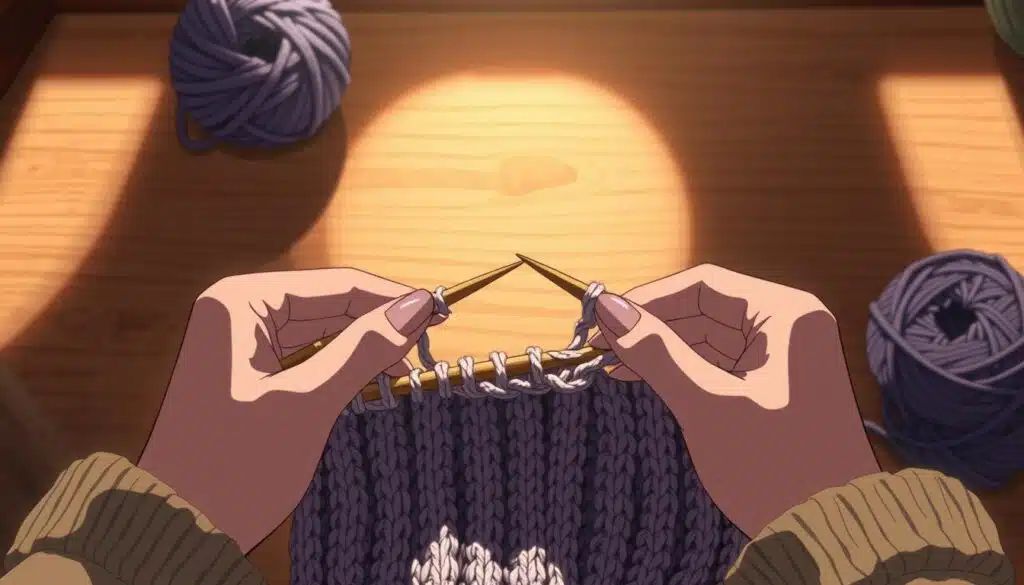
Want to make a heel, toe, or shoulder look like it was knit in one piece? The Kitchener stitch is a grafting method that joins two knitted edges. It makes the seam look like a single row of stitches. You’ll get a polished join every time, making it look like a tailor-made finish.
What Kitchener stitch is and why it feels meditative
This technique uses a tapestry needle and a running yarn tail. It mimics the path of live stitches. Many knitters find it meditative because of the repetitive motions and steady rhythm. It gives a calm, precise finish, perfect for stockinette rounds or neat sock toes.
Step-by-step setup and grafting instructions (front/back needle sequence)
Start by setting the two needles parallel with the wrong sides together. For the setup, go into the first stitch on the front needle as if to purl. Pull the yarn up and leave the stitch on the needle. Then, go into the first stitch on the back needle as if to knit, pull the yarn up, and leave that stitch on the needle.
- Front needle: go into the first stitch as if to knit, pull the yarn up, drop that stitch off.
- Front needle: go into the next stitch as if to purl, pull the yarn up, leave that stitch on the needle.
- Back needle: go into the first stitch as if to purl, pull the yarn up, drop that stitch off.
- Back needle: go into the next stitch as if to knit, pull the yarn up, leave that stitch on the needle.
Keep repeating this four-step grafting knitting sequence until all stitches are joined. At the end, weave in the tail and give the join a gentle block for the neatest seamless bind-off.
Tension tips and the “chant” trick to get your groove on
Even tension is key. Too loose and the join gaps; too tight and it pulls the fabric. Aim for the same tension as the surrounding rows.
Try chanting the sequence aloud or in your head as you work. The chant helps keep your tempo steady and supports meditative grafting. It keeps your hands moving, your mind focused, and your joins consistent.
| Step | Action | Tip |
|---|---|---|
| Setup | Place needles wrong sides together; purl into front, knit into back; leave both stitches on | Check that needle points align for smooth grafting |
| 1 | Front: knit, pull yarn, drop stitch | Keep yarn tension steady; don’t tug |
| 2 | Front: purl, pull yarn, leave stitch on | Count stitches occasionally to avoid mistakes |
| 3 | Back: purl, pull yarn, drop stitch | Watch the fabric lie flat as stitches drop |
| 4 | Back: knit, pull yarn, leave stitch on | Repeat the sequence in a steady rhythm |
| Finish | Weave tail and block the join | Blocking evens tension and completes the seamless bind-off |
Many patterns for socks, sleeves, and shoulder seams use this method. A short Kitchener stitch tutorial will repay you with cleaner finishes in a range of projects. Once you get the rhythm, grafting knitting becomes a satisfying end to any knit you love to wear.
Project Plans Using Different Yarns: From Linen to Wool
You want plans that match yarn to season and skill. Choose yarn that fits the project mood. For summer, pick something crisp and cool. For winter, go bulky and warm. And for the planet, choose mindful yarns.
Linen summer knits
Linen knitting makes garments feel cool and look clean. At first, rows might be a bit uneven. But, your tension will even out after a few inches.
Use fine needles like 2.25 mm for linen, like Quince & Co. Sparrow. This makes a crisp fabric that softens after washing.
For a simple tee, cast on to match a relaxed gauge. Plan for light blocking. Linen yarn projects look better with slightly larger needle sizes for more drape. Keep stitches tidy and avoid over-tightening. The fabric will bloom as you wear it.
Worsted and chunky projects for winter
Worsted yarn projects are balanced. They have good stitch definition, are relatively fast, and are warm. Knit Picks Brava worsted is a great choice for blankets and hats. For quick scarves and cowls, choose chunky yarn and big needles.
When making a blanket, plan worsted yardage based on pattern notes. Add extra for edge treatments. For accessories, pick chunky for texture and quick finishes. Choose worsted for items you’ll wear often and wash a lot.
Sustainability and sourcing
Sustainable yarn sourcing is key, not just the fiber. Plant fibers like linen can be better than cotton. But, transport distance matters too. Belgian linen is lovely, but high yarn miles can offset its benefits.
Look for local suppliers, small mills, and brands that share fiber origins. Choose lower-miles yarn when you can. This reduces environmental impact without losing quality.
- Practical tip: expect linen gauge to tighten after the first few inches; plan swatches for linen yarn projects.
- For quick gifts, prefer chunky textures. For long-wearing garments, consider worsted yarn projects for their versatility.
- Prioritize sustainable yarn sourcing when you can. Local yarn stores and regional mills are good places to start.
Sizing, Gauge, and Simple Pattern Notes to Keep You on Track
Before you switch yarn or needles, get familiar with gauge. Gauge shows how many stitches and rows fit in an inch. This ensures your finished piece fits the pattern’s size, avoiding surprises.
Understanding gauge: stitches and rows per inch and why it matters
Gauge is like a recipe for fit. If a pattern says 3.25 stitches and 5 rows = 1 inch in stockinette, your project will match. But if your gauge is different, the size will change. This can make a sweater too tight or too loose.
Make a swatch in the stitch pattern of your project. Wash and block it like the final piece. Measure and count stitches and rows per inch. Adjust your needles until your swatch matches the gauge.
Reading abbreviations and common shorthand for beginner patterns
Patterns use shortcuts to save space. Learning common knitting abbreviations helps you read patterns quickly. Basics include k (knit), yo (yarn over), skpo (slip one knitwise, knit one, pass slipped stitch over), and k2tog (knit two together).
If an abbreviation is unclear, look it up or check a tutorial like crochet troubleshooting. Knowing a few abbreviations can save time and reduce mistakes.
Adjusting simple patterns for fit and yarn substitutions
Want to change yarn or adjust size? Start by matching gauge. If the new yarn has the same gauge, the swap is likely okay. If not, adjust needle sizes to match.
To change width, adjust stitch counts. For example, if you get 3.25 stitches per inch, add or remove pattern repeats. Length changes are simpler: just knit more or fewer rows and check gauge.
Remember, different fibers behave differently. Linen is stiff, while wool stretches. These differences affect your adjustments, so test with a swatch before starting the full project.
Where to Find Patterns, Tutorials, and Community Support
Finding good knitting patterns and help makes projects easier and more fun. Start with trusted sources like Quince & Co. and Knit Picks. They offer clear instructions and great yarn suggestions.
For hands-on learning, watch step-by-step knitting tutorials. Experienced teachers show how to knit smoothly. A focused Kitchener stitch video can make finishing neat and calming.
Trusted pattern sources and affiliate considerations
Choose established shops and indie designers for reliable patterns. Look for clear sizing notes. Publishers like Interweave and Brooklyn Tweed offer tested patterns with good errata.
Video tutorials and classes for hands-on Kitchener and stitch demos
Search for tutorial series that break techniques into small steps. Short demos help you practice without feeling overwhelmed. Paid classes from knitting teachers offer direct feedback and structured learning.
Local knitting groups, online forums, and social media for encouragement
Visit your local yarn shop for in-person help and stitch nights. Ravelry groups, Facebook knitting communities, and Instagram or TikTok makers are great for pattern swaps and troubleshooting. Use community wisdom to refine your skills and celebrate small wins.
For quick reference patterns and starter projects, check curated roundups like this selection. Community forums often point to the best video demos and trusted pattern libraries when you ask specific questions.
Join a stitch-along or a local knitting circle to stay motivated and learn from peers. Mixing quality tutorials, a helpful Kitchener stitch video, and an active knitting community helps you build skills faster and keeps practice joyful.
Project Ideas With Materials Lists and Basic Gauges
Choose a project that matches your schedule and mood. Below, you’ll find lists of knitting materials, gauges, and tips. These mini-projects are easy to start and finish, whether you’re making a cozy blanket or quick gifts for friends.
Cozy blanket
For a big worsted blanket, use US Size 10 / 6 mm circular needles with a 32″ cord. You’ll need about 8 skeins, or 1700 yards of Knit Picks Brava worsted in Dove Heather. Your gauge should be 3.25 stitches and 5 rows = 1 inch in stockinette. Don’t forget a tapestry needle and scissors for finishing touches.
| Item | Recommendation | Notes |
|---|---|---|
| Needles | US 10 / 6 mm circular (32″) | Good for large blankets; less strain on wrists |
| Yarn | ~1700 yards Knit Picks Brava worsted | Approximate blanket yardage for a throw |
| Notions | Tapestry needle, scissors | Essential for weaving ends and trimming |
| Gauge | 3.25 sts / 5 rows = 1″ | Stockinette; swatch and block before committing |
Simple tee or summer top in linen
Linen tee knitting is rewarding but requires patience. Choose a linen like Quince & Co. Sparrow and use smaller needles, such as 2.25 mm, for neat fabric. Expect a tighter, less stretchy gauge that relaxes with wear and wet-blocking.
Finish sleeves with an i-cord bind-off for a tidy edge. Block carefully to shape panels and soften the linen. For beginner-friendly project ideas and yarn choices, check this helpful guide easy knitting projects for beginners.
Quick gift projects
Fast gift knitting projects include dishcloths in cotton, cowls in chunky yarn, and beanies via magic loop or small circulars. For dishcloths, use cotton or cotton-blend yarn and size-appropriate needles to practice new stitches.
- Dishcloth: cotton yarn, US 7-9 needles, quick practice piece.
- Cowl: chunky yarn, larger circulars, fast gratification.
- Beanie: small circulars or magic loop, simple decreases for fit.
Keep stitch markers, a tapestry needle, and scissors in your notions kit. This small list will save you from last-minute scrambles and speed up finishing.
Conclusion
You’ve seen how easy knitting projects can bring calm and craft together. Start with simple patterns like stockinette and basic shapes. Then, finish your projects with techniques like the Kitchener stitch and i-cord bind-off.
These steps will help you make useful items like scarves, dishcloths, hats, blankets, or even a linen tee for summer. Choose the right tools and yarn for your project. Worsted yarn is great for cozy blankets, while linen is perfect for breezy tops.
Remember to keep gauge and sustainability in mind. These mindful knitting tips will help you avoid mistakes and keep your projects on track. They also help reduce waste. Practice tension and simple patterns on small projects like dishcloths or cowls.
Ready to start knitting? Begin with a small, soothing project. Let the rhythm of knitting calm you. For more beginner-friendly ideas and videos, check out this guide: 12 knitting projects for the absolute beginner. Stitch by stitch, you’ll learn new skills, find calm, and create handmade treasures.
FAQ
What makes knitting meditative and calming?
Knitting’s repetitive motions calm your nervous system. Simple stitches let your hands move on autopilot. This lets your mind relax and focus.
Which simple projects are best when you want a no-thinking, soothing knit?
Try stockinette rounds, garter panels, and dishcloths. Quick scarves and blankets in chunky yarn are also good. They’re perfect for calming knitting.
Can you give a real-world example of meditative knitting?
Knitting endless rounds of stockinette in Quince & Co. Sparrow linen was very Zen. The linen’s crisp hand and natural color shifts were soothing.
What needles should I buy as a beginner?
Start with US 8 (5 mm) and US 10 (6 mm) needles. These are versatile for worsted and blanket projects. For larger projects, use chunky needles. Small sizes like 2.25 mm are good for linen tees.
Invest in circular needles with a range of cord lengths. Use the 32” cord and US 10 / 6 mm circulars for blankets. Straight needles are fine for flat pieces.
How do circular needles and the magic loop work?
Circular needles have two tips joined by a flexible cord. They let you knit flat pieces or join in the round. Magic loop uses a long cord to knit small circumferences without double-pointed needles.
What yarns should I consider and how do they behave?
Worsted is versatile and cozy. Linen is crisp and cool, softening with wear. Cotton is durable but has sustainability drawbacks. Choose based on drape, feel, and use.
How does sustainability factor into yarn choices?
Fiber type and sourcing matter. Linen and other plant fibers can be sustainable. Look for regional mills and lower-miles suppliers for better impact.
What are must-have notions for beginners?
Keep a tapestry/yarn needle, sharp scissors, and stitch markers handy. Trusted brands and tools are worth the investment. Many writers recommend items they use.
Which stitches should I master first?
Learn knit (k) and purl (p) first. These form stockinette and garter, great for meditative knitting. Practice simple shaping like increases and decreases.
What finishing techniques are worth learning right away?
Learn the i-cord bind-off and basic blocking. Kitchener stitch is useful for seamless grafting. Neat finishing makes projects look polished.
What is the Kitchener stitch and why learn it?
Kitchener stitch joins two knitted pieces invisibly. It’s handy for toe closures and shoulder seams. Many patterns include it, making it a useful skill.
Can you give the step-by-step Kitchener setup and graft sequence?
Setup: hold needles parallel with wrong sides together. Go into the first stitch on the front needle as if to purl, pull yarn up, and leave the stitch on the needle. Go into the first stitch on the back needle as if to knit, pull yarn up, and leave that stitch on the needle. Grafting sequence: 1) Front needle: go into first stitch as if to knit, pull yarn up, and drop stitch off. 2) Front needle: go into next stitch as if to purl, pull yarn up, leave stitch on. 3) Back needle: go into first stitch as if to purl, pull yarn up, drop stitch off. 4) Back needle: go into next stitch as if to knit, pull yarn up, leave stitch on. Repeat until finished.
Any tips for keeping Kitchener tension even?
Focus on even tension. Chanting the step sequence helps establish a steady rhythm. Practice on scrap swatches before grafting important pieces.
How do I plan yarn and gauge for a blanket?
Use worsted weight for blankets. About 8 skeins of Knit Picks Brava worsted in Dove Heather and US Size 10 / 6 mm circular needles with a 32” cord are good. Check your gauge and multiply to estimate yardage and finished size.
What gauge issues should I expect with linen and cotton?
Linen starts uneven and tight on small needles, then evens and softens with wear. Expect gauge to shift as you progress. Blocking will relax linen and cotton.
How can I adjust a pattern for a different yarn or size?
Swap yarns of similar weight and check gauge with a swatch. Adjust needle size to hit gauge. For width or length changes, scale stitch counts proportionally and keep shaping intervals consistent. Remember fiber properties affect drape and stretch, so tweak fit.
What common abbreviations should I know?
Learn these: k (knit), p (purl), yo (yarn over), k2tog (knit two together), skpo (slip one knitwise, knit one, pass slipped stitch over). Recognizing abbreviations makes following beginner patterns easier.
Where can I find trustworthy patterns and tutorials?
Look to reputable designers and retailers like Quince & Co. and Knit Picks. Video tutorials on Kitchener stitch and magic loop techniques are widely available. Local yarn shops, Ravelry groups, and social platforms like Instagram and TikTok also offer patterns and support.
What are quick gift projects with beginner-friendly materials?
Dishcloths in cotton or cotton blends, chunky cowls, and beanies knit with the magic loop are fast, useful gifts. Keep essentials nearby—stitch markers, tapestry needle, and scissors—and choose chunky or worsted yarns for instant gratification.
Any final practical tips before I cast on?
Choose a project that matches your time and needle/yarn choices. Keep a “no-thinking” project for relaxation. Learn Kitchener and i-cord bind-off early, check gauge, and consider sustainability when sourcing yarn. Then cast on, find your chant, and stitch your way to zen.