
Ever watched a skein turn into cozy handknit socks? Nicky Crane calls it magic. This guide will show you how to make your own knit socks. They’ll fit well, last long, and feel like a warm hug for your feet.
The Victoria and Albert Museum shows us socks are ancient and vital. Authors like Nancy Bush and Clara Parkes have taught many. Their tips on sock yarn and technique are here, ready for you to use.
Sock knitting is easy to take with you, quick, and fun. You might finish one sock on a flight and start another on the train. This guide is all about enjoying the process and making your socks better.
Key Takeaways
- Sock knitting mixes creativity with practical rewards—small projects, big satisfaction.
- Study classic authors like Nancy Bush and Ann Budd for trusted techniques.
- Choose sock yarn with wear in mind: strength and fiber matter.
- Keep projects portable—handknit socks are perfect travel knitting.
- This sock knitting guide will cover materials, anatomy, tips, and repairs to help you knit better socks.
Why Sock Knitting is So Satisfying: Warmth, History, and Joy
When you start with two needles and yarn, you see results right away. You get a warm, fitting, and lasting item. Knitting socks is great because you can work on them anywhere and see progress quickly.
The history of sock knitting is rich and fascinating. Museums like the Victoria and Albert show how socks were made long ago. During World War I, people knitted millions of socks for soldiers. This effort led to new tools and techniques, like the Magic Loop.
Learn more about the history of socks here.
The long history behind your hobby
Knitting socks has been a part of history for ages. You can find examples in museums and books by Nancy Bush and Lucy Neatby. Each pair you make connects you to a long line of makers.
The emotional and practical perks
Knitting socks has many benefits. You get durable socks and learn new stitches. You also enjoy the calm rhythm of knitting and the pride in finishing a pair.
What makes socks different from other knits
Socks require precision and attention to detail. You need to work at a finer gauge and pay attention to fit. Using superwash wool blended with nylon is a good choice for durability and warmth.
| Aspect | Why it matters | Practical tip |
|---|---|---|
| Gauge and fit | Good gauge ensures comfort and durability | Swatch in the yarn and needles you plan to use |
| Heel and toe reinforcement | Extends sock life where wear is highest | Use a reinforced stitch or a nylon blend yarn |
| Pattern memorability | Makes travel and TV knitting easy | Choose simple repeats like stockinette or rib |
| Technique variety | Offers creative options and skill growth | Experiment with Kitchener grafting or short rows |
Knitting socks is rewarding. You get practical items, improve your skills, and enjoy the process. It’s a great way to combine craft and comfort.
Essential Materials and Tools for Happy Sock Knitting
Before starting, gather a small kit to keep your project neat and easy to carry. The right yarn and tools save time, avoid frustration, and extend your socks’ life.
Choosing yarn: fiber, weight, and durability
Choose sock yarn that’s durable for wear. Wool or blends with nylon are elastic, durable, and often machine washable. Superwash wool with nylon is easy to care for without losing its spring.
Fingering weight is the top pick for fitted socks. DK-weight is quicker but warmer, though the fit changes. Malabrigo Sock shows how hand-dyed fingering can be soft yet strong.
For a list of must-haves, check this guide on essential items and tools for socks: essential knitting tools you can’t live.
Needles: DPNs, circulars, and the Magic Loop
Try both DPNs and circulars to find your preference. DPNs offer control on small sizes, while circulars are faster. Some prefer 6-inch DPNs for small circumferences.
Long-cabled circulars are great for Magic Loop or knitting two socks at once. Choose needle size based on your yarn and pattern. Brands like Signature Needle Arts and Knit Picks are reliable and durable.
Other must-haves: stitch markers, tapestry needle, and blockers
Use stitch markers for round starts and gusset decreases. A blunt tapestry needle is key for weaving ends and grafting toes.
Blockers are essential for shaping socks and highlighting patterns. Carry a small notebook, a tidy project bag, and consider compact shears. Lovesockwool and Sew Bendy offer great project bags for travel.
| Item | Why it matters | Recommended examples |
|---|---|---|
| sock yarn | Durability, elasticity, care | Superwash wool/nylon blends; Malabrigo Sock |
| Needles | Control, gauge, method choice | 6″ DPNs; long circulars for Magic Loop; Signature Needle Arts, Knit Picks |
| Stitch markers | Track rounds and decreases | Ring markers or locking markers |
| Tapestry needle | Weave ends and grafting | Blunt, size appropriate for yarn |
| Blockers | Shape and finish socks | Plastic or wood sock blockers in multiple sizes |
| Project bag & notes | Portability and repeat tracking | lovesockwool, Sew Bendy bags; small notebook |
Understanding Sock Anatomy to Improve Fit and Function
Before you start a new sock project, learn about sock anatomy. Knowing the parts of a sock helps you improve fit, comfort, and durability.
The cuff and leg form the vertical part of the sock. The cuff uses stretchy stitches for a snug fit. The leg is where you can add patterns without affecting the fit.
The heel is the most worn part. A heel flap adds strength. The heel turn shapes the sock to fit your foot. Using slip-stitch patterns or nylon blends helps extend the sock’s life.
The gusset connects the heel to the foot. It’s a triangular section that matches your instep. Proper shaping prevents sagging and ensures a snug fit.
The foot is usually plain stockinette for a smooth sole. The toe tapers with decreases. You can graft the toe for a seamless finish or use a stretchy bind-off for quick wearability.
Knowing sock anatomy helps with sizing. Adult socks use about 100 grams of fingering yarn. Children’s socks use half that amount. Adjust the stitch count and length for the right size.
For example, casting on 72 stitches can make a men’s size 11 sock. Decrease stitches to about 32 for a smooth toe. Use these as a starting point and adjust for your gauge and yarn.
Think of sock anatomy as a guide for better fit. Reinforcing heels and toes, shaping the gusset, and adjusting lengths make your socks stay put and feel custom.
| Part | Function | Common Adjustment for Fit |
|---|---|---|
| Cuff | Provides elasticity and holds sock up | Change ribbing depth or cast-on method for tighter or looser fit |
| Leg | Decorative area; affects sock height | Alter length in rows to raise or lower sock height |
| Heel flap | Reinforces high-wear area | Use slip-stitch reinforcement or stronger yarn for durability |
| Heel turn | Creates the cup that fits the back of the heel | Adjust short-row depth or flap row count for snugness |
| Gusset | Shapes sock to the instep and prevents sag | Add or remove gusset decreases to match instep width |
| Foot | Encases the sole and top of foot | Measure foot length in inches and knit to that point |
| Toe | Closes the sock; affects comfort at the tip | Choose grafting for seamless finish or stretchy bind-off for toe-up socks |
sock knitting tips
You want your socks to fit well, last long, and look made with care. Start by seeing gauge as a must, not just a suggestion. Swatching for socks helps avoid the need to rip and redo your work; make a small tube or flat swatch in the stitch pattern you’ll use, wash it, and measure. If your stitches per inch don’t match the pattern, change needle size until they do.
Gauge matters: swatching for socks
Swatching for socks is key to getting a good fit. Use the yarn and needles you plan to knit with. Aim for the pattern’s gauge—24 stitches per 4 inches is common for fingering sock yarn. Try a long-tail cast-on with one extra stitch for a stretchier cuff that fits well.
For a quick guide, check out the recipe at knittingit. It gives stitch counts and heel rows for a typical women’s U.S. 7–8 sock. It also lists measurements to compare as you swatch.
Managing tension and elasticity
Tension in socks affects both comfort and durability. Use an elastic cast-on—like cable cast-on or Old Norwegian—to keep the cuff flexible. Keep your stitch tension even while working small circumferences to avoid ladders when using double-pointed needles.
When moving from cuff to leg, or leg to heel, check your fabric. Compress it with your fingers and look for gaps. If stitches feel loose, tighten slightly on the next round; if too tight, go up a needle size for that section.
Yarn management for self-striping and variegated skeins
Yarn management is important when using self-striping or variegated yarns like Regia, Opal, Malabrigo, or Ashford Caterpillar Cotton. Wind center-pull cakes to control where stripes start.
For matched pairs, start the second sock at the same color point, or knit two-at-a-time to ensure symmetry. Many knitters use nearly the whole 100g ball with only a tiny tail left when they plan yardage carefully; DK weight moves faster but always check fit and gauge first.
| Issue | Quick Fix | When to Use |
|---|---|---|
| Loose cuff | Switch to cable cast-on or add one extra long-tail stitch | Elasticity needed without sacrificing fit |
| Ladders between needles | Tighten first stitch on each needle; use two-at-a-time method | Working on small circumferences with DPNs |
| Stripe mismatch | Wind center-pull cakes and begin second sock at matching color | Self-striping and variegated skeins |
| Gauge off | Adjust needle size and re-swatch | Any time swatch differs from pattern gauge |
| Running out of yarn | Check yardage early; reserve a small tail or plan a contrast toe | Close-fitted socks or nearly full 100g balls |
Techniques for Smooth Sock Construction
Get your needles ready. A tidy sock starts with smart moves. These keep the fabric even and the fit snug. Below, you’ll find tips to help you join in the round cleanly, shape heels with short rows, and pick up stitches for a neat gusset.
Joining without a twist
Before joining in the round, spread your stitches across needles or on the cable. Line up the cast-on edge so the working yarn leaves from the last cast-on stitch. Check once, then join; a single twist will haunt the sock forever.
Try a long-tail cast-on with one extra stitch at the end. This small tweak adds cuff elasticity and prevents puckering at the join.
Using short rows for smooth shaping
Short rows let you sculpt the heel without bulky seams. Work partial rows to build depth, then wrap-and-turn or use German short rows to close gaps cleanly. Each method reduces ladders and keeps the fabric flexible.
When you heel turn, set up a few base rows first. This creates the depth you need. Then follow decreases to form the heel pocket that cradles the foot.
How to pick up stitches and form a comfy gusset
Picking up stitches along the heel flap edges is a key step. Count carefully so you pick up the same number on each side. For example, an 18-stitch heel flap often takes 18 picked-up stitches per side when adapting patterns for larger sizes.
Once you pick up stitches, work gradual increases to rebuild the round stitch count. Then decrease across the top of the foot until you reach the original number. This sequence forms a snug gusset that follows the curve of the heel.
Quick checklist:
- Distribute stitches evenly before you join in the round.
- Use short rows to shape heels gently and avoid bulk.
- Pick up stitches with consistent tension for a tidy gusset.
Top-Down vs Toe-Up: Which Method Warms Your Toes Faster?
Choosing between top-down and toe-up socks is like picking your favorite coffee. Both wake you up, but each has its own taste. You want socks that fit well, feel great, and get on your feet quickly. This section helps you decide between top-down and toe-up socks without guessing.

Top-down pros and cons
Top-down socks start at the cuff and move toward the toe. If you learned this way from Melissa Morgan-Oakes or Wendy Johnson, you’ll find it familiar. It’s great for following traditional heel flap shaping and published designs.
You might need Kitchener grafting to close the toe, which takes time and skill. If you enjoy set patterns, cuff-first rhythm, and classic shaping, top-down socks are faster and more comfortable to plan.
Toe-up pros and cons
Toe-up socks start at the toe and grow toward the cuff. This method lets you try as you go for a perfect fit, which is great for feet with unusual shapes. You can use a provisional cast-on or a small loop and finish with a stretchy bind-off, avoiding toe grafting.
Toe-up works well with variegated yarn because you knit until the yarn runs out. This method gives efficient yarn usage with no leftover tails. If you want to skip grafting and tweak length on the fly, toe-up socks are quicker.
For matching pairs, knitting two-at-a-time on circular needles works with both methods. This trick keeps stripes and gauge consistent, so your socks pair up at first wear. When deciding between toe-up and top-down, think about fit adjustments and yarn efficiency or stick with the pattern flow that keeps you knitting joyfully.
Mastering Heels and Toes for Comfort and Durability
Want socks that last and feel great? Focus on the heel and toe. Choose a method that fits your pace and how much your feet wear the sock. Here are quick tips on reinforced heels, fast alternatives, and neat toe finishes.
Heel flap and gusset: tried-and-true reinforcement
The classic heel flap with a gusset is strong where it’s most worn. You often use a slip-stitch pattern on the heel flap for extra thickness. After turning the heel, you pick up stitches along the flap edge and work decreases to form the gusset.
This design makes a comfy pocket for the heel and lasts under heavy use. It’s perfect for everyday wear.
Short-row and afterthought heels for speed
Short-row heels shape the cup without a flap, using partial rows to build a curve. You work quickly and avoid many picked-up stitches for a neat fit. A short-row heel is great for toe-up socks.
The afterthought heel is the fastest if you knit the leg and foot first. You insert a waste yarn marker, finish the sock, then pick up the stitches later and knit a tidy heel. This method is flexible for making socks to size from a finished tube.
Toe shaping and grafting options
Toe shaping changes the sock’s final look. You can decrease into a wedge or work rounds of paired decreases for a rounded toe. For a seamless finish, many knitters use the Kitchener stitch to graft the remaining stitches closed.
On a typical men’s sock, you might decrease to 32 stitches—16 top, 16 bottom—and graft for a smooth join. If you prefer a simpler end, a secure bind-off will do. But grafting gives the best, no-bulk result at the toes.
Adding Style: Colourwork, Lace, and Cable Options
Your sock collection can be both useful and fun. Begin with simple stripes or bold patterns to create striking pairs. Brands like Malabrigo, Opal, or Ashford offer vibrant colors and durable yarns.
Plan your stripes by weight and length to place them where you like. For easy patterns, use self-striping yarn. To control color pooling, wind variegated skeins into short cakes and alternate with solid rounds.
Lace adds a touch of elegance to your socks. Start with small patterns and use wider needles for flexibility. Classic patterns from Nancy Bush and Lucy Neatby are great for beginners.
For more complex lace, use lifelines and stitch markers. These tools help keep your work neat. After finishing, steam-block your socks to enhance the pattern without losing fit.
Cables add warmth and structure to your socks. A twisted rib or simple cable can make your socks snug. Cable patterns resist sagging and last longer in high-wear areas.
Work small cable panels on the heel flap or foot top for a stylish mix. Ann Budd’s patterns show how to blend cables with standard sock shapes.
Combine different techniques for a unique pair. Try a self-striping foot with a lacy leg, or a textured cuff with a smooth foot. This way, you can show off colors and stitches without bulky changes.
Yarn Hacks: Mixing, Reinforcing, and Using Leftovers
If you love socks, you want them to fit well, feel great, and last long. These yarn hacks help you achieve that without losing style. Below are quick tips for mixing yarns for texture, reinforcing high-wear areas, and turning leftovers into charming details.
Mixing yarns for durability and texture
Try mixing a strand of nylon or fingering-weight wool with another yarn for strength without changing the fit. Use laceweight mohair with a fingering base for halo and softness. For quicker socks, pair a DK with a sock-weight strand for durability.
Reinforcing high-wear areas without changing gauge
Reinforcing socks works best when you keep the original fit. Slip-stitch heel flaps add abrasion resistance without changing gauge. You can also run a thin strand of nylon through the heel and toe rows or knit those sections with a tougher yarn held together, keeping your stitch count identical.
Scrap-busting and creative pairing
Leftovers become a design feature when you plan color repeats or surprise stripes. For scrap busting, blend short self-striping sections with solid scraps to avoid abrupt color breaks. Keep a small project notebook to track combinations that worked on patterns like Monkey by Cookie A and repeat the winners.
Want project ideas and more ways to use odd skeins? Check this guide for 63 imaginative projects that make scrap busting fun and practical: ways to use scrap yarn.
- Tip: Use sock yarn intended for wear—superwash wool with nylon remains the most reliable choice.
- Tip: When mixing yarns, swatch over the entire intended pattern to confirm hand and stretch.
- Tip: Keep reinforcing socks subtle: a slip-stitch contrast or held thread keeps the look handmade, not patched.
Care, Repair, and Making Socks Last
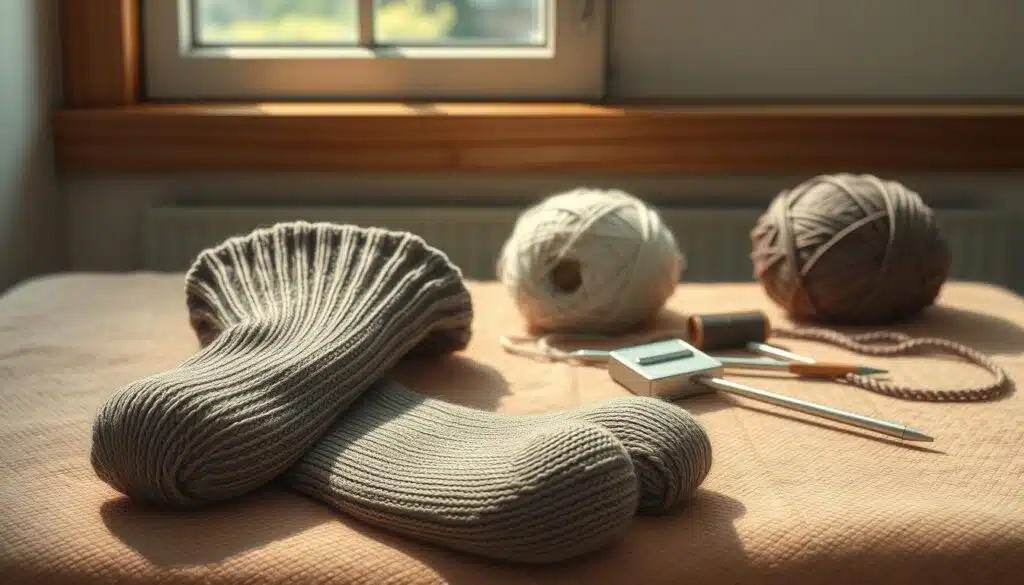
To keep your handknit socks fresh, adopt a few simple habits. Opt for machine-washable wool blends with nylon for everyday use. When washing, use a gentle cycle and cool water or a mesh bag to avoid damage.
Blocking your socks softens the stitches and sets their shape. Use sock blockers to define the ribbing and check the fit before wearing. Proper care starts when you finish knitting and continues with each wash.
Washing and blocking for longevity
Handle delicate pairs with care. If a label says hand wash, do it. For superwash blends, machine wash on low heat in a bag. Lay them flat to dry to maintain fit and elastic.
Blocking after the first wash evens out stitch tension and spots that need fixing. A quick steam can relax fibers without soaking the yarn.
Darning and mending with style
Every sock will need some love. Learn to darn socks invisibly or with flair. A tidy duplicate-stitch repair hides holes in the toe or heel.
If you like craftful fixes, try contrast yarn for a patch that looks intentional. Darning extends life and turns repair into part of the sock’s story. Use similar-weight yarn and a needle that glides through without stretching.
Storing and rotating your sock collection
Good sock storage keeps them elastic and prevents snags. Small baskets by the laundry and neat drawers with divider bins work well. Create a rotation system so high-wear pairs rest between wears.
Project bags and a simple notebook help track pairs on the needles and note which ones need reinforcement. This way, you can fix them before they wear out.
| Task | Best Practice | Why it Helps |
|---|---|---|
| Washing | Machine wash cool in mesh bag or hand wash with mild detergent | Reduces abrasion, preserves elastic and dye, keeps fit |
| Drying | Lay flat to dry; avoid dryer heat | Prevents shrinkage and fiber damage |
| Blocking | Use sock blockers after washing or steaming | Sets stitch definition and corrects shape |
| Reinforcement | Reinforce heels and toes with nylon or duplicate stitch | Makes high-wear zones last longer |
| Mending | Learn invisible darning and visible-mending techniques | Extends lifespan and adds personality |
| Storage | Use divided drawers, baskets, and labeled project bags | Prevents stretching and keeps pairs organized |
| Rotation | Rotate wear to rest fibers between uses | Even wear reduces frequent repairs |
For more detailed yarn care routines, check a concise guide at yarn care tips. Small steps in care, timely darning, and smart sock storage keep your knitting readable, wearable, and ready for colder nights.
Inspiration, Patterns, and Learning Resources
You’re looking for new ideas, reliable sources, and ways to improve. Start with a few books and a plan to move from simple socks to custom fits.
Check out books by Nancy Bush and Lucy Neatby for history and fun techniques. Clara Parkes and Ann Budd share yarn knowledge and shaping tips. Charlene Schurch and Vogue Knitting experts offer clear heel and toe methods.
Patterns to try as you learn:
- Beginner: start with basic cuff-down ribbed or stockinette socks to get gauge and joins right.
- Intermediate: try heel flap and gusset, and simple lace or cable socks like Cookie A’s Monkey for texture.
- Advanced: move to two-at-a-time, stranded colorwork, and custom-fit adjustments such as wider feet or longer cuffs.
Local yarn shops are great for hands-on advice and classes. Many shops offer classes with special yarn and pattern support. Online platforms and Ravelry pages are also good for solo learning.
Join the sock knitting community to share tips, ask questions, and show off your work. Community feedback helps you learn faster and feel confident in making changes. You’ll find mentors who have taught classes and helped beginners.
Start with a simple plan to build skills without feeling overwhelmed. Begin with one pair, repeat the same pattern twice, then add a lace or cable detail. Once you’re comfortable, try custom sizing, different heel types, or two-at-a-time magic.
| Resource Type | Recommended Names | What You’ll Learn |
|---|---|---|
| Books | Nancy Bush, Lucy Neatby, Clara Parkes, Ann Budd | History, creative patterns, yarn selection, shaping techniques |
| Patterns | Cookie A’s Monkey, free cuff-down guides, shop patterns | From basic rib to lace-with-structure and size modifications |
| Classes | Local yarn shops, Craftsy/Bluprint-style courses, in-person workshops | Hands-on help, live corrections, step-by-step project builds |
| Community | Ravelry groups, in-store meetups, social knit nights | Pattern support, troubleshooting, social motivation |
If you take classes, write down your goals and any challenges. This helps teachers give you better advice. Share your progress with the community for support and encouragement.
Mixing classic books with pattern work and classes speeds up your learning. Each pair you make builds your confidence and opens up new design possibilities.
Conclusion
Sock knitting is a mix of craft and comfort, making it both useful and addictive. Use the tips from this guide to create socks that fit well and show your style. With practice, making socks will become as easy as wearing them.
Remember, sock knitting has a rich history. Books and teachers can help you learn faster. If you’re starting, study a good pattern, swatch well, and try different methods. Reading classic books or following experts like Clara Parkes will improve your skills and avoid mistakes.
Keep your projects portable and collect yarns that make you happy. Rotate your handmade socks to keep your collection fresh. Share your progress with local guilds or Ravelry groups to stay inspired. This guide will keep your toes warm and your creativity flowing for many cozy nights.
FAQ
What makes sock knitting so satisfying?
Sock knitting is a mix of practical and creative. You turn a small skein into a wearable item. It’s portable and quick to finish, perfect for playing with colors and patterns.
It has a cozy history, from museum pieces to folk traditions. This adds a sense of continuity to every pair you make.
Which yarn should you choose for socks?
Choose fingering-weight yarn for durability. Superwash wool blended with nylon is best. It’s warm, elastic, and machine washable.
Popular choices include Malabrigo Sock, Opal, and Regia. DK yarn is faster but might change the fit. Use nylon for heel and toe reinforcement.
DPNs, circulars, or Magic Loop—which needles should you use?
Use what works best for you. Double-pointed needles (6″ DPNs) are classic and easy to carry. Long-cabled circulars are great for Magic Loop or knitting two-at-a-time.
Choose needle size based on your yarn and gauge. This avoids loose stitches or cramped toes.
What are the essential tools you really need?
Keep stitch markers, a tapestry needle, and sock blockers handy. A small pair of scissors and a notebook for formulas are also useful. A project bag keeps things tidy.
For finishing, learn Kitchener grafting and have a tapestry needle ready.
Can you explain sock anatomy in plain terms?
A sock is a seamless tube with different parts. The cuff stretches, the heel flap and turn form a pocket, and the gusset shapes the arch. The foot and toe close the sock.
Understanding these parts helps with fit, durability, and design.
Why does sock anatomy matter for fit and durability?
Properly shaped heels and gussets prevent sagging and blisters. Reinforced areas handle abrasion. Getting gauge right ensures a good fit.
How important is swatching for socks?
Swatching is very important. It affects fit and comfort. Swatch at the recommended stitch count and fabric; adjust needle size as needed.
A long-tail cast-on with an extra stitch gives a stretchier cuff. For toe-up projects, try a small instep or lace pattern.
Any tips for managing tension and avoiding ladders?
Keep short rows even and use elastic cast-ons for a comfy cuff. When using DPNs, redistribute stitches to avoid loose bars. Maintain consistent hand tension and practice joins to reduce laddering.
How do you handle self-striping and variegated yarns so pairs match?
Wind center-pull balls and start the second sock at the same color point. Or knit two-at-a-time on a long circular for matched stripes. Use contrast heels and toes for variety.
How do you join in the round without twisting the cast-on?
Lay your cast-on on the cable and spread stitches evenly. Check the first and last stitches aren’t flipped. Use a marker and knit a few rounds to settle the join.
What’s the difference between a heel flap/gusset and a short-row heel?
Heel flap/gusset is traditional and durable. Short-row heels are quicker and smoother. Afterthought heels are inserted later for flexibility.
How do you pick up stitches for a comfortable gusset?
Pick up stitches evenly along the heel flap. Use a formula to pick up roughly one stitch for every two rows. Decrease across the top of the foot to return to the original stitch count.
Top-down or toe-up—which should you learn first?
Both are useful. Top-down is familiar and often finishes with a Kitchener-grafted toe. Toe-up lets you try on as you go and often avoids grafting.
Choose top-down for patterns you love; choose toe-up for perfect fit and minimal leftover yarn.
How do you finish the toe neatly?
For a seamless finish, Kitchener grafting works well on top-down socks. Toe-up socks can be finished with a stretchy bind-off or grafted. Decrease to a small number of stitches before grafting for a tidy shape.
What reinforcement strategies work best without changing gauge?
Use slip-stitch heel-flap patterns to increase density. Hold a thin nylon strand or a stronger fingering in the heels and toes. Duplicate-stitch reinforcement and woven-in nylon threads are other subtle options.
How can you use leftover yarn creatively?
Use leftover yarn for colorful stripes, contrast heels/toes/cuffs, or tonal depth. Patterns like Cookie A’s Monkey adapt well to color repeats. Keep a small notebook for color sequences and stripe math.
How should you wash and store handmade socks?
Prefer superwash blends for machine-wash convenience; hand-wash and lay flat to dry if not. Use sock blockers to shape while damp. Rotate your sock drawer to spread wear across pairs.
Store clean socks in a cool, dry place to preserve elasticity.
Can you mend socks and make them look intentional?
Yes. Learn darning and visible mending techniques. Use contrasting yarns for decorative patches or match the original yarn for discreet repairs. Well-done mending becomes part of the sock’s story and extends its life.
Which books and teachers should you study to improve?
Start with Nancy Bush’s Folk Socks and Knitting Vintage Socks for history and technique. Lucy Neatby’s Cool Socks offers wild creative approaches. Clara Parkes provides yarn-centered insight.
Ann Budd, Charlene Schurch, and publications like Vogue Knitting are excellent next steps. Combine books with local yarn-shop classes, Ravelry patterns, and community meetups.
What patterns should you try at each skill level?
Beginner: a plain cuff-down stockinette sock with a simple heel flap. Intermediate: add a gusset, simple lace or cable bands, or try toe-up construction. Advanced: two-at-a-time knitting, complex colorwork, taming self-striping yarn for matched pairs, and custom-fit alterations.
Any quick tips to make socks more durable and comfy from the start?
Swatch for gauge, reinforce heels and toes, use an elastic cast-on, maintain even tension, and consider a nylon blend for yarn. Pick techniques that suit your lifestyle—afterthought heels for speed, heel-flap for longevity. Small choices add up to socks that last and feel great.