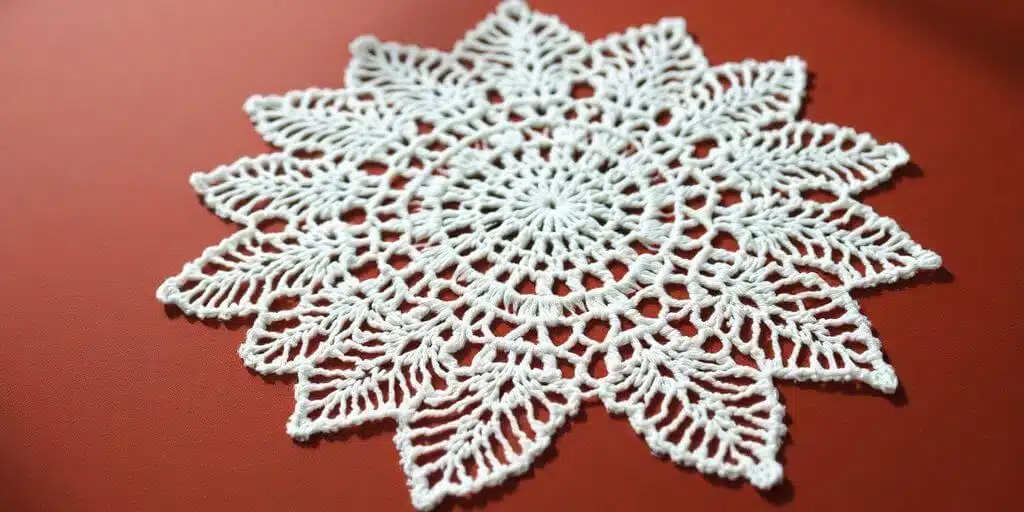
So, you want to make a crochet doily? Awesome! It’s a really cool way to add a handmade touch to your home. Whether you’re just starting out or you’ve been crocheting for a while, doilies can be super satisfying to make. We’re going to break down everything you need to know, from picking the right yarn and hook to understanding those sometimes-confusing patterns. Get ready to learn some new stitches and maybe even discover a new favorite craft!
Key Takeaways
- Understanding crochet pattern symbols and written instructions is key to successfully making a crochet doily.
- Mastering basic stitches like chain, single crochet, and double crochet forms the foundation for creating doily designs.
- Choosing the right yarn weight and fiber type, like cotton, affects the final look and feel of your crochet doily.
- Blocking your finished crochet doily is an important step to shape it and make the stitches look crisp and neat.
- Experimenting with different stitches, shapes, and embellishments can help you create unique and personalized crochet doilies.
Unraveling the Mysteries of Crochet Doily Patterns

Alright, let’s talk about the mysterious scrolls of crochet doily patterns. You know, those things that look like hieroglyphics mixed with a secret code? Don’t sweat it, though. Think of them less like a pop quiz and more like a treasure map. Following a crochet pattern is your ticket to creating something awesome. It tells you exactly what stitches to use, how many times to do them, and where to put them. It’s like a recipe, but way more satisfying when you get to eat (or, you know, display) the results.
Decoding the Secret Language of Patterns
So, what’s the deal with all those abbreviations? "Ch" for chain, "sc" for single crochet, "dc" for double crochet – it’s like learning a new language, but way cooler. Most patterns follow a pretty standard layout, so once you get the hang of the common terms, you’re golden. It’s all about understanding the consistent layout of most patterns, including sections like stitch counts and working in the back loop, which significantly simplifies the learning process. This universal language allows crafters worldwide to confidently create any design, moving beyond video tutorials to bring any vision to life. You’ll find that learning to read crochet patterns is a game-changer.
Stitch Symbols: Your Doily’s Rosetta Stone
Patterns aren’t always just words, though. Sometimes they come with charts, and these charts use symbols. Each little symbol is like a secret handshake for a specific stitch. It might seem overwhelming at first, but honestly, it’s just another way to get the same information. Think of it as your doily’s very own Rosetta Stone. Once you crack the code, you can make anything!
When Patterns Go Rogue: Troubleshooting Tips
Ever get halfway through a doily and realize something’s gone totally sideways? Yeah, me too. Sometimes patterns just… don’t make sense. Maybe you missed a stitch, or maybe the pattern writer had a bit too much coffee. Don’t panic! Take a deep breath, count your stitches (yes, really), and see where things went wrong. Often, you can frog (that’s crochet-speak for unraveling) a few rows and fix it. If you’re really stuck, don’t be afraid to look up a video for a specific stitch or technique. It happens to everyone, even the pros.
Yarn and Hook: The Dynamic Duo for Doily Delight
Alright, let’s talk about the tools of the trade for your doily adventures. Picking the right yarn and hook isn’t just about grabbing whatever’s closest; it’s like choosing your paintbrushes before you tackle a masterpiece. Get it wrong, and your doily might end up looking more like a lumpy potholder than a delicate piece of art. Nobody wants that, right?
Choosing Your Fiber: Cotton vs. Acrylic, The Great Debate
So, you’ve got cotton and acrylic duking it out for doily supremacy. Cotton is the old-school champ for a reason. It’s got this lovely crispness and a bit of weight that makes stitches pop, giving your doily that classic, defined look. Plus, it holds its shape like a champ, which is super important when you’re aiming for those intricate patterns. It also takes starch really well, if you’re into that super-stiff, architectural doily vibe. The downside? It can be a bit stiffer to work with, and if you’re not careful, it can split on you.
Acrylic, on the other hand, is the budget-friendly, super-soft cousin. It’s lighter, often comes in a rainbow of colors, and it’s way more forgiving on your hands if you’re doing a marathon crochet session. It’s also really easy to wash. But, and this is a big but, acrylic can be a bit… floppy. It doesn’t have that same crispness as cotton, so those delicate lace patterns might not stand out as much. It can also pill over time, which isn’t ideal for something you want to last. For doilies, most folks lean towards cotton, especially for those finer, more detailed designs. Think of it this way: cotton for the fancy doilies you display, acrylic for the practice ones or if you want something super soft.
Hook, Line, and Sinker: Finding Your Perfect Match
Now, about the hook. This little guy is your direct connection to the yarn, so you want it to feel right. Doily patterns often call for smaller hooks, especially when you’re working with thread. This is to keep your stitches tight and neat, creating that delicate, lacy effect. If you’re using a yarn that’s a bit thicker, you’ll naturally use a bigger hook. The key is to match your hook to your yarn and the pattern’s requirements. A good rule of thumb is to check the yarn label or the pattern itself for a suggested hook size. If you’re feeling adventurous, try a couple of different sizes to see what gives you the best tension and stitch definition. You don’t want a hook that’s too big, or your doily will look loose and sloppy. Too small, and you’ll be wrestling with the yarn, and your hands will hate you.
Here’s a quick rundown of common hook sizes you might see for doilies:
- Thread/Very Fine Yarn: You’ll likely be reaching for hooks in the 1.5mm to 3.0mm range. These are tiny! Think of the Square Lace Doily pattern, which often uses a 1.75mm hook.
- Fingering/Sport Weight Yarn: For slightly chunkier doilies, you might use hooks from 3.0mm to 4.0mm.
- DK/Worsted Weight Yarn: If you’re going for a really chunky, modern doily, you might even use hooks up to 5.5mm or larger, like the one suggested for the Tulips Doily.
Remember, gauge isn’t as critical for doilies as it is for garments, but consistent tension is your best friend. It’s what makes your stitches look uniform and your doily lay flat (or curve beautifully, depending on the design!).
Weight Matters: From Whispers to Worsted
When we talk about yarn weight for doilies, we’re usually talking about the really fine stuff. Think thread, lace weight, or superfine. These thin yarns are what give doilies their signature delicate, airy appearance. Using a heavier yarn, like worsted weight, will result in a much larger, chunkier doily. It’s not necessarily bad, just different! A chunky doily can be super cozy and modern, but if you’re aiming for that traditional, intricate lace look, you’ll want to stick with the finer weights. The pattern will almost always tell you what weight to use, and it’s usually a good idea to follow that advice, at least at first. It’s all about achieving that specific look and feel. For example, the Serene Swans Doily likely uses a fine thread to get those elegant, intertwined swan shapes just right.
Mastering the Stitches That Make Doilies Dazzle

Alright, let’s talk stitches! If you’ve ever looked at a doily and thought, "How on earth did they make that delicate little snowflake thing?" – well, you’re in the right place. It all comes down to mastering a few key stitches. Think of them as your doily-making superpowers.
The Holy Trinity: Chain, Single, and Double Crochet
These are your bread and butter, your ABCs, your… well, you get it. You absolutely cannot make a doily without these. The chain stitch (ch) is like the starting point for everything, creating those little loops. Single crochet (sc) is your sturdy workhorse, making solid fabric. And double crochet (dc)? That’s where the magic starts to happen, creating taller stitches that give your doily that lacy, airy feel. Seriously, get these down pat, and you’re already halfway to doily-dom.
Beyond the Basics: Treble, Picots, and Shells Galore
Once you’ve got the holy trinity down, it’s time to get fancy. Treble crochet (tr) is just a taller version of double crochet, adding even more height and airiness. Then you’ve got picots – those adorable little bumps that look like tiny pearls. They’re usually made with a chain and a slip stitch, and they add such a sweet, decorative touch. And shells? Oh, shells are glorious! They’re usually a cluster of stitches worked into the same spot, creating a fan-like effect that really makes a doily pop. Learning these stitches is like learning to add sprinkles and frosting to your crochet cake.
When Stitches Get Tricky: Avoiding Common Pitfalls
So, you’re crocheting along, feeling like a champ, and suddenly… your doily is doing something weird. Maybe it’s ruffling like crazy, or it’s just not lying flat. Nine times out of ten, it’s your stitch count or your tension. If it’s ruffling, you might be accidentally adding stitches where you shouldn’t be – check your pattern carefully for increases. If it’s not lying flat, your tension might be too tight, or you might need to adjust your hook size. Don’t be afraid to frog it (that’s crochet-speak for ripping it out) and try again. It’s all part of the learning process! Plus, knowing how to speed up your crochet projects can help you get back on track faster when you need to redo a section.
Remember, every single stitch you make is a step closer to a beautiful finished doily. Don’t get discouraged if things aren’t perfect right away. Embrace the process, learn from your mistakes, and keep those hooks moving!
The Art of Shaping: From Flat Circles to Fabulous Forms
So, you’ve got your stitches down, your yarn is behaving (mostly), and you’re ready to make something that isn’t just a lumpy blob. This is where the magic of shaping comes in! Think of it like giving your doily a personality. We’re going from a flat, maybe slightly wonky circle to something with actual dimension. It’s not rocket science, but it does involve a bit of math and a lot of faith in your hook.
The Magic of Increases: Making Your Doily Grow
Okay, so you want your doily to get bigger, right? That’s where increases come in. It’s basically like telling your yarn, "Hey, make more stitches here!" The most common way to do this in doilies is by working more than one stitch into the same stitch or space from the previous round. This is how you get that lovely, flat circle that doesn’t cup up like a sad little bowl. You’ll see instructions like "2 dc in next st" or "3 dc in ch-3 space." It sounds simple, and it is, but doing it consistently is key. Mess up your increases, and your doily will start doing its own thing, probably not in a good way.
Decreases: The Secret to Delicate Details
Now, sometimes you don’t want to get bigger; you want to get smaller, or at least create some pretty, lacy holes. That’s where decreases come in. They’re the opposite of increases, where you essentially combine two or more stitches into one. This is how you get those beautiful, intricate patterns and those delicate little points or scallops on the edge. Think of it as a controlled "un-making" of stitches to create shape. It can be a bit fiddly at first, but once you get the hang of it, you’ll be creating all sorts of fancy edges.
Beyond Round: Exploring Square and Other Shapes
Who says doilies have to be round? Boring! While the classic circle is great, you can totally branch out. Square doilies are super popular and often work up faster because you’re not constantly increasing in every round. They have a different kind of charm, often with more defined corners. Then there are hexagonal doilies, or even more complex shapes that look like flowers or stars. The principles of increases and decreases still apply, but you’re just applying them in different places to create those angles and points. It’s like a geometry lesson, but way more fun and with yarn.
Here’s a quick rundown of how increases typically work to keep your doily flat:
- Round 1: Start with a magic ring or a chain loop. Usually, you’ll put a bunch of single or double crochets into this center.
- Round 2: This is where the first increase happens. You’ll often work two stitches into each stitch from the previous round. This doubles your stitch count.
- Subsequent Rounds: The pattern will tell you where to increase. It might be every stitch, every other stitch, or in specific spaces. The goal is to add stitches evenly around the circle to maintain that flatness.
Remember, the key to a flat doily is consistent increases. If it starts to ruffle, you’re probably increasing too much. If it starts to cup, you’re not increasing enough. It’s a delicate balance, like trying to herd cats, but with yarn.
If you’re looking for some visual inspiration for different doily shapes, you can find tons of royalty-free crochet doily patterns online. They’re great for seeing how different shaping techniques come together.
Finishing Touches: Blocking Your Way to Perfection
Alright, you’ve wrestled with the yarn, conquered the stitches, and your doily is almost ready for its close-up. But wait, what’s this? It looks a bit… floppy? Like it had a rough night out? That’s where blocking comes in, your doily’s personal trainer and stylist all rolled into one. Think of it as the spa treatment your creation deserves after all that hard work. Blocking is the secret weapon that transforms a lumpy, bumpy crochet project into a crisp, perfectly shaped masterpiece. It’s not just about making it look pretty; it’s about setting those stitches and opening up the lace so your hard work really shines. Without it, your doily might just look like a sad, deflated pancake. Nobody wants that.
The Wet and Wild World of Blocking
So, how do you actually do this magical blocking thing? Well, the most common method is wet blocking. It’s pretty straightforward, though it can get a little splashy. You’ll need a basin or sink, some lukewarm water, and maybe a towel or two. Submerge your finished doily completely in the water. Let it soak for a bit – think of it as a relaxing bath. Then, gently squeeze out the excess water. Please, for the love of all that is holy, do not wring it out like a dish rag. You’ll stretch it all wonky. Just press it gently between your hands or roll it up in a towel to absorb most of the moisture. This is a great time to check out guides on how to block acrylic yarn.
Pinning Down Your Vision: Achieving Crisp Edges
Now for the fun part: shaping! You’ll need some rust-proof pins (seriously, don’t use your good sewing pins, they’ll get stained) and a blocking mat or a soft surface like a carpet or a thick towel. Lay your damp doily flat and start pinning it into the shape you want. Follow your pattern’s diagram if it has one, or just gently stretch it out to open up those lovely lace patterns. Make sure the edges are nice and straight, or perfectly circular, depending on your design. You’ll want to pin it securely, but not so tight that you distort the stitches. It’s a delicate balance, like trying to eat spaghetti without making a mess.
Drying Time: Patience is a Virtue (and a Necessity)
Once your doily is pinned and looking fabulous, you just have to let it dry. This is where patience comes in. Depending on the yarn, the humidity, and how much water you managed to squeeze out, this could take anywhere from a few hours to a couple of days. Resist the urge to poke it or move it around too much. Let it do its thing. Once it’s completely dry, carefully remove the pins. Voilà! You should have a beautifully shaped, crisp doily that looks like it came straight from a professional. You’ve officially mastered the finishing touches!
Adding Pizzazz: Embellishments and Personal Touches
Alright, so your doily is looking pretty darn good, right? It’s flat, it’s got shape, and it’s probably blocking itself into a perfect circle (or square, no judgment). But let’s be honest, sometimes a doily needs a little… oomph. It’s time to move beyond the basic stitches and really make it sing. Think of it as dressing up your crochet creation for a fancy party.
Beads, Tassels, and Fringes: Oh My!
Who says doilies have to be all about the yarn? Boring! Let’s jazz things up. Adding beads can give your doily a bit of sparkle and weight, making it drape beautifully. You can string them onto your yarn as you go, or sew them on afterward. Tassels and fringes are also your best friends here. They add a lovely, flowing movement that’s just chef’s kiss. Just remember to keep them proportional to your doily; a giant fringe on a tiny doily looks a bit like a poodle wearing a wig.
Color Play: Painting with Yarn
If you’ve been sticking to white or ecru, you’re missing out on a whole world of fun. Seriously, doilies don’t have to be vintage-looking. Want a pop of color? Go for it! You can use multiple colors in stripes, color blocks, or even just a contrasting border. It’s like painting, but with yarn. Just be mindful of how the colors work together. Sometimes, a bold contrast is amazing, and other times, you might want something more subtle. Experiment! You might surprise yourself with what looks good. If you’re feeling adventurous, check out some amigurumi patterns for color inspiration; they often use bright, cheerful hues.
Mixing and Matching: Creating Your Signature Style
This is where you really get to be you. Don’t be afraid to combine different techniques or embellishments. Maybe you want a beaded edge on a ruffled doily, or perhaps a tasseled corner on a color-blocked piece. The sky’s the limit! You can even mix different yarn weights for textural interest, though be careful not to make it look like a yarn bomb exploded. The goal is to create something that feels uniquely yours. It’s your doily, after all. Make it something you’ll be proud to display, or even gift to someone special. Remember, even simple crochet projects can become extraordinary with a little personal flair.
Want to make your crochet projects really stand out? Adding special details can make them unique. Think about adding fun stitches or colorful yarn to give your creations that extra sparkle. Ready to try some new techniques? Visit our website to discover more ways to add flair to your crochet work!
So, You’ve Made a Doily (Probably)
Alright, you’ve wrestled with yarn, battled confusing patterns, and maybe even ended up with a few extra stitches where they didn’t belong. But hey, look at you! You’ve gone from thinking a crochet hook was some kind of medieval torture device to actually making something that vaguely resembles a doily. Whether it’s a masterpiece or a charmingly wonky coaster, you did it! Now you can proudly display your creation, or, you know, hide it in a drawer and pretend it never happened. Either way, you’ve officially dipped your toes into the wild, wonderful world of doily making. Go forth and crochet… or just take a nap. You’ve earned it.
Frequently Asked Questions
How do I understand those tricky doily patterns?
Think of patterns like recipes for your doily! They use special symbols and abbreviations to tell you exactly which stitches to make and where. It might seem confusing at first, but once you learn what the symbols mean, like ‘ch’ for chain or ‘dc’ for double crochet, you’ll be able to follow along easily. Many patterns even have diagrams that look like little maps of your stitches.
What are the most important stitches for making doilies?
You’ve got this! Most doilies use basic stitches like chains, single crochet, and double crochet. Mastering these is like learning your ABCs for crochet. As you get more comfortable, you can try fancier stitches like treble crochet or picots, which add pretty little loops and details. Don’t be afraid to practice them separately first!
How do I pick the best yarn and hook for my doily?
Choosing the right yarn and hook is super important for how your doily turns out. For delicate, lacy doilies, you’ll want thinner thread and a smaller hook. If you want something a bit thicker and more textured, try yarn that’s a bit heavier, like DK or worsted weight, with a slightly larger hook. It’s all about getting the look and feel you want!
Why is blocking so important for my finished doily?
When you finish crocheting, blocking is like giving your doily a spa day! You gently wet it, then stretch and pin it into the perfect shape on a flat surface, like a towel or foam board. Let it dry completely. This makes all your stitches look super neat and crisp, and helps the doily lay flat and show off its pretty design.
What if I mess up or my doily doesn’t look right?
It’s totally normal for your first few tries to not be perfect! Crochet takes practice, and doilies can be tricky. If a pattern seems confusing or your stitches look wonky, take a deep breath. You can often unravel (or ‘frog’) your work back to where you made the mistake and try again. Watching video tutorials can also help a lot!
Can I make doilies in shapes other than circles, or add decorations?
Absolutely! While many doilies are round, you can totally switch things up. Try making them square, oval, or even heart-shaped! You can also add fun things like beads, colorful threads, or even tassels and fringes to make your doily totally unique. It’s your creation, so have fun making it your own!