
If your stash looks like a confetti blast after a craft fair, you’re in the right place. This short intro shows you how to turn leftovers into treasures. You can make scrappy blankets and tiny scrappy sock yarn projects that are perfect for travel.
Hexipuffs and mitered squares are great for using up yarn. They’re easy to make and can be mixed and matched. You’ll also learn about tools that make working with scrap yarn enjoyable. Plus, where to find inspiration online, like on Knitting Daddy.
Get ready for tips on making quick projects and ones that last a lifetime. A Beekeeper’s Quilt or a mitered-square blanket can start with the same oddball skeins. Keep reading to learn how to knit smarter, not just faster.
Key Takeaways
- Scrap yarn projects turn small leftovers into useful pieces, from coasters to scrappy blankets.
- Hexipuffs and mitered squares are portable, satisfying, and easy to mix and match.
- Scrappy sock yarn is versatile for tiny projects and charity items like preemie hats.
- Community resources — Instagram, Ravelry, and blog posts — fuel ideas and swaps.
- Simple tools and neat storage keep odd balls ready for the next quick project.
Why Scrappy Knitting Projects Are the Ultimate Yarn Therapy
Scrappy knitting is perfect for those who want a calming project. It offers small victories like finishing hexipuffs or mitered squares in one evening. These quick wins are a big part of what makes scrappy knitting so rewarding.
Working with yarn remnants turns stash guilt into a fun activity. You can try out different colors without buying a whole skein. Online communities and knitting groups provide support and suggestions, making the process even more enjoyable.
Scrappy knitting is like crafty recycling. It helps you use up your yarn stash, reducing waste. You can make patchwork shawls or the Beekeeper’s Quilt using leftover sock yarn.
The best part is the freedom to be creative. You can mix different fibers and textures without worrying about a big project. Patterns that encourage improvisation let you play with colors and patterns, all while avoiding tedious finishing steps.
There are practical tips to keep your project going smoothly. Knotting row ends, switching to circular needles, and planning yardage by round can save time. For more ideas, check out Morale Fiber’s scrappy tag.
| Therapy Element | How Scrappy Helps | Try This |
|---|---|---|
| Quick wins | Small projects finish fast and boost mood | Hexipuffs, mitered squares |
| Stash use | Turns odd balls into purposeful pieces | Scrappy blankets, shawls |
| Eco impact | Reduces waste and extends yarn life | Mix weights, repurpose scraps |
| Color play | Low-risk experimentation with palettes | Improvised stripes, random blocks |
| Finishing ease | Ends become design features like fringe | Tie-off fringe, weave mid-row changes |
Essential Tools and Notions for Scrappy-Yarn Success
You want gear that makes scrappy knitting simple, portable, and fun. Choose a compact kit so you can knit anywhere. This includes the bus stop, plane, or between meetings.
Needles and hooks that travel well
Portable circular needles and small interchangeable sets save space. They give consistent tension. A 16-inch circular in sizes US 4–7 works for most projects.
Lightweight needles reduce hand fatigue on long commutes.
Small notions: stitch markers, darning needles, and stuffing for hexipuffs
Pack bright stitch markers to spot increases and decrease points quickly. Blunt darning needles make finishing safe and tidy. For hexipuff stuffing, use toy-grade fiberfill or polyester stuffing.
Knitting Daddy’s community often recommends small sachets of fiberfill for consistent results.
Storage and organization tips for odd balls and partial skeins
Use clear zip bags, labeled pouches, and stackable containers to keep things visible. Small project pouches keep hexipuffs organized with stuffing, needles, and stitch markers.
| Item | Why it helps | Best for |
|---|---|---|
| 16″ Circular Needles | Compact, smooth joins, ideal for small rounds | Hexipuffs, mitered squares, travel projects |
| Interchangeable Set (small case) | Multiple sizes in one pouch, saves space | Mixed-gauge scrappy projects on the go |
| Stitch Markers | Quickly mark pattern changes and seam points | Complex colorwork and shaping |
| Blunt Darning Needles | Neat finishing without splitting yarn | Seaming hexipuffs and weaving ends |
| Fiberfill / Polyester Stuffing | Lightweight, machine-washable fill for shapes | Hexipuff stuffing and small toys |
| Clear Zip Bags & Labeled Pouches | Keep odd balls visible, prevent tangles | Stash organization and grab-and-go projects |
| Small Scissors & Tape Measure | Precise trimming and quick gauge checks | Any scrappy project |
Think of these tools as a travel kit for your creativity. With the right tools, your odd balls become a portable, productive stash. They’re ready to surprise you.
Beginner-Friendly Scrappy Projects to Start Right Now
You’re looking for quick wins that use scraps and teach basic skills. Choose projects that are easy to carry, forgiving, and fun. These beginner projects will help you learn how to shape, seam, and play with colors. They keep you happy and stress-free.
Start with small projects that you can finish in under an hour. They’re perfect for when you’re on the go or need a quick break. You’ll see your progress fast and learn important skills without spending too much time.
Hexipuffs and their addictive appeal
Hexipuffs are small, stuffed hexagons knitted in the round. They’re like a treat for your hands. A good tutorial will teach you how to pick up stitches, knit short rounds, and stuff them neatly.
Use sock yarn scraps and a tapestry needle for stuffing. These make great stash-busting projects and are easy to carry. Once you get the hang of it, making a Beekeeper’s Quilt will seem easier.
Mitered squares and knitted patchwork basics
Mitered squares teach you how to shape by decreasing at the center. Follow Martine Ellis’s recipe for clean edges and even gauge. You’ll learn to count rows, keep tension even, and attach as-you-go for neat seams.
You can make a single square into anything from a placemat to a blanket. Try different colors to learn how to balance them. These squares are great for practicing without worrying about making mistakes.
Quick in-between projects: wrist warmers, coasters, and scrappy hats
Quick scrappy knits give you instant satisfaction. Wrist warmers use little yarn and help you practice gauge and shaping. Coasters let you practice edge stitches and blocking on a small scale.
Modify a preemie hat pattern to make it bigger by using larger needles and thicker yarn. This trick turns sock yarn leftovers into gifts quickly. These small projects keep you going between bigger projects.
| Project | Skills Learned | Average Time | Best Yarn |
|---|---|---|---|
| Hexipuff | Knitting in the round, stuffing, pick-up stitches | 30–60 minutes | Sock yarn scraps |
| Mitered Square | Corner decreases, as-you-go joining, gauge control | 1–3 hours | DK or worsted scraps |
| Wrist Warmers | Small-circumference shaping, ribbing, seaming | 1–2 hours | Worsted or sport yarn |
| Coaster | Edge stitches, blocking, color contrast | 20–40 minutes | Cotton or sturdy scraps |
| Scrappy Hat (newborn) | Basic decreases, brim options, sizing adjustments | 2–4 hours | Sock yarn on larger needles |
Beekeeper’s Quilt: How to Turn Hexipuffs into a Heirloom
Have you seen the Beekeeper’s Quilt pattern by Tiny Owl Knits? It’s a project that involves making hundreds of small hexipuffs. These are then stitched together to form a blanket that looks like a honeycomb. The process is easy to take on the go, making it calming and enjoyable.
What a hexipuff is and why knitters love them
A hexipuff is a small, six-sided stuffed shape knitted flat and then closed. Knitters enjoy making hexipuffs because they offer a sense of accomplishment with each one. They also use up leftover yarn, making them a great way to use up scraps.
Stuffing options and finishing tips
When choosing stuffing for your hexipuffs, consider loft, washability, and feel. Polyester fiberfill is a good choice for its springy feel and easy care. Using scrap yarn can make the puffs denser and more eco-friendly. Wool adds natural loft but might shrink with heat.
To finish your hexipuffs, you can graft the top or pull the stitches tight. Trim loose ends and weave them in. If your yarn can handle it, block the puffs lightly to keep their shape.
Assembly strategies: assemble-as-you-go vs. block-and-seam
Assemble-as-you-go lets you join pieces as you go. This method is great for those who like a casual, flexible approach. You can change colors easily and see the quilt take shape.
Block-and-seam offers more control. You can lay out your hexipuffs and adjust their placement before sewing. This method is better for those who want precise placement or strict color patterns. Many knitters, including fans of Tiny Owl Knits, use this method to ensure their quilt looks perfect.
Choose the method that fits your style and schedule. Both ways lead to a beautiful Beekeeper’s Quilt that holds memories and happy moments.
Knitted Patchwork Recipe and Mitered Square Techniques
Start by reading the knitted patchwork recipe carefully. Martine Ellis’s approach focuses on consistent gauge and clear corner decreases. Follow the cast-on and center-decrease notes so your mitered square pattern stays square and predictable.
Reading the pattern and choosing yarn contrasts
Scan each row instruction before you cast on. A clear read prevents surprise decreases and helps you plan color changes. Pick two contrast types from your scraps: high-contrast pops for focal lines and low-contrast fills for calm blocks.
Use feedback from social threads, like Instagram, when you test palettes. That input can save you time and keep the knitted patchwork recipe lively without overwhelming the eye.
Joining methods for clean seams
Decide how you’ll handle joins before you assemble. Mattress stitch offers invisible seams. Stitch-and-seam-as-you-go keeps you working without big finishing days. Three-needle bind-off gives a neat ridge when you want structure.
For joining mitered squares while knitting, let the final stitch of one square become the first of the next. That trick reduces tails and reveals progress as you work, so you spend less time at the end sewing up.
Scaling a placemat to a full blanket without losing momentum
Turn small wins into long-term rhythm. Treat each session as two squares max. That creates steady progress and stops burnout.
Track squares completed, weight per square, and estimated yardage to plan growth. Use a kitchen scale to weigh a sample square and apply simple math to scale blankets from placemat size to throw or bedspread.
Practical recipe checklist
- Cast on odd number of stitches to allow center decreases.
- Use the specified center decrease—sk2togpsso or an alternative like ssk, k1, k2tog—and place markers where helpful.
- Work final stitch into the next square for continuous joining mitered squares.
- Pick up edge stitches for subsequent squares; crochet cast-on only where needed to reach full stitch count.
- Weigh one square to estimate total yarn for scaling blankets and plan purchases.
Want the full mechanics and a tested how-to? Follow a trusted tutorial such as the one in this knitted patchwork recipe to match technique and timing to your stash.
Scrappy Sock Yarn Projects Inspired by Podcast and Community Finds
Turn tiny leftover skeins into meaningful projects. You can follow a preemie hat pattern, join Ravelry groups, and listen to knitting podcasts. This mix of inspiration and feedback makes projects easy to start and hard to stop.
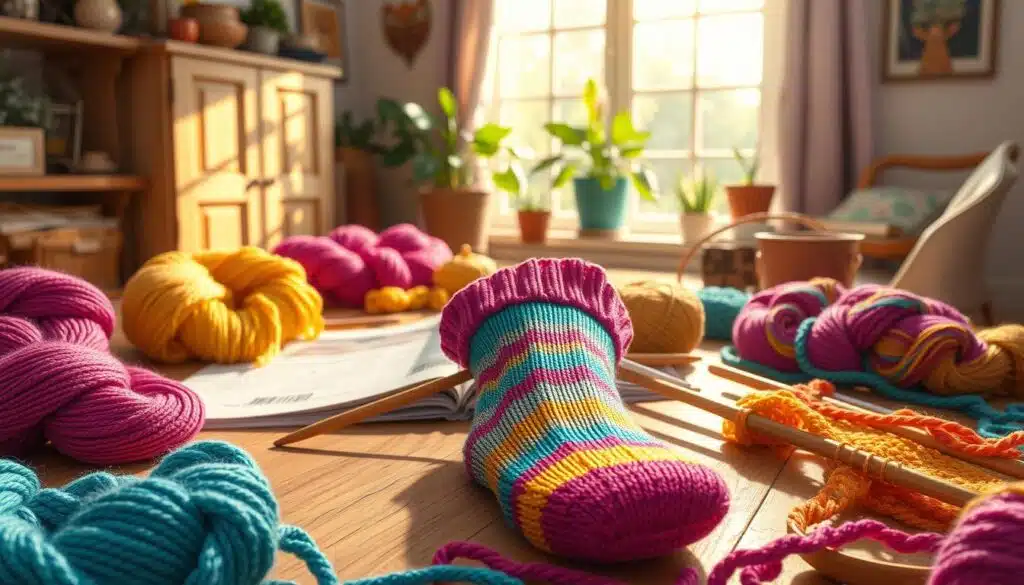
Preemie hats are a great starting point. Knitting Daddy’s preemie hat shows how scrap yarn can help. You can adjust the pattern to fit newborns and toddlers without losing its charm.
Podcasts add energy to your projects. Twinset Designs’ discussion on Episode 57 inspired many to try the pattern. You can plan your knitting around podcast episodes, making it a fun, focused activity.
The Instagram knitting community is full of quick tips and color ideas. It’s easy to find inspiration and learn new techniques. Knitters often share step-by-step photos to help you improve fast.
Ravelry groups help you stay organized. They have project pages for your stash-busting efforts. Join groups that match your goals, share your progress, and get tips from others. Knitting Daddy’s Ravelry thread and Google Sheet are great examples of keeping things transparent while you knit for charity.
Combine listening and knitting: play your favorite podcasts, save Instagram images, and share your projects on Ravelry. Your work will get feedback and new ideas to try.
For extra motivation, post updates weekly. Tag the pattern, mention any changes, and thank those who inspired you. Getting recognized in the community can encourage more giving and creativity with sock yarn scraps.
Charity Knitting with Scraps: Patterns That Give Back
You can turn odds and ends into real help. Small projects like scrappy hats and mini blankets are great. They travel well and make tangible gifts for hospitals and shelters.
Clear accounting and generous sharing keep donors and makers confident. As your effort grows, everyone stays on board.
Making preemie hats and tracking proceeds transparently
Knitting for neonatal units turns a simple hat into a comfort item for families. If you sell a pattern, tell where the money goes and post records. Knitting Daddy donates all proceeds from one preemie pattern to Family Support of Central Carolina.
They also cover platform fees so the charity gets full support.
Using pattern sales and donations to support causes
You can direct pattern proceeds donation to vetted nonprofits. Publish monthly invoices and donation posts to show the impact. This transparency builds trust and encourages repeat purchases.
Organizing informal yarn swaps for community projects
Yarn swaps for charity let you try new colors without spending more. Knitting Daddy swapped stash with a friend named Laura to collect colors for charity blankets. Host a local meetup or an Instagram call to collect scraps, assign projects, and schedule knit nights.
| Project Type | Typical Time | Materials | Why it Helps |
|---|---|---|---|
| Preemie hats | 1–3 hours | Small scraps, US2–US4 needles | Warmth, quick delivery to NICUs |
| Mini blankets | 8–20 hours | Multiple scraps, worsted or DK | Comfort for families and shelters |
| Donation scarves | 4–10 hours | Bulky scraps, simple pattern | Easy to produce in bulk |
| Hexipuff quilts | Variable | Many scraps, stuffing | Heirloom feel from small pieces |
Color Planning and Randomness: Making Scrappy Look Intentional
Begin by treating your scraps as a small palette, not a mess. Choose a main neutral and two or three accent colors from your partial skeins. This approach makes your mixed stash look intentional and consistent.
Keep it simple. Create a small test swatch to see how colors work together. This small step helps prevent surprises when you make a larger blanket.
Spacing matters. Place high-energy scraps apart and calm tones in between. A common border color helps tie everything together, making it look like one design.
Try different layouts for your blanket. Arrange squares or hexipuffs on the floor or a big table. Take photos of different setups and step back to choose the best one.
Use attaching-as-you-go for flexibility. This method lets you move pieces around without ripping. It makes the process fun and allows your project to grow over time.
If a clash is hard to fix, add a neutral stripe or a faded gray. These small changes help balance contrast while keeping your original color scheme.
Finishing and Care for Scrappy Knit Items
You’ve mixed colors, textures, and memories. Now, give your scrappy work the care it deserves. A few simple steps will make it last for years.
Blocking tips for mixed fibers
First, test a small swatch. Mixed fibers can react differently to water and heat. This keeps your work from shrinking or felting.
For delicate blends, use spot blocking. Damp towels and pins shape edges without soaking the whole item. Steam blocking is okay if fibers can handle heat, but press lightly and keep the iron an inch away.
Setting color on hand-dyed scraps
To stop colors from bleeding, set dye on hand-dyed yarn before making your project. A citric acid soak is a trusted method for socks and small items.
Follow the package for the right amount of citric acid. Rinse until the water is clear, then air-dry flat. This step prevents color run and keeps your project looking vibrant.
Seaming, edging, and giving scrappy pieces a professional finish
Choose a seam that fits your fabric’s look and stretch. Mattress stitch is great for stockinette seams. Whipstitch works well for small motifs.
Use a consistent border to tie everything together. A single-color garter edge or a simple crochet trim frames your work nicely. Tuck and weave in ends carefully to avoid them coming loose over time.
| Task | Recommended Method | Why it Works |
|---|---|---|
| Prevent distortion | Test swatch, spot block | Shows fiber reaction before risking the whole item |
| Set hand-dyed colors | Citric acid soak | Reduces bleeding without harming yarn structure |
| Invisible joins | Mattress stitch | Maintains fabric alignment and stretch |
| Small motifs | Whipstitch for hexipuffs | Fast, secure, minimal bulk |
| Unified edge | Single-color garter or simple crochet | Creates a polished frame for scrappy colors |
| Long-term durability | Weave ends and reinforce stress points | Prevents unraveling and extends garment life |
By blocking mixed-fiber knits carefully and setting dye scrappy yarn, you avoid surprises in the wash. Thoughtful seaming makes your project look intentional and durable. It will get compliments wherever you show it off.
Portable Scrappy Projects for Festivals, Commutes, and Between-Tasks Knitting
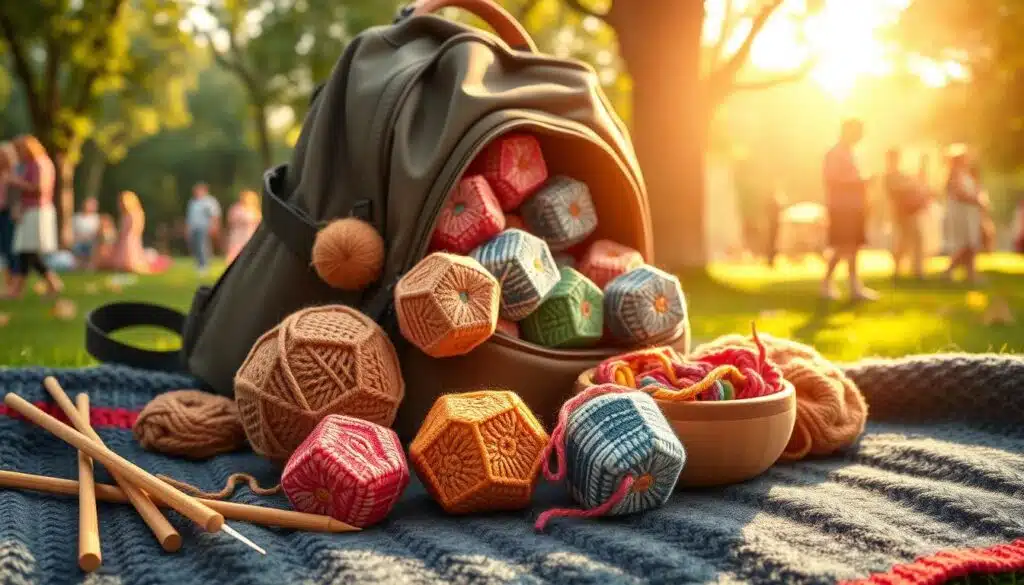
You’re looking for projects that fit in a tote and can handle a bumpy bus ride. They should also keep you busy during short coffee breaks. Choose small, easy projects that need little equipment and match your busy schedule.
Why hexipuffs and mitered squares travel well
Hexipuffs and mitered squares are small and easy to work on. You can finish one piece during a break and then start another. They’re great because they use short needles and don’t get tangled easily.
Packing and protecting partial skeins on the go
Storing partial skeins is easy with small bags or yarn sleeves. Wind the yarn into neat balls before you leave. Keep your pattern and notes in one place to save time.
Using podcasts and knit events for concentrated knitting time
Knitting podcasts are perfect for focused knitting. Shows like Twinset Designs and Knitmore Girls are great for short projects. Use them to set aside dedicated knitting time. Events like Maryland Sheep & Wool offer inspiration and chances to swap yarns.
| Project Type | Best Travel Gear | Why It Works |
|---|---|---|
| Portable hexipuffs | Short circulars, stuffing, small pouch | Compact, quick, low fuss for festivals and commutes |
| Mitered squares | Needles with cable, pattern card, stitch marker | Modular pieces that you can join later without bulky tools |
| Wrist warmers & coasters | Set of dpns or short circulars, yarn sleeve | Fast wins that finish in short podcast-length sessions |
| Scrappy preemie hats | Small skein bundles, project pouch, pattern card | Uses leftovers, perfect for charity knitting at events |
Inspiration Sources: Where to Find Patterns, Community, and Motivation
Looking for quick knitting inspiration? Start by visiting places where makers come together. Ravelry patterns are at the heart of thousands of projects and lively discussions. Here, you can follow projects, bookmark your favorite designers, and find tips to turn a small piece into something special.
Ravelry groups, project pages, and pattern hubs
Ravelry is home to pattern hubs for Beekeeper’s Quilt and other knitted patchwork recipes. Project pages show yarn choices, gauge tweaks, and finished photos from real knitters. Joining focused groups helps you stay updated on pattern changes and charity drives.
For a deeper dive, explore community threads on stash-busting and scrappy techniques. These threads share little hacks that aren’t always in pattern notes.
Podcasts and episodes that spark scrappy projects
Check out the knitting podcasts list for episode ideas and technique demos. Shows like Twinset Designs, Knitmore Girls, Knitting Pipeline, and Yarn Thing with Marly Bird often feature small, scrappy projects. They talk about festival finds, stitch patterns, and pattern shout-outs to get you started.
Make a list of your favorite episodes for commute knitting or festival downtime. Short episodes provide great background motivation without distracting you from your knitting.
Instagram, blogs, and local meet-ups for swap and show-and-tell
The Instagram knitting community is a great source of visual inspiration. Follow makers, tags, and event hashtags for color combos and blocking tips. Personal blogs like KnittingDaddy.com share step-by-step photos and in-depth thoughts you won’t find in captions.
Attend local yarn meetups and festivals like Maryland Sheep & Wool or New Hampshire Sheep & Wool. These events are perfect for trading scraps, testing new fibers, and joining workshops. Live swaps and show-and-tell sessions are incredibly motivating.
Explore curated roundups and long reads by clicking a recommended feature here to expand your idea bank.
| Source | What You Get | Best Use |
|---|---|---|
| Ravelry patterns and project pages | Patterns, finished photos, user notes, group discussions | Pattern selection, yarn substitution, charity coordination |
| Knitting podcasts list | Episode interviews, technique demos, festival reports | Hands-free learning, short project inspiration, audio company |
| Instagram knitting community | Visual ideas, color palettes, quick Q&A in comments | Color play, trend spotting, real-time feedback |
| Personal blogs and long-form posts | Detailed tutorials, pattern history, designer insight | Deep learning, pattern adaptations, project case studies |
| Local yarn meetups and festivals | Live swaps, hands-on workshops, networking | Swap scraps, test fibers, join community projects |
Conclusion
Scrappy knitting projects turn small leftovers into something special. You can make hexipuffs, mitered squares, charity hats, and even quilts. The cost is low, but the creativity is high.
Starting small helps build confidence quickly. It’s a great way to get started with scrap yarn inspiration.
Community support keeps the spark alive. Ravelry groups, Instagram, podcasts, and blogs like Knitting Daddy offer patterns and motivation. You can also swap yarn locally or find resources like leftover-yarn ideas to explore without spending more.
Practical tips make scrappy knitting easier. Carry portable needles and a small notion kit. Use fiberfill for hexipuffs and set dye for hand-dyed scraps. Choose a joining method that works for you.
This conclusion is simple: enjoy the journey, trust your color choices, and let your scraps tell a story. You’ll be proud to give them as gifts or keep them for yourself.
FAQ
What is scrappy knitting and why should you try it?
Scrappy knitting uses leftover yarn to make new pieces. It’s easy, saves money, and encourages creativity. You can make quick items like hexipuffs or mitered squares, reduce waste, and even create special gifts.
Which small projects are best when you’re starting with scraps?
Start with hexipuffs, mitered squares, or scrappy wrist warmers. These projects are quick, portable, and teach you important skills. They’re great for beginners because they’re not too big.
What tools and notions should you pack for scrappy projects on the go?
Take portable needles, stitch markers, and small scissors. Don’t forget blunt darning needles and stuffing for hexipuffs. Use clear bags or pouches to keep your yarn organized and easy to see.
How do hexipuffs work and how long do they take?
Hexipuffs are small, stuffed hexagons knitted in the round. They’re quick to make, often in under an hour. Stuff them with fiberfill or scrap yarn, then close with grafting or tightening.
What is the Beekeeper’s Quilt and how do you assemble it?
The Beekeeper’s Quilt is a blanket made from hundreds of hexipuffs. You can assemble it as you go or block and seam for precise placement. Lay out the hexipuffs first to plan the colors.
How do mitered squares work and which pattern should I consult?
Mitered squares use corner-to-corner shaping. The Knitted Patchwork Recipe by Martine Ellis is a good guide. Practice corner decreases for neat joins.
What joining methods give the neatest seams for scrappy patchwork?
Mattress stitch is great for flat pieces. For three-dimensional joins, try whipstitch or stitch-and-seam-as-you-go. A three-needle bind-off can tidy up the edges. Choose a method that works for you.
How do I plan color when my palette is a random mix of leftovers?
Choose a neutral color and add accents from your scraps. Mix high-contrast and low-contrast yarns for rhythm. Use a border color to tie everything together. Try laying out your pieces to see how they look together.
How should I store partial skeins and odd balls?
Use clear bags or small pouches to keep your yarn visible and organized. Protect your partial skeins with mini yarn sleeves or wind them into balls. Keep your pattern notes handy.
What stuffing options work best for hexipuffs and how do they affect washability?
Polyester fiberfill is common and washable. Scrap yarn stuffing adds density and uses more leftovers. Wool scraps loft but may felt if washed hot. Choose based on desired look and care needs.
Can scrappy sock yarn be used for charity items like preemie hats?
Yes, scrappy sock yarn makes warm, affordable charity hats. Patterns like the Scrappy Sock Yarn Preemie Hat can be adapted for different sizes. Many knitters donate hats to hospitals and groups.
How do I prevent color bleeding with hand-dyed scraps?
A citric acid soak can help set color and reduce bleeding in hand-dyed yarn. Test a small swatch first. Use cool water and gentle handling to avoid felting or color transfer.
What finishing tips make scrappy projects last and look polished?
Weave in ends neatly and trim close. Use a consistent edging like garter border or simple crochet. Block gently according to fiber content. For mixed-fiber projects, spot or steam block small areas to avoid distortion.
How do I keep momentum on a large scrappy blanket without burning out?
Work on it in small sessions, like a square or two. Keep a progress tracker and celebrate small wins. Alternate between color-play and focused projects to stay excited.
Where can I find community support and pattern inspiration for scrappy knitting?
Ravelry groups and project pages have galleries, discussions, and accountability threads. Instagram offers visual feedback and color advice. Podcasts like Twinset Designs and Knitmore Girls feature scrappy patterns. Blogs like KnittingDaddy.com document step-by-step projects and swaps.
How can I use pattern sales to support charities and keep the process transparent?
Direct sales to a cause and keep transparent accounting. Publish donation posts, monthly invoicing, or a shared Google Sheet. Knitting Daddy tracked sales and donated proceeds to Family Support of Central Carolina.
What are practical packing tips for knitting at festivals, commutes, or meet-ups?
Bring small needles, a notions kit, and clear bags for yarn. Use earbud-friendly podcasts for focused knitting. Festivals like Maryland Sheep & Wool and NH Sheep & Wool are great for swaps and inspiration.
How do informal yarn swaps work and how can they improve my scrappy palette?
Swaps can be simple, like calling for donations on Instagram. Clear labeling and photographing piles help plan combinations. Swapping expands your palette without buying full skeins.
Are mixed-fiber scrappy projects washable and durable?
Mixed fibers can be durable, but washability varies. Test a small swatch for felting, shrinkage, and colorfastness. Hand-wash gently or use a cold, delicate machine cycle and air-dry. Choose edging and seams that withstand handling, and weave ends securely.
How can I make a scrappy project look cohesive despite many yarn types?
Use a unifying element like a consistent border color or repeating neutral. Limit each piece to a small palette and alternate intense scraps with calmer tones. A consistent finishing method and neat seaming help unify the look.
What quick techniques help when joining pieces with different gauges or thicknesses?
Use a wider seam allowance and a flexible joining method like mattress stitch. Blocking individual pieces to similar dimensions before joining can reduce mismatch. For dramatic gauge differences, group similar-thickness squares together and use a neutral connector strip.